rotating header

Saturday, May 22, 2010

Egypt, My People

And the LORD will strike Egypt, He will stride and heal it, they will return to the LORD, and He will be entreated by them and heal them.  In that day there will be a highway from Egypt to Assyria, and the Assyrian will come into Egypt and the Egyptian into Assyria, and the Egyptians will serve with the Assyrians  In that day Israel will be on of three with Egypt and Assyria--a blessing in the midst of the land, whom the LORD of hosts shall bless, saying, " Blessed is Egypt My people, and Assyria the work of My hands, and Israel My inheritance." Is 19:22-25

This was the chapter I read as our plane descended into Cairo, just happened to be where I am in my multi-site read through the Bible.  What a beautiful vision of the MIddle East.  No rhetoric about rights of one country over another, but a promise of healing, of family, of three siblings all valued and unique, all loved and blessed.  

In fact much of Isaiah, and other parts of the Old Testament, express God's concern for the nations of the ancient world, for Sudan and Syria, Egypt and Lebanon, Palestine and Ethiopia.  The people of Israel are called to bless them, to live as channels of God's mercy and grace to the rest.  A far cry from most of history, I'm afraid, but a burden of tenderness towards diverse civilizations nonetheless.

More in the next few posts on a three-day three-night sojourn into Egypt.  Scott's seminary professor taught him that one must see and grasp and tread the geography to understand the story of the past, because rivers and valleys and rainfall and coastlines impact the movement of peoples and the progress of cultures.  Nowhere is that more true than in the biblical lands.  So it was a great privilege to follow the paths of Joseph, Moses, Elijah, and Jesus, from the Nile to the deserts and back. To appreciate Truth, with a capital T, embedded in ancient Egyptian civilization, to admire the scope and scale of their art and ambition, to marvel and hope, because this is a country of God's people.


Tuesday, May 18, 2010

On the way . . .

So far so good: almost 24 hours of driving has brought us from Bundibugyo to Nairobi, with only one two-hour mechanical delay (worrisome loud clicking thump whenever the wheels were turned sharply, so we purposed to drive in straight lines, but the final descent from the escarpment to Kijabe consists of hair-pin switchbacks so we finally decided to check it out . . a mechanic at a roadside fuel station took off both wheels and globbed in thick grease, which in spite of our skepticism miraculously did the trick).  We passed numerous disabled vehicles including a large truck hanging precariously off the road on the mountains coming out of Bundibugyo, and braked numerous times for barreling lorries using our lane to pass, or oblivious drivers pulling out heedlessly into traffic.  So it is no small thing to have crossed most of two countries and parked our truck and be waiting now in Nairobi for the taxi that will take us to the airport in the middle of the night.

Along the way, a day of respite at our favorite breathing place, Sunrise Acres.  I wrote notes to family and friends and supporters using the excuse of Luke's graduation announcements, pondering the American cultural issues with which I am out of touch (to whom does one announce a graduation?) and hoping that our friends will see them as expressions of THANKS for an ebeneezer of grace which we can view together, and not a subtle hint for gifts (which have already been given in the support we need to live here).  Scott pulled together some slides for a brief team intro at our upcoming retreat.  Both were exercises which involved some tedium (importing slides from a hard-drive onto a travel-laptop; addressing envelopes) but both reminded us over and over of how blessed we are.  Sacrificially generous friends, and a wealth of incredible experiences.

By morning we hope to be landing in Cairo.  Egypt Air turns out to be the most economical option between East Africa and Greece, where we have our meetings.  Thanks to Karen who planned ahead, we followed her lead, and are having a three-day lay-over in Egypt with the Massos.  Stay tuned, hopefully for tales of wonder and not of despair. It seems that Scott Will is poised to earn the Myhre Disaster Travel Award this time, after inexplicable delays and missed connections and horrific service and finally bailing on Ethiopian Airlines, we heard he arrived, stretching a ten hour trip to several days.  Heavy hearts for Scott Will who was already sick and beaten up by Sudan . . . and whispered prayers that we slide under the radar and progress without incident.  


Thursday, May 13, 2010

Not quite Heaven yet . . .

Tomorrow we load our truck with a half dozen trunks and a few duffels, to drive to Kenya one last time (when we go for Luke's graduation in July we will fly or take the bus).  So this week we've been sifting and sorting, a bittersweet process of trying to extract a carload of sentimental and practical treasures from the accumulated bulk of 17 years of living.  School papers and legos and cake pans and pottery; photos and music and a few meaningful gifts and a guitar.  It is hard work, so many decisions, so much clutter.  And only a small percentage of the work which is still to come.  

In the meantime I only went to the hospital two of the last four days, and found I enjoyed the time more for its limitation.  Our boys have been working around the yard and eating lunch here daily, so it's a dozen for that meal most of the time.  A couple of afternoons I've been able to visit neighbors.  So the tedious material focus of packing has been balanced a bit by the relational treasures of time with others.  I'm thankful for that, too.  In the wake of the Sudan team's visit we entered this week, our first one of really turning our sights towards closure, well prayed-for.

It is easy to idealize our history at the moment of wrapping it up . . but not too easy, since difficulties still crop up, like a stolen bike, the sense that people are kind of watching and waiting to take what they can.  In debriefing some cross-cultural frustrations with team mates this week, I found myself as I have often before wanting to apologize or justify the hard parts of peoples' behaviour here.  The Johnsons in particular are just such great people I want to protect them from the thieves and the manipulators, the liars and the abusively dependent, as well as the just plain hard truths of poverty that surround us.  Travis' response has echoed in my mind:  Jennifer, we didn't come here because it was already heaven.  Amen.  If this was not a broken place, then we wouldn't all be here.  

So we pull out of this not-quite-Heaven-yet place tomorrow, never and easy task, planning ahead on school fees and worker salaries and dog food and cow plans and all the details that have to be anticipated when leaving.  The entire World Harvest Mission will gather in Greece, one week for the leaders and then a second week when we're all together.  We're flying in and out of Nairobi, partly to take this load of "moving", and partly to accompany Caleb on the way back so he doesn't land at 3 in the morning alone (Luke and Caleb join us for the latter part of the time).  In the midst of packing we can lose sight of why we're going . . but hope that the fellowship of the retreat will be a closer taste of Heaven than we've had in a long time.   

for Micah

My nephew Micah turns ten next week, on a day we'll be in an airport somewhere on the way to World Harvest Mission's triennial (well, due to the economy, quadrennial this time) conference.  So this is an early tribute to him, inspired by one of my patients today.  Micah is a special kid, born with Down Syndrome.  I have been through many trying moments with many moms and kids, but few with my own relatives.  So it is no small gift that God allowed me to happen to be in America a week or so before my sister went into labor with her 4th child.  And to be in the delivery room with them when we cleaned off the tiny newborn boy and noticed a certain way he looked and moved.  We wept together for the hard road that lay ahead, and rejoiced together in God's perfect plan for him and all who love him.  I have NOT been present for most of his life, missed many late night trips to the Emergency room when he could not breathe well, or joining in family searches of the neighborhood when he escaped the house.  As the years add up, and the pain of our distance takes a toll on all our hearts, I think Micah is the family member most likely to forgive all that absence, the one who will unconditionally embrace us when we show up, the one who reflects a gracious and accepting reality of God's love.  I hope we can overcome the decade of barely-being-there.  I am looking forward to seeing him soon.

I have a patient admitted this week with Down syndrome.  He's an 8 month old Ugandan, but when I look at him I see my memories of Micah.  Today as I was doing rounds I heard laughter (not the usual sound on the ward, I can assure you).  This baby's mom was playing with him as he lay on the bed, snuggling and getting him to laugh, and she was laughing, too.  When I reached him he made such funny faces and then smiled at me.  This was such an unusual interaction, both the one I witnessed and then the way he received me, that it really struck me.  My patient has some pretty significant heart problems that Micah does not have, and he is extremely unlikely to reach the age of ten.  But during his sojourn on this earth he is, like Micah, already reflecting the image of God in a unique and powerful way, and I am humbly thankful for that.

Happy early 10th Birthday, Micah.  

Monday, May 10, 2010

Battling bats, and Romantic Roaches

Note to Travis: read the fine print in that Team Leader Job Description. Today Scott had two of our boys hold a spindly extension ladder so he could climb through a small outdoor vent into the attic over the Community Center wing rooms. He carried concentrated insecticide, a jerry can of water, a hammer and nails and bed sheets up that ladder, to hang up chlorpyriphos-treated cloths that would kill the smelly filthy infestation of bats whose guano sifts down the walls. This is one step in a process to turn our old Kwejuna-project store room into a community library, and to repaint and maintain the entire building before the Semliki Presbytery holds an official installation service in June.
And for our anniversary, a most welcome gift: dead roaches. Yes, many wives might hope for a bouquet of flowers or a fancy dinner out, but not me. In Bundibugyo there is no where to go really, and no flowers to buy. So . . . Scott went on one of his periodic roach jihads, with our workers, removing everything from the kitchen cabinets (the ones that used to have doors, but after one of his insecticide and fire mishaps blew them off, we found that we preferred the open look and that bugs had fewer places to hide) and spraying and cleaning. I love roses, but I would rather have a roach-free kitchen counter any day. This is the stuff of real love.
When you live in a jungle, you have to either succumb to the bats and bugs, or keep up a constant battle. Truce is not an option.

A tale of two 13 year olds

I find that as my children move through their ages, the patients who correspond at the time really get to my soul.  Julia is a delightful 13:  robust, fast, friendly, kind, smart, full of life, helpful, really an amazing person.  She just came back from a week with her friends on the football team, full of laughter and stories, tired and ready for a milkshake and tacos, but also leaner and tougher in some ways.  I missed her a lot when she was in Gulu and am thankful to have her back.  Now she's reveling in school vacation time, helping pack, playing games with her best friend Acacia, having sleep-overs, milking the cow, etc.  

Saidati, my 13 year old patient with the sudden onset of severe heart failure due to rheumatic fever, died last week.  She probably never kicked a football or drank a glass of cold milk in her life.  She was about six grades behind Julia in school, half her weight, and not more than up to her shoulder in height.  She could barely breathe when lying down to sleep.  She was a sweet girl with a caring mom who was no different than everyone else until her heart valves came under immune attack in the wake of a run-of-the-mill bacterial infection, most likely a strep throat.  

There is no reason that Julia should be a beautiful thriving young woman with hope of a full future, and Saidati should be dead.  If poverty can be defined as a lack of options, alternatives, safety nets, back-up plans . . then that poverty becomes most starkly evident when disease strikes.  We try to be a small voice and hand of justice in a skewed world, but even though a generous donor read Heidi's blog and wanted to help Saidati, Uganda does not have the capacity to offer a valve-replacing surgery yet, and she was far down a list of potential candidates for surgery abroad.

Hoping they can run and pass a ball in Heaven, equally fit and free.

Sunday, May 09, 2010

AIDS in Uganda

Excellent article, making public the slow recession of American funding for drugs and programs, the widening gap between resources and need:
This confirms on a national scale the experience we have had here in Bundibugyo:  good policies for early detection and treatment, but inconsistent or disappearing funds to carry them out.  

47 years, 23 years, and almost 17 years . . .

47 years ago my mom became a mother . . . . here is an old photo of us taken on her first visit to Uganda (that's 1-year-old Luke in my arms) 16 years ago. As my kids have gone to boarding school, and the first one prepares to launch to university, I can only begin to experience the burden she's carried in our long absences. So a salute to moms, in particular mine and Scott's mom Ruth, who have endured the painful callings of their children to far places and difficult lives, who interject rest and food and encouragement and the occasional not-previously-owned item of clothing whenever they can. Who listen and wait and pick up the pieces when needed, who carry on and do not complain. Hope I can be half as patient in their shoes from here on out. Not likely.
23 years ago today Scott and I were married, in Leesburg, Virginia. In our wedding the congregation prayed for us the Prayer of St Francis, that we would be instruments of God's peace and love. A prayer that is still needed. That was a lovely, perfect day, with beauty and sparkle and sumptuousness that the rest of our life has often lacked. But I would not trade the 23 years in to go back, because they have brought us to a deeper, better, holy place. Grateful.
In 1993, almost 17 years ago now, we arrived in Bundibugyo. Last night our team celebrated "Myhre Appreciation Night" with a Khana-Khazana (best Indian restaurant in the world which happens to exist in Kampala)-rivaling spread, candlelight and flowers, frozen drinks and delectable chicken, fellowship and laughter. And tears, as Karen put together a moving slide show that made me weep for those we've lost (especially photos of Betty and Jonah) but also weep for the wonder of the friendships that God has blessed us with along the way. There were funny speeches and even a puppet show, a Favorite Things song by the Julie Andrews sisters, statistics, and a retelling of our favorite Tale of Despereaux. Brownies and prayer. By 10 pm it was clear to me: we just need to merge the Sudan and Bundibugyo teams and all stay RIGHT HERE and pray-eat-love until Jesus comes back. Sigh.
So it's been a sentimental weekend. In about a week we drive to Kenya on the way to WHM's retreat in Greece, so we've started dismantling our house to pull out a truck-load of the essentials to store there (tents, the checkerboard Caleb made, Easter baskets, power drill, photos never put into albums, that sort of thing). Our physical life has now descended into chaos, even as our emotional life takes daily hits of grief. We'll be back home in June until mid-July, but even that time feels impossibly short for all the cleaning and packing, let alone the really important stuff. Pray for perseverance, clarity, priority, mercy.

Friday, May 07, 2010

The Journey and the Tourney Part 2: The Tourney

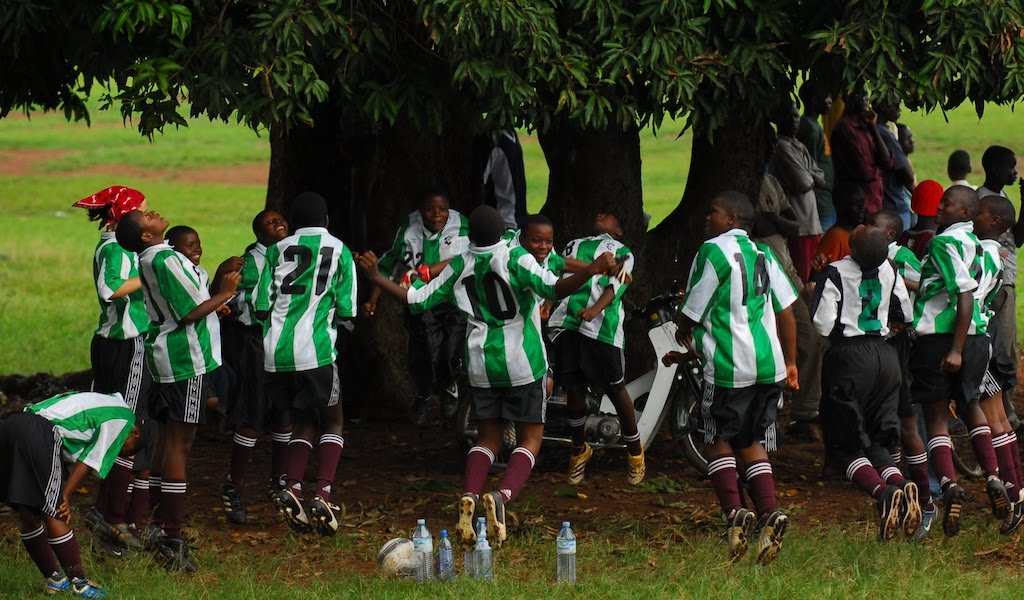
The Christ School Girls' Football Team joined 40 other schools from all over Uganda for the National Tournament in Gulu. Allow me to wax enthusiastically on women's sports. For the girls, sports participation is scientifically proven to be associated with lower rates of teen pregnancy and school drop-out, and higher rates of completion and success. In a culture where women are marginalized, an advantage like this is huge. Then when you add in the discipline, sense of belonging, group, community, team work, chance to get outside your district (where many females never leave), exposure to other cultures and places, physical fitness, and fun . . and the time spent with a solid role-model coach, it is a worthy investment in 17 girls. And one which would not have happened without Ashley. JD, Joanna, interns, all invested in sports for girls, but until Ashley they did not have a coach. Last year due to wedding plans made by her friends she was unable to accompany the team to finals (hence Alex as coach, and Eunice and I as chaperones). So this tournament in Gulu was her real opportunity to finally get her girls in competition, to spend a close-quarters all-out week with them, a type of closure before she completes her term. And for Julia, the tournaments last year and this have been great bonding times, deepening of friendships, developing resilience of cross-cultural dorm living, and being on a playing field as a human rather than a foreigner.
So when the location was announced as Gulu, all of the above overcame our reluctance to send our daughter and dear team mate and vulnerable girls there. First, the transport itself was nerve-wracking for me, sending all these girls off on flimsy matatus and accident-prone buses. Then, Gulu is infamously the center of the historically LRA-affected northern Uganda. Julia stayed in a dorm at Gulu High School which was funded by Invisible Children's school-to-school program. The school is a walled fortress, understandable in an area where the LRA conscripted school children ruthlessly in the 90's. The infamous abduction of the "Aboke Girls" occurred nearby. So I have to admire the bold redemptive gamble of staging the premier secondary school girls' event of the year in a place that was once notorious for danger to girls of this age. Instead of being an epicenter of pillage and worse, this year Gulu hosted the cream of Uganda's young women, to PLAY GAMES.
Our girls were put into a group with six other schools. We played six games. We tied one, and lost the others, which at first appears rather disappointing. And similar to the boys' experience: solid play, relatively close games, good effort, but no wins. No embarrassing huge margin defeats, respect from other teams, but we were clearly not going to advance. There are many reasons: a program only in its second year, NO pre-final in-district competition, few games ever played, a district where girls do not grow up playing football, a place with a 45% stunting rate, poor nutrition, lack of value on sports, a place where girls do not expect to succeed. There are many barriers to overcome. We prayed each game for just one little taste of victory, one out of six didn't seem like such an extravagant request. But it was not to be.
In the end, I see that the victories were less important to the girls than one might think. They love the play. They had a great time together. They learned team work, perseverance. They took in the new places and travel with wide eyes. My boys on the boys' team described their time at nationals to me, and in spite of a string of defeats they amazingly came away with a high sense of being able, competent, equal to the others, repeating to me praises they heard from others along the way. And a high sense that they came from a place (CSB) that did not cheat, did not recruit players who were not real students, did not boost their teams with outsiders, but instead had a team of real kids from a real school. They repeated back to me so many wise things from Nathan (as I'm sure the girls will from Ashley) about the real meaning of sportsmanship, that I realized they all won. Both the girls' and boys' teams have come away with a sense of value and accomplishment, an assurance that it is better to play fairly and hard than it is to win, a respect for their coaches and school, and a readiness to try again next year. None of us could ask for more.

The Journey and the Tourney: Part 1, Jouney

To Gulu and back: sounds reasonable, but it was a journey that almost did us in. Julia and Ashley left on a matatu last Friday, along with 16 other players and 1 other staff member. 19 women, escorted by angels I believe, have had a relatively smooth path, with people helping them along the way. They overnighted in Kampala and reached Gulu mid-day on Saturday, one of the first teams to register, and settled into a dorm at Gulu High School.
We, however, had a journey full of so many break-downs and problems you either have to cry, laugh, or wonder what God is up to. Be warned, this will be long. But if you want to know what it's like to be a parent trying to see your kid play in a sports match in Africa, read on.
5 am Monday: Bethany, Acacia, Jack, Scott and I emerge in the darkness, putting small bags into the back of the truck, headlights illuminating the rocky bumpy road out of Bundi. The sun rises over the eastern lip of the Rift Valley just as we crest the top of the mountain ridge, spectacular. In Fort Portal we fuel up and meet Kataramu Taddeo, Luke's best friend from his CSB days, an orphan who was sent to Christ School on sponsorship from the Good Samaritan program. Part of our response of gratefulness for the myriad of wise adults who have helped Luke and the opportunities that have opened before him has been to try and pass on some of the same to his friends. Last week we had taken Kataramu to interview at the Clinical Officer Training college in Fort Portal, and were advised that he might possibly get into the Bachelor of Medicine and Surgery program at Gulu University if they met him there. So we brought him along, six of us in the truck, speeding out on the highway east towards our turn-off in Kyenjojo.
10 am: Only we didn't make it to Kyenjojo, because about a half hour out of Fort I smelled something burning. Could that be us? The temperature guage was mid-range but we were alarmed, and as Scott slowed to pull off the road, the engine died, and clouds of smoke started to seep out from under the hood. Hissing sounds. Bad smells. Death? We all piled out, let things cool down a bit, opened this and checked that and called our trusted mechanic friend, Atwoki, who was already supposed to have done his last rescue for us (SSL trip). Thankfully we weren't so far, and he agreed to come take a look. As we waited for an hour or so, I noted one of the kids curiously watching us was about 8 years old but still with a cleft lip. With nothing else to do and wondering if this was God's way of redeeming the stop, I went with Kataramu to trace the boys' mom. Neighbors told us she was resistant to surgery. I happened to have a brochure in my bag from the new CoRSU hospital on Entebbe road, which offers cleft lip/palate repair free. With Kataramu we found her home, sat and talked, showed her convincing pictures of before and after. Her resistance changed . . it's not every day a doctor comes unannounced to your house and takes interest in your kid. I wrote out a referral and gave a small donation towards transport, and encouraged her to give it a try. Maybe the toughness her neighbors perceived was a self-protective defense from a heart that had been disappointed and did not dare to hope? By the time we got back to the car Atwoki had found a rusted-out fluid-leaking area, shut off that circuit (to the heater, not something we ever need!), added water and coolant, and we seemed to have the issue under control. He did not think any permanent damage had occurred. We continued on to Kyenjojo together, rechecked, bought a jerry can to fill with more water just in case, added fresh coolant, and soon were on our way again. Two hours lost, but Gulu was still in our sights.
3 pm Monday: We pull into a fuel station in Hoima, having made it several hours over dirt roads without any problem (we'd checked along the way, temps fine, coolant circulating, all was well). We decide we can't really get lunch, just bathroom and soda and diesel and plan to press on to Masindi, and from there to Gulu, hoping that we can be there between 7 and 8 pm if we push. But as soon as Scott turns the engine off, he hears a hissing sound again, the temperature guage suddenly shoots up to danger zone, and we're back to square one. Hot sun. Interested pump attendants. More exploration. Atwoki on the phone. Curious taunting children and a seemingly mentally ill muslim man who abuses us loudly the whole time. We find a leaking hose, so maybe this was the real problem? Or part of it? They can't replace it, but they can jerry-rig a repair cutting a pipe and using ties. Ok, we take a deep breath. Another two hours go by, and I troop everyone but Scott into town on foot to look for lunch, Jack finds us the "Aroma Cafe" which is pretty grubby but fast, and we eat trying not to think to much about where the food was cooked. Back to the fuel station, the repair is complete. Scott starts the engine. Now something is frothing forth out of a new place, in the water pump! Every place we plug seems to reveal a new leak. Back on the phone with Atwoki. This is a bigger problem. We are not going anywhere else that day. We consider hiring a taxi and abandoning our truck, but Atwoki says he will come with is truck from Fort and have a part put on a taxi from Kampala, and we must wait for him. Then he will fix our truck while we take his to Gulu and back.
5 pm: We find a Catholic guest house and check in for the night, order dinner, and try to calculate that if we get up at 5 am again, we might still make it to Gulu in time to see the girls play. Atwoki, bless his heart, arrives at midnight. Scott is so exhausted he can barely talk. They exchange keys, make plans, and go to bed.
5 am Tuesday: Up in the dark, take two. Pile the bags in the back of Atwoki's truck. Only as I'm putting mine in, I look at the passenger side tire, which is completely flat. The hope of making the game in time wavers. We can't get the spare off the complicated hanging mechanism under the back .. wake Atwoki and side-kick up, and they graciously help us change the tire. He looks amazed, because he's not had a puncture since he got this truck . . . One can not travel in Africa very far without a spare, so we look around town for an open repair shop. No go. We decide to press on towards Masindi. On what turns out to be the most abysmal road we've been on since ours was graded a while back. It is slow going. Praying all the way that the four functional tires hold out until we can get the spare fixed. We make it to Masindi, another wait . . the tube has so many patches and the materials for another patch will have to be obtained elsewhere, so Scott just decides to buy a new tube. On the road again.
11 am Tuesday: WE PULL INTO GULU, INTACT, MINUTES BEFORE THE GIRLS' GAME IS TO START! THE ENTIRE TEAM COMES RUNNING ACROSS THE FIELD TO HUG US WITH JOY, THEY COULD NOT HAVE BEEN HAPPIER IF WE WERE THEIR REAL PARENTS, IT WAS BEAUTIFUL. WE DECIDE THAT ALL THE HASSLE WAS WORTH IT FOR THAT MOMENT.
(more on tournament in next post)
2 pm: We have two hours between the girls' two games of the day, and this is our window (since we missed the morning on the road) to track down someone to interview Kataramu. We are directed to the medical school's old campus, a somewhat past-its-prime set of buildings next to Gulu hospital. No one around, but an angel appears, a young lady who says she will guide us to the new medical school administration building, which is a few km away. We get back in the truck (Atwoki's), only the key won't turn. Scott tries. And tries. Jiggles the steering wheel and the key. Minutes tick by. He calls Atwoki, who says it's an old worn key, sometimes this happens, just keep trying. No go. Scott is exhausted, 2 days at 5 am, about 14 hours of driving, pressure to get back in time for the game, poor Kataramu waiting. Why this? Our angel goes to find a driver friend, who reaches in the window and the key turns. We're stunned. OK, maybe we just needed to depend on others . . . off to the next place. Our angel stops the key professor who is just leaving in his car (reason for our delay, to meet him?). He is brusque but polite, explains that our info from Fort Portal is wrong, there is no value in seeing anyone at the medical school, all the decisions are made in Kampala by the Joint Admissions Board. But if we want to we can go to the main University campus office of the Registrar to enquire about the few private sponsorship slots that open next week after the government-sponsored slots are filled.
3 pm: Our angel takes us another few km away to the main Gulu University Campus, and inserts herself into a crowd in one office, and into a smaller queue in the next, and somehow manages to impress people that we've driven all the way from Bundibugyo . . and a few minutes later we're seated in stuffed chairs in the office of the official Registrar of the University, the main man in Admissions. He is very kind, professional, exuding knowledge and competence, intimidating but professional. He looks at all Kataramu's papers and grades, does calculations, and gives us the straight scoop. He won't be admitted. The competition is too fierce, and Kataramu's grades are not high enough. We believe in this kid, but this is a country where one exam spells your whole future, no matter how dedicated, hard working, bright you are. Sigh. The Registrar advises him and us on alternative health-related courses and careers. We leave, sobered, but glad for clarity. Kataramu later processes and says that God has a plan for him, that he'll be patient, and that's he's grateful for the opportunity to have tried.
4 pm: Back to Gulu high, just as the game starts again . . .watch, cheer, cringe, wish for better, comfort girls, hang out, see the dorms. We part at dusk, swing by Lacor Hospital which is inspiring, both for the husband/wife Italian missionary doctor team who spent their lives there (she died of AIDS acquired in the Operating Theatre, he continued to serve until his death) and as the place where Dr. Matthew Lukiywa also died of Ebola, like Dr. Jonah. We look for signs to a hotel and find the Golden Peace Hotel, impressive 3-story newly-built in the middle of village round huts. Gulu is like that, spread out. Dinner and the promise of a good nights' sleep. We intend to see a third game the next morning before starting back, but just before we retire we find out that the next days' schedule has changed and the game will not be until afternoon, so we'll miss it. This is Uganda. Plans change. We decide to sleep until 7ish to catch up a bit on the intensity of two days in the car, then begin our journey back . . .
6:12 am Weds But just before daylight, we are awakened by an earthquake. The 3-story building is shaking, our bed is shaking. Scott and I sit up. Do we run? How many corners were cut in this construction? By the time we decide, the tremor ends. But it might just be the first, and a larger one could follow. We decide to move out, it's just not worth the risk. How crazy is an earth quake on top of all the other things? The people in the hotel tell us it is very unusual in Gulu. We're tempted to tell them that it's our fault . . but we enjoy a big breakfast in a safer place, say goodbye to the girls and start our journey back.
2 pm Weds: We have passed a dead body of a man who was evidently carrying reeds on his bicycle and was hit by a vehicle just outside Gulu. Police are already there, and though the body still likes bloodied and at an unlivable angle on the road, it has been too long to think of help. Besides that, and signs warning of land mines, the road is clear and smooth. Over the Nile, spectacular crashing rapids. We decide to bag the slightly shorter distance of the dirt road through Hoima and go on the good pavement through Kampala. By 2 we're stopping for fuel just outside the city. On target to make it back to Fort Portal by dark, where Atwoki has now repaired our truck fully. But after putting in fuel, Atwoki's truck will not start. Lights come on the dash, then fade. Scott and the pump attendant check all the connections, they seem tights on the battery. More calls. No, this has not been a problem before. We decide that if we can roll start the truck, we'll just keep on to Fort without stopping again, so all of us get out and push the truck. On the second try it sputters to life.
7 pm Weds: Back in Fort Portal, we roll into Atwoki's Stitch and Sew Garage (yes, that's the name). He was the first Ugandan we met, when he picked us up at the airport, and once again he has gone to incredible humbling lengths to help us. He tells us it is because we are family. We try not to cry after such kindness, and such stress.
We sleep in Fort and make it back to Bundi on Thursday. On the way, my Bible reading falls on Numbers 22-24, the story of Balaam and his donkey. Hmmm. Coincidence? I think not. There was Balaam wanting to beat his donkey, just like we wanted to kick our truck. Transportation woes. But God was doing two things. First, He was protecting Balaam from destruction ahead. Did our breakdowns save our lives? We can't know, but it does put a different perspective on complaining about delays. Second, He was purifying Balaam's heart. After Balaam sees the spiritual reality of his danger, he rejects all the riches of Balak the King and chooses to stick with God. He describes himself as a man "with eyes wide open", who sees God is in control. That was not easy for us, as we so longed to see our Julia, and the team, and the games, and so wondered why God made it so hard. Hoping we don't have to have too many more trips like this one, but if we need to suffer more radiator issues for the purposes of protection or purification, then bring them on. At the time we were nearly in despair. Looking back, we can see that each issue occurred in places and times when we could receive help, that God always opened another door for us. If you've read this far, pray for us to be spiritually aware as a donkey (!) and not stubbornly complaining as a missionary (!!).