rotating header

Saturday, June 16, 2012

Embracing Farewell


I would wish today upon any young man entering the armed forces.  Caleb was truly embraced by the RVA community, in a beautiful and meaningful way.  We arrived at chapel early, to stake out our front row seats, and there was a buzz of greeting and activity as the kids and teachers drifted in.  Caleb showed up putting on the cap and gown neatly pressed from laundry, greeting friends and giving hugs and posing for photos.  It was all cheery and surreal until two of my fellow class-sponsor friends said "how are YOU doing?". . .Sigh.  The choir opened with the beautiful, haunting Kenyan national anthem, 70-some kids in their normal school clothes and Caleb in his graduation garb.  Then they sang "God bless the rains down in Africa . . ", a striking arrangement, but the words are deeply emotional for kids who have grown up here and have to leave.  Julia and a couple of Caleb's friends were crying by this point while trying to sing, and that pretty much crumpled the rest of our reserve.  After the choir, the principal spoke about living for something greater than yourself and Caleb's example of this, and then called him up and prayed for him. He handed Caleb his diploma, and the entire school clapped.  And clapped.  And soon the whole student body was giving him a standing ovation.  Caleb broke down in tears at that point, then pulled it together and stood there and saluted. It was a wonderful moment.  After the short ceremony there were more tears and hugs.  It felt more like a funeral than a celebration.  I think Caleb provided the flash point for all the senior angst, all the building emotions, the first rain in the storm of goodbye that is gathering. 

The night before friends had arranged a prayer time during the Koinonia fellowship; there was a party in English with more stories and cupcakes and prayer; the entire choir pulled in to lay hands on Caleb and pray at the beginning of choir class.  Throughout the day Caleb was singled out, blessed, thanked, exhorted, prayed over.  It was, in short, Caleb Day.  His quiet strength, his determination, his courage, something about him struck a chord at last.  We could only marvel at where God had brought him, through years of being on the outside, being the foreign kid, the new kid, to the point of being at the very center of a very caring community.


The next two months will push Caleb to his limits.  When that happens, the strength of the love that embraced him today will propel him on towards perseverance and service.


We end by appending the letter we sent out to supporters last month, which summarizes our gratefulness to all of you who read and pray, in making it to this day: 


1 May 2012

Seventeen years ago we wrote an article for WHM’s newsletter about some of the difficult decisions around Caleb’s birth entitled “Why Risk My Son’s Life?”  The cover photo shows a much-younger mom supporting a plump and floppy little guy with sparse hair.  After losing three children in pregnancy and then having Luke prematurely, we were soberly aware that being faithful missionaries in Uganda and responsible parents to our unborn son Caleb required a hard look at faith.  We wrote, “The risk we incur with our children is not theoretical.  Living in isolated conditions in rural Africa, it is disturbingly, palpably real . . .And faith does not erase it.”  A close look at Hebrews 11 made it clear that faith would not guarantee an optimistic outcome to Caleb’s gestation.  Though we were tempted to demand health and life somehow earned by missionary service, God led us to the story of Abraham and we followed, laying Caleb on that altar.

And like Abraham, we suspect, that excruciating choice had to be repeated day after day, year after year.  Through repeated illnesses that sapped his little body of strength until he was hospitalized at Hopkins, through the dangers of two emergency surgeries in marginal conditions in Uganda.  Through escapes from rebels, through days and years of watching him fend for himself amongst older and sometimes hostile peers.  Through sending him off to boarding school at age 14.  Through hesitant permission to let him scale a glacier, bungee jump a hundred meter fall, raft the Nile, fly a Cessna, drive a motorcycle, play rugby, or embark unaccompanied to foreign countries.  Through the molding of a boy into a man of inner strength, a musical ear, a ready kindness and thoughtful spirituality.

So it should not have surprised us when this child who taught us about faith decided to pursue pilot training via the United States Air Force Academy.  The application process itself was a daunting accomplishment to complete, and against very stiff odds Caleb was nominated by Senator Mark Warner and subsequently offered an appointment in the class of 2016.  On Easter, after two weeks of prayer and pondering several great options, he announced that he had decided to enter this service.  He embraces the physical as well as the mental challenge, and the opportunity to serve a higher purpose than his own comfort.

Today we write to thank you for being an integral part of this story from before birth to high school graduation.  You have prayed Caleb through many dangers, toils and snares, and we would ask that you continue to pray for the grace he needs to survive this next phase of God’s calling.  And the grace we need to let go, and lay him on that altar once again.

Caleb will leave RVA a month early, in mid-June, to get through jet lag and be ready to enter Basic Cadet Training (boot camp) on June 28 in Colorado Springs.  So you can’t really come to his graduation (he won’t be there), nor can you give him gifts (personal possessions will be nearly non-existent, though we hope he can have his beloved guitar with him eventually).  But you can pray.  And you can write him letters to lift his spirits in the grueling weeks of boot camp, or the demanding years of a tough school far from home that will follow.

With deeply grateful and trembling hearts . . .

Jennifer and Scott, for Luke, Caleb, Julia, and Jack too.

Mail:  Basic Cadet Caleb S. Myhre/PO Box 2694/USAF   CO  80841


Thursday, June 14, 2012

Here we are, at the end of all things

I know graduations are called "commencements" which is one of those optimistic spins that doesn't really fool anyone.  Two weeks ago we had "the breaking of the fellowship", our last day as a family.  Now Luke is in Mombasa and by the time he comes back Caleb and I will be far away.  Today Caleb is slated to stand up during chapel and receive his diploma, all alone.  There is another month of school at RVA, but he has worked hard to complete all his courses in time to enter basic cadet training for the Air Force.  So in an hour we'll head up to witness this lone graduate coming to the end of his high school, his Africa-school, career.

 This map shows the loneliness of this process.  These are the tags of where RVA students are going to college. There are clusters at some of the popular Christian schools:  Calvin, Anderson, Asbury, Liberty, Le Tourneu.  There are kids scattered up and down the coasts at Duke, Princeton, UNC, Florida, Biola.  But that one little tag in the green square, all by itself in the middle, is Caleb.


 Last night we had installment one of our two last family meals, with a scrap-book review of Caleb's growing up and some hilarious readings of his 1rst to 3rd grade school papers.  Back when his favorite afternoon was to shoot baskets in our yard with Basiime Godfrey, or to get pounded  in the goal with all the boys playing soccer.  We read his version of being stuck in the elevator at a team retreat (Pain in Spain).  We laughed.  And then watched a video about the summer of Basic Cadet Training that the Kraus family lent us, from when their son went through five years ago.  It was sobering but helpful to see in real life the shouting, the inspections, the grueling crawls through mud and under barbed wire, the team events, even the gliding and parachuting. 

This photo I purchased when parents were given the option to buy their kids' graduation pictures (they suit up early and do a photo op in March so there is time to process and print in Africa . . ).  Two smiling friends who will hopefully inspire Caleb to persevere.  I know they'll be praying for him.

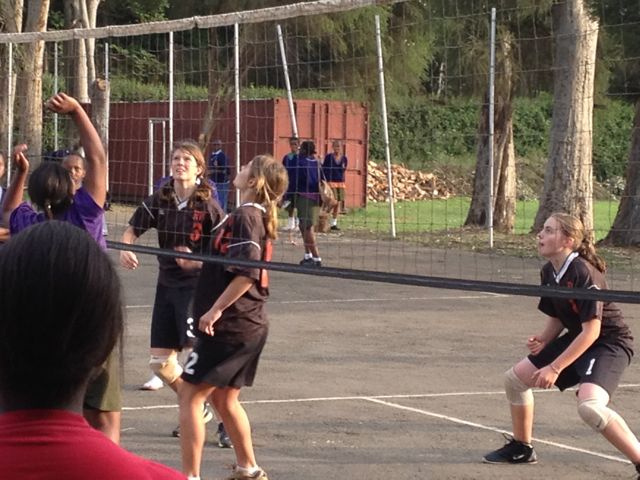
Meanwhile life goes on, and Julia and Acacia and Jack have sports events this weekend.  The teams dress for a "psych": Volleyball as princesses, and Rugby as  . . rugby players.
 Julia and Acacia above at Moi Girls' High School in Nairobi--they played well, but were defeated by some very adept Kenyan girls.  Our newest WHM-Kenya missionaries Stephen and Karis Rigby live near the school and were able to join us at the match to visit.  We're so thankful they are here now, exploring ways to bring the Kingdom to the poor in the city through sports ministry.


Lastly La Trattoria, the RVA cafeteria transformed into an Italian pizzaria for Sophomore Restaurant last weekend, which took a huge amount of collective time and energy this past week.

As we head up the hill to graduation, it is a bit sad that we won't have family or team here.  But we do have the entire RVA community, one we have grown to love and appreciate.  So here at the end of life as we've known it we are thankful for the dedicated teachers, caring chaplains, skilled coaches, organized administrators, inspiring choir director, helpful nurses, capable dorm parents, reliable cooks, all the people who have poured into Caleb's life to enable him to reach this milestone today.

Friday, June 08, 2012

Off-Kilter


I'm not sure if KILTER is a physical part of the brain, or a quality of the soul, or an achievement of community, or all of the above.  Perhaps the Hebrew is shalom.  One of those things that you can take for granted until it is missing.

This is a week (month . . year?) in which the kilter is askew.  Monday, instead of working, I was in the car.  ALL DAY.  Reading a good book (Allah, a Christian Perspective, by Miroslav Volf) and doing some computer work, but confined to the car nonetheless.  Leaving half our family (Luke and Caleb) behind on the coast, and hurtling back towards responsibility.  Because of that, and some staffing issues, I worked T/W/R instead of M/T/W in the hospital, which meant that my usual R things like Swahili lessons and prayer meeting and RVA clinic had to be juggled alongside of patient care.  The week was also kilter-imbalanced because the interns were pulled off their rotations for trauma training, and my only remaining partner, a clinical officer, was feeling sick.  Scott and I had staggered calls instead of the same night.  I had two patients die in ICU.  In both cases I poured my all into their care for a day or more, and had glimmers of hope, but in both cases their brains could not recover.  Both had lovely caring pairs of parents.  People that hugged ME and reassured ME that I had done everything possible, people that thanked ME for the care that ended in their child dying.  That, and the sobbing, always get me.  

Some of the off-kilter comes when bumping against good things, too, like having a delightful kid stay with us for the week, or a visit from potential new long-term Kijabe doctors, a pediatric plastic surgeon and his pediatrician wife.  The surgeon was my medical student in Chicago when I was a resident.  Just over twenty years ago now, he was a bright, committed, helpful, competent student who was also a Christian, and we kept in touch as he even supported us over the ensuing decades.  Now he gave a phenomenal talk about the cleft lip surgery program he helped establish in Ethiopia and the way God had used that to concretely demonstrate love to some very resistant unreached people groups.  We're hoping to get them to Kijabe in order to train others.

Then there is the usual fact that our front-line friends have their own off-kilter experiences, week in and week out.  Which mostly affects Scott, who is working very hard.

And did I mention the three-hour sophomore class sponsor meeting?   The guilty anxiety that we're not going to pull off our part of the class project?

Work and sleeplessness and death and loose ends and visitors and cooking are part of life.  The real reason it all felt so . . .well, I should just say it, STRESSFUL . . . was that the background of this week is the looming end-of-this-chapter of our family's life.  The dispersal of the fellowship once again.  A week from today Caleb will have a mini-graduation recognition at chapel, and then over the weekend we'll fly out.  He and Luke already said goodbye.  Reality is hitting, hard, that the days our family can spend together are precious, that we can't see them or count on them from here.  We'll have Luke in a summer Swahili Language program at the coast, Jack and Julia and Acacia finishing the term at RVA, Scott working, and Caleb will be suffering through basic training.  My heart aches, already.  I don't know when we'll be together again.

In a perfect world, such as the one that we are promised, shalom will be the air we breathe, all will be on-kilter.  But in the meantime, I think the jarring imbalance of these sorrows and even joys keeps us living by faith.  Off-kilter can be a state of grace.  A gift.  
At one point this week, I rushed home to pull leftovers out for the kids for lunch and then rushed back in response to a page about a critically ill baby.  When that was settled I had a half hour before RVA clinic so I decided to just plow through some charts in the outpatient clinic, since there are no interns to see them.  I pulled out the first two:  malnutrition, sounding dire.  Depressing, complicated, no-quick-fix, and I admit to feeling resentful and stuck.  When I called the name, it took me a while to reconcile the smiling plump baby with the chart.  It was C, the orphan from Sudan, and his fellow-abandoned-child S.  The Kenyan NGO worker who had been hired by the American group to manage the project in South Sudan had been keeping C and S at his own home in Nairobi for the month since we had discharged them.  He decided that his wife needed to get involved.  And she did.  Those children had each gained 1.2 kg.  C had now doubled his weight since we first started.  They were playful, relaxed, loved-looking kids, with grandparently-type well-educated Kenyan caregivers.  He plans to return them to South Sudan with their siblings but not until next month, when his wife can also go and spend some weeks supervising the care and teaching the orphanage-workers about feeding and nutrition.  

I was almost "too busy" to see these kids, and if I had protected my kilter from one more interruption, I would have missed a real treat.  A reminder that God can mix things up a bit, for good.  Move kids across borders and families, involve multiple people and agencies, push us a little harder but bring out new life.  A reminder that the loss I grieve may be hidden gain and glory.


(above, 3.7 kg, day 3 of admission, to the right 6.2 kg, yesterday)


Wednesday, June 06, 2012

a weekend together

We drove 11 harrowing, white-knuckle hours (each way) on the pot-holed Nairobi-Mombasa road to spend a 3 day weekend at the beach.  We had just over 24 hours together as an intact family.

After one day together, Scott drove Caleb to the beach hotel where the RVA Senior Class celebrated their last hurrah together.  Sun, surf, and swimming.

Then Luke left to begin his Yale Summer Swahili Study Abroad Program in Mombasa.


Our next time together?  God knows.  Maybe Christmas? Perhaps beyond.  A lot of water to pass under the bridge before then (and a lot of push-ups for Caleb)...

Wednesday, May 30, 2012

Edge-Notes Day 3

Third day, third camp.  Each has its own subtle unique atmosphere, a combination of it's age and size perhaps, or of the NGO which "runs" it.  Today's camp is the purview of MSF, and is one of the larger ones.  More spread out, more space, a bustling market.  Humans are humans, put 150 thousand of them together and they will begin selling things to each other.  The hospital compound is thoroughly fenced and heavily guarded.  this feels more like one thinks a refugee camp would.  The buildings are plank on cement, not permanent.  Dust, tents, thorny scrub bushes.  Open rafters, naked bulbs for lights, plank benches, cluttered tables.  Perhaps because MSF normally works in war zones and disasters, this hospital has that feel.  But in spite of the external shabbiness the level of care is excellent.  The Medical Officer in charge started one month ago, and gives his opinion that this hospital has more supplies and better outcomes than any provincial government hospital in Kenya.  There are 72 malnourished children admitted in three long barn-like wards.  Only one child has died from malnutrition in the last month.  That is impressive.  The numbers are considerably down from the peak of the post-drought crisis of 2011, but this is still the most malnourished patients I've ever seen in one place.  There is a sense of order and calm, of protocol, good records, plenty of space and supplies.  These people know what they are doing.

And perhaps because of that, they are confident in their abilities, less desperate for input.  A crowd comes to my newborn resuscitation workshop, and there is good interaction and teaching, laughter and interest as they practice with the model babies.  But after the first hour, we take a break, and when I offer another topic (something eagerly requested in the other camps) the 30 or so nursses, CO's and doctors seem to drift away, busy with their own world.  They used to have lots of MSF-employed temporary doctors, so perhaps they are more used to people coming in and out.  In the last year this has changed, however, due to the insecurity of the borders and the camps.  Now, like all the other camps, there is a small army of Kenyan workers employed by the NGO's, and the expatriates stay at the base in Dadaab and make brief escorted forays into the camp proper.

Today we have to finish by noon.  There is the usual confusion of the returning convoy, the speeding along the rough road, the clouds of dust, the discussion in the vehicle about whether to wait for the police or not.  We fly by fences and thorn scrubs, rounded huts, donkey carts stacked with firewood sticks, bright-scarved women, listless goats.  The refugees themselves must stay in the camps, but there are ethnically related Kenyans who have lived in this border area for a generation or more who move back and forth.  We are deposited safely back at our base camp just in time for lunch in the small screened "mess".  

And just in time for the most surreal moment of the day.  The "mess" is a rickety wooden building with screen windows, a stove and counter, a table and plastic chairs.  And a TV, hooked up to satellite channels.  There is a loud TV blaring wherever the NGO workers gather.  This time as we're washing our hands, we become aware of the news story.   "Attack in Dadaab" reads the title banner, beneath pictures of wounded police being loaded into an ambulance.  What?  There we are standing smack in the middle of Dadaab, hearing about a 2 hour gun battle via TV.  It seems that Somali bandits crossed the border and attacked vehicles on the road 10 km outside of town, so the police responded, with numerous injuries on both sides.  

A bizarre feeling.  Life was going on as "normal" as it could, people eating lunch and chatting, while we learned of local insecurity via the media.  Thankfully we were flying out.  

And within an hour we were back at the airfield where we started, huddled under the only shade around with about 40 people all waiting for the plane.  A few Norwegians and other Europeans, us, and MANY Kenyans, all young and casual and smart, checking their phone messages, planning their arrivals in Nairobi, interacting familiarly with one another.  

And then the cool air of Nairobi, the traffic, the relief of being back in a more comfortable and recognizable place.  I'm thankful to have had the opportunity to see the AID world, the refugee world, the remote NE Kenyan world.  To have taught life-saving skills to almost a hundred health workers.  To bear witness  to the reality of this life.  To contribute in a small way to the health capacity of the 2nd or 3rd largest population center in Kenya, and an area that represents 5% of the population of Somalia.  To spend time with surgeons I respect and admire, and with my son.

But mostly I'm thankful to be home.


Tuesday, May 29, 2012

Edge Notes Day 2

The bougainvillea and acacias whisper in the evening wind as light fades and the dust and heat of the day slip away.  I am just back from a walk through D-b town with Luke.  Not sure it would have occurred to me that we could leave our UN-zone bunker but it did, of course, occur to him.  No one objected.  After being herded and jostled from base to camp to base, it was freeing to simply walk out the gate into the evening's quiet bustle of any African town.  Well, not any town.  There are more Landcruisers per square km here than probably any place on earth.  But outside of the UN compound there is a semblance of normal life.  A huddle of sheep in the middle of the road, pausing heads down, as if in prayer.  Wandering donkeys.  Pairs of men striding along the roadside.  Veiled women sitting at sewing machines.  And the signs:  you know you're in a refugee zone when the small tin shacks along the road, each selling the usual assortment of soap and sugar and plastic basins and other life necessities, have the following names (not making this up):  Tehran Fashion, Bosnia Shop, and others named Soweto, Baghdad.  Not the names that would entice customers in some parts of the world, but the life experience of the NGO-following crowd here I guess.  Luke chatted in Swahili with a few people until we located chapatis, and for bargain (50 shillings a piece) we ordered two that came with a beef stew.  Hygienically sketchy place, but atmospheric.

This morning started with the real deal convoy.  This time we were in the main exodus from D-b town to the largest set of camps to the north-east.  Though they are only 5 or 10 km away, it takes a major motorcade production to get there.  It really has to be seen to be believed.  A dozen or more nearly identical Landcruisers, each packed with aid workers, again mostly Kenyan, all mill about and vie for position at the police headquarters.  Engines idle.  Windows open and close.  People chat.  Then suddenly the police appear and zoom off, and everyone follows.  The idea seems to be to drive as fast as possible through any potential danger zone.  So we careen down the dirt highway in a cloud of dust, across open scrubland, until we reach the outskirts of the largest camp, home to 188,000 people in three sections.  The windows are closed against the dust and the back of the "ambulance" is stiflingly hot, the wash-board road and swerving around ruts forces us to cling to our seats, but the trip is mercifully short.  We see bent-stick igloo-shaped homes covered in plastic bags, thorn fences, and worn signs for various NGO's.  We turn off the main road and pass deeper into the camp to reach the hospital, the gates open, and we roll to a relieved stop.  Everyone piles out for a day of work, until the convoy will re-collect and re-careen back in the evening.  

Once again patients were waiting, patiently as patients do, squatting in the small shade of the overhang of the main hospital administration block.  There was the usual confusion and negotiation as Erik and Ken set up at table, chairs, a small exam area, met translators, decided on crowd control.  Luke and I moved on with the Matron to tour the facility.  This one was 5 years instead of 5 days old, so a bit more worn, more lived-in.  Again an impressively stocked pharmacy and lab.  18-bed wards in neat rows.  All with mattresses and nets.  Oxygen concentrators humming in two wards, the generator buzzing in the background.  Malnourished kids with stick-thin arms, listless moms.  Eerily calm, little crying or commotion, resigned people just sitting on their beds, waiting.  We asked questions and looked into rooms and checked our check-lists.  I was asked to consult on a febrile newborn, whose antibiotic choice had not been very appropriate, but the IV fluids and oxygen were well done.  Then I also got pulled in to examine some admitted and outpatients.  Most of the day, though, I spent teaching.

The morning was mostly auxillary nurses, with a few maternity staff.  The afternoon was mostly clinical officers, nurses, and the one medical officer.  Both groups were about 25 people each.  I used the flip charts and baby models to teach newborn resuscitation, because that is the crucial intervention that can save lives.  A couple of the nurses were very adept at handling the ambu bags.  Most were not.  They laughed and helped each other.  I then taught two topics (pre-prepared lectures I've done before) in the morning and two more in the afternoon.  So I was talking, listening, cajoling, trying to draw out participation, to stimulate thinking, to praise, to inspire, for about five hours today.  My hat is off to teachers.  It was very tiring, especially considering that English isn't anyone's first language but me, there are multiple cultures and levels of training represented.  But they asked questions and wanted more and I was literally zipping up my bag as the convoy vehicle was beeping for me as they finally let me go . . 

The surgical team once again had fewer patients than expected, so went back to base camp mid day.  I ended up on my own at the hospital for lunch and the afternoon, which was fine, it didn't waste their time waiting for me.  But I am still glad to be safely back with the guys.

One more day, one more camp.  There are many hard-working people here doing a pretty reasonable job in a difficult situation, and it's a privilege to give them a boost.  


Monday, May 28, 2012

Notes from the Edge Day One

4:30 a.m. we squeeze into a taxi, the escarpment is dark and cool and quiet at this hour, and I am wedged in the back seat between a paeds surgery fellow who was once a national rugby player for Kenya, and my own 19 year old whose 6 foot 2-and-a-half inch frame is more muscular and substantive after two years of collegiate club football.  Consolation:  if we get into trouble here, these are two of the kind of guys you want to have your back.  We squint at oncoming headlights, pass trucks, weave in and out of matatus and buses even at this predawn hour, all the way to Wilson Airport.  The UN has people flying to K-a on the Sudan border and D-b on the S0mali border, with their coolers of vaccines and blue diplomatic passports, their jeans and scarves and NGO-casual wear, their newspapers and glasses.  Perk of the international aid scene:  there is a coffee bar which opens before our plane boards, with legitimate lattes.  Hooray.  

We doze at the 19,000 foot cruising altitude and descend through thick clouds towards the srub-land of NE Kenya.  Thorn kraals and tiny white goats and cows are visible against the dusty red earth; the slight green of acacia trees and no buildings or tarmac for miles in any direction.  Then out of the desert there is a camp, strictly straight lines of roads with an impossible conglomeration of dwellings crammed into every millimeter of the grid they form.  Homes made from sticks covered by bits of plastic.  Then the airfield, and we touch down.  Into a world that is uniquely its own.  We're in Kenya, so there are Kenyan police in camo with guns.  But the airstrip is tarmac, and neatly apportioned, and everything here is clearly controlled by the UN.  A veritable fleet of white landcruisers awaits the plane.  Each says "Owned by UNHCR for use by ______", fill in the alphabet of organizations.  Each driver searches for his particular people, until they are all sorted into the proper nearly identical white 4WD for the five minute trip to UN central.

D-b used to be a sleepy crossroad with a few dukas.  Now it is the epicenter of aid.  The roads are wide and graded.  Containers and mbati have been transformed into a thriving market.  We pass through a security checkpoint into the home base area for all the organizations which support this massive community.  Behind sandbags and barbed wire, apportioned areas are given to each NGO.  There are guest houses, open areas for eating, offices, computers, dusty paths.  I am escorted to my room-a couch on a screened porch, my own bathroom and simple bed and mosquito net--to drop off my things and head out to the first camp.

Back into the ubiquitous white landcruiser, and out of the maze of the secure compound, we pick up our required police escort vehicle and follow it out of town.  Through the final checkpoint, and then out into the wasteland, roaring along in a cloud of dust.  We are in the middle of nowhere when our lead vehicle stops.  The armed policeman and the driver get out.  No, not s security risk, just a flat tire.  A totally blown out tire, and as the driver explains, "hakuna spare".  So we wonder which is riskier, sitting like a duck out on the road or continuing on unescorted.  Before long other vehicles come, the policeman switches to a new lead car, and we continue while the first car waits for a spare tire.  (On the way back, the police escort vehicle was stalled and had to be pushed and coaxed to life by the crowd getting rides in the back.  There is considerable debate about whether the presence of security makes one more or less secure).

Our first camp is a handful of kilometers southeast of D-b.  The geography is this:  the foreigners and most of the Kenyan staff (the vast majority of aid workers here are Kenyan) stay in makeshift compounds which have grown into the sprawling UN village in D-b, and make forays by armed convoy out to the camps, which are tightly clustered masses of humanity surrounding schools and hospitals.  It feels surreal and controlled.  We are delivered through another guarded gate into the small universe of the International Rescue Committee, the organization that basically runs this particular camp of 132,000 people, and also serves a newer camp of about 10,000.  Each camp is the kingdom of a different NGO.  The IRC has just poured a boatload of money into this hospital.  New facilities, cleanly painted, sport plaques saying they were dedicated four days ago.  Incongruously, the place feels fresh and clean, a hot wind blows through, patients cluster and squat in the shade, until they see the Kijabe team then they push forward to muscle their way into line.  While the surgeons examine a smaller-than-expected number of referrals and follow-up patients, Luke and I spend the morning in the maternity ward and nursery.  We talk to nurses, midwives, and doctors, thumb through records, make notes on facilities, ask questions. 

I teach an abbreviated version of Helping Babies Breathe.  I've traveled with the resucitatable model babies, twin "NeoNatalies".  We discuss the golden minute, the crucial assistance a trained birth attendant can give to make the baby's transition from fetal to extra-uterine life successful, the heavy burden of neonatal mortality.   The small class of six medical personnel practices suctioning and then bagging the babies, awkwardly learning to handle the ambu bag, to see the chest rise, to feel the cord pulsate.  They are bright and interested and game.  I thoroughly enjoy them and feel like we could spend the whole day, but before too long the surgeons are done and we are called away.

Then we embark upon a tour of the entire facility, noting the presence or absence of microscopes and oxygen, antibiotic choices, malnutrition programs.  A goal of this trip is to assess opportunities for Kijabe Hospital to assist and improve Paediatric care in these camps.  We find excellently equipped facilities but some gaps in knowledge and practice, and an eager openness to further training.  We make a list of topics that the staff would like to be taught, dreaming of the next trips.  Luke ruminates and I agree, the facilities and staff we see here are far superior to most rural African hospitals.  The refugees suffer loss of land and identity and livelihood and dignity and a thousand other things tangible and intangible.  But their access to health care is probably better than most.  Another paradox.

Now it is evening, the hot wind has cooled, a cold shower has removed the dust, and darkness falls early and fast in this eastern province.  Thankful to be here.


Sunday, May 27, 2012

Living on the edge

"If you aren't living on the edge, you're taking up too much room."  This has been a only-half-joking family motto of ours.  This week Luke and I are thankful for the opportunity to head out to an edge together.  We're accompanying a team from Kijabe (two surgical doctors and us) to a refugee camp on a border of this country.  Back to the edge.  Where the largest collection of refugees in the world (about half a million people) live.  People who fled war and drought to eke out an existence.  People who have now been there for about twenty years, an entire generation who knows only this way of life.  Through a series of providences doctors from Kijabe have been invited to provide teaching and medical care.  Ever since I read of the massive influx of population into these camps in the last year I have wanted to go, a humanitarian disaster on our doorstep so to speak.  The camps closed to NGO's for about six months because of the danger of kidnapping and attack in 2011-2012.  But now the UN is allowing workers to return.  Even up to the last few hours today we wondered if we would be canceled, however.  This is a culture where violence is an accepted expression of will, where displeasure is expressed through a grenade.  Thankfully the situation is considered stable at the moment in spite of recent isolated events affecting Kenyans mostly, who became targets when the country's military invaded their neighbor.

Jesus moved towards hostile people, and healed and loved and cared in spite of risk. 

This is a rare opportunity for us to follow in those footsteps.  Please pray for the Kingdom to make subtle but real inroads into a desperate place, and for us to be used in that process.  Please pray for meaningful service, stamina, and a safe return Wednesday evening.  And pray for precious time together for Luke and me, and for God to continue to make his future calling clear.
LUKE IS HOME!!!  For a few days our family is whole.  These days become more rare with each year, our family is in a life-phase of dispersion.  So we revel in the right-ness of his being with us until his Swahili program starts in Mombasa.  Half way through Yale.  He's energetic, full of ideas, fun, pulling out his trash-picked treasures from a two-week janitorial job moving furniture and cleaning up dorms after the students left, full of stories, and so happy to be back in Africa.  Almost as happy as we are to have him. 

Here he arrived Friday morning, and we stopped at Art Cafe on our way back to Kijabe.  


Enjoy a few pictures from the last 48 hours, arrival, pizza with some kids and neighbors, church, a hike (not to mention being on call and doing rounds together . . )


The whole family this morning after church, and then we spent the afternoon climbing Longonot.  A long-time wish of Acacia's and a goodbye trip for Caleb and Hannah . . .


 Caleb was asked to lead worship this morning, very meaningful for us as he only has one more Sunday at RVA.


Thursday, May 24, 2012

Out of Eden . . .

. . and back to reality.  

This week felt a little Job-ish.  Perhaps it is my African world-view.  Africans don't mention the good news of a new baby, or praise their happiness, for fear of attracting jealousy from evil spirits.  But there is Biblical precedent, when Satan challenges God to allow some loss and testing to seep into his life of abundance.  And so we landed back in Kenya from paradise.  And promptly paid the price for our week of joy.  Infections in multiple body systems, the kind of wipe-out fever, two of the last four nights on call (one blessedly benign for much-needed recovery, the other typically sleepless with a deteriorating patient needing intubation and ICU admission), meetings and responsibilities and rain and mold and just the challenges of survival.  We're back to real life, but thankful for the divine hedge which protected those days away.

I like to win.  I like to fight a disease and see a rescue, a recovery.  And while that often happens, and makes much of the above worth the effort, sometimes I utterly fail.  Turanta died yesterday morning on my watch, after a week and a half of trying to get the upper hand against an infection in his brain.  My second 15-year-old previously-healthy boy to succumb to meningitis in the last month or so.  The first, James, was a 35-day battle that we eventually did win, though initially I didn't have a lot of hope, he overcame sinusitis that spread to meningitis and brain abscesses to walk out of the hospital normal.  Not so with Turanta.  This tall lean Maasai boy fell ill a few weeks ago, and bounced from a couple of other hospitals with inadequate care as his infection progressed.  By the time he came to Kijabe he was in bad shape.  Still he improved initially, then entered a slow steady slide towards death, progressing from alert to confused to restless to responding-only-to-pain to completely unresponsive to brain dead.  Yesterday morning after consultation with others and confirmation of his absent reflexes, I sat down with his older brother to explain that he was essentially gone, that his heart was only still beating because of the ventilator her was on.  Turanta's elderly parents were unable to come, so this adult brother was functioning as the caretaker and responsible family.  In the conference room with the chaplain and nurse I prayed and explained and held it together pretty well until the brother thanked us, and started to cry himself.  People have told me they have never seen a Maasai man cry.  As a mother of a 15 year old myself, I found this death very very painful.  The graciousness of this brother overwhelmed me, he accepted God's hand in the entire situation, thanked us for our effort, and agreed to discontinue life support.  He even agreed to a post-mortem (unusual) in case we can learn something that helps others in the future.  I pushed for this, because I want to know what we were treating, what we were missing, what we could have done.

I never saw Turanta when he was well, but I can imagine him running across the valley, or sitting around a fire under the stars, or kicking a football, or jostling with friends in school uniforms between classes.  And in fact I went almost straight from his death to watch my 14 year old son play rugby, his own long legs running, his strong arms tackling as we cheered his team to a narrow and hard-fought victory against the JV team of Nairobi School, currently the top Rugby school in the league.  Then we caught the final games of the girls' volleyball match where I have a 14 and a 15 year old on the team, again a close contest and hard-won victory against a nearby Kenyan school.  Then we were invited to dinner with another station family, between us and visitors there were about 8 or 9 teens around that huge table laughing and telling stories and eating heartily, seeming invincible.  But they aren't.  I love these teen years and yet patients like Turanta remind me of the fragility of these lives. There but for the grace of God any of these kids could be.  

So we continue to walk this path, reveling in the moments of Eden made bittersweet by the immediate juxtaposition of loss.  I begin to glimpse the paradoxical reality of Psalm 23:  thou preparest a table before me in the presence of my enemies.  The feast is spread in the valley of the shadow of death.  Post-mortem to rugby game, ICU to family meal.  

Both are reality.