rotating header

Wednesday, May 20, 2015

Miaka Mia Moja

Not that I expect to live a hundred years, but if I do, I want to be like Dr. Bill Barnette.  He's only two years younger than Kijabe.  And every once and a while as he talks, telling stories in deadpan detail, his mischievous character shines through.

Two stories from today.  
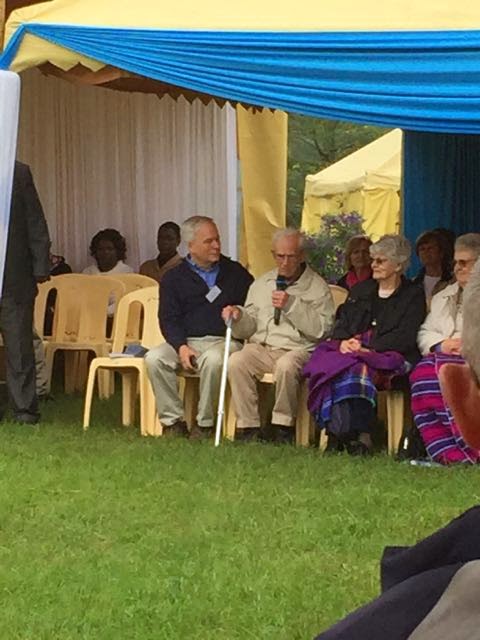
Shortly after the first lab was established by the no-nonsense Justy, Dr. Bill decided to play a prank. He had been given a bottle of wine ("I didn't know what to do with it!," the good AIM-doc comment).  He sent some in a specimen container to the lab and ordered a slew of tests as if it was a body fluid.  A few hours later, he went into the lab and found Justy and her assistant a bit flummoxed.  Oh, he said, there's one test you didn't do.  The taste test!  Then he opened the specimen container and took a swig, to the horrified faces of Justy and her colleague.  Later she got him back by marching into his exam room and presenting him with a long bill of charges for all the tests she had run.

An old photo taken in an operating theatre with meticulously tiled walls in the background led down a path of remembering how he did the tiling, and how the floors had to have strips of copper beneath the tiles to conduct electricity away in case of a spark from the electric cautery . . . because the anesthetic of the time, ether, was basically a potential bomb.  Which then led to the memory of a displaced missionary from Congo after the Simba rebellion, Fernando, who helped with that tiling and was a whiz with administration and building, but was not not a medical person.  So one day Dr. Bill had a patient with a serious leg fracture.  He also happened to have a prosthetic leg laying around, which he tucked under the sheet with the patient with a fracture.  When his friend Fernando came into the theatre hall, he called for help.  He explained that to set the fracture properly required some traction, so he needed help from someone strong.  Could Fernando pull on the patient's foot while Dr. Bill held his shoulders?  Innocently Fernando took hold of the proffered shoe, and pulled hard, landing on his back with a loose leg in the air.  He yelled, certain he had just pulled the patient's leg off.  

I guess the lesson is that the kind of person who can play practical jokes as the sole doctor in a busy mission hospital is the kind of person who lives 98 years.

The other highlight of today was a lunch in which the AIC Church leadership invited all the honored returning missionaries, along with some equally ancient local Kenyans, and all the current missionaries. The Bishop of the AIC for all of Kenya attended, as well as the deputy Bishop and various secretaries and principles and pastors.  These formal events can be tedious with protocol.  But this time the intent was truly sweet:  these senior Kenyan leaders wanted to formally say thank you.  They stood up and acknowledged, we are here because you came, you taught us, you believed in us, and we are grateful. They are now in charge and we are partners who serve their purposes, but they demonstrated great humility in this celebration.  At the end there was a cake to cut, and the Bishop was given the honor.  However he insisted that Dr. Bill and the others come up, and he and Dr. Bill held the knife together.  I am certain that missionaries, those past and present, have frustrated the Kenyans time and time again, caused misunderstanding and heartache and despair.  So it was beautiful to see the charity, the forgiveness, the modesty, of this gesture.

Another treat of this event:  we snagged a table with the Bransfords.  Millie invited me into her home for Bible Study when we were beleagered refugees here almost two decades ago.


We are also hosting our own honored returnees, the H's who worked at Kijabe for a dozen years or more. Mrs. H was given an award for her work on curriculum development in the nursing school, and Dr. H reminded us this morning that the current area where they work which is decidedly non-Christian and dangerous is open to them partly because the Kijabe name is respected and trusted even in hostile enclaves.  After our boys played rugby together this evening (in a resounding 64-0 defeat of Kijabe Boys High School, which included a 70-meter run from Jack breaking a number of tackles and dodging around people to score a try . . . and several tries from the H's son and conversions from both boys . . .) we enjoyed dinner together.

So another day of paying our respects to the saints who have labored before us, interspersed with taking care of 4 sick kids in ICU and other patients.  Not to mention an unexpected encounter in the hall with 3 visiting doctors from Norway's Christian Medical Association.  One saw my name and said "That's my mom's name!  We're practically family!".  Which is true, in the best Kingdom sense.  

And did I mention that our Sudanese partners were in town for a conference, unrelated to all the Kijabe drama?  The Reeds hosted a delightful dinner with this Bishop and school Principal.  I wish you could have heard them telling stories about their travels, many of which related to the unsurvivable temperatures in places non-South-Sudan (anything less than 80 degrees I suspect).  That two men from a place teetering on the brink of economic collapse and war could be so relaxed, graceful, and cheerful was somehow heartening.

So it's been quite a 24 hours.  In the way that only Kijabe can be, full of memories and learning, challenging cases and juggling responsibilities.  We are in many ways newbies, very small threads in a rich tapestry.  Weeks like this can make me wonder if we have spent our last 21-and-a-half years well.  I suspect we have a lot less to show for it than we could, and I confess I am finding it necessary to pray for contentment to be a toe in the great body of Christ.  Nevertheless, we are enjoying the history and the fellowship.  And a few good stories!

Tuesday, May 19, 2015

A Hundred Years of Amazing Grace

 The Kijabe Hospital Centennial celebration kicked off on Monday morning with the Centennial choir’s stirring version of Amazing Grace.  An apt summary of a century of history—this string of buildings clinging to the escarpment, this blustery spot between the Maasai herders of the Rift Valley and the Kikuyu farmers of the high forests, this unlikely center of excellence in medical care and education, this home to dozens of doctors and hundreds of nurses and thousands of patients.  


Though we have only been here 4 ½ years, our intermittent contact with Kijabe extends for over two decades.  And over those years, we have been inspired by the lives of those who have gone ahead.  Dr. Dick and Millie Bransford, pioneer surgeon and kind wise woman who invited us into their Bible study when we were bewildered young missionary parents.  Art and Mary Ellen Davis, whose grandfather was the original doctor here, and whose son has been our kids’ teacher and coach (the  black and white photos are his).  The Stovers, who are related to 98-year-old Dr. Bill Barnette the original medical director, and have always enveloped us with kindness when we traveled through Eldama Ravine.  And over the last two days I’ve met Rosemary Scott, original matron, as well as Nettie the founder of the School of Nursing who was instrumental in establishing the Nurse Anesthetist program, and Justy the woman who set up the lab, the Andersons who worked here decades.  The Barnette family is out in force to celebrate Dr. Bill’s birthday and attend this centennial. So many faithful people. 

Today these saints sat around a table and told stories.  Back in the day that a list of admissions was more likely to include lion bites than diabetes.  When an early female doctor, Dr. Virginia, courageously collected a man taken out into the bush to die alone (as was the tradition) and defied the widespread rumor that the hospital stole organs but treating him and sending him back healed.  Back when the Gospel meant treating girls as humans and not property, standing up against female genital mutilation which was the universal practice in Kenya.  Back when opening a girls’ school met with death threats.  Back when the Mau Mau (who had some pretty legitimate grievances against a colonial government, but were a threat to missionaries all the same) came to attack Kijabe where school-boys cowered with slingshots waiting for the battle that never materialized, because the Mau Mau fighters saw shining angelic warriors and fled.  Back in the day when people of vision built buildings and wrote curriculum and soldiered on to get us where we are today.

These are the saints. Saints not because they are perfect.  They struggled, with the culture and each other.  But saints because they risked all, followed into hard places, created, served, loved.

It is an honor to follow in their footsteps, now with a 600-strong Kenyan work force of a new generation of saints.  Like our missionary predecessors, our current colleagues sacrifice and inspire.

Each day of the Centennial week adds to this picture of God’s grace over a long, long haul, taking a small clinic and building it into a regional center of excellence where vulnerable people receive life-giving care.

Friday, May 15, 2015

Coups and Ascension

Two days ago, a general in Burundi’s military announced a coup d’état while President Nkurunziza attended a regional emergency security meeting of Heads of State in Tanzania. 

This followed a couple weeks of unrest stemming from disagreement over the legality of the president’s intention to run for a third term.  The Arusha Accords which ended the civil war, and the country’s constitution, incorporate a two-term limit.  However President Nkurunziza and his supporters insist that since his first term followed a parliamentary rather than a general election, it should not count, leaving him one more term to contest for office.  It seems that many citizens in the capital, Bujumbura, perceived the president’s intention to stand for re-election as a breach of democracy and so daily protest marches occurred.  The police force, under presidential control, dismantled roadblocks and tear-gassed protestors.  The military, a more neutral force, kept the police in check and allowed protests to continue.  About 20 people died over the course of the protests, which in a country that has known genocide and chaos seemed like a relatively peaceful outcome.  Our team in Bujumbura found themselves frequently stuck at home, as University classes were canceled and each day held uncertainty.  They would hear gunfire, or see smoke rising from burning tires one hour, then drive through normal-life peaceful commerce the next.  One family moved upcountry to join our rural team, and one couple stayed put.  Crazily enough, the upcountry drive occurred just as the coup was announced which led to a couple hours of anxiety as we weren’t sure whether the announcement was the beginning of a war . . . the countryside is more pro-president while the city is more pro-protestor.  However they arrived safely.  Now we have 21 Sergers and a few other expat missionary-types bunkered in a small rural town where our primary clinical teaching occurs, and 2 adults in the capital.  The borders closed, the airport closed, and essentially the country was without a clear government while everyone inhaled to see what would happen.

Today, the coup has been declared “failed”, as the portion of the military loyal to the president arrested the other part of the military loyal to the coup.  Rumors are flying about where the president really is, who controls the airport and radio, what escape routes might be open.  We are checking mail and news, making phone calls, holding security meetings, as each hour unfolds.

In between the announcement of the coup and the announcement of its failure, Burundi and much of the church around the world celebrated a holiday:  Ascension Day.  For forty days after Easter, Jesus walked and talked with his disciples, teaching about the Kingdom.  They were waiting, daily, for the kind of political take-over they could understand.  However on that 40th day, he ascended into clouds, to the throne of the Father.  The Bible readings for Ascension day remind us that GOD IS ON THE THRONE, that GOD REIGNS OVER THE NATIONS (Psalm 47 and 93; Daniel 7).

Here we are like the bewildered disciples, staring into the sky, wondering.  Clouds obscure our vision of glory.  Presidents come and go, protestors celebrate and die, tanks roll down the streets, children play too close to bullets.  We cannot place any confidence in the power of human government today, but we do know who reigns in that dimension beyond our sight.


Please pray for the country of Burundi.  99.9% of the people want only peace. Peace to move about the country, to hoe their gardens, to study, to visit friends, to sell wares, to beat drums (they are quite famous for this).  Pray that the fear-mongering 0.1% would be defeated, that panic would not lead to violence.  Pray for justice, pray for calm minds, pray that the Church would have a voice that reconciles and protects.  Pray for our teams to make wise decisions.  Pray for safe travel, if travel becomes an option, for those we would like to evacuate until the government stabilizes. 

Pray we would remember that our God reigns.

Monday, May 11, 2015

Life and Death, just a normal Monday


The interesting thing about Kijabe, you don't have to make anything up, it all really happens.

This is Mary W, a smiling bundle of 4th grade cuteness.  Last year she was paralyzed by a neurological disorder called Guillan Barre Syndrome.  We kept her in the ICU for a month on a ventilator, with a tracheostomy.  We didn't know how much recovery she would get, and how the experience would affect her.  So it is very kind of her mother to come back and visit, to adamantly encourage our current patients, to give them a glimpse of things to come. 
And our other patients need it.  J, pictured above, is also paralyzed with a tracheostomy, though from a different etiology.  She seems to flirt with death at least once or twice a day.  Today it was a plug of mucus in her breathing tube that almost did her in.

I walked into the hospital this morning after a weekend off, to find 4 of 5 ICU beds filled with kids.  Two with brain tumors.  One had a partial surgery which had to be ended due to her clinical condition, but will be completed later in the week.  We discussed a long time whether she was ready to come off the ventilator.  Some signs were encouraging, but her xray showed a totally collapsed left lung.  Hmm.  Maybe tomorrow I thought.  But as we rounded on the next patient, this girl on morphine and sedation wiggled her hands in the restraints and pulled her own tube out.  Nice when patients just make the decisions for you.  She managed to breathe, and we pray she'll eventually get all the tumor out.  The other child with a tumor had been dwindling for 6 months in Congo (DRC).  In March a hospital in Kigali told the mom it looked like a brain tumor.  But it took them 2 more months to get the money to come here.  Sadly this family was Jehovah's Witnesses:  NO BLOOD TRANSFUSIONS.  I pulled some good God-makes-exceptions-to-all-rules-to-save-lives stories (David and the showbread, Jesus on the sabbath) to try and convince the mom to allow a transfusion, because the surgeons refused to take him to the operating room for certain death without a potential to transfuse.  Meanwhile the little boy kept getting worse.  By this afternoon, his deterioration was outpacing our convincing.  After 4 rounds of CPR he was not longer even able to open eyes or move, and our tests showed he was brain dead.  His mom said this was not the last time she would see her son, they would be together in Heaven.  But when his heart finally stopped, she sobbed.  I am torn between admiring her faith and feeling very angry that false-theology costs lives.

Brain tumor from Congo?  Four complicated surgical patients in ICU?  Just a routine day at Kijabe.  Emergency page to help the nursery team?  Also routine, but by the time I arrived they had decided to stop resuscitating a newborn with many birth defects, premature, and not able to breathe.  His misshapen legs and large head made us wonder, did he have kidneys?  Was the amniotic fluid low?  The midwife remarked that they didn't have time to get a scan, but the fundal height was normal.  For a premature?  Mom still looked big and uncomfortable ten minutes post partum, when it occurred to me to ask, could this be a twin?  Sure enough, Twin two had plenty of fluid, a bulging sac, and I could barely put Twin one off to the side before two was out.  So this couple who walked through the door to have a baby, lost one, and gained another.  A beautiful hopeful image of redemption.  

Surprise twins and tumors and long days of work.  I do love Kijabe, and even though I'm emotionally turning towards departure, I'll miss crazy patients like these.  And even the craziness of Monday did not quite erase the loveliness of a weekend overnight for our 28th anniversary.  I'll close with one of Scott's pictures, that definitely makes us look better than real life.  Thankful for walking 28 years through thick and thin and countless Mondays with my best friend.

Sunday, May 10, 2015

Mother's Day by Grace

Today we acknowledge grace, which is perhaps seen most clearly in acknowledging that most of us had mothers who loved us for no other reason than we were theirs, long before they knew anything about how we would turn out.  I am thankful for my mother, who created a home, read to us, protected us, believed in us.  Who provided a piano and dolls and pets and books and visits to historic sites and a solid connection to a church community.  Who honored our relatives and sang old songs and drove us to Pioneer Girls and watched classic movies and musicals.  Who sent us off to summer camp, and took us to swim meets, and the beach.  By grace I was blessed with innumerable tastes of the goodness of this world.

I am also thankful for my mother-in-law, who also received me with grace, teaching me to make pie crusts and Norwegian cookies, telling me stories about the Myhre family history and Scott's childhood, always welcoming me as one of the family.  She had no say in my inclusion, but she accepted me just the same.

My own foray into motherhood did not feel like grace at first.  Loosing three babies in 1991 and 1992 meant that most people would not have wished me a happy Mother's Day until 1993.  But in retrospect I cling to grace, to the reality and substance of it.  Those griefs slammed me up against the stakes of being in a broken world.  One can read about the Fall and how we bring forth children in pain.  But until one cries over one baby after another, those anciently poetic words are not imbued with raw pain.  And perhaps a tiny sliver of redemption comes as Scott and I led two short worship services this week for friends grieving miscarriage (if you want a liturgy for such, email me).  Those heartbreaks cast a shadow of this day of celebrating motherhood, but also remind to be aware of the women around me who long for marriage, or who are married longing for children, or who are conceiving yet losing, or whose children are sick or have died or run away or a thousand other wrinkles in the path we thought would be smooth.  So many of these women in my life are true mothers, caring for so many children with even more grace than the rest of us, children they can not call their own.


And those days fill me with a bittersweet awareness of the tenuous gift I have been given, the grace of having four live, growing, healthy amazing human beings in my life who call me mom.  Much about their gestations, their births, their childhoods, has been touch-and-go.  But there is no investment of energy in the last two-plus decades that has been more worthwhile.


Thursday, May 07, 2015

The Kingdom, The Power, and the Glory

Once a month, everyone from the entire RVA/Kijabe station squeezes into the local AIC church together, students and townspeople and visitors from Scotland or Marsabit (the other three Sundays RVA has its own church service). This week Pastor Simon preached from the end of the Lord's prayer, with a talk entitled "the path to blessing". When one reads that title in an African church, one wonders.  The health-and-wealth gospel has been strongly imported in this country.  Just have faith and you'll be healed and driving a Mercedes.

How refreshing and convicting then to hear the path to blessing explained by this faithful Kenyan pastor.  Seek first the Kingdom.  Live by God's power, and for His glory, not your own.

The second point about power really struck me, because he told us that God blesses people who are NOT self-sufficient, so God puts us in situations that are bigger than we are so we have to depend upon his power.  Like Abraham, or Esther.  And if I had to think of a current example, my heart went to my Air Force cadet.  Because the entire educational philosophy of that place is to keep the cadets pushed, off-balance, over-stretched.  They always have more work than they can do, higher expectations than they can manage.  The idea is that if they go into combat, things are not do-able or tidy.  They have to be able to focus under stress.  So rather than generally finishing all his work, or making perfect scores, or organizing his life in a way that is comfortable, he just plunges on forward and does his best.  Which can be a brutal way to live, but it can also be a path of blessing.

Case in point:  the day before, we had a cryptic text from his older brother.  Pray for C, because he's got a long run today.  Hmm I wondered, was this the periodic physical fitness tests they always have to pass?  I texted my query.  No, it's optional (from brother, silence from C).  Suspicious, I googled USAFA and race, wondering if he was really recovered enough to do a 5 or 10 K race.  Instead I found out there was a military marathon that day.  The three events were a normal marathon, a heavy marathon (26.2 miles with full gear including uniform, boots, and a 35 pound pack), or an ultramarathon (50 miles).  With a reconstructed knee, I didn't think any of those sounded healthy or even possible, which is why I was the last to know (echoes of Nemo's Dad in my head).  He ran the heavy marathon, a grueling endurance event.  And finished.  Because he wanted to.  Because he lives by a power deep within, from the Spirit, which makes him take risks.  Risks I would not dream of.

A few days later, I asked if he had a picture of himself running in that gear, for this post.  No picture, mom, only this:

I guess he forgot to mention the detail that his first marathon was not only a heavy, but that he came in third.

And as I look around, I see my friends and colleagues running their own heavies.  Dealing with grief.  Putting in long hours.  Listening to too-close riots or gunfire.  Agonizing over kids.  Counseling and teaching and doctoring and learning languages.  Taking risks, doing things that are too big and too hard.  A third friend miscarried, and my heart aches.  And one of my three Paediatrician partners had a baby on my call night this week, which was a bit like running a heavy marathon.  I supported her onto the operating table for her c-section, after all those hours of contractions she was wiped out, the only time I have ever known her to be without a laugh and completely at the end of herself (though I did get a weak smile when I complimented her spiff toenails, utterly incongruous in the midst of agony).  Half our Paeds team hovered in the hallway, and together we welcomed a perfect, beautiful girl into the world.

So we keep throwing ourselves onto God's power, biting off more than we can chew, entering situations that are bigger than we are.  And we keep seeing God's power at work, which is the path of blessing for us and others.

(A few more examples)


At family clinic, a mom stops me.  Here is your baby, Doctor Jennifer, she says happily, showing me a perfectly normal toddler.  Don't you remember?  I didn't.  That's because he was a 1200 gram preemie that she says I intubated to give surfactant.  She is beaming with happiness, showing me her healthy kid.  I never feel confident intubating preemies, but I guess this is one time God's power came through, it worked, and he's fine!

Scott was on call with me this past week one night, and a young woman came in with an ectopic pregnancy.  A fetus stuck in a fallopian tube rather than the womb.  Not good; the baby is by definition not viable but the mother can also die.  He decided he could do a more difficult procedure that would remove the fetus but also spare the mother's tube, making it easier for her to get pregnant again.  It was technically challenging. But it worked.


Right across from our house, a reminder of God's power to bring brilliance out of rainy circumstances.

Wednesday, April 29, 2015

Crumbling edges

This may just be the post-call weariness speaking.  But it strikes me that being a paediatrician in a place with high mortality looks more like mopping up in a war than it looks like enhancing the health of the thriving.  Some days the sadness just starts to crumble the edges of resolve.  Generally one wants a doctor who is decisive, firm, unshaken, tough.  So it is hard to sometimes find the space for genuine human emotion in the face of sorrow.

And in a place like Kijabe, the sheer volume and complexity of the ways evil takes its toll on the weak keeps us in motion, from battle to battle.

The last 24 hours included some joy for sure.  I never lose the wonder of a baby being born, the matted bloody hair followed by slippery shoulders and the gasp of reality as a living being separates from his mother and wails.  The mom's shivering exhaustion, tears of relief.  Holding her infant up to her tired lips for a kiss.  I think my intern last night had never seen a birth, so it was fun to walk him through the miracle, and fun to join Scott who was doing the OB side of call.  But there are a thousand ways for things to go wrong.  Around midnight I was in the delivery room with a mom in labor.  Only she had a baby only half-way through gestation, nowhere near ready to breathe.  I noticed her only living child was born in 1997, so basically my kids' age.  Since then she had known only sad endings, and she was braced for another.  I explained to her that we would not be able to save her baby, and held her hand.  I offered to pray, and then checked the file to catch her name.  Julia.  Ouch.

Then there was the five-month-old whose mother watched her dwindle as she struggled to make enough milk.  Or the mom whose child with cerebral palsy came in with seizures and difficulty breathing.  Or the neurosurgery patient with the sunken eyes of dehydration from his gastroenteritis.  Or the articulate 11 year old boarding student with panic attacks, responding to family tensions.   Seven admissions before daylight.  Early morning consultation with colleagues about a mysterious parasitic leg swelling, about the lesser of many evils in keeping a baby with an intestinal malformation alive, about what intrauterine infection was most likely to explain another infant patient's small head, cataracts, pneumonia, liver inflammation.  And on to the day, soldiering through, evaluating, teaching, helping.  Being tough.

But two cases today stood out to me, in that crumbling-edge glimpse of sorrow and beauty.

The first was a 2 year old, AA.  Well, he turns two on his birthday tomorrow.  His parents traveled three days on trucks in the flooded sop that is rainy season to make it here from an insecure area in the north.  His parents' dress was traditional and set them apart from the average local people.  AA was born with a spinal cord defect called meningomyelocele, and the accumulation of fluid in the brain ventricles called hydrocephalus plus the crooked spine and compressed chest that usually accompanies this.  He weighed 5.8 kilos (about 12 pounds) at age 2, watching a bit anxiously from his mom's lap.  He had been seen earlier by the neurosurgery resident for a huge open wound on his back, then sent over to paediatrics.  At first I pondered how we could possibly help this boy's nutrition, what infections might be pulling him down, what we could get done in a day, how they would manage in their remote home.  Then the dad made a speech." I have four children", he told me, "and I love them all.  But I love this boy the most.  He is God's creation too.  I love to carry him around with me, and show him to my friends.  Can you please give us a medicine to make him want to eat?  We try so hard to feed him.  He doesn't have an appetite."  Well, I was blown away.  These were not neglectful parents, going through the motions of seeking care.  They were sacrificing a lot to get this boy help.  I decided to admit him and try to get him on a path of nutrition, growth, healing wounds.  He's one of hundreds, thousands of disabled children that pass through our doors every year.  Taking on the desperate love of all those parents trying so hard. . . crumbling.

Then an hour later, a call from casualty.  I rushed up to find a 15 year old boy who was only inches on the life-side of that fine line between life and death.  J was dying from AIDS.  His wasted body was stick-thin, his skin covered with the dark spots and nodules of an HIV-related cancer, his lips bloody with another infection, his head barely more than skin stretched over a skull, his blood pressure too low to record.  But somehow he was awake, and tried to talk to me.  His oxygen mask was uncomfortable, and he was thirsty.  My mind could barely grasp the level of suffering this teen must have endured.  He was a little younger than Jack, and about an eighth of his weight.  Where do you even start, 15 years too late?  How did his parents let him get to this point?  Where did the whole system break down, losing track of him for the last year and a half since his last visit to Kijabe?  Is it too late for hope?  What kind of world is this, that events way beyond J's control would have sentenced him to a slow and terrible extinguishing of life?  What could we do that wouldn't make him worse, tip him over the line towards death?  How can I as a paediatrician, a mom, a person, look at this?  How can I look away?   Another crumble of resolve, of equanimity, of professional distance.

One can not doubt evil when conversing with a skeletal teenage AIDS patient, when touching the wounds of a baby who will never walk.  And so we reach for faith as the evidence of all that is not seen, of redemptive endings and no more tears.  And some days, faith feels like a distant stretch.  But the very clear not-rightness of these cases raises the stakes.  Evil can not have the final say.  Holding on to love.


Friday, April 24, 2015

Bean to Bar

This was the awesome title of a certain MK's science project.  Growing up in Bundibugyo, our kids were fascinated with chocolate.  When we moved there in 1993, the primary cash crop was coffee.  Sweet honey-suckle fragrance from the white blossoms would welcome us back from trips as we wound down into the jungly valley.  But by the end of the decade a coffee-blight had wilted trees, and rebels had interrupted commercial patterns.  People switched in masse from coffee to cocoa, and soon Bundibugyo became a huge exporter of cocoa beans.  We even had cocoa trees in our yard.  So one year Luke decided to try and figure out how to turn those lumpy yellow fruits into something resembling a sweet treat.  With his expert friends, he harvested, fermented (by burying in the soil), and dried the beans.  We roasted, ground (in an improvised coffee grinder), and mixed with sugar.  And there was a chocolate-smelling, coarse granular product that at least reminded one of chocolate.  Many times we dreamed of a chocolate factory, decrying the value loss as local small-scale farmers sold their beans to distant buyers.  John Clark took Luke's attempts a step further and produced a smoother paste with a better taste.  But we never quite had the technical or business expertise to pull off a commercial product. Meanwhile hunger increased in Bundibugyo as people stopped growing adequate family food to convert all their land to the potentially lucrative cocoa; the major cocoa buyers flew into our airstrip to inspect and negotiate; cocoa was stolen at night, traded by day, kids missed school whenever the trees came into harvest season, etc.  And life went on and as a mission, other than trying to use the Christ School farms to earn money with cocoa, we never progressed in our Willie Wonka dreams.

So imagine our surprise last night when Bethany whipped out the following chocolate bars from her trip to South Africa:


Yes, this is the same title as the science project of old.  Yes, this is Ugandan-origin chocolate.  But better by far is the fact when you turn it over and read the fine print, this chocolate actually COMES FROM BUNDIBUGYO.  And it tastes GOOD.  Really really good, smooth and rich and vibrant and amazing.  It is produced by a small-scale origin-specific family-owned business in the Cape called De Villiers Chocolate.  If you lived in South Africa, you could actually buy them on line here or here.

Who would have guessed that in all the heat and humidity and malarious fog of Bundibugyo, the mudslides and gunfire, the superstitions and isolation, something could incubate that tastes like this?

Pure grace, the extraction of sweet from the bitterness of life, the purification that produces joy.

Two teams of Bundibugyo kids are at the national football tournament this week.  Others are in medical school, or getting married, or teaching primary school kids.  The New Testament in Lubwisi will be published within the year.  We have far to go in pushing back injustice and death, but this chocolate bar reminds me of the emerging beauty in a place that has known too much pain.


Tuesday, April 21, 2015

Double Duke

In case anyone missed this news, Jack is going to Duke.

And of all the happy people about this in the world, Julia may be the happiest.  These two have been almost like twins their whole life.  With all the dispersion in our family, having two children in the SAME UNIVERSITY feels like a real gift.

The process this year was far from sure or pain-free.  Jack had some great options; he also had some unexpected rejections.  When he was interviewed for a full-everything Gates Foundation funding in Duke's University Scholars Program, we tried not to get our hopes up about those elusive eight spots. So when he got the news that he was chosen for the scholarship and academic program, it was a very sweet confirmation that God had opened a nearly-impossible door, and this was the path he was supposed to walk.

A few days later, I was reading Psalm 16:
I have said to the Lord, 'You are my Lord, all my good depends on you.' . . .
The Lord himself is my portion and my cup;
in your hands alone is my fortune.
My share has fallen in a fair land;
indeed, I have a goodly heritage.
I will bless the Lord who has given me counsel . . . 

The great thing about the Psalms is their spectrum of emotion, because you can almost always find one to fit exactly what is happening in your life.  In this case, dependence upon God for good and for counsel, and affirmation of a share falling in the fair land of Durham.

But even this celebration is not without shadow. First, our celebration is tempered by the sober realization of the dozens, hundreds, thousands of kids who are equally deserving and yet did not win scholarships.  We are hesitant, trying to tread the line of sincere thanks to God, acknowledgment that our fortune is in His hands, while respecting that kids with a different story are equally loved.  We want to testify that God has sent us a provision we didn't even know existed until a few weeks ago, a pretty incredible turn of events for missionaries earning the kind of minimal salaries that could NEVER pay for such an education.  But we also acknowledge that many of our friends and relatives also struggle financially to provide for their kids.

And second, realizing that having the Lord as your portion can be a painful experience.  "The Lord is my cup" juxtaposes with "Let this cup pass" and "Can you drink this cup"?  The cup from God's hand is not unmitigated ease, in spite of the wonder of this blessing.  One of my most relatable mom-stories is the mother of the disciples who asks for them to succeed in the Kingdom, and Jesus' reminder that the path to glory is one of suffering.  That those chosen to lead must be slaves; those chosen for honor must reach it through the cross.

In spite of the mixed emotions, the complexity of God's unpredictable ways, tonight we resonate with the end of the psalm, my heart is glad and my spirit rejoices, phrases that echo in Mary's joy over her son and ours over our son.  And we thank our partners who have prayed for Jack and for us.  We are grateful.


Monday, April 20, 2015

This is Africa

Two patients, back to back.

First a diminutive 1 1/2 year old from Upper Nile, a conflict-torn state in South Sudan. Missionaries had noticed the baby's bulge of brain tissue covered by soft skin between her eyes.  Her dad left to join someone's army, her 18-yr-old mom is dependent on her own mother's garden supporting the nine siblings, so she has not received medical care until now.  Somehow this malnourished toddler and her teenage mom with tribal facial-scar markings braved being put on planes and landed at Kijabe, where a Sudanese nursing student was able to translate for them.  As I was examining her another missionary brought in a chapati, and she was so hungry she wailed until she could eat some of it, tearing off tiny pieces to chew, and then screaming in total terror every time I tried to touch her.  We'll be treating her malnutrition and infections, and the ENT surgeons will fix her face, and her teen mom will just roll with the inexplicable system.  Later I passed her in the hall, and she smiled at me, as I was suddenly more familiar than the rest of her world.  

An hour later, I was in private clinic, seeing a fat smiling 4-month-old.  A mom with stylish clothes and makeup and a diaper bag bigger than the suitcase I just traveled with; a hovering dad who asked questions and looked proud and answered his cell phone.  Cute coordinated baby clothes, layers of blankets, and pampers.  They were convinced their baby had a whole list of problems, but she was perfectly healthy and growing.  I listened to their anxiety, examined and reassured.  This 4 month old was about the same weight as the Sudanese 1 1/2 year old.

This is Africa.  A child of war, hungry, with a life-threatening problem, waiting over a year for help, a teen mom, a disintegrating social system.  A child of prosperity, doting parents, products of education and globalization.  Both are true, both are Africa 2015.  They are as different from each other as either would be from a baby from another continent, yet in many ways they are the same.  Loved.  Desired.  Parents who care, who go to extreme lengths to do their best for their child.  Curious, adaptable, taking the vastness of the world in stride.

The first one fits most stereotypes of Africa in the west, and those generalizations have strong elements of truth.  But she is only one part of the story of this continent, and the second baby is an equally valid representation of things present and things to come.  Both will get the care they need at Kijabe, which makes it a very interesting cross roads.