rotating header

Wednesday, December 23, 2015

On the Paradox of Home: Holy and Hard

Christmas movies are my jam.  Favorites include It’s a Wonderful Life, Family Man, Miracle on 34th Street, A Christmas Carol, Prancer . . . all of which capture something which is essential to the Christmas story. Namely the numinous supernatural reality that shimmers just out of our sight, just beyond our consciousness, until that moment when a glimpse is given.  Perhaps the main character is in desperation, or perhaps the character’s longing is recognized and fulfilled.  Or perhaps the main character just needs a shocking infusion of terror and grace to shake life onto a better track. 


This past weekend I was watching the beautifully animated and true-to-literature recent version of A Christmas Carol (Jim Carrey, Colin Firth).  There is a scene on Christmas Eve when Scrooge leans out the window and sees the air filled with spirits.  The holiday seems to bring the visible and invisible worlds to a common threshold where communication becomes possible, and epiphanies occur.


Which, if you think of it, fits into the story.  Zecharias and Mary receive visits from the angel Gabriel, Joseph receives instructions in dreams, the Magi interpret signs in the sky, the shepherds see a sudden infusion of light and glory.  After a long silence, God is speaking.

And for most of those characters, the revelations come in the mundane routine of daily life, unexpected, unsought. 


More often than not, home becomes the site where spiritual otherliness pierces concrete ordinariness.   I imagine Mary with her hands floured to the elbows, or sunk into a washtub.  I imagine Joseph on a pallet covered with a woven blanket after a hard day’s work.  I imagine the shepherds around the embers of a campfire, at one of their regular field shelters.  Moments which are as familiar to them as a thousand days of life before, only on this thousand-and-first there is a ripple in the molecules of air, a tremor in the energy waves of heat and light, and for the first time in their lives they are aware of a Heavenly realm which coexists.

And after the revelations, the briefest of glimpses, there are hours and years of laundry and sheep.  There are doors and drains and hearths, mending and sweeping and cooking to be done.  There are journeys and dramas, but even for Jesus the majority of life still happens at home.   Which is why the good news has to matter here, or nowhere.  The transformations in the best movies lead to refreshed love for the core people in our hearts.  The Kingdom images, again and again, involve feasts and children and vines and safety.  Miracle on 34th street ends in a new home, a new family.  Home is the context of the holiness and wonder that God’s presence brings, the Garden restored, the city rebuilt, the temple of His light.

I believe we get that right much of the time with our Christmas traditions of meals and family.  But there is a danger here too.  Because if home is the place we meet God, it will also be the place we face our greatest challenges. The Enemy knows the potential of home to reflect glory.  So from Cain and Abel on, we see home corrupted and frayed.  We see people of faith in exile, longing, excluded, unsettled.  We see friction between sisters, jealousy between brothers, alienation between parents and children.  We see unfaithfulness.  We see murder.  And that’s just in the Bible, let alone the world.

So we hold the paradox of home:  the potential to re-create a taste of the divine wholeness of shalom, with the battle against our own selfishness and despair. 


And here is the hope:  Emmanuel, God with us.  Our homes may be shining rather dimly at the moment.  We may carry heavy hearts as we care for a family member crumbling from illness or dementia, as we watch a kid struggle, as we worry about the future.  But as we think about what our homes may hold in the next 48 holiday ours, or the next 48 years of life, let us remember that God will be there.  In the beauty of a perfectly wrapped gift or the messiness of a broken heart, God has chosen to dwell with humankind.  The unseen world meets our experience in space and time.  We are not alone.  This is the hope of Advent, the truth of Christmas, the barely-glimpsed reality with power to heal our fragmented interactions into . . . home, a holy rest.


Friday, December 18, 2015

"Selfishness posing as freedom"--W.B.

American Christianity will break your heart.

This week, we had another Republican debate.  As far as I can tell, everyone running claims to be Christian.  Which is awkward when they speak with rude disrespect for our current President and attack each other ten times more often than they actually debate issues.

At the Service of Lessons and Carols this week, the pastor prayed against "selfishness posing as freedom" which is about the best description of current affairs I've heard.  So many people want guns, they want low taxes, they want to exploit all the coal and oil they can get their hands on, they want cheap gasoline, they want access to the ultimate in medical technology, they want zero risk of crossing paths with the wrong kind of foreigner.  All of that no matter what the cost to their neighbor.  So we have candidates who, with a straight face, say that they can not support denying terrorist-watch-list people the right to buy assault weapons, while at the same time saying, with a straight face, that we should build a wall to keep out the undesirables.  Selfishness goes on masquerade as policies that ensure freedom.

Then to add insult to injury, a sober, respectable, intellectual Christian college suspended their only black female tenured professor because she expressed an opinion that Christians and Muslims (and one must also wonder, Jews) all worship the God of Abraham.  Not that Christianity and Islam (or Judaism) are the same religion, but that at their core they aim at worshiping the one true God. As a missionary who grew up on Richardon's Eternity in Their Hearts, who sings worship in Lubwisi and Swahili that uses local-language names for the one high creator God which preceded Christian thought but are now incorporated and enriched, the fact that this is a debate baffles me.  Read an articulate response here, an essay I thought was on-target and well put.

Yes, American Christianity will break your heart.

Until, of course, you spend your weeks with American Christians.  People who give sacrificially.  Who open their homes, care for the poor, sing with gusto.  Who bring their faith into art, creating beauty.  Who provide safe haven for the alien and the widow.

It's just that the heart of American Christianity exudes silent goodness while the vocal minority comes across as stridently self-righteous, paranoid about being persecuted, over-ready to draw lines.

There are worse things than a broken heart, namely, a hard one.  So even as I look around and mourn the way our faith is portrayed and discussed and maligned, I know that I need to start with my own broken-hearted embrace of my own part in bigotry, in fear, in self-protection, and isolation.  No guiltlessness here to justify throwing stones.  Just a hope that the silent majority of decent kind American Christians will not swallow the fearful hateful rhetoric we are being fed.  Repent.  Ask disruptive questions.  Consider.  Listen to Jesus.  

Thursday, December 17, 2015

Advent: Darkness, Silence, Unknowing and Longing

In this darkness I do not ask to walk by light,
but to feel the touch of your hand 
and understand that sight
is not seeing.

In this silence I do not ask to hear Your voice,
but to sense Your spirit breathe
and grow in me a heart
that is listening.

In unknowing I do not ask that You explain,
but for grace to comprehend 
Your love for me 
that casts out my fearing

In this longing I do not ask to forfeit pain,
but to gain the strength to love
through loss, and bear Your cross
in my waiting.

(Pat Bennett/John L. Bell, Iona Community)

Advent begins in darkness, the stage empty.  Hope seems dim at the nadir of the year.

The story of Christmas begins in centuries of silence.  The temple destroyed, the peoples scattered and occupied.  Even the priest Zechariah does not truly expect to meet God.

The plan of salvation is unveiled piece by piece to the unknowing, to villagers, shepherds, and foreign magi.

The season is born in a sharp, deep place of longing.

So when the Festival of Lessons and Carols choir at Trinity sang this song in a soft minor key this weekend, it caught my heart.  So much darkness in our world, so often we meet silence in our struggle to know the Mystery of our God.  The soul-piercing sorrow of emptiness precedes the Messiah's coming, and pervades the story, from Elizabeth's womb to Mary's witnessing her child's suffering.  This prayer does not gloss over those aspects of the story, but asks for Presence in the darkness, a breathing in and out of faith to bear the cross.

Today I am mourning the loss of a friend's baby.  Which is both the physical bleeding sorrowful loss of a tiny miscarried body, and the gaping unknowing loss of grasping onto our assumptions of how a loving God works in this world.  Another dream deferred.  Another wrenching shift of plans.  Another cycle of doubt, of walking a road not-chosen into a valley which has no guaranteed re-ascent.

Let's pray this Advent for those who are bearing a cross of waiting to sense the Love that holds them up, to catch a glimmer of light in their darkness.

Tuesday, December 15, 2015

Video Link!

As we travel around the USA this year sharing the stories of our work, thanking our faithful supporters, we are showing a short (5 min) video which we put together while we were in Kijabe this past summer.  It summarizes our vision, our work, and the work of our East Africa Teams.  It's the next best thing to a visit...

So, take a look and share it!

Click HERE to watch.


Monday, December 07, 2015

Advent week 2: Identity

Identity lies at the core of our humanity, so what was once a bedrock upon which to rest has become a broken, jagged minefield.  The incarnation, then, includes Jesus taking a human identity.  A name, a family, a nationality.  The gospel writers go to great lengths to trace this baby's genealogy.  Matthew connects to Jewish hopes for a King, emphasizing the line of David, the visit of the magi.  Luke connects to Jewish hopes for a Saviour, connecting to prophecy, angelic visits, naming, humility.  John connects to Jewish awareness of the creative Word, connecting Jesus to that energy of light and power.  A rich network of identities for a real, individual, concrete human being whom every family in the world can relate to.

Identity features prominently in the news this week as well.  Because a young couple walked into a holiday party heavily armed and proceeded to murder 14 people.  They have Muslim names, and presumably were influenced by their religious beliefs to commit this horror, though I'm not sure we've seen any of their writings or explanations.  The husband was an American citizen, with no previous criminal record.  The wife hailed from Pakistan via Saudi Arabia.  The guns were purchased legally.  As of Monday afternoon, President Obama has declared the attack "terrorist", the FBI is investigating links to ISIS, the country is reliving secondary trauma as we listen to incessant news coverage and the visceral panic of 9/11 resurfaces.  Some people see this as a reason to limit access to assault-style weapons, and others see this as a reason to note that "if more good people had concealed carry permits we could end these Muslims before they walked in and killed them" (Falwell at Liberty, speaking to college students and encouraging them to arm themselves).

So, some facts.  With this shooting, the number of deaths from Islamic extremists in the USA since 9/11 (45) approaches those from non-Islamic extremists (48). (And since Muslims are a small minority in the USA the fact that these numbers are similar is not good news, but it still counters the perception that only Muslims do this sort of thing).


We would prefer to have zero from either.  So what can we do?  While some are calling for mass arming of the civilian population, I can't see that really working in anyone's favor except gun manufacturers and funeral parlors.  

1.  The opposite of identity is alienation.  And much of our political process at this moment sounds very alienating. Whether we are talking about disturbed young men who shoot African-American church goers, or a young man who is born and raised in Chicago but buys guns and picks a fight at work, somewhere along the way these people lost their connection to human community.  I read an articulate plea this week from a Muslim writer enjoining Americans not to turn on all Muslims, which will only lead to more alienation and more disaster.  Please.

2.  The answer to alienation is love.   Only reaching out to the loners, loving the strangers in our midst, will close that gap.  The Bible is full of admonitions to treat the "resident alien" (Jer 22:3) with kindness, to ensure justice.  We're reminded that all of us who are not Jewish were once aliens to the covenant but have now been brought near by the One who broke down the "dividing wall of hostility" (Eph 2).  The 1rst century Jews wanted a military answer to their problems; Jesus turned their views of God's Kingdom upside down, healing the child of the oppressor, submitting to wrongful hateful fatal treatment in order to win us back.

3.  Arming civilians, in my opinion, will NOT lead to more security.  I do not see a state where everyone has a handgun in their back pocket ready to execute immediate justice as a utopia.  The times when someone has taken action in mass shooting situations that I can think of as effective were military-trained unarmed young men of courage. On the train in France.  In the hallway in Oregon.  That kind of reaction, to run TOWARDS danger and to throw yourself into the fray, takes time and effort to drill in.  I have the utmost respect for our young men and women who choose to serve, and would prefer that military and police who have training, accountability, command structures, etc. be the ones with weapons.  That is just my opinion, but I offer it in contrast to other statements being made.

4.  As we think through these issues of terrorism and identity, I think it is important to remember that not all Americans are Christians, not all Christians are Americans.  I happen to be both, which in the craziness of 2015 leads to some real identity issues.   I hope my interpretation of Scripture impacts my life as an American (who is rarely in America).  Fear God and honor the King, pray for our leaders, pay taxes (yes that's in the Bible check Romans 13), etc.  But America's values of Life, Liberty, and the Pursuit of Happiness are not completely the same as Jesus' values of Love your Neighbor as yourself.  So it would be heartening to see American Christians standing upon their values.  Weigh what our candidates and church leaders and so-called-Christian-college executives say.  Could Jesus be asking us to use this time of turmoil to turn to our roots, to be the good Samaritan who eschews racism and fear and acts in love?

5.  Because God's love is not a limited commodity.  God sent dreams to people from Sudan and Syria even in the times when the primary work of salvation was centered on the nation of Israel.  Israel failed many times in their role to bless the nations, until Jesus came along.  We need voices with a robust theology of mission, of God's desire for the healing of the nations.  It's not time to hunker down in fear thinking we can distinguish bad from good and save ourselves.

6.  Support the restraint of evil, but refuse to believe that force wins the day.  I'll end with this past week's reading in Matthew 13.  The Kingdom of Heaven is like a man who sows good seed in his field, but his enemy came and sowed tares among the wheat.  The servants want to tear up the weeds, but the Master enjoins patience, lest the wheat be pulled up too. This world is an untold complicated mixture of good and bad.  The Master does not immediately blast all the bad out, because he knows that the collateral damage will be catastrophic.  All of us have wheat and tares in our hearts.  Yes, support the rightful rule of law, the validity of the state to protect, the necessity of the military to respond at times.  But do so soberly.  Don't be deluded that we know the good from the bad so clearly.  My own child may end up in a military response, and if he does, he will hope and we will all hope that it is closer to his great uncles' clarity on the beaches of Normandy than to some of the recent decisions we have made.  
7.  Lastly, be of good cheer.  It's Christmas.  Jesus said that in this world we would have trouble, but to be of good cheer.  Why?  Because He has overcome the world.  (John 16:33 was spoken to give us peace). The Incarnation is the beginning of a story that ends in a new Heavens and new Earth where no mass shootings can occur.  Jesus will win.  Nothing can ultimately harm us, even death itself.


Sunday, December 06, 2015

Christmas should be frolicsome

In a departure from my usual somber posts I am celebrating this evening with a line from tonight's service of Lessons and Carols at West Virginia Wesleyan College here in Buckhannon.  It is from a carol published in 1720 in the Burgundian dialect in France, and enjoins all to praise the fact that "God and man are now become more at one than fife and drum . .  when we hear the fife and drum, Christmas should be frolicsome."

Yes, frolicking is possible even when your company is mostly over 80 and you're living in rural Appalachia.  Maybe ESPECIALLY if those two things are true, because that's the spirit of these old carols.  The days are waning, and evil is palpable, so it takes an act of faith and will to choose joy.

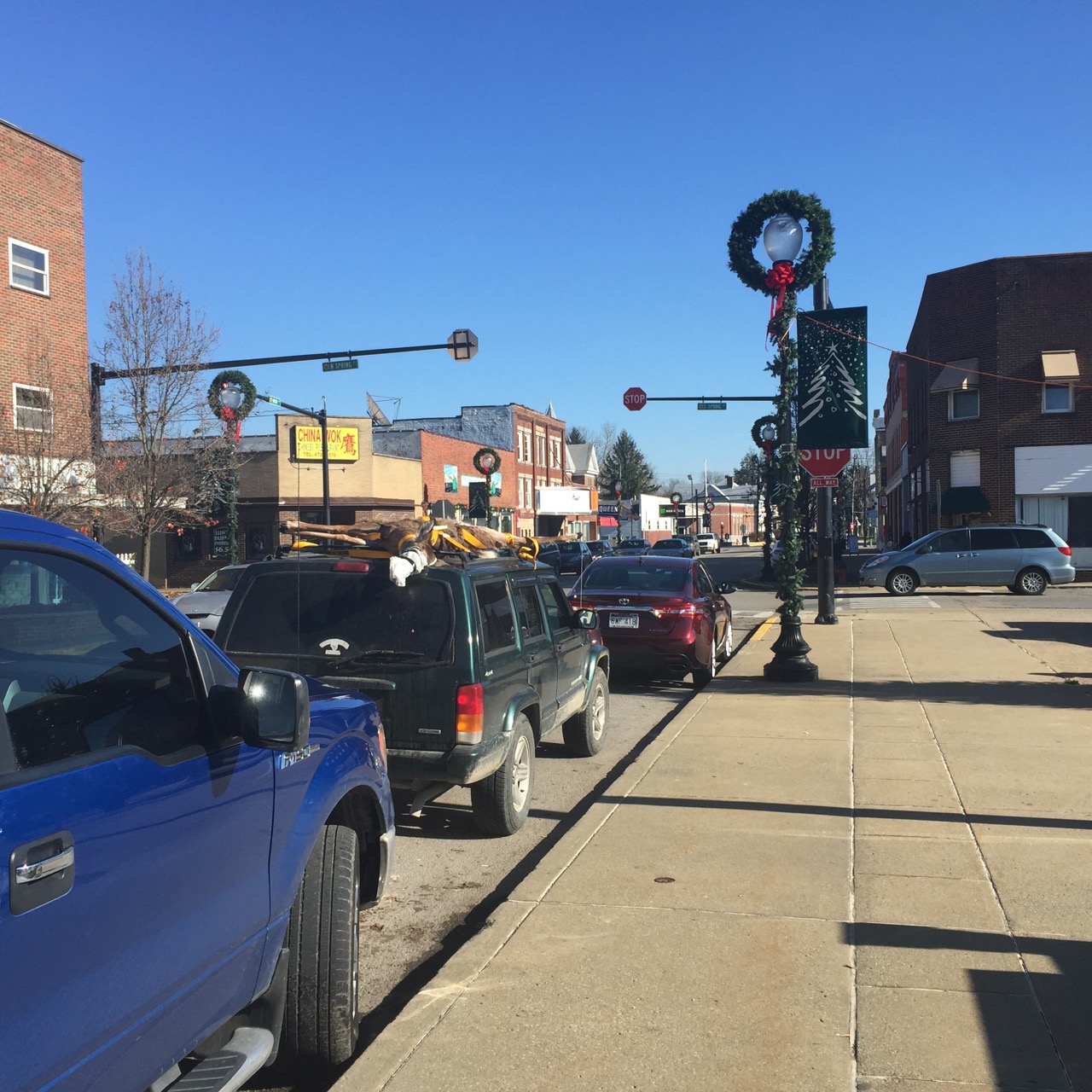
Friday we left Scott to do some heavy-duty skype meetings and work and enjoyed a day on the town, discovering gourmet coffee, main street, organic lunch, and a thousand poinsettias in a greenhouse at the local florists.  Points if you can pick out a very un-prancer detail that assures you the photo is a typical downtown view in central WV in early December.


Thanks to the friendly proprietor of Dough-Re-Mi (the apple tarts are worth the trip) we were alerted to the evening festivities, which we thought was a choral society singing carols but turned out to be a CHRISTMAS PARADE.  Yes, in the dark of midwinter, the frolicking of fire engines and baton twirlers and a marching band. (Note our bargain battery-powered flashing-light hats).


This is the cement truck that poured our pizza oven slab.

There were multiple girls on fire.

Selfie with Santa

Saturday Scott and I drove to Virginia for my Uncle Harold's 90th birthday party.  Out of 15 kids, there are only 3 siblings of my dad's still alive.  Uncle Harold was his business partner his entire adult life, and his closest-in-age brother.  It was well worth the drive (there and back because we didn't want to leave the parents too long) to hear him pray for all of us in the same phrases my dad would use, to delve into my cousin Doug's pig roast, to hug relatives I've only seen a few times in the last two decades, and to listen to excellent bluegrass music.  
 My cousin Doug, we share the same bday month and year and went to high school together
 Uncle Harold 
 Cousins


Today we invited our neighbors for dinner after church, then headed back into Buckhannon for the WVWC festival of Lessons and Carols.  This is the school where my parents met, and both graduated from there in the late 50's.  Scripture, carols, creative arrangements, and the tried and true of brass and organ and Hark the Herald.  All ending in filing out to light candles around a Christmas tree, and meet some people who knew my mom back in the day.  Christmas music is my jam.  This is the kind of event that I long for when I am in Africa.  So this was a true treat.


Tomorrow we're working on our seminars for Urbana, and all weekend between these events we've been working on a mailing to supporters.  We have security meetings and correspondence and writing assignments and many undone to-do's.  But tonight let's remember that in the face of a world gone awry, Christmas should be frolicsome.  Go frolic.

Friday, December 04, 2015

Dec 4: Remembering a Life Lost

December 4th is always a somber reminder for us, that as we enter the season of Advent the anticipation of Life is tangled in the anguish of death.  Eight years ago, on December 4th, our best friend in Uganda died of Ebola.  Dr. Jonah Kule had contracted the disease before we knew the mystery epidemic stemmed from a previously unknown form of the virus, and died in an isolation tent a few days later.  Those were dark hours in our lives, of grief and fear.  Even now, so many years later, I feel the weight of that loss for his wife Melen, his children, the district where he was a powerful symbol of hope and change, for the country of Uganda, for the Kingdom of God.  And for us.

That epidemic pales in comparison to the West African epidemic of 2014/15, but as humans the personal connection to loss cuts more deeply than the impersonal piling of numbers.  It takes one's breath away to think that each of the 11,300 deaths there feels as sorrowful to God and to their families as Jonah's has to us.

But that sorrow is the context in which the rescue of Christmas makes sense.  This is not a G-rated happy story.  This is war.  Behind the manger-scene there is an evil that steals life, and we worship a God who entered human flesh to win life back.

Tonight pray for Melen, and for Masika, Biira, Magga, Keren, Sarah and Jonah (Jr).  And as you think back in mourning, look forward in hope as well, hope of reunion, of the seed that died and the new life that has come since then, of a final victory where tears are no more.  Then let that sense of loss compel us all on to "not love our lives to the death" (Rev 12).  In memory.