rotating header

Sunday, September 25, 2016

Reviews of A Bird, A Girl, and A Rescue


Yesterday I gave you 10 reasons to get this book, which would feel embarrassingly self-serving except for reason #1.

Today, I offer the opinions of the initial reviewers.  The sales start tomorrow here and here.  

“A children’s book is a gem if it enables a child to journey into a bigger world, and a prize if it woos an adult to return to being a child. This book is an enthralling story that weaves myth, fantasy, and harsh truth about living in the world while also conveying what it means to become a person of character in a hostile terrain. As the father of two girls and two granddaughters, I am especially happy to have a story that magnifies the resilience, courage, savvy, and playfulness of a girl who embodies what it means to grow in wisdom. I love this story and can’t wait to read this prize to my grandchildren.”
Dan B. Allender, Professor of Counseling Psychology and Founding President, The Seattle School of Theology and Psychology


“Much of the beauty of fiction is its unique ability to transport us to places we have never been so we can enjoy experiences through the eyes, hands, and minds of fictional characters. J. A. Myhre’s novels invite boys and girls to embark on distinctly African adventures that are as exciting as they are instructive. I think your children—and perhaps also their parents—will love them.”
Tim Challies, Author; blogger at challies.com


A Bird, a Girl, and a Rescue by Jennifer Myhre captures life in an African school in vivid detail. A mysterious bird befriends Kiisa, the new girl in school, when she feels most alone. More than just a story about school and soccer and adventure, the book also explores universal themes like self-confidence, standing up for friends, and forgiveness. Worth reading for parents and kids alike.”
Shel Arensen, Editor of Old Africa magazine; author of nine children’s books.

“Jennifer Myhre’s grasp of God’s grace and gift of writing are a marriage made in heaven. A Bird, a Girl, and a Rescue—the second entry in her The Rwendigo Tales series—is a feast of imagination-fueling, heart-engaging, gospel storytelling. If Jennifer’s original audience was children and teenagers, then I’m not as old as my birth certificate indicates. I’ll recommend this book to friends of every age. Thank you, my sister, for giving us an honest, formula-free, reflection on the gospel of the kingdom, birthed from your own tears, journey, and hope-filled heart.”  
Scotty Smith, Teacher in Residence, West End Community Church, Nashville, TN


“Dr. Jennifer Myhre’s stories are birthed from the African outpost where her husband and family have shared their lives, skills, and hearts for the cause of the Christ. Each account, written so that her own family would embrace and rejoice in the power of the gospel, is told in engaging narrative fiction but also rings true with deep knowledge of the African experience and biblical hope for all nations.”
Bryan Chapell, Pastor, Grace Presbyterian Church, Peoria, IL


“Kids love adventure stories. A Bird, a Girl, and a Rescue will have them begging you to read the next chapter, and each one seemed to hold a surprise—a great family bedtime story.”
Marty Machowski, Family Pastor; author of The Ology, The Gospel Story Bible, Long Story Short, and other gospel-rich resources for families


“Having lived and worked in rural Africa for many years, I appreciate Jennifer’s poignant use of allegory to draw the reader into the wonder, beauty and sadness of life experienced by Kiisa. With vivid detail, you are quickly drawn into and captivated by Kiisa’s adventures. Don’t be fooled to think this is just a nice children’s book—it is a powerful read for anyone at any age.”
Bob Osborne, Executive Director, Serge


“The geography, tumult, and humanity of Africa loom large in this second installment in J. A. Myhre’s The Rwendigo Tales. Myhre ably brings to life for young adult readers the wild wonder of the continent, and so much more. As the reluctant boarding schoolgirl Kiisa takes a leap of faith, we join in her breathless rescue involving sacrifice and reconciliation—plus one fearless monkey.”
Mindy Belz, Senior editor, World magazine; author of They Say We Are Infidels


“After reading A Chameleon, a Boy, and a Quest, I was eagerly anticipating, and then very excited to see, the arrival of A Bird, a Girl, and a Rescue. Here is another delightful tale from Jennifer Myhre, full of adventure, surprise, and a wonderfully compelling picture of emerging friendship. There is plenty of excitement here to keep our full attention as we witness the awakening of bravery and the beauty of selflessness. A Bird, a Girl, and a Rescue both captivates and teaches. Find a cozy chair and enjoy!”
Mike Bullmore, Senior Pastor, CrossWay Community Church, Bristol, Wisconsin


“Another delightful gospel-tinged story from Jennifer Myhre. Her storytelling is enchanting. You won’t be disappointed!”
Paul E. Miller, Author of A Praying Life and A Loving Life

“Myhre’s delightful and fast-paced story brings readers to the unfamiliar to explore the familiar. It is spiritual without being religious; and important without being self-important. Myhre offers in both Kiisa and her father, Mugisa, compelling characters who model courage and humility and make us care about them and their choices; what happens in the story really matters (at many levels). This work of magical spiritual realism is true in the most important sense of that word.”
Matthew Dickerson, Author of the medieval historical novel The Rood and the Torc: The Song of Kristinge, Son of Finn and the fantasy novel The Gifted: Volume 1 of the Daegmon War, as well as numerous works about fantasy literature and ecology

Saturday, September 24, 2016

A Bird, A Girl, and A Rescue: 10 reasons to get this book


This is really happening, on Monday.

The second book in my Rwendigo Tales series is poised for release.  You can buy it from New Growth Press, where there will be a special deal of 30% off on the new book and 40% off on the dual purchase of both A Bird, A Girl, and a Rescue and A Chameleon, A Boy, and A Quest (book one).  Or you can buy it from Amazon.

Admittedly, the standard price of a book these days seems quite steep.  $15 for these high-quality illustrated paperbacks (without the discount . . . with it you pay $10 for one or $9 each for two); $28+ for brand new hardbacks (we didn't even go there).  It's an investment.

So why should anyone buy this book?  Here are 10 reasons.

10.  You have someone in your life in the 8-14 age range whom you love.  These books were written as Christmas-present family read-alouds when my kids were that age.  As a parent or grandparent or aunt or uncle or neighbor or teacher, we value a solid piece of writing that grabs our kids' imaginations.  And we value a birthday or Christmas gift that becomes a friend, that can be read and re-read and shared.

9.  You love words.  The vocabulary of the Rwendigo Tales pushes us a bit.  They are written with the confidence that kids want to be challenged and stretched.

8.  You love illustrations.  Acacia Masso, who grew up with our family and is now studying art at Arcadia University, created original line drawings for each chapter.


7.  You don't live in Africa, but you care about those who do.  Literature offers us the opportunity to love our neighbours as ourselves, the first step of which is to see them.  To be transported to a part of the world you would not otherwise experience is a gift.  A friend posted this review by Jeffery Overstreet of the movie Timbuktu that really resonated with this point:

Instead, I was inspired by the great Presbyterian minister Frederick Buechner, who in his book Whistling in the Dark reminds us of Jesus’ commandments:  "If we are to love our neighbors, before doing anything else we must see our neighbors. With our imagination as well as our eyes, that is to say like artists, we must see not just their faces, but the life behind and within their faces. Here it is love that is the frame we see them in."
Christians can choose to dwell on — and invest in — movies that show us what we already like, tell us what we already know, assure us of our own salvation, and make us feel happily entertained. That isn’t wrong. But might we make better use of our time? Might we exercise courage and conscience, step outside of our comfort zones, attend to our neighbors, and learn from their experiences?
6.  You do live in Africa, and there is a dearth of literature for kids that actually relates to their experience.  One gift of story is to communicate to a child that they are not alone, that there are others who have lived through challenges like theirs, that they are normal and there is hope.

5.  You look for stories with female leads.  Because half of humanity is female, after all.

4.  You appreciate encountering hard realities like human trafficking, and the connection between environmental exploitation and funding conflicts, but would prefer to do so in the context of a story.  This isn't just for children.  Most of the Bible is story too . . . we need truth, but we absorb it best when it comes to us connected to characters.

3.  You want to help your kids ponder how to live with bullies, how to face evil, how to forgive. This book does not shy away from violence on a personal and societal level, and the protagonist must search within her own soul to respond.

2.  You like a book grounded in historical events, but you're also open to a bit of magical realism.  This series subtly weaves both genres.  The climax event of A Bird, a Girl, and a Rescue actually happened not far from where we lived, when a rebel army invaded.  In the book, however, the spiritual world breaks into the material, and unexpected plot twists occur.  You have to read it to see.

1.  You believe in changing the stories that others may be trapped in.  I saved the best for last, because this is my favourite thing about the series and the reason I'm willing to beg you to buy it.  All of the above is true and worth your investment.  But if you need one more justification to spend so much money, it is this: half of all the royalties (the portion paid to me, not the portion the publisher retains to cover their own costs of printing and distribution) goes into a Rwendigo Fund that actually supports kids like the ones in the stories.  So you get a good book to read, and a girl on the other side of the world gets an education.  Here is the final page of the book, which explains the process:

Saturday, September 17, 2016

Haya Ni Maisha

Not sure this is the right Swahili, but I like the hash-tag Lauren on our Chogoria team uses, #thisislife.  It seems to express the normal day to day that can be taken for granted.  It can appear from a blog or a facebook account that one is habitually traversing ancient cathedrals or scenic mountaintops, when most days tend towards the mundane faithfulness of plugging along.

So, haya ni maisha yetu siku hizi (this is our life these days), since we returned from our Area Director meetings and found ourselves facing the next stretch.  Now there are no major trips or events standing between us and what we returned to Kenya to do, but we’re still in the in-between of transition.


Swahili
Being away for ten days was brutal, even though we did listen to our recordings for a half hour each evening after our meetings were over.  I found that entering Greece in Swahili-learning mode made me attuned to the Greek alphabet, to deciphering signs, to listening to and repeating greetings.  But that tapered over the week and by the time we came back to Kenya language learning required a significant effort to plunge back into.  Never the less, faithful Gideon has borne with us, and we are back to listening, conversing, discussing, reading.  Karen had the brilliant idea of using a photo collection of Labor and Delivery pictures from Uganda to increase our hospital vocabulary (see photo  above of us trying).  And this being the “Global Participator Approach” method, we’ve also spent some hours this week just absorbing some “haya ni maisha” stories, which remind us that this is about real people, with courage and love and a lot to teach those of us who have had easier lives.  For instance, a person who started excelling in later primary school because the first two years he was in school there was drought, so he never got any food before class and went to bed hungry each night . . . but in third grade the rains resumed so he could eat and by 4th grade he was first in his class of 70+ students (one teacher).  Or the fact that teachers would have all the students without shoes lie on the dirt floor of the classroom and cane their legs to motivate them to beg their parents for shoes, which one just accepted as normal life because one knew one’s parents could never afford shoes.  Or the fact that our teacher’s formal education ended in 9th grade when he fell asleep on the long bus ride with his school fees in his pocket, and awoke to find the money which his father had slaved to collect, gone.  There was no replacing it.  The way that a rain pattern, a theft, a broken bone, a hospital bill can irrevocably alter a life is eye opening.  And the reminder that we’re working at this language because we want to relate to real people keeps us going.


Housing
Evidently there is a crisis/change of law or something regarding Kenyan banking that is affecting our landlord’s ability to finish the house we had hoped to live in by the end of this month.  While I am still holding out hope for a possible miracle, we will be homeless in less than two weeks.  So next week we need to come up with some plan B’s.   After three months in a nice, but not OURS, house we were ready to settle, but it looks like God is stretching us again.  We’re praying for a place to rent short-term that would still be accessible to begin working in the hospital, and perhaps even be a boon for Swahili learning?


Work
Even though we’re not yet resuming our medical jobs, we’re still working hours each day after Swahili class to support our teams across East Africa.  This week my Bible reading included this paragraph in Acts 20 where Paul is taking leave of the leaders in Ephesus (Turkey!):
            Therefore take heed to yourselves and to all the flock, among which the Holy
Spirit has made you overseers, to shepherd the church of God which He purchased with His own blood.  For I know this, that after my departure savage wolves will come in among you, not sparing the flock.  Also from among yourselves men will rise up, speaking perverse things, to draw away the disciples after themselves.   . . . So now, brethren, I commend you to God and to the word of His grace, which is able to build you up and give you an inheritance among all those who are sanctified.
This passage leapt out to me the way that certain verses sometimes do.  We had just tried to study Psalm 23 in Swahili, so the shepherding is in the context of the reality that God is our Shepherd, we aren’t ultimately alone in this work of overseeing.  And the savage wolves hearken to two stories told this summer about Bundibugyo (where there are no animal wolves), a child’s dream and a praying healer’s vision, of evil in the form of a wolf.  Evil has tried to bite into us in several places in the last week, children’s health, mental health, dissension.  Scary stuff.  But the passage reminds us that those we serve have been purchased by Jesus’ own blood, that God’s grace assures us of ultimately a table of fellowship even if it is set in the shades of a deathly walk.


Team
While we are in Kijabe we continue to enjoy the friendship of this team, weekly morning prayer meetings together, weekly dinners and prayer times afterwards, informal opportunities for walks and talks.  This team labors in significant spots for the Kingdom.  Long hospital hours.  Setting policy.  Raising funds.  Counseling war-affected students.  Intervening for safety when kids start to fall apart.  Initiating and managing language programs.  Teaching English and statistics.  Watching out for each other.  It is a privilege to participate for this season.  Friday I was asked to cover a Public Health elective class for Seniors at RVA taught normally by our former Serge team mate Jennifer Chedester.  In spite of some computer glitches (!) I thoroughly enjoyed teaching the next generation of missionary/ngo workers about child survival.


Kids
And our own four kids are never far from our thoughts.  We rejoice in the occasional facetime chats, the photos we get, the text chains.  And in the context of savage wolves and perverse men, we thank God for the remarkable way all are thriving.  Life is not easy for them scattered to independence, and we long to be more present, but in the meantime we are grateful for ongoing prayers.  For the first, for wisdom, compassion, and perseverance in a challenging 3rd year of medical school where he is shining (and sweating, the boy works HARD).  For the second, weekly mercies as Infantry Basic Officer Leadership Course continues in days of trekking, orienteering, target practice, tactical lessons.  So far so good, but success always feels tenuous in that environment.  For the third, friendship and learning opportunities and reading speed and safety as she studies abroad, right now in India.  For the fourth, balance and wisdom and spiritual growth again as he plays on the rugby team, takes difficult engineering classes, and commits to quite a few activities.   They are all gems and we miss them terribly.


Souls
I keep drifting back to Psalm 119:32—
I will run the course of Your commandments,
For You shall enlarge my heart.

Missing kids, being homeless, struggling with language, and battling wolves . . all that can tend to make me want to shrink down into survival mode and pull in my heart to a firmly shielded state.  Pray that instead our hearts would keep growing.  Reaching a solidly middle-age verging-on-old phase of life does not preclude an expanding heart, a deepening of love, a growing in grace.  Praying we don’t become stodgy or bitter or defensive (I can see all three in myself) but rather we are transformed more and more to be like Jesus, courageous and risk-taking and meek as we run this course. (Or bike it, above).


There you have it, maisha in all it’s daily-ness. 

Tuesday, September 13, 2016

Two Days in Istanbul


A few months ago, traveling Turskish Air through Istanbul for a Serge meeting in Greece, as the least expensive option, sounded quite reasonable.  And having never been to Turkey, why not stretch the return connection for a weekend exploration?  That was before the wedding bombing and the Ataturk airport attack, before there was an attempted coup in July, before Turkey sent troops into Syria, before a summer in which hundreds of people died from terrible violence.  Oh, and did I mention that our return flight was on 9-11? 

Nevertheless, when your support account is only marginally on the positive side, once you buy tickets you want to honor them.  Turkey, like Kenya, has responded to the escalating risk with tightened security.  So on our way back from our meetings in Crete, we stopped over in Istanbul for 48 hours. 

And how thankful we are.  This is a world city, rich in history, diversity, commerce, life.  The helpful Turkish Airlines stocked the plane seat-pockets with a magazine-length explanation of the attempted coup.  Hour-by-hour logistics with compelling photos, extolling the resilience of the Turkish people who took to the streets, stopped the tanks, saved the day.  Reassuring, and inspiring in many ways.  The flight attendant asked us about prior visits, and seemed genuinely incredulous that this was our first.  How anyone who could afford an airline ticket had not been to Istanbul was beyond comprehension.  Whether it is the unbroken line of written history, a strong family connection to an admirable culture, or a Mediterranean bravado, in both Greece and Turkey there is a refreshing confidence that comes of being convinced they are the center of the world.

We arrived on a Friday evening just before sunset, and took the convenient and inexpensive bus service to Taksim Square.  This section of the city has been upgraded in the past century, providing a large open space that is the favored location for demonstrations, thankfully not at the time we arrived. From there we followed thousands of milling Friday-night locals, strolling down the nerve-cord of the city, a pedestrian mall that stretches a couple of miles from Taksim down to the Galata Tower.  Perky red carts sold roasted chestnuts and pretzels, aproned men hawked doner kebabs from their shop-fronts, dramatic ice cream sellers with long spoons delivered cones with a flourish.  Food, we learned, is a theatrical production.  Friends arm-in-arm, women in full hijab (rare) to women in shorts and tank tops, families pushing strollers, the full gamut of society.  The atmosphere was friendly, festive, alive.


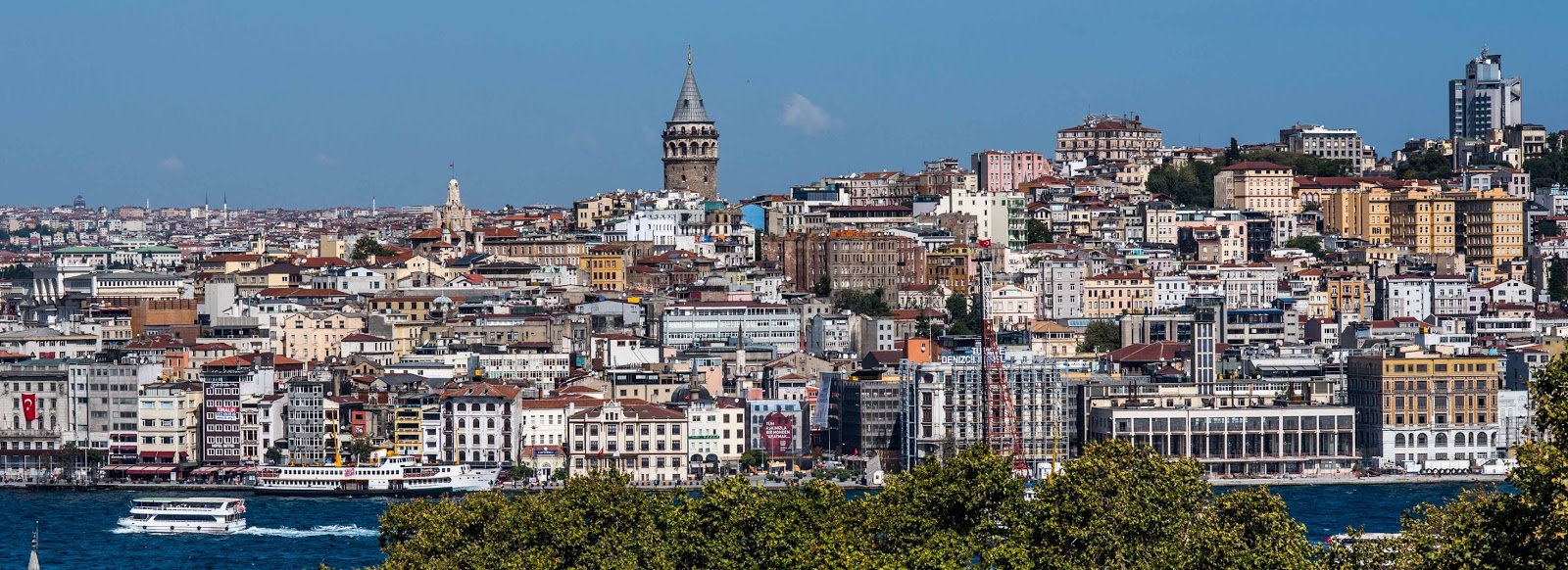
Our Airbnb turned out to be a tasteful refuge with 12-foot (or more) arched brick ceilings and a comfortable bed/bath/living room in the old Venetian district a block from the Galata Tower (Vildan's place, if you're looking).  The tower was built in 528, upgraded in the 1300’s, and several times since.  Originally a testament to Christ, then a fire-watch point, then a military base, now a tourist monument that is surrounded by artsy shops and small cafes.  Late dinner on a terrace in view of the tower, and we called it a day.

Day One
Saturday we walked the two miles or so across a bridge spanning  the “Golden Horn”  waterway and through narrow twisting cobblestone streets to the Sultanahmet district, the most historic area of the city.  We spent most of the morning at the Topkapi Palace, which is basically the equivalent of the Smithsonian museums.  Pottery and cauldrons from the 1400’s to the 1800’s are displayed in the kitchens, weaponry, clocks, calligraphy and other artifacts fill the rooms of this complex of buildings that once housed thousands of people.  There are spacious rose gardens, intricately tiled “kiosks”, throne rooms, and a harem.  One section is decidated to the most precious relics the Ottoman Empire collected:  pieces of Mohammed’s beard, his and his followers’ swords, not to mention the purported staff of Abraham, sword of David, and turban of Joseph, all displayed with reverence while an imam continuously reads aloud from the Qu’ran over loudspeakers. 


The Topkapi palace is situated adjacent to the Aya Sofya (Haggia Sophia), which was the largest cathedral of Christendom for a thousand years.  Completed in 536, the full name really refers to the 2nd person of the Trinity, the Holy Wisdom of God.  As we walked through, I thought of the chilling parallels to Rwanda in 1994:  when the Ottomans conquered the Byzantine empire in 1453, many Christians took refuge in this church and even attempted to continue services while the conquerors were allowed three days of unchecked rape and murder (which was not dissimilar to the actions of the Western European Crusaders in the two preceding centuries).  For the next half-millenium the Aya Sofya became a mosque, with many Biblical mosaics destroyed and Qu’ranic writings added.  But the secular state of Turkey decided to change the structure into a museum, so now one can see the juxtaposition of the Virgin Mary holding Jesus surrounded by Arabic script extolling Mohammed.  The massive scale, the span of history, the witness to suffering, and the mingling of East and West, Christian and Muslim, makes this spot of ground something like Jerusalem, a geographical confluence of spiritual significance. The mosaics which remain are haunting in their simplicity and timelessness.  Evidently even this place remains vulnerable to religious posturing though, as calls for a return of the structure to the Eastern Orthodox church have been met with a resumption of the call to prayer from the minarets for the first time in over a century.

The Ottomans were not satisfied with adding minarets to a cathedral, so a couple hundred years into their rule they also constructed the Sultan Ahmet Mosque across a fountained courtyard.  The scale is similarly vast, but here the interior remains unscathed, intricate patterns of mosaic with a blue predominance (hence the “Blue Mosque”).  Tourists are given long skirts, long tops, and skirts if any of those parts of their dress are lacking, and a plastic bag to hold their shoes, so they can enter the mosque even as non-tourists kneel and pray.  I am not an unbiased observer, but in spite of the beautiful tiles and domed architecture, this place lacked the gravity of the Aya Sofya for me.

By this time it was mid-afternoon, and after asking a few of the hawkers who stand in front of the dozens and dozens of small restaurants that spill into the streets, we located the one place showing Premier League football so we could eat a late lunch while watching the Manchester Darby.  Nothing like football to connect with locals; we and they were equally crushed by the match’s outcome.


We chose a route to walk back that took us through the Grand Bazaar, a remarkably clean and orderly maze of small shops under a roof that spans several blocks, selling carpets, ceramics, clothes, shoes, towels, kitschy tourist junk, artwork, belts, you name it.  Then through the “Egyptian Bazaar” which is outdoor and more basic, wooden spoons and charcoal stoves and rope and suitcases and rather like Owino in Kampala. 

For dinner, we checked yelp to find Karakoy Lokantasi, which was packed with locals, a 12 minute walk to the waterfront, and delicious.  Certainly the above tour could have been stretched over several days, but the cluster of history we saw is certainly accessible in one or two days with a bit of walking.  We bought individual tickets to the palace, Aya Sofya, and Galata Tower, but it was only a couple dollars more to have just bought the Istanbul pass and in retrospect that would have been simpler.

Day Two
Sunday we set out to sample one of the two coffee-roaster-café’s we had noticed in the neighborhood.  Only one was open, so we sat down for a much-appreciated cappuccino (though the chocolate croissant was acutally just nutella spread on a croissant).  Our walk to church was quick, so we had time for a second more authentic Turkish coffee (thick strong rich espresso - but the bottom third is a thick sludge which necessitates the small glass of water for the post-coffee rinse) with variations on pistachio/filo/honey pastries.  The English-speaking service we attended has been held since 1857 in the chapel of the Dutch embassy—a small collection of international workers who worship together and reach out to immigrants. 

Since most of the historic sites are on the European side of the Bosporus, we had yet to cross to the Asian half of the city.   short walk to the waterside again took us to the ferry, which serves as public transport, so for just over a dollar apiece we enjoyed the brisk winds and scenic perspectives across the strait.  On the other side we found another neighborhood of narrow streets and bustling shops, persuaded after a few blocks to sit at sidewalk tables next to a display of freshly caught fish while a sea bass was grilled just for us.  Back to the ferry landing, and we secured a return trip on the top deck, with views of the old train terminal (built to help pilgrims complete the Haj), massive stacks of shipping containers at the port, scores of boats going about their business, the bridge which spans the two continents, and the sprawling silhouette of Istanbul punctuated by domed mosques with their slender minarets, and modern skyscrapers.

Our last visit was to the top of the Galata Tower for its 360-degree city view, and then it was time to return to the airport.  Rather than lug our now bursting carry-on bags to the metro or bus (yes, I fit a new bedspread in my handy North Face small duffel) we splurged for a $20 taxi back to the airport.  Which was about as entertaining as any other aspect of our 48 hours.  First, there were no functional seat-belts, but our affable driver assured us that his stingy boss was about to upgrade him to a better car so we shouldn’t worry that this one looked so old, he’d just drive slowly.  Or not.  As soon as he determined we were Americans, he began to gush about George Bush.  “Oh, George Bush!  Like Rambo!”.  Did we know George Bush?  Well, we explained the president now is Barak Obama.  “Oh, Obama, he (incomprensible Turkish word).  You know (incomprehensible Turkish word)?”  No, we didn’t, but no problem, as he sped through intersections he spoke into his mobile phone to Google Translate....which rendered the English translation:“Funky!  Obama he Funky!  You know this word Funky?”  Which goes to show that a lot of politics is perspective. If you border Iraq and Syria, you might prefer Rambo as your president.

In spite of the inauspicious confluence of 9-11's 15th anniversary, a war in Syria, an American connection to the purported mastermind of the coup last month, and the eve of the Eid al-Adha, the holiest festival of Islam which signals the end of the Hajj and the commemoration of Abraham's near-sacrifice of (in Muslim teaching) Ishmael . . . we felt at peace in Istanbul, surrounded by that majority of people in most places whose concerns lie more with family, business, health, and life than with harming others.

So, we left wishing Turkey well.  It is no small task to be attempting an integration of Muslim faith and Greco-Roman-Byzantine heritage, of a thriving trade and European influence alongside ancient near-Eastern values.  To placate neighbors who do not tolerate tolerance to the east, and neighbors who do not tolerate intolerance the west.  To embrace education for women and allow freedom for some to choose the hijab.  Istanbul is a microcosm of today’s world, and if they can figure it out, there’s hope for all of us.