rotating header

Tuesday, November 01, 2016

Litein Hospital and the Kabarak Family Medicine Residency Program

Litein Hospital began as a western Kenyan AIM mission outpost amongst the Kipsigis people in 1924, with a slowly growing medical and community health ministry since 1932.  We were invited to visit with potential new missionaries, and I have to say the visit was extremely encouraging.  Pictured above, the old hospital which is now a training school for nurses and lab technicians.  

Here are a dozen reasons that we would like to see a new Serge team in Litein:


1.  A long faithful track record by senior Kenyan staff.  Dr. Munala, the medical director, came in 1990.  26 years later, he's presenting the new Vision and Mission statements to us, with a strategic plan for growth.  The Hospital Director has been working persistently since 1979.  But these men aren't done.  They are dreaming big.


2.  In the 15 years since missionaries were last involved, the Kenyans built a brand new 150-bed modernized hospital.  To serve their own people better.  They aren't waiting for others to do things for them.  This is a place where true partnership is possible.

3.  This year, they hired a newly-trained PAACS surgeon (the Christian surgery training program that Kijabe and Tenwek participate in).  Dr. Blasto inspired us with his passion for teaching and excellence.  He wants to pour into the younger trainees in the same way he was mentored by missionaries.  He's a leader we would love to work with.


4.  A strong foundation of compassion and commitment.  The spirit here was palpably different than we've seen in many places.  These people take Jesus' words seriously.  One of their core values is to NOT TURN ANY PATIENT AWAY, based on John 6:37 (All that the Father gives me will come to me, and whoever comes to me I will never cast out).  


5.  Bright, ventilated, well-maintained spaces.  The new building has been used for about 7 years now, and we liked the design of the wards, the cleanliness and openness.  Also if you look closely, there are VITAL SIGN charts on the beds, with actual vital signs recorded.  The theatres are spiff, and thanks to one of the Kijabe-trained Nurse Anesthetists who went out and asked and advocated, they have some good equipment.


6.  Boldness to push the limits.  This HDU (high dependency unit)  has two monitored beds, oxygen, even a simple ventilator.  The man under the pink blanket had been saved by an emergency thoracotomy (open the chest) surgery the night before, when he came in with an arrow sticking out of his chest.  The tip went right into his left ventricle.  Most places he would have died.  But he was recovering well, thanks to quick surgical care.

7.  Opportunities to teach.  This is a class of nursing students.  There are 7 Medical Officer Interns (just finished med school, so young doctors) and 10 Clinical Officer interns (equivalent of PA).  The vision is to place two Family Medicine Residents here as well.  As the interns introduced themselves, over and over they asked for teachers to come and work with them.  They want to become good doctors.
8.  Medical needs.  The hospital was bustling.  We saw full wards, patients waiting to be seen, education going on, immunizations being given, specialty services like dental and ophthalmology.  Nearby government facilities refer to Litein.  There is a long history of community involvement and outreach, so the patients know and trust the place. 


9.  Wisdom and innovation.  These two run the OVC (orphans and vulnerable children) program.  Instead of collecting more kids into the nearby orphanage, they monitor them within their extended family, providing nutrition, school fees, psychosocial support.  This is great, evidence-based, truly helpful care.  Next door on this hallway there is a nurse doing a study on the impact that ARV's are having on quality of life for people living with AIDS.


10.  Climate and community.  Though the housing hasn't had an upgrade since the 1940's . . . there is space and will to do so.  The elevation means pleasant days and cool nights, surrounded by rolling green hills and tea fields.  It's a moderate town in a rural area, but accessible to Nakuru (where there is a Java house and shopping).

11.  Broader East/Central Africa impact.  Here Scott talks to Gad from Burundi and Musa from Eastern Congo, two of the poorest and least healthy places on earth.  The residents who will train at Litein are not just from Kenya, but from even needier places.


12.  Being part of the future of medicine in Africa.  Less than a quarter of medical school graduates have the opportunity for training beyond internship.  Yet only a year of internship, much of that in places poorly equipped for supervision, does not adequately prepare doctors for the breadth and depth of skill they need.  The Kabarak Family Medicine Residency is a pioneer effort to give young doctors four more years of intensive education and supervision, so they will be equipped to handle the majority of medical care (broad hospitalists), have a solid foundation in discipleship as servant-leaders, and gain a holistic view of working with people and communities.  Right now our teams in Kijabe and Chogoria are part of this program, but we need more clinical sites.  Litein seems ideal.

Though there are many logical reasons this makes sense, we ask you to pray for God's leading.  Particularly for the young couple who visited with us, for clarity.  And for team mates if they are to come.  We do see some of those fingerprints of God as we look forward.  As we drove in, it dawned on me that I had prayed for Litein because former OPC missionaries Lois Ooms and Dr. Griet Rietkerk worked there for a period of time.  Dr. Rietkerk was the woman whose talk to my church's Pioneer Girls group when I was 8, about medical missions in Eritrea and Kenya, God used to grab my own heart.  So in realising that this was a place she had worked, and meeting some of those she had worked with, more than 4 decades later . . . well, we sensed God's smile.  

We could use primary school teachers, family medicine doctors, nursing professors, pastor/chaplains, OB/GYN's, hospital administration or resource-mobilization types.  Give us a message if this post stirs your interest.

Saturday, October 29, 2016

Kenya on a Saturday

A perk of being an Area Director:  we sometimes get to host potential new missionaries, people who have sensed God prodding them to consider the broader needs of the world, and take their own time and money to visit our teams.  This is pretty great on several levels.  Connecting with people walking the paths we stepped onto 25 years ago (we went through Assessment and Orientation in October of 1991) puts some meaning to a lifetime of struggles and joys and mistakes, and when we find so much in common it makes us feel less peculiar.  We rejoice in potential saving grace pouring into lives on both sides of the oceans.  And we get a great excuse to show off the beauty of Kenya on a Saturday.

The next four days we'll be with a doctor-doctor couple from Mississippi.  We've already found some amazing parallels in our stories.  Today we took them around Naivasha District Hospital, to Java House for amazing Kenyan coffee, then out to Crescent Island, a local private wildlife sanctuary.  (Extra benefit:  coffee and sunshine both cure jet lag).   Here are Scott's photos of the afternoon, to bring beauty into your day as well, to remember the creativity of God, and to prompt the next exploratory vision trip for more Sergers.


Thursday, October 27, 2016

Thursday by the numbers


80-90:  The number of inpatients on our daily rounds this
 week, at least the couple of days I tried to count.  It's pretty challenging to even see, let alone think carefully about that many, particularly when they are filtered through trainees, or don't have vital signs, or are crowded two to a bed.  About 2/3 are in the Newborn Unit, which is not exactly a NICU, but aspires to be.  It takes a lot of stamina and patience to plow through this many patients, and supernatural intervention to identify the handful who truly need attention to survive.  One thing we're trying to model:  at the end of each section, look back and think, who is the sickest here?  Today's choice had been with us for days and just wasn't better.  We checked a malaria smear. Positive.  Oh.  Prayers appreciated that in the onslaught, we would be alert to potentially crucial diagnoses.

1143 umol/l (13 mg/dl):  a very high creatinine, which means very poor kidney function.  Babies who fail to breast feed well sometimes show up at about 2 weeks of age with dehydration, looking shriveled and yellow and lethargic.  This one got into trouble right under our nose, as his mom stayed admitted for an infected wound after her C-section.  I found baby J convulsing because he was no longer breathing effectively, he was infected, sick, feverish, wasted, hadn't passed any urine in a day or two, and nearly dead, having lost almost a third of his body weight.  A week later we aren't out of the woods, but in spite of trying to treat this ICU-level sickness with limited resources, he's alive.  This is one of the few moms I've been able to pray with, and I'm really pulling for her.


 3 in 3 weeks:  the number of confirmed new TB diagnoses found on Paediatrics.  The first was the girl with the drooping face whose morning headaches and vomiting led us to suspect something more sinister than a Bell's palsy, whose mom overheard me talking about Neurosurgery at Kijabe, checked herself out and went there just as the visiting team was wrapping up, and had emergency surgery to relieve the pressure in her brain caused by a tuberculoma.  The second was a preemie I found here as I started, somehow during the strike the baby's very sick mother was transferred to Kenyatta but the baby stayed with us.  Though the mom's diagnosis was uncertain, she was discharged on TB meds so I decided to put the baby on prophylactic treatment.  Just as baby A was reaching a 2 kg potential for discharge, the nurses noted a suspicious lymph node.  Sure enough, a biopsy proved TB, perhaps congenital which is pretty unusual.  It's tricky to manage medication for someone that small, but we're treating her.  The third was a 12 year old admitted late Sunday night.  I happened to be there for another problem, and heard we had a new patient vomiting blood so I thought I should take a look.  A quick exam revealed her problem was in her lungs, not her stomach (see xray).  She was big enough to cough a sputum for us confirming the diagnosis.  There are many many challenges at Naivasha Sub-County Hospital, but we have a very key piece of laboratory equipment called Gene Expert that detects TB very effectively.  I love it.  This is a fatal disease if untreated, and a curable one if found.  Very satisfying.

19:  number of reported deaths last month on our service.  I feel like I saw a little dead body, or heard about a baby passing away, about 2 days out of 3 so far, so that rings true.  It also explains how hard it is emotionally to respond to that level of loss, and to keep believing we can make a difference, and to care.  But kudos to my partner here, we had a mortality review meeting which was inefficiently long and painful, but productive.  We identified some issues that I've already seen improve.  In the last week I've turned a little corner where I'm suddenly being called more. The up side is that sometimes I can help.  The down side is being actually present for more deaths when I can't.  I miss working in a place with chaplains.

53: number of pages in the 2016 Kenya Paediatric Protocol, that I had printed and laminated and taped up to walls all over this place.  Kenya really is impressive sometimes, and this protocol is one of those places where this country takes a lead.  It is practical, evidence-based, thorough, and gives us a standard of care.


45:  number of moms I counted when I showed up early one morning, and found they have their own singing, devotions, and prayer.  I can't say how encouraging it was to stumble upon the mothers inviting Jesus into the nursery, each praying for her baby.  We may not have any actually functional equipment (except one monitor that works, and one incubator that heats, and a couple of oxygen concentrators whose output is split and shared by a dozen babies, the rest is just a graveyard of junk that is useful as a cupboard or a table), we may only have 1 or 2 nurses per shift for 50-60 babies, we may have demoralised doctors and government squabbles . . . but we have praying moms.  So there's hope.


6:12.  The verse in Ephesians that changed my day.  Yesterday I was back at the proverbial end of my rope of frustration.  This morning this verse smacked me right in the face:  our struggle is not against flesh and blood human beings, it is against the system that grinds them down, the corruption, the evil, the dysfunction, the microbes, the despair.  I SO NEED PRAYER to remember this, to not blame a trainee for laziness, to not snap at a lab person when a sample is lost.  Somehow the re-set to my own heart made for a better day, some laughing, some teaching.  Part of my bang-head-against-wall melt down the day before was over the passive-aggressive failure to get some critical blood transfusions done . . and last night the intern managed to swing all three.  So by GRACE alone I went to the lab today to thank them, to fill in the clinical scenarios, to give them a sense of partnership in lives saved.  Much more fun than complaining.  Maybe I should try it more often.  A trusted Kenyan friend reminded me that the way to make change is by making friends.  I believe Jesus would say the same.  Please pray for us to humbly and kindly remember that, for the Spirit to smooth over our failures, and for true relational building to bring about better care.

Sunday, October 23, 2016

Aberdares


Saturday morning we wended our way through farm roads, past sheep and cows and dusty cornfields and painted dukas, up the Rift Valley escarpment, higher and higher, into the Aberdares.  Our google-map shortcut from Naivasha (NOT, this time we were betrayed) finally spit us out at the base of the mountains.  In spite of many camping trips here in the past, we never managed to time it right to climb to the Ol Donyo Lesatima peak, the third highest point in Kenya (after Mt. Kenya and Mt. Elgon).  In theory, the bulk of the ascent occurs by road (up to 10,000 feet or so) so the final peak climb (to 13,000ft/4001M) is do-able in a day.  But as you can see above, we were thwarted once again by roadwork within the park. Massive lorries lay down piles of "hard-core" which will eventually be spread out, but at the moment form an impenetrable block.  

Not to be totally defeated after our 3.5 hour driving investment, we confirmed with a lorry driver that we could park off the road and not be boxed in (thanks to our Swahili program, we caught that it was "sawa" to be "hapo" "mpaka" Monday . . . until Monday.  Google maps once again, estimated that parking and walking the rest of the way to the trailhead would add 3 miles so about an hour to our hike.  Seemed reasonable.


Roadwork is progressing from both ends, so the section we hiked was completely silent.  No cars.  No people.  As thunder rolled and echoed around the hills, we stopped and listened in between rumblings.  Silence.  Beauty.


We saw buffalo, reedbuck, duiker, colobus monkey, another antelope I'm not sure of.  Leopard tracks in the dust.  Elephant droppings.  We walked.  And walked.  After 2-plus hours we were sure we'd come at least 5 miles, but were no where near the trailhead.  So we lunched on our honey-covered cashews and apples, and turned back, reaching the car just as the clouds let loose a burst of hail.  The austere beauty, the thin-air elevation (10-11 K ft), the changing sky, conversation, isolation . . . wonderful.  As we drove out, we stopped to look at the Chania Falls where we've often camped before.


There is a majesty to the alpine ecosystem that may explain why God often calls people upwards to meet with them.  We're thankful to be within driving distance of protected wilderness, thankful for the people who work to keep this place pristine, thankful to be witnesses to the wonders.  Next time, coming to camp the night before, and reaching the peak . . . 

Friday, October 21, 2016

On Heroes, Beast's Bellies, and Better Days

Tuesday was a hard day, a beat-your-head-against-the-wall kind of hard day.  It seems for me, a wall unmoved by head-banging futility must be necessary to remember the Truth:  the way up first goes down.

Because as the week winds down, the light is breaking through.  Time, pause, perspective, prayer, and some thought-provoking reading about the Cross.  Rohr reminds us that the sign Jesus mentioned was the sign of Jonah.  But who wants to be swallowed by a whale??

We seldom go freely into the belly of the beast.  Unless we face a major disaster, such as the death of a friend or spouse or the loss of a marriage or job, we usually will not go there.  As a culture, we have to be taught the language of descent because we are by training capitalists and accumulators.  . .We would prefer clear and easy answers, but questions hold the greatest potential for opening us to transformation.  . We Christians are given the privilege to name the mystery--as the path of descent, the Way of the Cross, or the paschal mystery.. . If that isn't saying you win by losing, what is it going to take for us to get the message?  How often do we have to look at the Crucified and miss the point?  Life is all about winning by losing--losing with grace and letting our losses teach and transform us.  And yes, this is somehow saying that God suffers--and our suffering is also God's suffering, and God's suffering is ours (Col 1:24).  That has the power to transform the human dilemma  . . 

So we will muck on in the dark, trusting that being wrong, stubborn, foolish, stumbling missionaries is a paradoxical road to glory.

And as we moan over our pitifully small sufferings, we also look up to see daylight shining through.  Pretty much every day, we can see opportunities to save a life.  In spite of my impatient mouth, my team is growing to trust and listen.  We're enjoying the seeds of friendships with colleagues.  The last couple days have included some fun moments:  teaching trainees to do procedures like a lumbar puncture, walking them through a resuscitation, seeing the effect of giving glucose to a baby who wakes up from a convulsing coma, brainstorming together about how to get something done.  Almost every morning I find out about a death of some infant, which is still bewilderingly hard.  But almost every day there's a death averted, or several.  We got feedback this week that the sweet 8-year-old "M" who went to Kijabe for a head CT after her neurologic status slipped, was confirmed to have TB in her brain, not a tumor.  She should recover.  The starving, semi-abandoned 5-year-old "C" greets us every morning with a heart-melting smile, the difference food makes as her swollen face transforms from listlessness to joy.  My first Man-U-named patient Martial, a former preemie who came in malnourished, is perking up too.  A Serge team family who came to Kenya for medical care for their baby, now improving, finally thriving (and thanks to prayer, all four kids we were very concerned about a few weeks ago on our teams have turned corners towards health!).
"C"

"M" 
Pray for "J" who is still quite ill
The fun side of being Area Directors: breakfast with visiting team
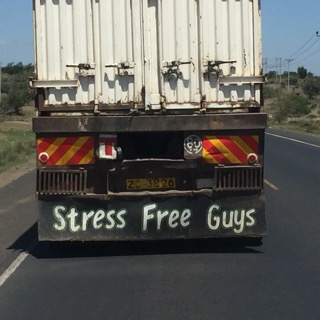
(and when you can't see hope in patient improvement, there's always trucks on the road to encourage you)

This week Kenya celebrated Heroes' Day.  Which leads us to think about who the true heroes are.  The volunteer that is feeding "C", and showing her the healing love her short life has lacked.  The interns who write up five, or ten, or twenty new admissions in a night.  The nurses who scurry around finding tubing and ceftriaxone and 50% dextrose and syringes as we work on a baby.  My own kids, bravely forging ahead in unfamiliar places, running miles upon miles with heavy packs, learning about mental illness in prisons, pouring into the newer students around them, navigating uncertain futures.  Our teams, facing corruption and danger and suffering.  All the unseen people at our elbows, willingly walking a descending, cross-like path, for the good of others.
Heroes' Day Parade

And of course, my personal hero, living in this dorm-room-like life, walking into chaos unsure of our welcome or role, making Swahili mistakes, figuring out how to live in a new (and lower) station in life.
(scrubs washed by hand each morning, strung on balcony)

(Heroes' Day TREAT)

(Longonot Rim a week ago)

(Quick evening bike ride, less than a mile from town)

Friday evening, at last, and the Truth holds:  Heroes get swallowed, and crucified, and emptied, and stressed.  But glory follows descent, light comes through the clouds, and Love always wins.


Tuesday, October 18, 2016

When Words Become Walls

Today I hit the proverbial wall, and reflecting on why, I think much of it was miscommunication.  Words were meant to connect us. Word can be synonymous with Love, with the extension of self to another person.  (The Word become flesh, and dwelt among us).

But when you're working in a new place and new language, perhaps words can do more to exclude than to connect.  We don't even know many people here, but the two young women who work in the guest house are two of the few we see daily.  So when one called in the pounding rain asking me to see her sick children, I thought I was helping by hurrying back to the guest house, only she had brought them to the hospital.  Communication fail.  She was very frustrated with me.  I felt terrible.

Yesterday I made many phone calls thinking I was connecting with the myriad of people who were involved in a particularly sick patient's care.  This boy had landed in the ward after a public hospital administrator from an underserved eastern region of Kenya somehow connected with a visiting team of Texas doctors who would be working nearby . . and loaded 50-some cardiac patients on a bus across the country to see the cardiologist, hoping some kids might be chosen for free surgical trips to America.  It was a news splash in the paper, and medically kind of crazily haphazard, and not surprisingly one of the kids was so sick he didn't make it to the visiting doctors and landed instead with us.  I am not going to belabor the ins and outs of who said what, but after much effort we got him a space at Kijabe (where the visitors were headed today) and an ambulance to take him there.  Sorted.  Only I walked into the ward this morning, and there he still was with his dyspnic breaths and distended abdomen.  The uncle insisted that he was waiting there because the regional doctor who brought the kids to our town told him to do so; the regional doctor however insisted that the uncle refused to go to Kijabe.  Who knows?  It took more people and hours to sort it all out with the regional doctor insisting he would take over and take the patient back where they came from . . . only for me to get a call two hours later from Kijabe saying they landed there anyway.  So many conversations and versions of why things did or didn't happen, all to land right back where they were supposed to be, only 24 hours later.

Then there was the lab result that was days late.  Thinking I could show how it's done, I went to track it down (TB test results for a pretty sick malnourished child, so important).  IN THE VERY LAB where the tests are done, the people doing the work told me directly that though they had seen the paperwork there was no sample.  The intern was positive he had taken it there.  I went to find out where it could have disappeared to . . . and found another lab worker who said the sample was IN THE MACHINE at that moment, the machine the first two were using.  OK, maybe that sounds simple, but again multiple people, enquiries, time, resulting in confusing and contradictory stories.

Or the one moment I thought maybe I was helping teach some people, taking extra time on a 10 year old with a hemoglobin of 3 to teach physical exam points (hear the gallop?  Feel the spleen?) and list a differential.  We discussed the work up.  We ordered some tests to be done on the patient's blood before the life-saving blood transfusion.  But they weren't.  And the trainees looked at me and said, "you never explained that we had to do that".  Obviously what I thought I said wasn't what was heard.

Maybe all this sounds trivial, but when it stacks up in a day, when everywhere you turn you're in the dark . . . it's words making a wall that isolates rather than a bridge that connects.  And I wish I could say that I patiently endured, and gently sought understanding.  Oh no, I did not.  It was not a shining missionary day.  I complained.  I criticized.  I pointed out gaps.  I begged.  I badgered.  I knocked on that wall with a sledge hammer instead of looking for the keyhole.  Pretty much a failure day, for sure.

So, maybe the wall will add a layer tomorrow when I face the consequences of today.   Prayers appreciated that instead grace will seep in, somehow, that the damage won't be irrecoverable.  I am not enough for this transformation.  When words walled me out, I forgot the cross, the way of suffering, the way of love.  Ironically, the final exclusion came from the regional doctor team who arrived in their ambulance, and refused to shake my hand as I greeted them.  I had forgotten how dehumanizing it is, the infidel-foreign-female-leperousness too impure to touch in a handshake.  My awkward hand, hanging in the air, untaken, the perfect symbol of a day gone wrong.  Reaching out but ineffective, a gap not crossed.  

Tonight we're both tired, tired of wandering into a maze of uncertainty where we're not understood and don't understand.  I know we should read our own cheery blog posts on how to cope.  Perhaps we cam start to survive by communicating with the one other person we get, each other.  As Scott was doing other things in Labor and Delivery he took note of a nursing student trying to assess a mother in labor, and saw that the fetal heart rate was stressfully high.  Upon further assessment he realized the baby was in danger, and the mom would need an emergency C-section, added to an already busy theatre day.  As he wheeled her into the operating theatre, he texted me while I was on rounds.  In this hospital it is not standard care for the peds team to come into the operating theatre, but Scott realized the baby was going to need more care than the nursing student assisting him could offer.  Come in 15 minutes, the text said.  So I tried to sort out the preemies I was rounding on then walked over.  Due to the fact that this isn't done, I couldn't get anyone's attention, so I had to walk in barefoot, no gloves, no mask, no gown . . . to find the limp baby with a barely detectable heart rate and no breathing, her mouth full of a bulb sucker.  Oh well.  I tried to teach the nursing student what to do as we gave the baby breaths, and watched her come to life.  Apgar 2 at the first minute as I arrived, and then 8 and then 9.  Yeah.  If words in a text, words of explanation and instruction while working on a baby, could bring life in those five minutes of the day, maybe there's hope.