rotating header

Friday, March 02, 2018

Jack Myhre, a 20 year journey

Twenty years ago today, God gave us one of the greatest gifts of our life.  We had evacuated from war in Uganda, and were taking refuge working at Kijabe.  Scott was my OB (not our preference but choices were limited) and after months of displacement, illness, terror, uncertainty . . a healthy big baby boy joined our lives.
(The weight of responsibility seems to be sinking in for big brother Luke. . )
Back in Uganda, his baptism party descended into a tribal conflict, his first birthday party Scott missed because he had a potentially fatal infection, and we spent the next few years of his life trying to hold on in spite of frequent temporary evacuations.

Grammy and Grampy came to visit


The "balongo" (twins) . . these two have stuck together through thick and thin for 20 years.
And so he grew up, playing football every day, fiercely determined to do anything his big siblings did, riding a bike with no hands and running miles and reading everything in sight.  He said the deepest things, big thoughts, tender heart, a "great dane who thinks he's a lap dog" a friend once said and that summed him up.

Fearless and funny, loud and boisterous, a "one-man tomato".  Until one day he was taller than the rest of us and playing three varsity sports and debating in MUN and surrounded by a diverse group of great friends from all over the world.


And then he was graduating and heading out of Africa to go to school in America for the first time.

God's last-minute provision of an amazing scholarship allowed him to join Julia at Duke, for which we are ever grateful.  More sports with club football and rugby, more studies with engineering, more fun with intramurals and motorsports and Cameron Craziness, more friends and fellowship.


Which brings us up to this 20th birthday.  This is a young man who is . . . . 
A scholar and a gentleman
A gifted artist
A creative cook and barista
An athlete playing in a rugby tournament today (praying for MY birthday gift, no injuries please!)
A loyal loving little brother


And a delightful son to us his parents and to the many others who have helped us raise him.

As you can tell from all the photos, another birthday apart makes us miss him even more.  Today he'll be playing on the Duke men's club rugby 7's team in a tournament, and serving as the official Duke yearbook photographer at the Duke-UNC basketball game.  Happy Birthday Jack.  We love you.

Watch out world.  Here he comes.


Tuesday, February 27, 2018

CSM, 23 years of faith

Ours, that is. Well before he was born, with our history of loss and preterm labor, living in the era of no phone coverage/power/running water/paved road/post office for hours in any direction . . .  we had to cling to faith in the goodness of God without a guaranteed outcome.  Our first flight out on the new airstrip was to get to Kijabe for what we thought was an imminent slightly preterm birth, only to wait until within 12 hours of his due date.
(back at Kijabe exactly three years later for Jack's birth)

This child.  Some serious life-threatening illnesses.  Some evacuations.  Some tragic injuries.  Well before being deployed to Afghanistan, he brought stretching challenges into our life, time and time again.  The juxtaposition of loving someone so much, and not being able to control the circumstances around him at all.  
Friends and a dog and a sandpile and mango tree and soccer ball.  That pretty much filled the days.


From the beginning he was adventurous and affectionate.  He tuned into music. He loved airplanes and tech and guitars and computers.  He was fierce when provoked, but could also be happy for hours alone.
These two.  What a bond of loyalty and understanding.
These two (note the progression to wear the bigger shirt . . I guess we didn't have many or always took photos in the nice shirts sent by grandparents), surviving the squeeze in the middle, very much alike in many ways.
These two.  Bonding even more as they grow up, similarly strong and independent, after an epic backpacking adventure.

This kid.  We proudly celebrated his graduation from the US Air Force Academy.

His commissioning as a 2nd Lt into the US Army.


And . . his successful completion of Infantry Basic Officer Leadership Course and Ranger School. 


This boy.  Yes, he's been pushing us towards faith from the time he was in utero, right up to today.  We are grateful to be the parents of such a young man, who quietly strides into the hardest path possible at every turn it seems.  He cares deeply for his friends and family, he strives intently to become a leader of integrity and skill, he works to build strength and wisdom, he never complains.  In the course of building our faith, he's developed his own, and for that we are even more grateful.

We wish him Happy Birthday on the 28th, and a clear sense of God's mercy and grace in a hard place.


Sunday, February 25, 2018

Bundibugyo: a tattered fray, and glimpses of grace

Serge's tag line: Grace at the Fray.  We're called to be that stitch that binds the unraveling edge.  We're called to pour our lives into leaking pots fractured by evil, until the glory of God fills the earth like the waters fill the sea.  The problem with fray and fracture is that those are taxing places to live.  They are hard to get to, or hot, or dangerous, or corrupt, or exhausting, or crowded.

Bundibugyo is one of those places.  Poverty is an every day reality, accentuated by a season of drought that is withering the primary cash crop of cocoa.  And accentuated by widespread corruption (how can records show the health service has 99% of projected staffing when only 50% of jobs are actually being performed?).  And accentuated by population growth putting pressure on limited land and resources(125,000 people in the district when we arrived in 1993, but now bursting the seams at 350,000).  And accentuated by crippling beliefs, fear, constant loss. We consulted on a 4-month-old inexplicably febrile, lethargic, refusing to eat . . .until we asked about the mythic "false teeth" and found the mom had taken him to a local traditional healer who cut his gums with a razor blade.  We started our week at the burial of an old man who had been a regular church member over the last few decades, and ended it visiting the widow of our former houseworker who died of uncontrolled diabetes a few months ago. The son of our former neighbor is in prison for supplying a criminal gang with weapons.  We counseled with another young person we care about who had relapsed into alcoholism.  We met another young neighbor and church leader whose child had just been diagnosed with sickle cell anemia (Bundibugyo is a genetic epicenter for this disease, and in most cases it is fatal before adulthood).  We stayed with our team leader family the Dickensons as malaria and/or another debilitating fever marched inexorably through their beleaguered midst, and spent hours with team mates who were reeling from the spiritual battle. Almost everyone we encountered told us genuine stories of their suffering, and that's without even reaching back to the history of war and ebola and witchcraft and marginalization that have impacted this place.


These sorrows are part of Bundibugyo's story, but certainly not the full story, and not the ending.

A week back in our former home reminded us of those sorrows as we encountered them again and again in people we care about.  But it also gave us the more robust picture of God's grace at work.  For some Kingdom parables, you need time lapse photography, or a long enough arc to keep returning and witnessing.  The tiny seed that grows into a bush for the birds to rest in, the small measure of yeast that leavens the whole lump of dough, the muddy field that contains a hidden pearl of great value.  The buried kernel of wheat that produces a crop a hundred times greater.

So glimpse with us some of those unfolding redemptions, those signs of grace restoring beauty.

Proclaiming mercy and truth--

A church that is mere poles and a roof, on the very edge of the vast Ituri rain forest, reached by winding paths following ridges and crossing rivers. Dr. Marc shares with the gathered crowd that Jesus went out preaching and healing, and then while he, a medical student Alex, and a nutrition apprentice Mary see patients and dispense medicine, an Elder Josephu reads from the newly published Lubwisi New Testament and invites people to be prayed for.

Almost every afternoon, dozens and dozens of children flock to the Books for Bundi library.  For an hour they chat excitedly as they turn pages, try out reading, show each other pictures and words.  Then they also listen to a story about God's goodness and character, and they work on memory verses with Laura. Outside the window young men in their teens and twenties play football (soccer) and receive discipleship to equip them for the challenges of becoming men of integrity.


Healing body and soul--

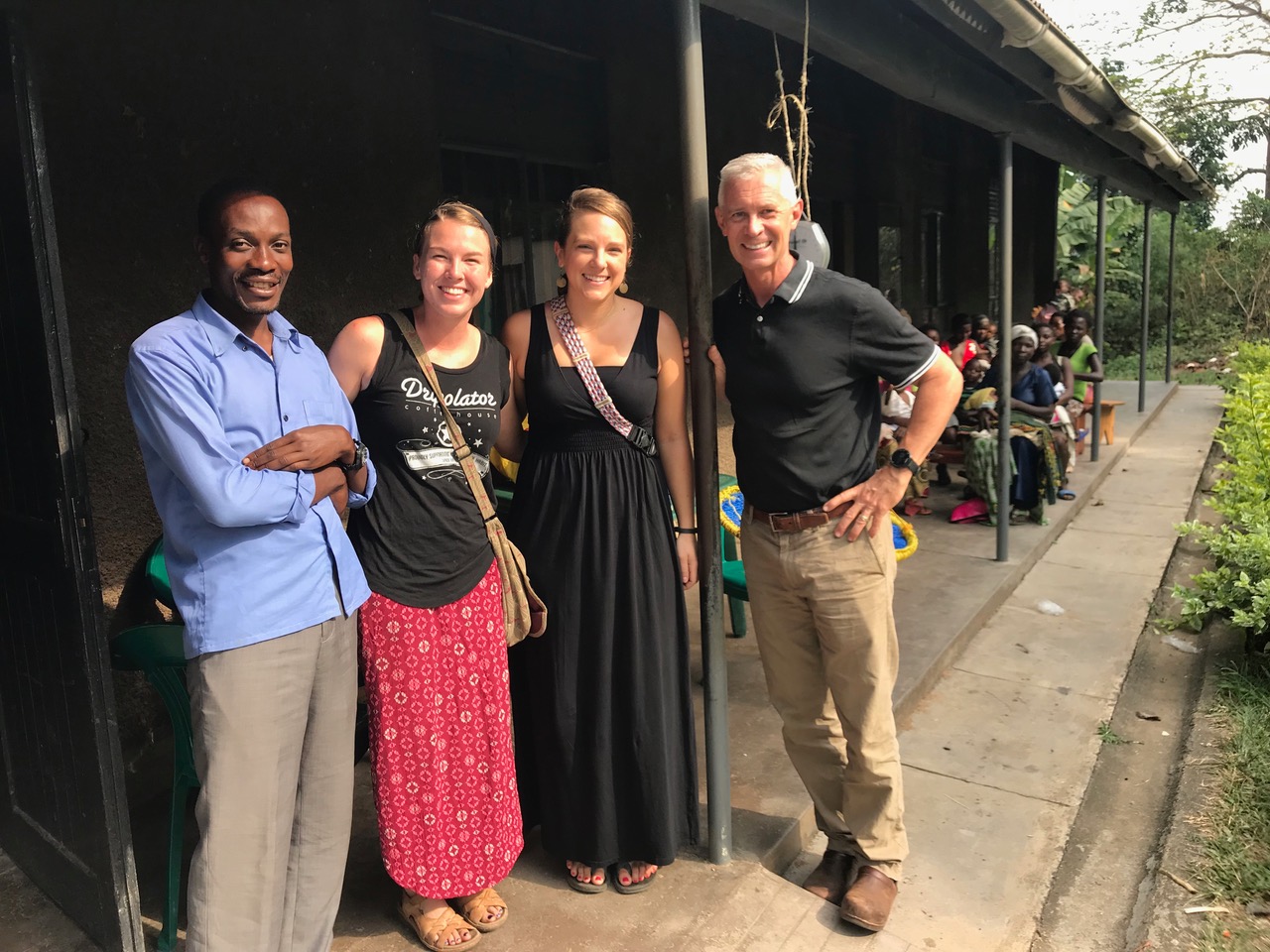
We walk into the ward we had built at Nyahuka Health center to find midwives we trained delivering babies.  Next door, our team's PT Rhett is gently explaining to the mom of an extremely disabled baby how to hold him in ways that support his head and counteract the stiff arching of his neurological condition. On the porch our nutritionist Alisha with her team prepares to weigh children enrolled in our team's nutrition program, supplementing them with locally produced supplemental food.


FAVORITE MOMENT OF THE WEEK--DO NOT MISS THIS ONE) We sit on the couch with Dr. Ammon and his family after a morning at Bundibugyo Hospital.  He is one of the post-ebola scholarship recipients who was enabled to go to medical school, a real leader with genuine faith and solid clinical skills.  Now he's the superintendent of the hospital, and he's spent the entire morning showing us what he's doing.  Continuing medical education for staff, deliberate discussion of outcomes, financial accountability and planning amongst the leadership.  God bless Baylor for a brand new laboratory.  Renovated wards.  Plans for a newborn special care unit.  As we moved from area to area, we ran into two nurses whom we had selected 20 years ago to be part of the "Mother and Child Survival Project" to train high school leavers in community health and then send them to nursing school, and there they were, faithfully working for mothers and children to survive.  And we met the latest Kule Leadership Fund scholarship recipient, training as an anesthetist.  It's not easy--Ammon's trying to run the primary hospital for 250,000 people, keeping up the facility, supervising 200 staff, running clinics, supplementing medicine supplies, teaching, doing surgeries, and on an on, on a budget of $4,000 a month.  As we finish our whirlwind several hours of greeting and consulting and listening and applauding, we walk over to his staff-quarters home to see his family.  His four children have all been born prematurely and dangerously, and all survived.  The youngest two were 1-kg 28-weekers.  Bwambale is nearly 2, and Biira is just reaching 4 months old.  The odds of their survival in this place were very poor, yet here they are.  At that moment, it hit me:  this was our dream for Dr. Jonah. To be here in Bundi, a leader, in charge, making changes, bringing integrity and grit to the needs of this place.  Exactly ten years after his death, the dream is being fulfilled.  Bittersweet.


Equipping the next generation--

Everywhere we go, we meet Christ School graduates.  A nurse will shake our hands, and say, "greet Luke", I was in his class.  Late in the evening as our team leader's toddler suffers another fever, we accompany them to a nearby health center for a malaria smear, and the nurse on duty tells us he graduated from Christ School.  They are church leaders and teachers, they are working in the nutrition program and the library.  We spend one day meeting the budget committee, another day with the full board, another with the head teacher, hours with Josh managing the budgets and vision.  This school's 2017 performance single handedly pulled Bundibugyo out of last place in the district rankings; the individual school results put us #208 out of more than 3000 secondary schools in Uganda.  And yet, the struggle continues.  Parents depend upon cocoa for cash, and there is none.  Even though we raise 50% of the school's budget from donations (which is itself a yearly exercise in faith), if the parents don't partner with their half, teachers can't be paid and students can't eat.  This is a school for people at the margin, and we know it makes an impact.  So we feel the desperation as we celebrate where we've come, but beg God to help us continue.

One afternoon we arrange a lunch for six of the young people we have personally "fostered" over their lifetimes, kids who befriended ours, who played at our house, whose lives became entwined with ours. Some are orphans; all come from places of difficulty and we partnered with their families to sponsor their tuition   Now they are parents themselves, and working.  In the group we have two teachers, a librarian, a laboratory technician, an accountant, an electrician, and an agriculturalist.  As we share food and stories and memories, we end by going around the circle to share a praise and prayer request, and they speak about wanting to raise their children well, to grow in their faith, to maintain their jobs, to care for extended family.  Ndiyezika goes last, and launches into a testimony about marriage as his ten-year anniversary approaches, reminding his younger "siblings" that nothing is more important than keeping God in the center of their lives and remaining faithful to their spouse, no matter what difficulties they face (and he has faced many). It is a beautiful moment.


Living in Community--

All of the above happens because a small group of people were willing to leave their families and homes, supported by a much larger group of generous friends and donors and churches.  And because the relationships built over decades have drawn in local partners.  This community is at the core of Kingdom witness.  And like the examples from the parables, often not the most obvious thing one sees.  Ann, for instance, prepares curriculum and meets with young apprentices to mentor and teach.  Anna (W) and Sierra teach the team's kids, enabling families to live here.  Anna (D) and Stephanie and Holly create homes and meals and Bible studies, essential to survival, even while they juggle their own ministries.  Brent supervises and disciples a team of maintenance workers and guards to enable this team to live in a remote place.  Josh struggles through the complex tax laws, NGO requirements, land titling, administrative nightmares, all of which drain time and energy.  Community is essential; community is messy and complex.


Want to join?

Yes, Bundibugyo is the fray.  But the promises of God paradoxically insist that this is where we find the greatest outpouring of grace, the absolute presence of Jesus.  We could use help, and we could use it yesterday, I think in this order--

Pastors/Youth Leaders:  chaplaincy at Christ School, ongoing mentoring of church leaders, after-school youth programs.

Project Manager/Engineer/Business/Accountant skills:  Managing the budgets and requirements for the school and the NGO (Josh needs help, and he has to take a furlough soon).

Mentor to Teachers/School Administrator:  the kind of person who can walk alongside local leadership to be supportive.

Medical:  doctors, PT, Nutrition, nursing willing to work in lowest-resource highest-need area.

If any of those sound like you, or you want to explore, or know someone who should, pass along this link to the Go form, which is just a preliminary step in connecting with us.  Or send us an email.  Or leave a comment with your contacts.  We'd also love artists and missionary kid teachers and biomedical equipment specialists and lab techs and musicians.  If you love Jesus and have a heart for pouring your gifts out to bless others, and are willing to put up with a buggy jungle and the challenges of living communally, you are welcome.

If you can't go, but you sense God's work in this place, consider starting to include Christ School in your regular tithing.  I know we need to support our own churches, don't ignore them, but a few hundred people deciding to split their giving 5% to CSB and 5% to their church would have a barely noticeable effect in America but be the difference between life and death in Bundibugyo.  Or maybe you can afford a bit more.  We sometimes get an amazing rescue gift; but we need long-term small regular increments accompanied by prayer too.


Saturday, February 17, 2018

Going home

Tomorrow we're heading back to Uganda for the week, the place we called home for 17 years. It's actually the longest we lived anywhere in our lives, where all our children took their first steps and said their first words and grew to be who they are.  Yet we've been away now for 7, and life has moved on.  Bundibugyo has a paved road and electricity, a published Lubwisi-language New Testament, and exponential increases in college graduates, health care workers, cash crops, water projects, cars.  In these 24 years child deaths in the world have been cut in half and if the improvement is not quite that neat and stark in Bundibugyo, it's at least going in the right direction.  There are more churches and schools than one could count.  Still, change comes slowly across generations, and the people we love face stiff challenges.  Malaria is still rampant.  Girls are still lured into early sexual relationships for survival.  Corruption and injustice still take a toll.  Fear and gossip still undermine the freedom of living in the love of God.  Politics still play out in a way to enrich the winners at the expense of the losers.
our yard, about 1999?

Christ School Bundibugyo has been right at the heart of our team's strategy to incorporate Kingdom values on the real-life soil of a place steeped in violence.  Now in it's 20th year, it is a boarding secondary school where (to the best of our ability) girls are safe from exploitation, sit in the same classes with the same opportunities as boys, even travel to national sporting tournaments.  This alone has the greatest impact possible on child survival; so much evidence that the best public health intervention is to educate girls.  Boys as well learn to respect others and themselves, to work in a system based on merit and kindness rather than corruption and grabbing.  There is a focus on science, a computer lab, a strong math program.  Students compete in music and dance that preserves cultural traditions.  There is a library, with actual books.  Through small groups and chapel, young people encounter the good news on a daily basis.  A long strong line of Sergers have invested significant parts of their hearts in this work. We now have a Ugandan Head Teacher, Kenneth, whose work over the last couple of years has resulted in the best performance of any school in the district.  We'll be celebrating that news with the staff, and congratulating them.  We'll see some of the graduates who are thriving.
One of the reasons we believe in this school--all our kids attended.  Luke with his class about 2005.

And yet . . . every year, from the first to the twentieth, feels like a year-long struggle against ever-present evil.  This year of drought the cocoa harvest dwindled at the same time that world market prices fell, so parents who almost universally rely upon the crop for money for school fees defaulted on payment.  For the first time we were late with teacher salaries.  Rumors swirled, violence was threatened.  At another point, there was a massive cultural consternation about our response to a teacher whose physical punishment of students was both illegal and unconscionable.  And on and on.  We still need to subsidize the school to keep it affordable.  We still need Serge workers who can walk a delicate balance of encouraging the staff and managing a project that is largely in local hands.  Both the funds and the personnel have worn thin.

So the next week we'll be listening to issues, looking at budgets, strategizing with the leaders, to move into this 20th year of operation and dream of the future. We'll also be visiting with our team who do many other things in Bundi:  water projects, church leader development, nutrition and agriculture, children's literacy and evangelism, physical therapy, sports ministry, medical care, community health.  We'll see the kids with whom we've had long relationships as something like foster parents, many now launching their own families and careers.  We'll see old friends who walked with us through some of the hardest days of our lives, and new ones who carry on in fresh ways with their energy and vision.

It feels intimidating.  It's hard to go home.  It's hard to absorb change.  It's hard to confront suffering.  It's hard to help untangle problems that seem intractable.  It's hard to have faith that we have anything to offer.  We're walking into this trip after a pretty trying week.  We've lost some patients, and beat our heads against the passive-aggressive wall of inaction, or the impossibility of sparse staffing.  I really like my team and have enjoyed several teaching opportunities this week, but giving multiple lectures while also managing patient care takes time. We've had visitors.  I had a bug that knocked sent me to bed early with aches and exhaustion.  That's life, but we're depleted. 

So it's good to remember this isn't about us.  God can reach into our weakness and pour through us something good for our Ugandan friends and our teams.  Prayers appreciated that we would bring a sense of God's presence and blessing.

Monday, February 12, 2018

Portrait of a Winner

This is not the portrait of a winner.  Or is it?

Tomorrow begins the season of Lent.  Per the highly recommended Biola Lent Project (a daily offering of art, music, poetry, Scripture, and a thoughtful essay, you can get the daily email or add it to your smart phone home-screen to look at daily for free) the tradition of Lent includes six practices: self-examination, repentance, prayer, fasting, self-denial, reading, and meditating on God's word.  We are culturally aware of the denial part (no dessert for six weeks??) but the full picture is much richer.  The purpose is not to build stamina, gain points with God, look more fit, prove toughness.  The purpose is to prepare for the manner in which Jesus changes the world.  

Because it's not a winner-takes-all-by-force manner.  It's a shockingly unconventional, supra-political world renewal.  That's why we need inner preparation.  As we move through Mark's gospel, we are now in chapter 8.  Jesus' followers are fixated on free food and flashy miracles, envisioning a coup that will eliminate the oppressive Roman domination of their homeland and bring them back into their rightful place as BEST.  RULING.  IN CONTROL of the land. The pharisaic approach reminds me of today's Taliban or Moral Majority--let's make sure everyone follows the jot and tittle of our careful religious structure, let's get some military and legislative control over the offensive personal lives of the citizenry, because that's what it means to be God's country.

But Jesus is heading towards the cross.  His path to the throne passes through not just the shadow of death, but ACTUAL death, defeat, loss, grief, pain.  He's not going to lead an army, write new laws, win an election, dazzle the crowds, debate the high priest, strike down the corrupt king.  Instead he's heading straight towards an apparent disaster.  He's going to change the world by a sacrifice that defeats evil in a dimension we can't yet see, and reverses the arc of the universe from decay to glory.

This is a work of subtlety.  It's not going to feel great much of the time.  It's going to require gritty perseverance in hard places, exposure to danger, personal loss.  It's going to keep us out of step with the world's winners.  It's going to require eyes that look beyond the surface, pondering the essentials that make life beautiful:  faith, hope, and love.  It's going to take us on paths where people don't offer awards; where they question our sanity.  We can't do that on a steady diet of platitudes and superficial half-truths.  We can only endure by Lent-like seasons of inner conditioning.

The end of Lent is Resurrection.  There is a table, a party, a celebration.  This is not a faith of perpetual misery . . . instead it is a rhythm of fasting that leads to feasting.  But we can't short-circuit the process, and pound our way through to comfort.  That's what the 1rst century Palestinian Hebrews wanted; that's what the 21rst century prosperity preachers promise.  But that's not Jesus' way.

Let's pray for a season to examine, ponder, re-set our sights, paint a new picture of winning, and embrace the way of the cross.

(painting photo from our museum day in London with Julia's RVA classmates, sadly didn't capture the artist credit)

Saturday, February 10, 2018

Not a boring life: astonishing things

Healing then, and perhaps healing now (though we don't always realize it), can never be simply a matter of correcting a few faults in the machine called the human body.  It always was and is, and perhaps supremely so in Jesus' actions, a sign of God's love breaking in to the painful and death-laden present world.  It was and is a pointer to the great Healing that will occur when the secret is out, when Jesus is finally revealed to the whole world, and our present stammering praise is turned into full-hearted song.  When Mark urges his readers to follow Jesus, he envisages, not a boring life of conventional religion, but things happening that would make people astonished.  . . .

The closer we are to Jesus, the more likely it is that he will call us to share in his work of compassion, healing and feeding, bringing his kingdom-work to an ever wider circle.  Unlike magicians in the ancient world, performing tricks to gain money or personal kudos, Jesus is concerned to bring his disciples into the work in which he is engaged.  The Christian life, as a disciplined rhythm of following Jesus, involves not only being fed but becoming in turn one through whom Jesus' love can be extended to the world.
(Mark for Everyone, NT Wright, commentary on healing the deaf and dumb man, and on feeding the 4000, Mark 7 and 8)


Not a boring life, for sure.  This yawn (pictured) aside, some days you just need a full-fledged theological pep talk to put the craziness into perspective.  A surgery or an antibiotic are more than just little tweaks to slightly malfunctioning physical systems.  They are signs that flare out the truth, that life has broken into this disintegration and decay, that the end involves a great reversal, that the Creator has not forgotten the dusty specks we are.  And that believing all that leads to the privilege of holding life in your hands and participating in the healing love that pours out on the world.  So enjoy the photos below from the last day or two, and remember the big picture.


This is the baby from the post Scott wrote about the mom that spent hours on buses and vans to get here for her 5th C-section. Blissfully unaware of the danger averted.
A rare theatre selfie--turns out Friday not only were we down to 1 consultant, 1 medical officer, and 1 intern to do the paeds work usually done by a team of 10-12, maternity said they had no spare nurse to go receive a baby from an emergency C-section, so Scott called me to come.

Turns out it was good he did--this little one weighed 950 grams and was born at 29 weeks with only a barely perceptible, slow heart thump.  No movement, no breathing, floppy, purple, scary.  But some ventilation and oxygen and warming and drying and resuscitation brought him to life, for now.  There's always hope, particularly after God brought this experience the SAME DAY . . . . 

. . . we went down to the local protected area by the Lake, walking distance from our house, Friday evening.  As Scott paid our $3 fees, I started chatting with this cute preschooler.  Which gave his mom courage to say:  " I always see you and tell people, that's A's doctor, she took care of him at Kijabe in 2014.  You're Dr. Jennifer right?  A was 900 grams, born at 6 months, and we were in the NICU for 2 months with you.  Now he's in school and doing well."  Well, as you can imagine that was a bit encouraging.

This mom told me her 1-month premature boy was her first live child . . she had previously miscarried twins.  I told her, the same thing happened to me!  And her son was born the day before (and 25 years after) my son's birthday. Kind of sweet.

So many malnourished little ones, needing oxygen, needing fluids, needing attention.  It's tiring but there are also times when we remember, this is a privilege, to participate in renewing their hope.

This is a red-throated white-fronted bee-eater, one of the most beautiful and graceful birds ever, and we have dozens around our house.  We often see them mornings and evenings.  A reminder of God's eye for beauty and care for the small details.

Here are a few more photos (from Scott so better!) of Friday evening's walk to the lake.  Another joy we have in engaging with God's bigger work is hosting team mates from distant places, in this case Rhett visiting his daughter Elizabeth from Uganda for RVA's mid-term break.  


We are always part of a huge world-changing process, but it takes eyes to see and ears to hear.  May we open our hearts to observe.

Wednesday, February 07, 2018

Luke Myhre: A quarter century of wonder


Dear Orthopedic Surgery Residency Program Director:

In case you google Luke Myhre, now you know two things.  He likes bones, and he's turning 25 tomorrow.  This photo was taken over Christmas here near his home in Kenya, holding an elephant femur we came upon in a game park.  If he hadn't opted for medicine, he would have been a ranger protecting wildlife from poachers.

Twenty-five years ago tomorrow, he was born a month premature, and from the first week of his life he demonstrated characteristics that will make him an excellent orthopedic surgery resident:  a tenacious determination and an inhuman ability to remain alert.  Sleep was never his strong suit.

He was 8 months old when we moved to Uganda, where he lived for the next 17 years.  His childhood prepared him well for survival in tough circumstances including evacuating under rebel gunfire and surviving an ebola epidemic.  More than the dramatic crises, he learned to feel rich in circumstances that would qualify as poverty-level in the USA (no indoor plumbing, no grid electricity, no phone or TV service or even a post office for many years).  He had to be confident and resilient to spend his days cross-culturally with his friends, to bravely enter Ugandan school as the only foreigner, and later to go to a boarding school that was a 23-hour grueling 2 1/2 day drive from home.  This childhood was actually rich: rich in community, in beauty, in adventure, in reading, in love.  

At age 17 he graduated from high school and went to Yale University on a scholarship, fulfilling premed requirements while pursuing a broader education in the history, culture, and language of the continent where he grew up.  He graduated with honors and by amazing grace got another scholarship to go to medical school at the University of Virginia (our state of residency).  In these almost 8 years of pursuing degrees, he's maintained friendships here in Africa, coming back many summers to work on diverse research projects from exploring a link between malaria and congenital neural tube defects, to using cell phone messaging to improve post-trauma care and follow-up.

Now he's turning 25, and embarking upon a career in orthopedic surgery.  Whoever matches this young man will get a creative, outside-the-box cross-cultural thinker, an intellectually curious person who will make a mark on the world, who will combine physics and public health and mechanics and intensive care all into his surgical skills.  You'll get a resident characterized by supreme loyalty, self-sacrifice for his fellow residents and patients.  Your community will be enriched by his talent for gathering people around food and fun.  He's an athlete and strong and smart but so are most of your applicants.  Take it from us:  he's brought us joy for 25 years and we know he'll do the same for you for the next 5, or more.

Sincerely, 
Jennifer A. Myhre, MD, MPH
Scott D. Myhre, MD, MPH
Unbiased sources of medical student evaluation


Tuesday, February 06, 2018

The least of these...

As I (Scott) arrived at the hospital this morning, I did my usual preliminary pass through the Labor & Delivery area scouting for potential problems or emergencies.  The day shift midwife was bustling amidst at least ten pregnant women in various stages of labor and informed me that there was a mother who just arrived and needed a C-Section.  I nodded and asked her give me a short summary.  

“She’s a  32 year old mom in active labor at term with four previous scars.”  That means she has had four previous cesarean sections.  Some mothers are able to have normal vaginal deliveries after one (or even two) c-sections (called a VBAC: vaginal birth after cesarean).  But a mother whose uterus has been cut four times would be at very high risk of a uterine rupture if she were permitted to labor.  I took one look at the mom and could see she was really contracting.  She was flexed at the waist, leaning on her elbows on the bed, eyes squeezed shut as she endured a long hard contraction.  The midwife was preparing to examine her cervix so I waited to find out how urgent this case was going to be.  The midwife gasped.  “She’s eight centimeters.”  That’s 80% of the way toward the baby’s delivery.  So we needed to act quickly.

It took about a half hour to get her prepared and into the operating theatre (shockingly efficient for our hospital).  As part of the routine pre-operative care, I inserted a catheter into the mom’s bladder and found the urine to be bloody.  The baby’s head was like a battering ram, propelled by the strong uterine muscular contractions, smashing against the mom’s pubic bone - and the poor bladder caught in the cross-fire.  But at least there was no evidence that the uterus had ruptured…

Doing a c-section on a mother who has had four previous c-sections is no small challenge.  It often seems like someone has poured glue into the abdomen and let it set.  Everything is adherent to everything else.  In this case, the bladder was stuck high up on the uterus making access to the baby difficult.  But we manage to deliver a healthy baby - 3.2 kg.  As I put the mom back together, I conversed with the senior nurse who assisted me in the surgery and we discussed this mother’s story.

“Did you know this mother is from The Bush,” she said.  Typically that means “far away.”  However, it this particular case, this patient came from a village so far away, that the actual name of the village is “Bush.”  Prior to the surgery I was looking at her little blank notebook which some women use for antenatal care.  The entirety of her antenatal care consisted of two third-trimester dispensary visits where they measured her blood pressure only.  The routine antenatal blood tests (such as blood typing, HIV & syphilis testing, and hemoglobin level) were never done.  No advice was given about the need for or timing of an elective cesarean.  She didn’t know the date of her last menstrual period so there were just question marks about the dating of her gestation.  No ultrasound.

Last night, the patient went into labor, but she lives in Bush and her husband has no means of transport.  So they waited until morning.  They had to ride three different matatus (12-person mini-van) for over three hours to reach our hospital.   As we explained the need for a C-section, she quietly nodded.  We handed the consent form to her sign, but there was an awkward pause and look of confusion.  She could not read or write and didn’t know what to do with the pen.  I felt so sad for her.  She managed to make some semblance of a signature.  And then we went through the same awkward process as we offered and explained the option of a tubal ligation.  Thankfully, she was eager for a permanent family planning solution.  This could potentially save her life.  Today was her fifth C-section.  Going for a sixth could be deadly.


This afternoon, I have been thinking about this patient.  I’ve often said this year that I find it so difficult to understand what my Kenyan medical colleagues are thinking.  But wow - trying to get inside the experience of a patient who does not read or write is nigh impossible for me. What I can imagine though is that her life is defined by her family and tribe.  That she loves her new baby more than life itself.  That she came to our hospital hoping against hope that she and her baby might somehow survive.  And I count it a privilege to be part of a team that laid our hands on her and assisted in that miraculous process of a new life exploding from the inside of a woman.  

Sunday, February 04, 2018

Perspective gained by space and time

"If you can see a thing whole," he said, "it seems that it is always beautiful.  Planets, lives . . . But close up, a world is all dirt and rocks.  And day to day, life's a hard job, you get tired, you lose the pattern.  You need distance, interval.  The way to see how beautiful the earth is, is to see it as the moon.  The way to see how beautiful life is, is from the vantage point of death." (Shevek, character in Ursula K. LeGuin's The Dispossessed)

As we slog through time sequentially, we don't always see the whole picture.  Hard things happen, and they are truly painful, and they become part of our stories.  But, as one of my characters says, they aren't the end of the story.  It's only from the vantage point of death, or eternity, that a life's full beauty can shine.  And to bring that sublime thought down to earth, it sometimes helps to look back a few months or so to feel less discouraged.

Friday was the last day of rounds with the current set of interns; they switch services every three months through their year, rotating in OB/GYN, Paeds, Surgery, and Internal Medicine.  They come in quite vague about babies and children, and often leave with some sense of accomplishment.  I noticed on rounds on Friday, the row of 9 of the smallest preems (2 per incubator and one yet-to-be-squeezed in, and that was before 2 more were born that afternoon . . ) every single one had appropriate increments of milk feeds in their nasogastric tubes and IV fluids in their veins, every single one was gaining about 1.5% per day of body weight.  THIS IS NO SMALL THING.  It takes time to learn how to gently and meticulously manage beings who weigh 2-3 pounds (this row is 800 to nearly 1600 grams).  On the other side of the room there is a row of the 1600-1800 size, tubes out, learning to breast and cup feed.  My other intern had appropriately corrected the management of a critically ill and dehydrated baby admitted overnight, and had thought through some of the more complicated cases on his service.  In short they had both come a long way.  We're trying to measure what we do with pre and post tests and a core curriculum, and both of these interns raised their score by 20 points over the 3 months.

It's also great to finally have the nurses settled.  December was chaos as the strike ended and assignments were reshuffled, then at Christmas and into January many took their accumulated leave (strike time doesn't count as leave . . ).  So finally we have the queen of Kangaroo Care (skin to skin warmth and nursing of babies by their moms) back in action. The twins pictured here were SO SICK at birth, yet to see them now you'd hardly remember it as they move into their third week.

At home on the weekend this is what my table looks like as I review labs and cases with the intern.  The point being, a year ago no one was following very closely, especially on the weekends.  So there's that.

These are the senior preems, Kangarooing.  When deaths feel overwhelming it's good to look and see the lineup of babies who make it through a harrowing month or more to grow enough to go home.

This is what 3 babies-per-incubator looks like.  Crowded or cozy?  It's an infection-control nightmare but the alternatives aren't great.  We don't turn anyone away.  Some are born at home, or at small clinics with no capacity to manage an infant, so are sent here.  My Medical Officer colleague who did her internship a few years ago, and is now working on Paeds, commented this past week that when she was an intern these babies were not surviving, and things are so much better now.  Good reminder that my perspective is so limited, and people looking over a longer interval see more change.

And it's not only the babies:  here are 2 moms-per-bed awaiting C-sections this week as Scott was working to get them into theatre.  I think the patient resilience of Kenyans, the willingness to share a bed and to endure discomfort and to sacrifice for their children, will win out over all obstacles, eventually.

This is a Monday pep talk to ourselves.  The point is, it's all disease and crying close up, but when you get the distance of a day or a rotation or a year or a lifetime, there is great beauty.