rotating header

Thursday, October 11, 2018

Vulnerability, humility, Hagar and Naivasha


This is what a week looks like.  Tiny feet, too many of them, waving from the broken doors of four over-stuffed incubators (we have 14 preems in 4 incubators today, that's 4-4-3-3).  Moms carefully expressing milk, sitting patiently on benches, breaking into smiles when released to go home.  An HIV-infected 5 year old with TB revived by a blood transfusion and TB meds, whose mother's apathy seems to fade with each day of her survival. Abscesses drained and packed with guaze, IV cannulas inserted, oxygen tubing connected, weights charted.  Gathering interns for teaching, buying them lunch as we go step by step through the complicated fluid calculations for dehydration with kidney injury.  A departmental review of all the deaths in a month, the sorrow of each case, the obscurity of trying to discern what went wrong.  A holiday, whose celebration was unclear up until 12 hours before . . . Scott and I sense we should just bike over mid-morning to check up on things . . . and find a mother referred on a public matatu unconscious from ecclampsia (high blood pressure and convulsions associated with pregnancy) . . . Scott mobilizes the emergency cesarean staff and calls me to join as the mother shakes with seizures.  He pulls out a nearly dead, totally limp and still baby from a womb thick with meconium (stool). There is a faint heart beat but nothing else, but slowly the baby comes to life as we give breaths and oxygen and dry. Mother and baby are both in critical condition but alive and possibly will be fine.  


 A week also looks like this: for every exciting save, another sorrowful death.  Today I walked into the ward and found a mom making fun of my Swahili, loudly, with the others laughing.  I know it's not typical, but it was surprisingly humiliating. Or the antibiotics are out of stock, or the person on call was not found to help so there is a terrible outcome, or the oxygen runs out, or we get messages one after the other of absences. Or a c-section gets delayed by the reluctance of the anesthetist or someone else to step into their job, and the next day Scott checks for a fetal heart rate, and it's not there. Or we get a glimpse of how our own mothers feel our distance, or how our own kids have challenges we can't help with.
 This is what living vulnerably in the real world looks like.  We are not in control of a thousand things around us, we are just showing up and trying to do our best.  Trying to be a flickering light. Trying to bring a small measure of order, accountability, education, healing into a place where some people are eager for the mentoring and burden-sharing, and others may resent the intrusion. Trying to walk a line of faith, of praying against injustice, of seeing the best in others, of waiting for God to act . . . without feeling complicit in a system that is deeply flawed.

And as we continue, a few things happen.  First, we get a front row seat to redemption and restoration.  Baby A. above finishes 17 days of treatment today, finally with a firm lifeward direction after a severe pneumonia that required a powerful, expensive antibiotic.  Second, we find our in-this-boat-together powerlessness draws us into community with others.  Our weekly prayer time has a few new attenders.  This week we talked about Hagar, and the interns could deeply relate to feeling used, feeling without choice, feeling lost and alone and desperate.  Hagar the foreign slave tries to escape, but God sends her back.  Her path of humility leads to the dangers of childbirth (still dangerous now, imagine several thousand years ago) and the inglorious, demeaning life of a captive.  Yet Hagar gets to see, and be seen by, God.  So the third perk is just that:  this is the paradox of the Kingdom, the taking up a cross, the all loss becoming gain.  God is here. With our interns, with us, with our patients, and it is a worthwhile calling to point to that truth.
Ending with a reminder:  this is a personal forum to bear witness to our experience of God and the world.  We seek, imperfectly and haltingly, to walk into the mess, and to try to apply the logic and love of Jesus around us.  As we do that, we get a hundred things wrong every day.  Please don't think that our writing reflects any official Serge theological stance, or political either.  We love ideas, and passionately desire to reflect on what is wrong and what could help . .  and to spark others do the same.  But not everyone enjoys the process, so please forgive us for diverting into American issues the last two weeks.  Stick with us and don't hesitate to share with us your feedback and struggles too. 

Wednesday, October 10, 2018

Truth, Reconciliation, and Africa shining

Last week we Americans experienced a national, collective convulsion of desperation and pain and feeling victimized and feeling justified, only that collective experience tore us more apart than bringing us together.  (see earlier post below)  Those who supported the nomination of Judge Kavanaugh won, though you'd hardly know that as the narrative continues to emphasize a sense of injustice.  Those who opposed his nomination feel disenfranchised, as if their concerns did not matter.  The false dichotomy between due process (innocent until proven guilty) and #metoo (listening to survivors of sexual harassment and abuse) continues to be assumed and perpetrated.

So, as an American living in Africa 25 years, I offer a glimpse of the way this continent has shone in matters of truth and reconciliation.  Two of the places on this continent which have seen some of the most horrific violence and sorrow in my lifetime are South Africa and Rwanda.  In both, the survival of one group was posed as threatened by the presence of another, and the solution was to fight to the death over presumed limited resources.  Years of injustice and smoldering imprisonment, death, suffocating poverty, in one; weeks of all-out slaughter in the other.  How to recover? So many acts of hate carried out on such a large scale by so many average people overwhelmed the criminal justice capacity.  So South Africa set up their "Truth and Reconciliation Commissions", and Rwanda set up their "Gacaca Courts" (justice amongst the grass).  Neither were perfect, but both were attempts to allow for restoration in the process of justice, and not just retribution.  Both took as fundamental the need for the community to be the basis of justice, the importance of all sides being able to tell their story and be heard, the opportunity for forgiveness, and for some form of reparation.

In America in 2018, we are floundering for ways to look at the truth about our slave-holding racial-injustice past (and present) and our objectifying exploitative approach to sexuality, without crumbling into a litigious, court-clogged, angry mass.  I don't know how Dr. Ford feels now, but certainly many of the #metoo stories seem to have been told in a sense of relief that one's experience can be uncovered, heard, with an attempt to understand.  If the stakes were lower, perhaps Judge Kavanaugh could have listened and even if he truly believed himself to be innocent of this particular night's events, he might have at least acknowledged her pain and the way his high school and college behavior could have hurt several women.  In South Africa and Rwanda, some cases still were so grievous as to require criminal prosecution, and that is needed in America too.  But we have such a vast backlog of sexism and racism that we need some fresh ideas.

So . . . let's tell stories.  Truth.  That can come in personal narrative, or fiction, or art.  And let's react to them with compassion, questions, empathy, repentance.  Africans, I find, are not as worried about punishing as they are about holding together the fabric of community.  The idea is not so much to identify, isolate, shame or imprison a particular person who did wrong as much as it is to restore relationships.
Our friend Greg posted a photo of this painting this week, and I found it powerful, and keep thinking about it. The artist is Titus Kaphar, and he just received a MacArthur Fellowship to support his work.  I think it captures the essence of getting behind the facade to the complexity of racial and sexual injustice that we would rather paint over and not acknowledge, to the layers of reality upon which our stories are built.  Thomas Jefferson was a brilliant man who did much good; he was not a perfect man who did all good.  

Happy Columbus Day? Indigenous People's day?  Ugandan Independence Day? Moi Day?  It's a big week in October as many countries celebrate their stories.  One group's tale of salvation is another group's tale of loss, and both are true.  We can have complicated, deeply layered stories that require listening to one another.  Let's stop letting ourselves be divided into camps that must choose sides, let's learn to embrace a bit of discordance.  Let's hold onto the sinner-sufferer-saint mix that characterizes us all (thanks Serge for that language) and not turn each other into flat caricatures of heroes and victims.

One of the best ways to raise kids who can think this way? Good literature, stories from diverse points of view, getting behind the eyes of someone else.  So while you're at it, remember to go to the library or buy a good book this month . . . that's partly a plug, but it's actually true!


Friday, October 05, 2018

On Condemnation and Fear and False Dichotomies

As I write, the tumultuous week of the Kavanaugh Supreme Court nomination continues. A week ago, we watched Dr. Ford's compelling testimony and Judge Kavanaugh's emotional response.  And since then, pretty much everyone I've read has felt justified in their binary lens, and in feeling increasingly self-righteous, increasingly persecuted, increasingly frustrated, increasingly alienated, and increasingly angry.

This week, a Bible verse jumped out at me:  Jesus was on the way to Jerusalem and some Samaritan cities did not seem to be welcoming him.  His followers, high on their own power and expectation, breathing the atmosphere of unambiguous surety, wanted to call down fire upon the inhospitable towns.  Jesus replied, don't you understand, I didn't come here to condemn, but to save! 

What?  God isn't mostly about putting the sinners in their place?  God is mostly about opening a way for all of us to thrive and grow and love?  Who would have thought that in anything that's been said?

Jesus, evidently.  Instead of condemning, Jesus walked right into the hate, misunderstanding, corruption, horror, and pain of bearing our world's brokenness.  Instead of condemning certain people, cities, ethnicities, groups . . He condemned evil by taking the brunt of it into his own body, to the point of death, and then offering life.

We are all sinners, sufferers, and saints in a massively mixed bag.  And yet we are living in a time and context where, lacking any credible lens with which to make sense of such human mystery, our leaders latch onto our fears and whip them up.  "This woman is out to ruin a man's life for political purposes/greed, watch out men, you might be next, your survival is under attack!" "This man represents all that is wrong with every privilege of race and gender, and if you doubt his guilt you don't support the huge numbers of women in the world who have been sexually assaulted!"  Moral high-grounds abound, fueled by fear and false dichotomies.

Could we take a deep breath and try to embrace what is true?

  • A significant number of women experience sexual trauma (1 in 5), and Dr. Ford gave us as a nation a gripping, credible, painful, honest description of hers.
  • MOST of those girls and women keep silent, blame themselves, fear disclosure, seek to move on.  When they do speak, MOST of the time allegations of sexual abuse turn out to be true.
  • The courage and poise of Dr. Ford sparked a useful national reckoning and awareness of sexual abuse of power, deeply meaningful to many humans.
  • Teenagers are still developing their brains, and do things that range from foolish to evil.  Maturity requires we acknowledge our wrong-doing and seek to change, grow, and where possible, make amends. 
  • Alcohol dis-inhibits the brain, and people who are drunk perpetrate even more sorrows than people who are not, and they don't always remember what they do.
  • We live in a democracy where almost half of people voted knowingly to elect a person to the highest office whose character includes numerous documented sexually abusive/ inappropriate/ immoral/ unkind/ mean statements and actions.  People have chosen to overlook his personal characteristics in order to feel more powerful or secure.  Those same people will most likely also approach the approval of his nominees in the same way, willing to overlook morals and behavior if the nominee can offer them something they feel is worth their vote.
  • The Senate judiciary committee hearing was not a court of law to try a case from three decades ago, it was an attempt to listen to witnesses who had serious concerns about the capacity and character of the nominee.  Dr. Ford was heard; Judge Kavanaugh responded, and now the Senate must decide how to weigh his record and potential to serve in view of the unproven but possible criminal deeds he committed many years ago, and in view of the way he has handled himself in the review process.  
  • If this case were to be tried, like many others, we must be careful to extend the justice of innocent-until-proven-guilty to all.
  • If you want to make America great, it won't happen by glossing over abuse or by shaming the innocent in order to get your side in power.  It will only happen by the day-to-day slow sure transformation that comes from living authentic lives of sacrifice and love.
What would Jesus make of half of us wanting to call down fire from Heaven upon the other half?  I think Jesus might listen with care to each, and then sigh.  From the Gospels we can guess that if he had to take a side, he would side with the less powerful, the wounded, the suffering.  But in so doing he would also see the pain of the other.  He would very likely speak up on behalf of the #metoo movement.  And he would forgive anyone who asked for it.  

This was in my devotional reading from Matthew 27 today: "This is how he is shining the light of God's love into the dark corners of the world:  by taking the evil of the world, the hatred and cruelty and unthinking mockery of the world, the gratuitous violence, bullying and torture that still deface the world, and letting it do its worst to him.  Never let it be said that the Christian faith is an airy-fairy thing, all about having wonderful inner, spiritual experience, and not about the real world.  This story takes us to the very heart of what Christianity is all about; and here we meet, close up and raw, the anger and bitterness of the world, doing its worst against the one who embodies and represents the love of the creator God himself. . . . we are of course outraged that such things should happen.  Yes, Jesus will say to us, and they are still happening around the world today; what are we doing about it?" (NT Wright commentary on Mathew)

Could we channel some of our angst over this very disturbing week into taking up our own crosses, and following Jesus into the hard path of healing?  The world is waiting.


Wednesday, October 03, 2018

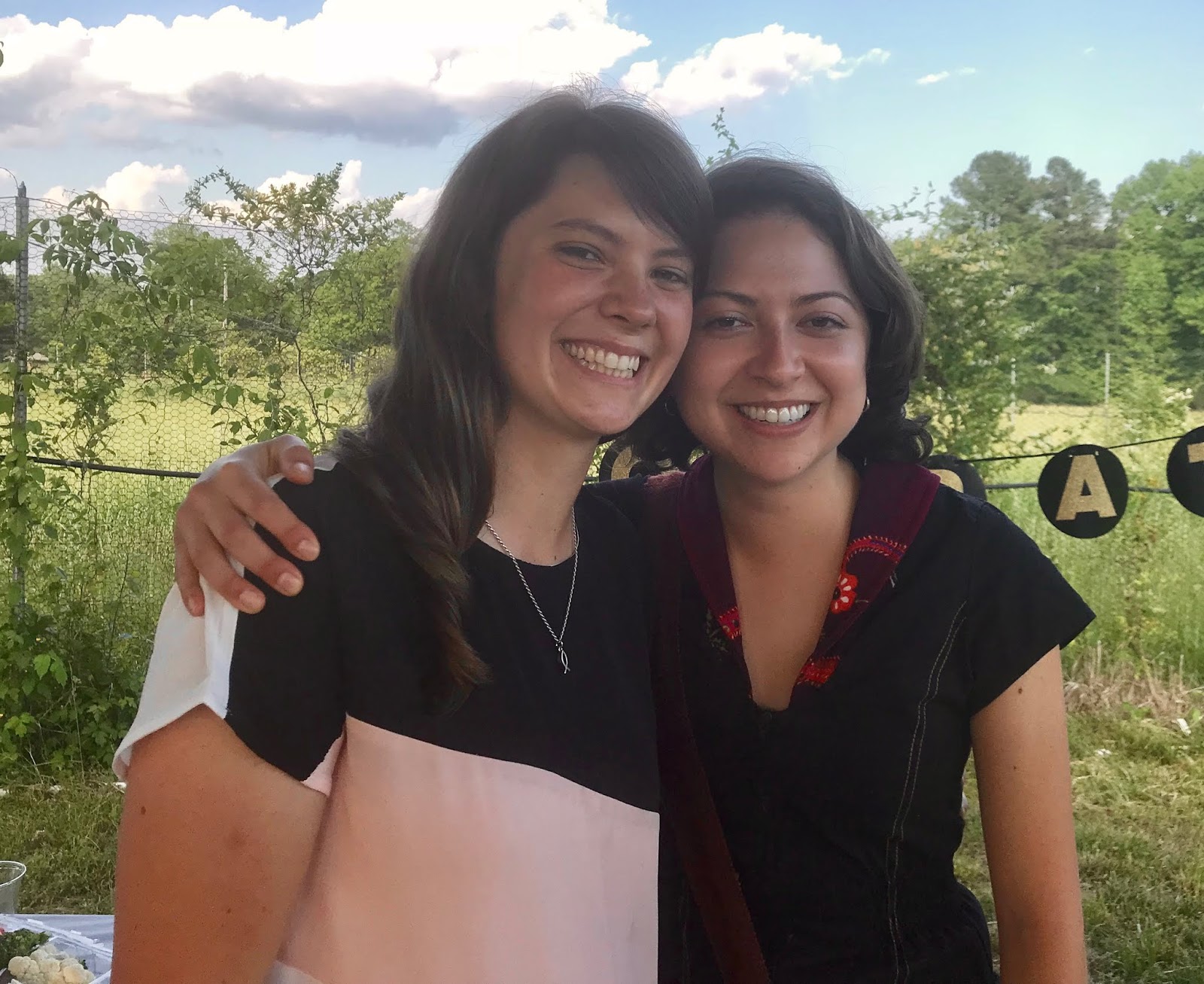
JULIA 22 YEARS OF A JEWEL: 4 OCT 2018

Happy Birthday to Julia!!  It's been quite a year leading up to #22--graduating from Duke, taking a job for the summer on a therapeutic farm for people with mental health issues, then starting in the Fellow's program in Greensboro.
Oct 4 1996
Julia!

2018 has been a banner year . . .


We had celebrations with family and friends . . .


And then a fantastic cross-country escapade with brothers and mountains and way too many car miles . . .  


I love this one, from Utah, of just the two of us.
And then she went to take her quite brave job in Vermont, then came back to Greenboro NC to begin a 9-month mentored leadership development program encouraging the integration of faith and work. She takes classes 1 day weekly, works 3 days a week for a sustainable agriculture project, and volunteers 1-2 days a week for a church, with this group:
All these pictures show facets of the jewel that is Julia--spunky and sparkly, a committed friend, a kind soul who serves others, a thoughtful young woman who is delving into her faith and identity, a human thirsty for true friendship, a lover of trees and plants who works hard and gets her hands dirty, a steward of this earth for the good of others.  We pray for her to grow deeper in Mercy and Truth this year.
And a accomplished and mature and gorgeous as the 22 year old Julia is, in my heart she is still the 2 year old Julia too, taking charge of daddy's motorcycle and her baby brother.  And off to conquer the world.

A Fever, A Flight, and a Fight for the World--the book is OUT!!


It's October, which means rainy afternoons in Naivasha, the 9-months-post-Christmas baby boom wreaking havoc in the hospital in full swing, Julia's birthday tomorrow, Rugby for Jack and snow for Caleb and trauma rotations for Luke . . . and for me, the fourth and final Rwendigo Tale being published this week.  (Link to New Growth Press here where it is on SALE, Link to Amazon here).

My favorite reviewer comment so far:  don't start this one right before bed.  

As I wrote these four books, my kids moved from age 7-12 to age 10-15.  The stories move from a magical-realism talking-animals kingdom quest to a more action-drama mystery young adult flavor.  Though each one stands alone, the characters are loosely related and the storyline does connect.  This final volume was written a few months after we survived an Ebola epidemic in Bundibugyo.  It is being published in the midst of another Ebola epidemic, that is creeping closer and closer to our teams in Nyankunde and Bundibugyo.  Our confusion, terror, sorrow, and soul-searching in 2007-8 informed the process these characters take in resisting evil; and are very much relevant to our daily work in 2018.  After the 2007-8 epidemic, we were given a 3-week leave to stay in a very simple, open, thatch-roofed house on the coast of Zanzibar as part of our recovery process, and I started writing this book during that short sabbatical.  The rhythm of the coast provides the setting for the first half of the book.  

Each of the books was written with one particular kid in mind.  Three have male main characters and one a female, because that's our family, though there are key male and female roles in each.  They aren't about any real person, but the personality of each kid comes into the stories, the sibling relationships, the pets, etc.  This last book is dedicated to Luke, who ten years ago was a young teen.  In the decade since, he put a hand-written note on his wall for a while that says "I will sacrifice for those I love."  And that pretty much sums up this book.  It's a story of choices, courage, the way the struggle against evil requires real risks, the difficulty of a path that leads to sacrifice, the tenderness of friendship and empathy, the mystery of forces beyond our sight and control.

I don't want to give more than that away, you have to read the book to find out what happens.  You can be sure that the setting immerses you in a fictional universe where almost all characters are authentic East-Africans.  You can expect the usual vocabulary, both English at a level that is middle and high school appropriately stretching, and terms that give flavor from other languages.  You can expect some hard majority-world topics to surface (loss of parents, corruption, danger) in a way that honors the reality that most kids must live, but also points to the resilience and hope that is possible to grasp.

Please consider buying a few for your kids, your friends, your relatives, your library, your youth group or church.  I have been swamped by life and am pretty much out of marketing ideas, and NGP the publisher has little reach outside their usual church-based audience.  If blog readers averaged ten copies . . we'd be set (I know that's not realistic, but buying a few and promoting others to buy a few . . you never know). You can also help me a LOT if you post a review on Amazon, Google, or elsewhere after you read it. You can feel good about this investment because: books are the best gifts that keep giving, and the author portion is split equally between me and a Rwendigo Fund that can be used for blessing actual people in real-life Rwendigo-like places.

Since I'm in Kenya, I haven't actually seen or held a copy yet . . . so I have no photo to post. Instead I'll post one of a Serge kid whose expression perfectly matches how I feel about this book coming out, and about books in general (photo thanks to his mom Brooke West, used by permission).


So you can do your Christmas shopping now, though you probably won't want to wait that long to read your own copy!  Enjoy and ponder and let me know what you think.


Sunday, September 30, 2018

Crushing news, truth, and the mystery of love in suffering

In the last week, cancer has sent shock waves through some lives close to ours.  One of our team leaders learned their father has a very aggressive brain tumor with a median survival just over a year.  Our former Bundibugyo team leader, Travis, learned that the immunotherapy trial he has been on this year is no longer helping him; his metastatic tumors are growing.  He's already beat some serious odds surviving over 5 years since his diagnosis, but this news was a sobering blow to him, his young family (he got cancer in his 30s), and all of us.  A dear friend and supporter (our age) learned this week that she has ovarian cancer, and it has already spread across her abdomen.  Two of our Serge founders' grandchildren, young 30-40 year olds, died of cancer within a week of each other in September.  That's 2 deaths, 2 new diagnoses, and 1 treatment-no-longer-working, all in people from their 30s to 60s, all Serge-associated in some way (2 of them are on our board), all in the last week to ten days.  That gets our attention.  These are five people who have loved well and lived well and for whom, it would make sense to us, the balance of good would benefit from keeping them all on earth for many more decades.

It's not that we should be so surprised, suffering is all around us, every day.  Perhaps the suffering that is part and parcel of our hours tends to be more palpable and fightable.  Surely we can infuse the right antibiotic, fix the oxygen supply, counsel with the right words, lance the boil, perform the surgery, raise the funds, that engages evil and changes the outcome.  But cancer doesn't work that way.  It is a brokenness insidious and hidden and pervasive and costly. 


So here are two books to recommend.  The first, I read this weekend.  Kate Bowler is a Duke Divinity school professor and another 35-year old upended by cancer.  This is a personal account, funny and raw and reflective and brutally honest.  It is not a treatise on theodicy, it is her story (which is mostly how the Bible writes about God and suffering too).  She grapples with the loss of control, and learning to live in the now. She grieves the sorrows loudly and she holds onto the good. But mostly she tells us the only true thing:  in the worst moment of her life, she knows God is love.  There are two appendices:  what not to say, and how to be helpful.  


The second book is equally profound.  Langberg writes from her lifetime experience as a counselor specializing in trauma, particularly sexual abuse, about the way evil wounds us and how we as a church and community can respond.  This book is more of a text, with illustrative vignettes but not a narrative.  Her solid affirmation of a theology of suffering rings true, and her wisdom in walking alongside the sufferers is clearly and carefully laid out.  In a week where not only fatal diagnoses abounded, but the trauma of sexual abuse of power was powerfully and articulately personified by Dr. Ford as millions watched the senate confirmation hearings, Langberg's book is one I would like to return to.

Neither book purports to have all the answers, which is appropriate for people who are supposedly centered on something like a cross.  Mysteriously, God does not end cancer or abuse or war or the sadness of missing our families.  Not yet.  Instead we are plunged into this unpredictable story which arcs towards good, but passes through a thousand dark valleys on the way. We follow Jesus, who did not crush the Romans or raise every widow's prematurely dead son, but walked straight into unimaginable suffering as the means of introducing a quiet and slow redemption. Immediate incontrovertible victory sounds good, but that's not what God usually does, which is why we are still here on this earth. Kate, and Travis, and others, will probably not have their cancers disappear, but they will experience the Mercy and show us how to walk with courage on a path of love that gives space for all 7 billion of us to find God's love.  Which is a miracle. And we can walk with them as friends who pray, and care, and cheer, and weep.

Let me close with one of our songs from church today: New Wine, by Hillsong. In the crushing, there is new wine pouring out.  It sounds poetic until you are the one being crushed, but it is an image of Jesus and a prayer of faith all the same.

Thursday, September 27, 2018

Tribalism, Patriotism, Globalism--from Abraham to America

This Fall, we are studying the lives of Abraham, Sarah, Hagar and Lot as people called to leave behind the familiar, called as a group to stake their lives on God's promises.  The idea is to find wisdom for our own lives here in Naivasha.  Here where we are down to TWO (from 12) medical officer interns, where there are 49 babies in NICU, where a 1375 gram twin (3lb) didn't make the cut of the 12 smallest/sickest to squeeze 3-per-incubator in our 4 boxes held together by plastic ties and tape. Where teamwork and hope must be thoughtfully inculcated day by day.


On Monday, we looked at the story of Abram and Lot getting a little too crowded and close, and needing to divide the land.  Abram, who in the last story was lying to save his skin and putting his wife in peril, has grown.  He affirms his family connection with his nephew, and then gives Lot first pick, willingly scooting over.  This takes wisdom, and a large amount of faith that all shall be well.  That his family and flocks will find provision. That we live in a world of abundance of grace, where there is more than meets the eye. That God will come through

And God does, immediately promising him again the things he longs for: children and home, descendants to carry on his name and the space for them to establish themselves.  That this family will be the means of redemption and enlargement and blessing for the entire globe.

We know how the story goes later.  The 12 tribes that follow from Isaac and Jacob, as well as the 12 from Ishmael, rarely get along.  For brief periods, a sense of patriotism (loyalty to a larger grouping that traces back to the father, Abraham) supersedes tribal instincts, then tribalism (promoting my immediate group against other groups) fractures the nation.  The tribalism and patriotism that grip us all rarely transcends to a Godly globalism.  Fear, selfishness, promoting one's kin, suspicion of the others, grabbing to control resources that are perceived to be limited, seeking power to insure one's interests win out over someone less related's interests, continue to plague the generations that follow.  The original idea:  chosen to be a conduit of blessing to the nations, a unique group of people meant to reach out to the world, blessed to be a blessing . . . gets lost.  Even in the eras where patriotism outweighs tribalism, the descendants of Abraham try to hold onto the blessing as a means for power, not as a way to pour that blessing out into the wider world.  This culminates in the showdown between Jesus and the Temple priests on the night of his arrest:  the religious establishment wants to control the Temple, the power, the God-on-our-side-to-conquer-all-others sense of history, and Jesus quietly and subversively goes to his death, the curtain tears, the stone rolls, the blessings start to scatter out with no limits of ethnicity or geography.

Thousands of years post-Abraham, more than two thousand post-Jesus, here we are still stuck in our tribalistic ways.  Kenya's leaders are betraying the people, if Naivasha hospital is any measure of reality.  Voting occurs by ethnic "tribal" groupings, those in power grab for their group and oppress the rest.  Half of America feels alienated from the other half, and in spite of the fact that the vast majority of us are a crazy mixture of immigration from other continents over several centuries, unjust capture and enslavement of humans from Africa, with perhaps a trace of original nation genetics from the people who survived an annihilating onslaught of disease and a full-scale seizure of lands, many of us feel entitled to the privileges we enjoy and are afraid our happiness will be diluted if we are too generous.  Like Lot, we Kenyans and Americans and pretty much most places in between want to stake out the best for those we are related to.  We are afraid we won't make it unless we control the resources.  Too few have an Abrahamic vision.


God, I believe, loves the whole world.  God celebrates diversity of culture and language and dress and custom and food, the uniqueness of each tribe brings glory (in the visions of the indescribable, the prophets carefully mention "every tribe and tongue", a kaleidoscope not a bland mash). But where a tribe or nation seeks only, or primarily, to promote themselves at the expense of the poor, to exploit for short-term personal enrichment the resources of the globe, we are not living by faith.

This week we've heard powerful men express the same me-first mine-first tribalism and patriotism that tripped up the children of Abraham, the same attitudes that confronted Jesus. "Blessed to be a blessing" has turned into "the right to hold onto blessing for ourselves".  As a global health worker, it is unsettling to hear one of the world's leaders say "we reject globalism".  Time for people of faith to re-examine God's promises and challenges to Abraham, Lot, Sarah, Hagar and thousands of men and women through the ages. Time to ask hard questions, to look for ways to celebrate our tribes and countries while generously opening our hearts and hands to the world.

Tuesday, September 25, 2018

You are not alone: fractured love, the human reality

Perhaps the most important signpost in all our fog is this:  you are not alone.


As a ten-day stretch of woe unfolded, we also had four sets of visitors, two prayer group meetings, worship practice, church.  In other words, the bolstering reality of community, however imperfect, that reminds us that we are never alone.  That no matter how frustrating or futile the work can feel, no matter how anxious or self-serving we are disappointed to find out that we are, no matter how weary or irritable we become, we are part of a larger group of people on similar paths.  

Some of these are people we serve, people we have befriended, people that pray for us, people with whom we work.  None of them will ever make up for all that is wrong in this world, nor will we smooth it all over for them.  But by acknowledging together the losses, and hunting together for the thankfulness and joy, we are strengthened to continue.

I found this book Accidental Saints at a supporter's home this summer, and he kindly and quickly handed it over.  It's not for everyone, but Nadia Bolz-Weber writes with refreshing poetic truth about the smudgy messiness and the gleaming loveliness of the community of believers.  She is just edgy and challenging enough to give us a glimpse of what the counter-cultural nature of Jesus' teaching must have felt like in the context of established religion.  And here is a quote that came back to my mind today:

" . . human love is never perfect.  We just aren't that kind of species.  There are cracks in everything and even the most shining aspects of our lives--even love, or perhaps especially love--come with imperfection. . . we always love imperfectly.  It is the nature of human love.  And it is okay."


So, today a pause and a tribute to the imperfect but hopeful signpost of human relationships.
Here and above, the Mixons . . we are both coming up to the quarter-century mark in living in and loving Africa.

Three Serge teens from RVA came out to Naivasha, food and sunshine and sleeping in and games for them, a taste of our missing kids for us.

Most weeks we get in a meal or two with our neighbors the Ickes family, here from Wheaton College doing nutrition research and bringing spark, liveliness, memories, and gourmet veggies into our life.

The last few days we hosted the Trinity Presbyterian (Charlottesville) Missions Director Kevin Sawyer and his associate Grady Smith.  We felt very supported by the church through these representatives.

Plus it is always a treat to show off the local wildlife.

Most weeks we participate in leading worship at our local church, a few blocks walk in our neighborhood, where we can pray for our town with people who care and understand.

No photo, but the interns who came to pray with us this week also encouraged us with their faith. 

So even as we long for the day when our life does not require that our immediate family (parents, siblings, kids) be spread across 3 continents, 6 time zones, 8 cities . . .we take comfort in the community at hand, and in the imperfect but shining love we give and receive.


Saturday, September 22, 2018

Signposts in the Fog

Some months are harder than others, and the last couple of weeks have felt like walking through a thick fog with dim lighting (more below).  But even in the cloud we see God's mercy, signposts of grace if you squint your eyes and pay attention.

This young man Mutegheki Joshua came into our life when he lost his father and landed with his mother and siblings in the care of his brother, who worked for us in Uganda.  Then his mother died too, and we took him under our family wing as we paid school fees and "fostered" his life.  He was a good friend of our kids and a good student and we have walked through loss and celebration with him over many years.  He graduated from Christ School Bundibugyo, and then two weeks ago he graduated FIRST IN HIS CLASS from Victoria University; this past week he started a job in Fort Portal, working in a business with another long-time Ugandan friend there.  This is what life should look like:  enfolding the orphan, sharing life, holding on through ups and downs, growth in discipleship, sacrifice and success, opportunities for transformation for us and for him. This is our dream for Christ School--the orphans and vulnerable children boosted to bring blessing back (if that resonates, here's a way to participate).  It's a long road ahead for him, but this is a great first step.  We are proud of his hard work and faithfulness.

These two interns are not even on the Paeds service anymore, but I found them one afternoon in the Newborn Unit helping voluntarily.  More about the health system below, but I do hold onto the signpost of gracious, humble, learning people.  Sharing their skills, working extra hours.  I've had some great interns lately, and it is a joy to see them become independent in their skills, to hear good questions, to get their concerned calls.  This is also what it's all about:  passing on the art and science and spirituality of medicine.  We started a life-of-Abraham based study and prayer group this month.  Out of over a hundred people in the orbit of internship, students, medical officers, workers . . only one has been coming.  But that's the way the Kingdom starts.  Slow, subtle, subversive? Change occurs in our hearts as well, as we choose to pray and not just complain.

This baby went home.  No small feat, because she started off less than half that size, a very tiny preemie in a very harsh environment.  The nurses later told me that her mom had been a bar maid, unhappily pregnant, and trying to abort, but the baby cried so she brought her in.  Over the nearly two months she stayed with us, this mom was caring and faithful. Perhaps this baby will bring about some transformation in her life.  We pray so. But she is a signpost of the victory of life over death.

There are more signposts, sunsets that reflect glory, good meals with friends, clean laundry in the breeze, mangoes.  Young Sergers in DRC have started a discipleship group for their hospital staff, even as ebola threatens to spread their way.  A NEW FAMILY to work on education in Bundibugyo was approved this week for Serge, the answer to several years of prayer!  Our sports-as-discipleship Nairobi leader opened roof-top playing fields to give space for youth to get out of the inner-city dangers and harshness and encounter real love. 

But frankly, this post is an exercise in the discipline of gratefulness because the last two weeks in our day to day life have been quite challenging.  All of this and more has happened:
-Scott goes in to do an emergency C-section, with no light, no suction, no cautery, wearing a head lamp and doing his best.  Another day he has to use a side-room, again with no overhead light, and he forgot his headlamp so he manages in the dimness.
a day the lights were working . . .

-Same day I find my sickest baby with AIDS in severe respiratory distress because the oxygen ran out.
-This week, on the day scheduled for elective C-sections (those done for important indications like multiple previous scars or maternal severe illness) the maintenance team decided to close the theatre and fix all the doors.  And then they didn't finish, so they closed another day.  Meanwhile cases were piling up, and lives were being lost. 
-A mom who had a c-section came back with her intestines slipping out of the wound . . the trainee who did it without supervision didn't tie correct knots.
-A baby who seems to have been burned, a child abandoned nearly dead at the emergency room, and many other heart wrenching stories.
-The politics continue to spiral downward, 1/3 staffing for nursing means 2 nurses caring for 40 patients.  Strikes from last year continue to have an effect because medical school graduations had to be delayed, so we are trying to run a hospital that depends on interns without enough of them.  The fewer the people, the more tired those left get, so then more quit.  It's a vicious self-propagating sorrow.  We briefly had a medical superintendent who was pushing back on the politics, and he was quickly removed by the county.  Very demoralizing.
-I routinely find near-death patients on rounds.  No one is noticing, or calling attention, because they are so stretched and the habits of taking vital signs are so sporadic.  There is something very unsettling about being an hour into rounds and noticing the next patient looks dead.
-Twice in the last week I had to beg, make phone calls, walk five buildings over and push, just to get xrays done that revealed life-threatening diagnoses that required emergency attention.  Having to push for what should be routine gets exhausting.
-The more stretched and discouraged the staff becomes, the harder it is to get people to do their job, which resulted in two stillborn babies yesterday.  It's impossible to pin people down to a call schedule, there is safety in vagueness.  Which means there is always a delay in finding the right medical officer or anesthetist for a surgery.
-When we come home, we counsel colleagues with even bigger problems.  Miscarriages and emergency surgeries and cancer diagnoses and new ebola cases and so much evidence of the world gone awry.

We live in the cloud, seeing only a step or two at a time.  But the main insight of our retreat speaker (Greg Thompson) and a key truth God has been impressing upon us for some time is this:  IN THE CLOUD, GOD IS PRESENT.  In fact the cloud is a physical symbol of a spiritual reality throughout the Bible.  None of the above dashed points are aspects of this life that we would choose.  But what if those very aspects were the way God was tearing away the obscuring veil to envelop us in a cloud of glory, to bring us into intimate dependence?  


That's a truth that is very, very difficult to hold onto in the midst of the chaos.  The signposts are helpful reminders God sends to keep us from totally wandering off-course.  Thanks for wading through the fog with us, and praying for the signposts to appear.

(PS to those who get our direct emails for prayer:  L's medical board results won't be out for 4-6 weeks.)