rotating header

Friday, April 05, 2019

Tear Gas and Soul Searching

Wednesday saw the culmination of the boys' football season for secondary schools in Bundibugyo district.  A quick week of group play, play-offs, and quarter finals had whittled the field down to 4 teams from the 23 secondary schools serving this area of 250,000 people. The plan was to play both semi-finals in the morning at Christ School, then the finals in the afternoon a half-mile up the road at St. Mary's Simbiya.  One team for the first semi-final showed up 4 hours late, so the second semi proceeded first. CSB won that one 4-1, back on stride, playing like a team. The second semi was won by St. Mary's Simbiya, meaning we would all troop up the road to their home field for the final. This is a school that has, for two decades, used intimidation and violence to express their desire to win. Still, we all had hopes that the veneer of organization and the growing skills, equality, collaboration would win the day.


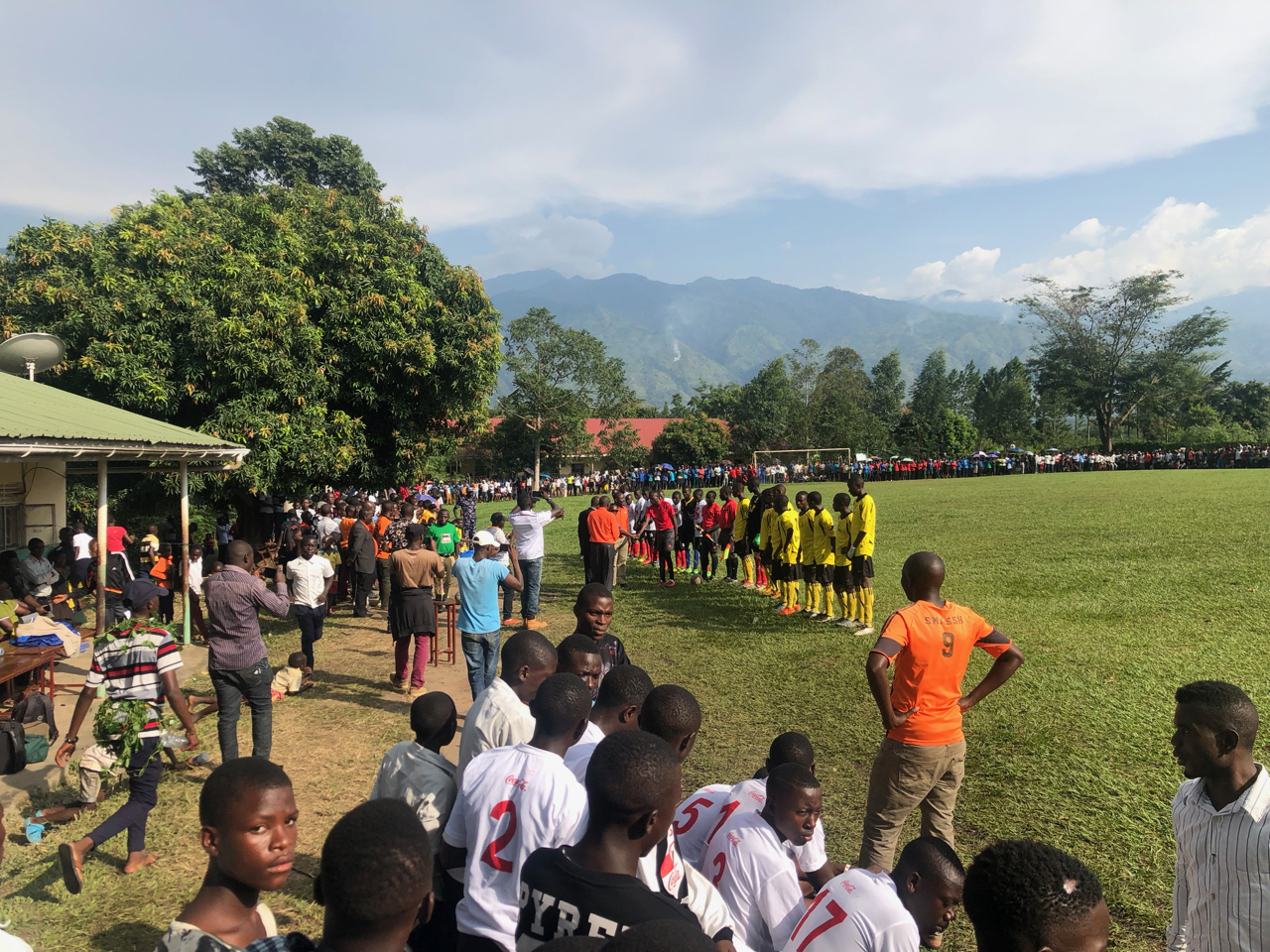
The final match started after 5 pm. CSB students gathered in a group near one of the goals with their incessantly loud vuvuzelas and a handful of hovering staff to keep order. We were near the center field, dutifully behind roped lines with 4 apprentices (one with strong ear drums elected to hang with the student group), cheering and craning to see the plays as more and more people seeped under and around ropes right up onto the lines of the field. Our head teacher had brought UPDF (army) and police for security. There were officials from the district, from the sports committee, from the Coca-Cola sponsors of the national tournament overseeing fairness at the district level. The first half ended 0-0, which was a reasonable outcome as the teams are pretty evenly matched and the officiating quirks were pretty evenly spread. Simbiya students ran the perimeter of the pitch wrapped traditionally in vines and leaves, chanting. Our students huddled in their area blowing their horns. Another thousand people smashed around the field and into the road. A couple of disinhibited men under the influence said rude things.  In other words, kind of normal.


However, after the half-time break, the Simbiya coach and another Simbiya teacher/administrator came out blazing.  As the teams lined up to begin, these two men were shouting loudly in the faces of the onlookers and the officials, claiming that "the bajungu have paid off the referees".  We were five feet away as this hateful angry speech about us was being used to rile the crowds. The uproar delayed the game another 15 minutes or so, with the police saying "just let the kids play, this is their match, stop ruining it" and who knows what the officials were saying. Finally these two men stopped shouting and we began, but the atmosphere was now very tense.

About 15 minutes into the second half, the refs called a foul on Simbiya at about mid-field and gave us a free kick. Our boys played that masterfully and converted it into a goal, the first score of the game. Our students erupted in joy, running onto the pitch and then back over the end line as has happened with every goal in the entire week of the tournament on every side. As they returned, the Simbiya keeper grabbed ?one or two of the CSB girls, and a CSB female teacher Madame Pamela intervened.  She got between the irate goal-keeper and the students.  So the goal-keeper punched Madame Pamela in the face. Bleeding copiously, she was then rushed off the field in the midst of pandemonium.

I ran with Pamela and a student to get out of the crowd and seek help, followed by a the Coca-Cola rep who very helpfully was a head taller than everyone around, very strong, and had a car.  A quick exam of Pamela did not show any lacerations, just a profusely bleeding nose, but she was so shaken and the Coca-Cola organizer really wanted to get out of Dodge so we got in his car to take her to a clinic, blood on our hands trying not to ruin his seats. He had to jump back out numerous times to push rioting students off the vehicle to get out of the gate. We finally made it to the road and sped to Nyahuka where the clinic was manned by one of our old friends and colleagues, who kindly and professionally administered first aid and let us wash off our bloody hands.  I walked Pamela back to the safety of Christ School then proceeded back up the road on foot alone.  I suspect the Coca-Cola guy had fled the district, I never saw him again.

Meanwhile at Simbiya, things went from bad to worse. While we were fighting the melee to get out of the gate in the car, Simbiya scored an equalizer, upon which the field was overtaken by the crowd and the referees feared for their lives.  They abandoned the game, pulling off their uniforms to blend in. Scott gathered the apprentices, Ken the headteacher had all the CSB team and students sit in one spot surrounded by army. The army fired off five tear gas cannisters and fired shots into the air to disperse the crowd. People trampled the fence down into the road to get away from the tear gas. CSB students were coughing and crying. The CSB group stood to march out with the army escort, as Simbiya students threw stones at them. All the way down the road CSB students were falling down overcome by the tear gas, looking for water to wash burning faces, protecting themselves with arms and clothes. Army were chasing ambushes by rock-throwers.  Staff were trying to keep the students together. Scott felt like someone was going to get killed.

But no one did.  There was rock-throwing into the CSB compound into the night, there was increased awareness and security, but a heavy rain dampened tempers and the night passed without further trouble. And in the light of day, we're all wondering, WHAT WAS THAT???  Just rowdy enthusiasm for a game, a craving for victory, an assumption that any score against your team is illegal? Was it the natural consequence of rampant indiscipline amongst restless young men with too much alcohol and time on their hands? Was it simmering rivalry seeking an outburst? Or something deeper?

Are we doing anything that exacerbates the tension? Yes, just be being here and being different, we are DISRUPTIVE. Christ School gives scholarships based on need and potential, not family/political connection. That sends a ripple through the system. Christ School does not tolerate teachers trading grades for sex, or beating students, or holding multiple jobs and never showing up for class, or bowing to the chaos of disgruntled teens, or cheating by smuggling test answers to students.  That disrupts the way things usually run. Christ School asks for accountability, not popular.  But are we doing other things that disrupt unnecessarily, in our attitudes, our manner of relating to the district? Are we communicating superiority or pride? I know I have that attitude and we all need prayer to not despise and judge our neighbors.

On Sunday, Desmond preached to us to love our enemies and to seek to be a blessing to this place.  Now that we've been punched, gassed, and stoned, the challenge is upon us. We hope for the district sports committee to bring consequences, because it is not merciful to allow bullies to ruin the day for children playing football. But most likely, it will all be swept under the rug and the violence will resurface. So how do we move forward in this place, trying to protect our students and do the right thing . . . but not perpetuating division, growing scorn in our own hearts and giving room to hatred in others?

Sunday, March 31, 2019

Why football is so much more than a game

The football season for secondary schools in Uganda is upon us.  And by football, of course, we mean the game played with a ball and your feet, namely, soccer. In the majority world, football reigns as the most universal sport. Kids can make balls out of wads of plastic bags and string, or dried banana leaves. Goals can be as simple as a couple of sticks. The pitch might be a street, a dusty plot, a goat field, a beach, an alley between houses, the lawn around a church or school. Shoes are strictly optional.  The very accessibility of this game, the inclusion of it, the (albeit rare) possibilities for stardom plucking a village kid to become a millionaire, lend a magical allure.  Pretty much everyone has a favorite major team, knock-off jerseys are found in the remotest places, crowds gather around any device that can broadcast a European match. 
So it is no exaggeration to say that the brief but intense school football season garners the biggest crowds of the year, a festive, rowdy, engaged atmosphere. The word "season" here is a bit confusing. Bundibugyo now has 23 senior secondary schools. And true to form, it has taken almost two months of the 3 month school term for most of those schools to pay the dues needed for the sports association to manage the games.  So the season for the boys has consisted of 4 games in 3 days, all played at CSB (other locations were operating simultaneously for other schools) in a modified group-stage play-off.  This narrows the district pool down to 8 male teams for quarter finals (to be played Monday) then semi-finals and finals (both planned for Wednesday!).  Then the girls get their chance, two days of games Thursday and Friday. It's a one-week, nearly every-day (sometimes more than once-a-day) marathon of games.
Madame Illuminate, who has worked tirelessly to organize the whole district season!

Our team looks good! At the beginning 20 years ago, the district only had a handful of schools and we regularly went to nationals.  Now the competition has increased, and there is a regional layer between district and nationals. Most recently we have no longer been winning the district, and THAT CAME UP ON NEARLY EVERY SURVEY SCOTT DID WHEN WE ARRIVED.  Staff took the football losses very seriously.  But this year we have a former student who is coaching, Happy, and we have some kids who've been in the program a couple of years and learned and grown. They control the ball, pass, play as a team, exude confidence.  The first three games we won 4-0, 5-1, and 9-0.  Scott asked Ike one of our new Serge Apprentices to make a score board, and that was a huge hit and focus of celebration. Our students surrounded it and sang the school anthem!
Our pitch, teams shaking hands before game
Match days start with horns and shouts at dawn as teams warm up. Classes are rescheduled to occur early mornings or late evenings so every student can come out and watch the games.  Probably a thousand people or more come to watch. There are vuvuzelas, a la the South African world cup.  There is marching, chanting, drumming, animated coaching from every sideline, jubilant screams from supporters, face painting, concessions. There are uniformed police officers with long sticks trying to maintain the onlookers at least a few inches off the side and end lines; and UPDF soldiers with massive guns. After one game our teachers had to help get the ref's off the field safely when angry losers stormed towards them.
see if you can pick out the camo and gun 
The intensity built through the first two days to yesterday's "playoff" between CSB and a school recently started by former teachers who broke away from CSB to do their own thing.  They were better than the first three teams we played, and we were rattled, a completely different team than we had been. The refs were calling offsides on people dribbling the ball towards goal, and once when our player intercepted a goal kick done by a defender with the keeper at his side. It was not a pretty game, and ended 1-1. Which prompted a penalty shoot-out, the crowd pressing in towards the goal, the players taking their shots. We ended up winning the shoot-out 4-2.
coaches preparing team for shootout with a pressing crowd of onlookers
the shootout in process

We were happy for the win, but the painful reality was that the students clearly saw that the crowd was against the school.  When our players hit their penalty shots, the only cheers came from our students. When the other team scored, the entire crowd went wild. It was our "home field" (we have by far the best pitch in the district) but the lack of community support felt sad for the kids.
the boys' team doubling as a choir, showing leadership at chapel!
Which brings us to chapel this morning, and a stunning sermon by Desmond the math teacher who is the longest-serving staff member. We've been studying Exodus.  He chose three texts, and I will try to do justice to his points.

  • Exodus 4:1-14 when God calls a reluctant Moses and gives him signs, then brings Aaron in to be the spokesperson. Desmond applied to the CSB community by saying, you are in a community that does not fully trust and embrace you. Like Moses, we humbly tell God that we feel inadequate to the task. We appreciate times when God dramatically helps us and marks us with His favor, and we acknowledge that we need each other as a team just as Aaron and Moses complemented each other.
  • Mark 6:1-6 when Jesus explains that his hometown, Nazareth, rejected him. Desmond pointed out that hometowns want to keep us all level, even Jesus' neighbors were skeptical and eager to cut him down to size. It should not be shocking to students to face the same challenges that Jesus encountered. Of course there are many who love and support the school too, parents and leaders, but there will also be a significant crowd who cannot wish us well.
  • Isaiah 61:1-6 the prophecy about being sent to bring good news to the poor, freedom to the captives.  Desmond said, you might feel like this community is your enemy. But Jesus says to love your enemy. This school is not just here to be a great school or enable our students to get ahead in life.  This school is here to bless the entire community. Whether we feel liked or not, our mission is to live the Gospel. To model humility and respect. To turn the other cheek, to play and study and then use our gifts to help everyone around us. This slowly brings transformation.
What a powerful way to bring the reality of the football experience into a loving focus. Not a message of "God is on our side so we must always win" but of "we are here to serve God and our neighbors". 

So, football is much more than a game in Bundibugyo and I suspect many places.  It is a training ground for teamwork and discipline. It is a gathering point for wholesome community passion and fun. It is an opportunity to build confidence and loyalty and to begin writing new stories for kids who have always felt themselves to be at the bottom of the world's pile. And it is a learning lab for embracing the Gospel, responding with love and vision to a community that does not always cheer our way.


Saturday, March 30, 2019

Simple to say: there is gash, then balm.

This line from today's poetry on the Biola Lent readings site (Temple Gaudete by Lisa Russ Spaar) captures the arc of history.

And the season of Lent simply stops us from slathering on all the substitute salves for six weeks, living in the reality of that wound and waiting for the true healing ointment. It is like washing off a year's accumulation of self-protective comforts, inward focused anesthesia. There may be some bleeding as the wound is cleaned, but that friable surface becomes the site of new growth and eventually, a sturdy scar holds us together.
Chagall captures the gash and the balm

For us, the 2019 Lent has many layers. This season has coincided with a return to Bundibugyo with all its beauty and brokenness. The journey up is a journey down. Literally, into a rainforest tropical valley, redolent with cocoa and echoing with birdsong. It's a place that could have been the Edenic cradle of life, only it has also become a lightning rod of the curse, an epicenter of malaria and sickle cell disease and excessive infant mortality and malnutrition and, historically, Ebola. A complicated undercurrent of fears stirs up conflict. Once isolated and suspicious, and now rising with more confidence. Yet there remains a thick spirit of hiddenness, passiveness, clinging, lethargy, desperation that drags people down. It is painful to watch our friends suffer. It is painful to hear our team doubt.


It is difficult to write fairly and inoffensively. It is easy to sound overly dramatic, except that when you look back over the trail of people chewed up and spit out, or talk to Ugandans who have lived in many parts of this country and enter this one with such hesitation, you can't deny this valley has some serious shadows. My equanimity falters when faced with ?50 ?60 ?more inpatients, a disorganized pile of mixed files and frayed exercise books, kids on mats on the floor between beds, staff hours late and more than half absent, medications not given, labs not done, plugging person to person to take my own vitals, history, exam, write briefly scribbled assessments and orders that probably won't be completed, eye out of the masses the five or so life-threatening-today kids in the crowd. A wasted pale twin who needs an urgent blood transfusion, a 1-year-old admitted for diarrhea who is hypoxic with pneumonia and needs oxygen, several with racing pulses and untreated infections, a deeply jaundiced 4-day-old, and a 14 year old boy who has bounced to us from several other clinics because no one has recognized his appendicitis. These are all things we should be able to treat, if there is the will, but I recognize that my will is also faltering in the face of so many walls. Later we try to untangle the complex web of stories that tangles us in school issues. We sit and listen, we pray and enjoin. It's hard to know whether that helps. Haven't we been holding this line long enough? Pushing back against these particular evils? Maybe it's just the second knock-down sickness of the month edging me to darker thoughts, maybe it is having Caleb in the unknowable limbo of Special Forces tryouts, or Luke and Abby working day and night through internships, or Julia looking for a job so she can survive on the part-time church work she's doing, or Jack about to be the final Myhre launching from college.

 Everything in the world tells us that the answer to "shouldn't this be easier" is yes, in one's later 50s after over 25 years in this work, it is time to have reliable electricity, functional systems, temperatures that don't drain the life out of you, the possibility of sitting on a porch uneaten by swarms of insects, reasonable options to buy groceries or refill airtime or get to an airport. It seems sensible to think that specialized experience should garner some position where people listen and learn? Is this a strategic place to invest so much? Would this team's gifts go further if they were poured out in more receptive climates?
Then the season reminds us, this is the path of the cross. 

Oh, the gash. 

This Bundibugyo team, and the partners we have in Christ School staff, BundiNutrition Staff, medical colleagues, the construction/compound team, the Bible translators, the accountant and administrators, these human beings are all living sacrifices. If you've read this far, please pray for them and us. For willingness to do hard things; for belief that in that moment the balm will come. For willingness to put down roots in a difficult place; for belief that in that clinging we will find Jesus. For choosing to love a place that wounds us; for belief that in so doing, God's balm will be enough.

CSB girls cheering the football team on to victory

Stephen and Basime running the concession stand

The football team, so far 3 wins/0 losses with a goal differential of 17 . . playing again in a few hours

Mary, Pamela, Susan, Topista at CSB

Dramatic skies to match the mood

Spent an afternoon teaching Serge Apprentices on "Unsettling Cultural Situations"

Bundi team courtesy of Stephanie taking photo, after an evening Ultimate Frisbee game. Love these people and hopeful for prayers to sustain us all!


Wednesday, March 20, 2019

Kibuye, the presence of hope and a model of perseverance

This week in Kibuye was our fourth trip in 8 years of cheering from the sideline as our Serge team established an outpost of medical education and care for the poor in rural Burundi. The team has tripled in size, as has the compound of homes, as has the hospital, with new wards, oxygen, a solar electric system, new operating theatres, appropriate-technology locally fabricated incubators for premature babies, specialized ophthalmology equipment and an expanded plant to make nutritional supplements. If you build it they will come, and hundreds of patients present each day, attracted by the competence and compassion. They come in labor to deliver their babies, they come with festering wounds months old, they come with broken bones and traumatic injuries, malarial fevers and twisted bowels.


How does an initial group of medical students find themselves over a decade later staffing a simple hospital, pushing the boundaries to make it a premier teaching center in a very needy place?

Vision, certainly, for investing in a rising generation of local doctors, for hands-on care for the poor with as much excellence as limited resources will allow. Connections, partnership, fundraising, for sure, hundreds of thousands of dollars worth of construction and equipment to just get some space and light and cleanliness, some water and power, nothing fancy. Courage and patience, to live initially in crowded spaces without amenities, to plug through language learning and to see problem after problem beyond any easy solutions. Humor I think, to not let the setbacks swallow you, and community, the kind of friendship that steels one to put their kids and lives on the line as part of something larger.

But mostly, it’s endurance.  Being present in a hard place, listening to local partners, voluntarily setting aside the path of quick fixes or domination and working from the ground upward. This visit we stayed in a lovely guest apartment, with hot running water (solar), plenty of electricity, appliances, a comfortable bed. We rounded with the team on patients who had vital signs documented, who were getting IV medications, who were recovering from complicated surgeries. We attended church where the Gospel was powerfully preached, and where the pianist, guitar, and vocalists led with talent and Spirit. It was not always so. Coming in 2019 one might not appreciate the pouring out of life necessary to negotiate, to construct, to organize, to build relationships, to adapt. 


As we head towards a decade, the momentum is palpable, but the challenges never cease.  In the last week, for instance, the hospital lost several generalist doctors to transfers to the city, entered a period where no medical students (upon whom much of the care falls) will be rotating for the foreseeable future, had one Serge doc leave suddenly for a family funeral and faced a planned week of specialty surgeries thrown into question when another visiting missionary doc got held up by visa issues. It is a resilient community but the prospect of trying to stretch to cover even greater gaps, when already working crazily hard, looks daunting.
Please keep this team in your prayers. Rapid, expanding development stretches the soul, too. They work in three languages, continuously.  Caleb our engineer supervises 146 Burundian construction workers, meaning they have a steady meaningful job that provide for their families, but it's a huge weight of responsibility to do that and keep the essential infrastructure intact. We have ten doctors with very little specialty overlap, so everyone is full-on at all times, but even moreso now with the staffing gap. Pray for supernatural patience and quick resolution on hiring more local doctor help. Our docs do much more than patient care; they disciple the chaplains and students, work with the administration on vision and planning, lead Bible studies, travel to Bujumbura to teach medical school classes. Though we have 3 full-time professional teachers for the 18 school-age kids, six other moms (some of whom are trained teachers too) pitch in several class periods per day. Without a school, none of the other work would go forward. And the 15 non-doctor adults not only build buildings and teach school, they work with the malnutrition programs, help with microenterprise, raise funds for the neediest patients, track all the donor spending and administer projects like ward construction, care for wounds, help with the retinoblastoma program, provide lactation consultation for the NICU moms, invest in therapeutic play with admitted kids, run an informal preschool (there are 7 kids too young for school yet!), and spend many hours investing in hospitality. All while living in intensely interdependent community, where the grocery store is hours away and every normal life activity is harder than you thought it should be.


We are hopeful for them, and for Burundi. The first two Burundian specialists (surgery and ophthalmology) have been appointed, both men who were trained with the help of this Serge team. The vision is to raise up a new generation of Burundian young leaders who can help their country overcome the effects of genocide and poverty. It is starting to happen.

Tuesday, March 19, 2019

Bujumbura Welcomes YOU!!

Between 10% and 20% of Burundi’s population lives in the sprawling lakeside city of Bujumbura. Wide avenues and palms, portside industry, gracious beaches, crumbling concrete buildings dotted with ambitiously modern ones, throngs of bicycles carrying anything from matoke to passengers, chaotic intersections, vibrant informal housing areas, a tropical sunshine and a mountainous view into Congo. Grilled fish and sweet mangoes, dust washed by afternoon downpours, a cool breeze by evening. A population which has known unspeakable trauma, wary and yet determined to emerge into the world scene. Universities, cafes, orphanages, markets, coffee roasting, artsy sewing projects. The early morning flood of villagers descending the surrounding hills on foot, carrying baskets on their heads or pushing carpentry projects on bikes, chatting with school mates or stopping to buy bread. Bright colors and matching patterns in the cloth wrapping women’s waists. Central Africa with a French touch. An international church committed to reconciliation, preaching a Gospel of peace, embracing all ethnicities.

We spent four days in the city to visit our team leaders Randy and Carolyn. They are second-career missionaries, people who left behind academically renowned and reasonably lucrative careers, a beautiful suburban home, young adult children, nearness to friends and family . . . and decided to invest their 60’s into one of the poorest countries in the world. Randy serves as the Dean of Hope Africa University’s medical school, and Carolyn teaches English. By the words “dean” and “professor” you should not conjure images of paneled ivory towers or comfortable lecture halls.  Instead, picture the kind of vision and audacity that makes this continent shine (even as it frustrates some of us to distraction): a university founded on sheer determination, by Burundian exiles in Kenya during a genocide, who then returned to their capital to equip a new generation with hope.  Cement buildings, cluttered offices, throngs of students, pockets of well-equipped resources like labs or microscopes but minimal basics like computers or books.  Packed classrooms where students must sometimes compete for chairs. The scramble to keep up with changing government targets as this emerging economy makes abrupt decisions about education. Up to a quarter of students coming across the borders, mostly from Congo, because they have no options nearer to their homes.
Randy’s job might best be pictured as designing 60 or more simultaneous but non-overlapping pathways through a maze. Medical students enter from several countries, after various courses of study, and embark upon pre-clinical classes and clinical rotations designed to produce competent doctors in 6 years. Only at any given time, any given course may or may not have funding or professors or space, so it turns into a multidimensional jigsaw. Randy designs curriculum, arranges professors, teaches in the classroom and on the wards, coordinates visitors, contracts with the public University or private experts for specialized instruction not possible from HAU staff, negotiates with hospitals for rotations, and even raises money for scholarships. Carolyn gets assigned English classes, from beginner to graduate, from ten students in a discussion group to 60 in a crowded classroom, usually with only a week or less notice, constantly changing schedules and hours.  HAU is a bilingual university, where French and English are both used for instruction.

Serge Bujumbura needs help. Hope Africa has hundreds of Engineering, IT, and nursing students with few qualified teachers. We could use 2-5 year commitments from people with a master’s or beyond in those subjects, or any of the basic sciences. The medical school can use pre-clinical science (pathology, anatomy, etc.) professors as well as specialists to teach shorter courses such as neurology or psychiatry . . . these can often be done in 2-4 week blocks. Speaking French is a plus, but we can send you to France for a year to learn first if you are long term.

The good news is this: because of the Bond’s service the last five years, over 200 new doctors have been added in a country with one of the lowest doctor-to-population ratios in the world. A hundred more are in process. They have entered into the Christian community of the city, mentoring and supporting other workers, preaching in their church, offering hospitality. Burundi is not an easy place to get to, or to stay in, but there are many young families making it work.

Email us, or use this Go Form link to get more information. You may enter a difficult path, but you will never regret it.