rotating header

Friday, November 15, 2019

Let's not repeat this week . . .


A week ago we pulled into Bundibugyo on a Friday evening, having flown back from the USA, spent one day doing errands and resupply in Kampala, then driving across the country. We went to bed for the last time Friday night in the borrowed Dickenson house and woke up Saturday to news of my dear friend Robin's death. No time to grieve because that day we had to move into our new/old house, loading up the last carload or two of suitcases and groceries we had lived out of since last December and bringing it across the road into the freshly repainted, re-wired, re-plumbed and cleaned house in which we raised our family for 17 years. All our Kenyan furniture, books, clothes, sheets, curtains, etc etc had been stashed in a container 11 months ago then hauled across two countries in August then moldered in a dusty ratty store room a few months. Each piece of a bed or chair, each trunk, had to be washed off before it was installed/opened. A few of our team mates were able to come up to help for a few hours, which was tremendously important. Our goal was to get all the junk dusted/cleaned a bit and into the house, and a bed set up that we could sleep in that night. Six days later we have a functional kitchen (except for the fact that the electrician came to work on a final step last night and turned our power off for the last 24 hours, not so helpful for food storage). We have places to sit to talk, and to eat. We have books on the bookshelf and clothes in the wooden wardrobes. The guest room is still a pile of curtains and blankets, and the office pass through is still cluttered with unopened boxes. But we can affirm that we made a huge amount of progress by staying up late and hauling and discussing and sorting and repacking. The second phase (curtains, pictures, rugs, office) will take another couple of weeks I'm sure.


Having a new puppy helps attract workers

Moving, transition, is just plain hard. It is hard to re-learn patterns, to find keys and the coffee filter and your toothbrush. It is hard to get filthy things clean and dry when it rains much of every day. It is hard to put the energy into yet another home, though a bit easier since this is round two on this one. It just takes tremendous energy to go through days without ANYTHING being easy and routine; such is the nature of crossing cultures and making moves. It is hard to live in the spot where the most significant parts of life occurred, without 4 of the 6 people involved. It is hard to focus on trivialities like shoe storage and trash disposal when being pulled into much more significant issues. Still, we know that a spot of visual peace will sustain our souls, and our bodies need a place to exist in the minutes between crises. And hospitality has been a crucial part of our life. We got the first taste of that last night, as our team of 23 came for pizza night, and we added in two freezers turning of homemade ice cream to celebrate Scott's birthday.


Bwindi the birthday dog

Meanwhile, our push to get ourselves settled this week had to be squeezed into the gaps in the tension of the four other huge parts of our job.

Team-we are the de facto leaders, trying to have meetings, organize the finances, supervise, plan, meet with individuals, and on and on. We're not doing a superb job. We used to be much better at this. We are weak and even though the Bible keeps saying it is GOOD to depend on God, we need some pretty big prayer here.  We have pulled together the essentials, and we have a great group of people independently moving forward, and helping each other. We have our son John Balitebia without whom we would surely be lost; he's an accountant and Scott's right hand on team and CSB matters. This week we added the Dickenson family back, having grown to five with the birth of Benjamin in September! And we welcomed Lindsey Knapp who had interned here for a summer three years ago. Ready or not, the team is growing.


In our weekly team meeting we are working through Bethany Ferguson's "The Mission Centered Life"

CSB-Scott is still up to his neck in CSB affairs, and there is always something.  The jungle basically pulled down another section of fence. We discovered the social security taxes had not been paid all year. A teacher had to be let go. Thankfully the O level (UCE) exams finished without any scandal, and A level (UACE) exams started. There is a weekly leadership meeting, weekly chapel afternoon, weekly Sunday services. We are getting ready for a board meeting next week, and the next court date for the land case. Our main witness changed his mind and now wants to retract his testimony.  Policies are always in question and needing shoring up. Again, weakness. It's too much.

Medical-Monday was one of the most hectic days I've ever spent on the Peads ward, and that's saying something!! Expected help had last minute issues, patients had accumulated all weekend and were literally spilling out the hall into the sidewalk, every space crowded and every case difficult. This morning I had five in a row who would have been in an ICU most places: hemoglobins less than five, oxygen saturations in the 80's, respiratory rates 60, 80, 98 (!!), heart rates 188 or an ominous 85, moaning, grunting, lethargic, pale. Malaria is a wicked disease. The nursing staff was mostly absent for various reasons, the blood supply had trickled to zero whence we all realized that the person in charge of documenting and ordering had stopped doing so due to a personal family member with illness that took away his full attention, the oxygen cylinders had not been exchanged since emptying, and the night staff had run out of essential meds.  And on and on it goes. Dr. Isaiah, one of our Kule scholars, was with me and what a life-saver--he ran and got one of the only two units of blood left (both group B, but 2/5 kids in shock were group B !), made sure IV's were in, pushed malaria meds, talked to patients. Dr. Ammon found an ambulance from a smaller health center willing to take the closest-to-death child to Fort Portal if I paid for fuel, and thankfully Scott had handed me some money so I did. Jessie found a guy with a wrench to work on the oxygen cylinders.  I kept plowing through the ward, found a child with a probable brain tumor, two with mysterious hepatitis quite ill, and while some horribly infected lesions were improving one was probably entering bone, a six-year-old with TB. If ampicillin, artemether, or abscess drainage can save your life, Bundibugyo is the right place.  For everyone else, it's stressful. There are a thousand things that need to be improved, and yet every day I am there I just try to keep my head above water. Again, feeling inadequate.


Highlight of the week: the hand-carts that Rhett got donated and Marc cleared tediously through customs were finally here, and distributed to people who have been crawling on the ground their whole life since polio.

Area--yes, we are still supporting our teams across East and Central Africa. Between travel and moving and the last two months of the 20-year celebration, the language intensive, the Bible Storying week of seminars, doubling our team size . . well, our attention has been thin. Ebola has finally started to taper off in the DRC. Building projects are marching on in Burundi. Kids are being taught and coached and mentored all over the region. Our emerging Malawi team leaders made another vision trip with potential partners. Our Ugandan NGO registration was updated and our Kenyan company forms are still in limbo. Some under-the-wire visa pressure had a happy ending, and many others are still in question. Our apprentices from Uganda and Kenya will meet up on Monday for a prayer trip to Litein.

Tomorrow my mom and sister will represent at a funeral I hate to miss. We will be here plugging along, doing a lot of things marginally, wresting a tad more order out of chaos around us, and praying for a new season of God's presence and grace.


Tuesday, November 12, 2019

Robin Maury Hutchison Iida: A tribute of grief and memories from across many miles and years


Robin Iida was my best friend growing up. Basically until I met Scott. We both got married in our early 20's (my dad walked her down the aisle; she was my only non-sister bridesmaid) and our paths diverged, but from about 1rst grade until college we were kindred spirits (our preferred Anne of Green Gables term for friendship). We met because Robin's aunt lived across the road from my family in Herndon, Virginia, and our moms became friends at a pivotal time. Pivotal, because Robin's dad died that year, and my family absorbed hers into a circle of four families that created a little community of shared faith, geographic proximity, carpools to the same small Christian school and church and Pioneer Girls' group. Robin was two years ahead of me but we were the oldest girls; the other two families started with boys. So, friends. That friendship deepened into kindred-spirit-quality though untold numbers of slumber parties, books passed back and forth as we both loved to read, forts built in the woods, paths explored, dress-up and imagination and drama, sewing and crafts (who remembers decoupage and counted cross stitch?), camps, vacations, homework.

Robin died on Friday. She was 59. She had a sudden hemorrhage in her brain from a burst aneurysm, one of those 1 in ten thousand kind of rare events that upends a life. The initial bleed occurred the prior Saturday; we got messages during the party Abby's parents threw for her and Luke. We were able to go see Robin and family in the ICU in Washington DC the next day and in spite of all she had been through she opened her eyes in surprise at my voice. We prayed for her. By Monday she was off the ventilator and whisper-talking, and through the week as we flew back to Uganda we all had great hope. But on Friday a second and larger bleed occurred, and in spite of high levels of care, she died. Her community now will remember her for her four wonderful young adult children, her three and one-on-the-way darling grandchildren, her marriage, the musical gifts she shared with her church and other groups, the international students to whom she gave a home, her active role in making this world a better place. But I have been thinking of the earlier part of her life, and the unique gift of her friendship.

And if I had to sum up that gift in two words, I think it would be smiling grit.

For some reason, we were both quite concerned about our knobby knees. I'm not sure I've even heard that term in the last few decades but as pre-adolescents we looked at our bony legs in despair, feeling awkwardly gangly, and talked about those knees a lot. We both loved to play soccer, but were never the first-picked athletic types, not particularly muscular or speedy or coordinated (though in our small-school world that didn't put us off the teams, just off being stars). We both liked boys, but never felt like we were the most beautiful or interesting (in our world, that did not mean zero dates but did prevent the status of cheerleaders or the homecoming court). And neither of us hit puberty with sudden graceful curves. Our hair difficulties were opposite: Robin's sandy blonde straighter hair was thin but cooperated with the 70's allowing her bangs and feathered layers. Mine was kinky curly thick and unruly and very much NOT blonde and I thought at the time, along with those knobby knees and flat figure, socially irredeemable. Trivial as it sounds, navigating growing up as a girl is a thousand times more survivable with a companion. So the first thing I have to remember about Robin was the life-saving effect of having a knobby-kneed partner who could commiserate, normalize, and LAUGH. Yes, Robin taught me to not take my self and my hair and figure woes so seriously. She exuded a kind of strength and spunk and humor that let us be ourselves. We didn't mourn about it, we made it funny. We had clubs and codes and secret languages, phrases that could send us into doubled-over giggles. I think all girls look around and assume everyone else has it more together than they do. So having a true soul friend walking through all those adolescent years with laughter, was priceless. (And I should have done more of this for my sister, but am grateful for Kristin who was the parallel in her life).

Secondly, and probably related to that ability to take life with humor, Robin swam against the current. We attended a very conservative Christian school in primary and middle and early high that met for years in a massive Victorian house in Leesburg. Then by a tragedy of county lines dividing us, we went to separate public high schools. Looking back, I think Robin shored up my own determination to find the path less traveled. She was an artist at heart, a talented musician with an eye for beauty. She married a first-generation Japanese American, and embraced his cultural heritage (one of my high school friends actually, so it seemed quite normal to me then, but in 2019 eyes I can now admire the courage of that decision). Perhaps losing her dad so early, perhaps just her personality, but she had a core determination that did not bow to changing tides. She decided to have all of her children as home births, even when she was a bit high-risk. She decided to home-school them creatively. She supported her first son's desire to train as an officer in the marines, and her daughter's passion to become a professional ballerina/dancer. She and Ken were never financially rich, but they made their town-home into a place of nurture for their own family and many others. Robin had opinions, and she did not mind those being different from the majority. Her goal in life was never wealth or success or fame; her goal was to be faithful, to serve others, and to sparkle. She was loyal, protective, assured. And again the humor let her stand against the flow without being obnoxious. While her adult life remained within a few miles of our childhood homes, and her adult focus within the walls of her own home, and mine went out towards medical school and Africa with all those miles and all that immersion in a more public arena, I think our kindredness of spirit is that we both made choices based on faith, hope, and love. We both risked the less expected paths. And I suspect that those choices were possible partly because of the strong foundation we gave each other.

Today is Scott's birthday. From the late 60's to the 80's Robin gave me her grit and her smile; from the 80's to now it has been Scott. Losing Robin makes every birthday a wonder. Objectively, Scott has nearly died multiple times but here we are. This year has been one of the hardest ever, wresting Christ School from the brink of demise, moving away from the slightly more do-able comforts of near-Nairobi to the decidedly more tiring life of the Uganda-Congo border. I know Robin's family needs her just as much as our family and community need Scott. It's not fair. God's mercy is an inscrutable tangle that I cannot justify and explain. I can merely be grateful today for Scott, and ask Jesus to walk closely with Ken, with Robin's mom Kay, and my mom, and all our siblings and friends. I can ask Jesus to be a presence of peace in a time of anguish. I can give testimony to the assurance that Robin's death and Scott's birthday are both redeemable mercies, even if one feels severe, in the end all shall be well.

I wish I could be with everyone who loved Robin on Saturday at her service. I wish I could find photos in the chaos of this move. But these words are all I have to give today. Rest in peace Robin.


Monday, November 04, 2019

Celebration: where the paradox of connection and creativity cross


"This touches on a real paradox: as humans, we crave belonging, we need the connectedness to others that brings security, but this connected ness can prevent the natural movement and evolution that we need in our lives.  It can also get in the way of creativity and stifle the natural loneliness that pushes us to discover something new, that pushes us closer to God . . . we are caught between competing drives, the drive to belong and be a part of something bigger than ourselves, and the drive to let our deepest selves rise up, to refuse the accepted and the comfortable. . . it is in the group that we discover what we have in common.  It is as individuals that we discover a personal relationship with God. We must find a way to balance our two opposing impulses. " Becoming Human, Jean Vanier.

(All quotes from chapter one of this book, highly recommended.  Raising children, getting married, this is about becoming human.  Human in the glorious sense of that word, soaking in love, being refined into the imago dei.)


"There are, for me, seven aspects of love that seem necessary for the transformation of the heart. . . The first is to reveal someone's beauty, to reveal their value by giving them time, attention, and tenderness. . . To love also means to understand, and this is the second aspect of love."

(Abby's parents said their goal in this party was for Luke and Abby to feel loved. I think they succeeded grandly, because this night was just the flowering flame on a bush of days and years of loving, giving, noticing, protecting, honoring.)


"The third aspect of love is then communication. Communication is the heart of love.. . understanding, as well as truth, comes not only from the intellect but also from the body."

(Vanier writes from the perspective of a life with persons who have intellectual different-abilities. When we reflected on this wedding, we all felt one of the highlights was the giftedness of our nephew Micah, his unabashed joy in dancing at his cousin's wedding. He carries an open-hearted curiosity towards others, a passion for music and rhythm, a delight in being in the middle of the crowd, that lifted all of us to a better place. Both Luke's and Abby's family have members with a spectrum of different genetics and life-long challenges, and we are the richer for it. And Luke is one of the few doctors I can imagine who would have connected with a Congolese refugee janitor so meaningfully that he would also brave the journey and crowd to join in.)


"The fourth aspect of love is celebration. Every child, every person, needs to know that they are a source of joy; every child, every person, needs to be celebrated."

(Those are celebrated faces right there. It takes a village as pictured below, to help convince someone they are a source of joy. And the effort and sacrifice these people made to come and be with us . . we are so grateful.)


"The fifth aspect of love is empowerment.  It is not just a question of doing things for others but of helping them to do things for themselves, helping them to discover the meaning of their lives.  To love means to empower."

(I'm not sure we helped Luke discover he could do things for himself, so much as gave up trying to prevent him. Still, a wedding is a milestone of launching, a time of leaving that must precede cleaving to a new loyalty.)


"Communion is the to-and-fro movement of love between two people where each one gives and each one receives.  Communion is not a fixed state, it is an ever growing and deepening reality  . . [of] mutual vulnerability and openness."

(Abby and her sisterhood, perhaps most significantly Ruth (second from left) and her new sister Julia (far left). Vulnerability needs practice, and that is difficult in a culture of shame, of canceling, of taking the easy road of scorn rather than the harder road of empathy. We should all be on our knees over the fear of vulnerability in our world right now. We're a mess, and God loves us anyway, and in that very fragility we find beauty. Truth.)
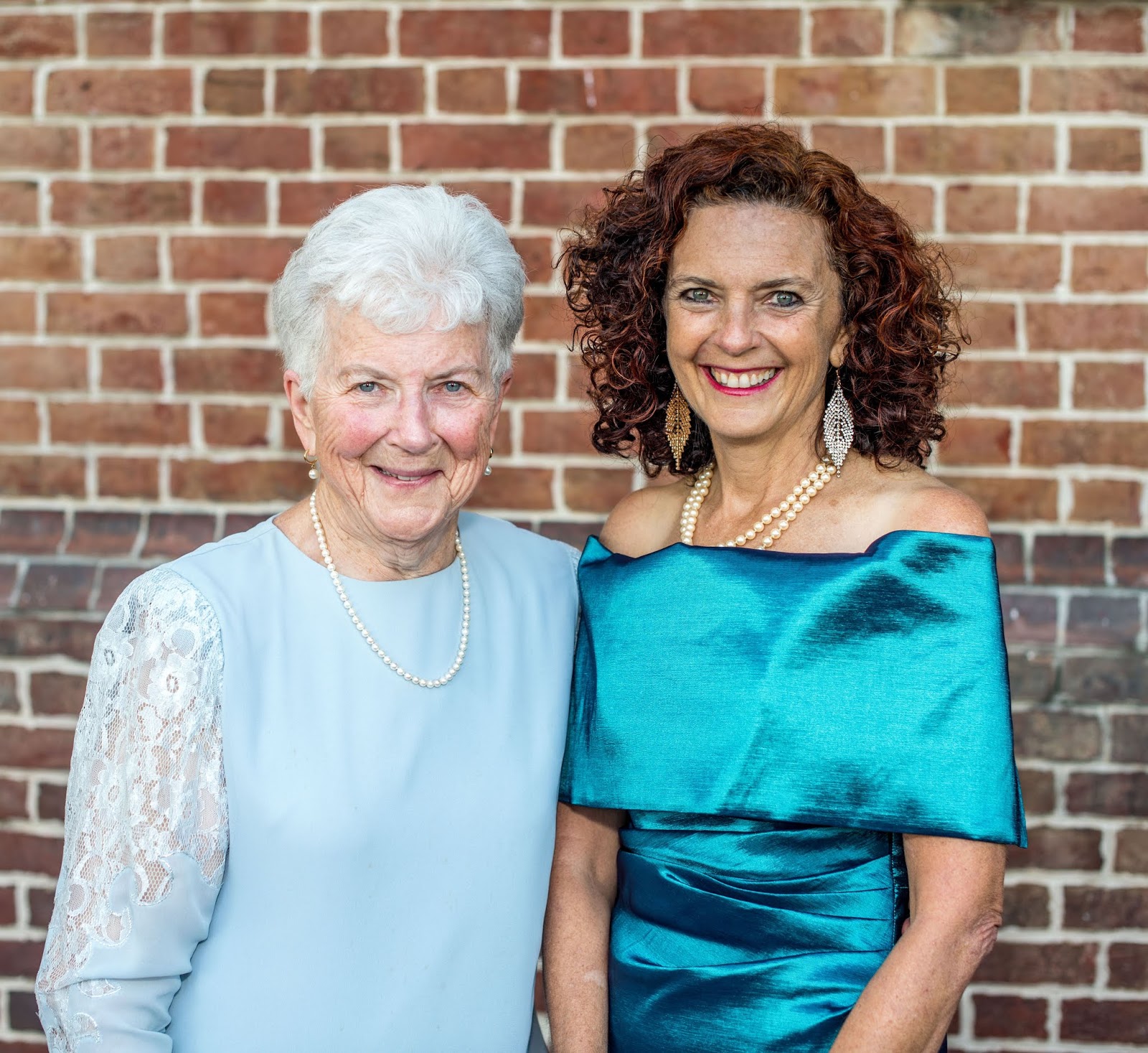
 (My two generations, daughters and mother, a bridge between)
My mom brought out the same dress she wore to my wedding 32 years ago.

(the Myhres)

"There is a seventh and final aspect of love, and that is forgiveness. All of us carry within ourselves brokenness, as well as shadow areas, dark corners of the spirit. Human beings cannot be constantly attentive, loving, and nonviolent. [we must] learn that is is acceptable to be less than perfect."


(These seven taught our four kids at various stages in Uganda, forging life-long ties as mentors and friends. Surely that's what living a forgiving life looks like, being able to encourage and empower children and having the joy of watching them grow into adults).


"There was a place where much of this spiritual struggle and growth occurred: in prayer.  For most people, prayer necessitates stepping back from the pains and joys of daily life. That vision we are seeking together . . is to create a place of love and belonging.  Prayer is a time to let the light flow into our lives, to literally 'enlighten' each day."

(Light was flowing this weekend. A celebration is a form of prayer, a time apart, a sparkling glimpse of eternity. Keep praying for Luke and Abby who have been plunged today back into trauma and impossible situations and sleepless nights. Pray they would seek the primary connection of their own new community of a family, and they would take their aches and loneliness to God. Pray they would be strengthened by love to risk, and that sacrifice would bless this world.)

Friday, November 01, 2019

When the "ordinary" feels extraordinary

The last six days have been what I imagine to be ordinary in a life-path not taken.


Day one, driving down to see our son Caleb who is in the army.  He greets us with dinner salads and gives us his bed, we wake up to walk a few blocks into town and stop for coffee and browsing the farmer's market. We drive his usual commute to base, past buildings where he normally attends classes or signs in and out, to a museum dedicated to Airborne and Special Operations. There we can browse history and ponder that someone first thought of deploying troops by parachuting out of planes less than a hundred years ago; we can hear stories of the current training.  We end the day with an hour-and-a-half drive to our daughter Julia's apartment, making dinner together.


Day two, church with our two middle children, worship and meditation.  Then my sister stops by with her husband and son on their way back to their home, and we hop in cars to drive to downtown Greensboro for the one-year party celebrating a social enterprise sort of French restaurant.  Julia's room mate works here, and the bold dream of affordable excellent food created and served by people with different-abilities, providing not just a job but a sense of accomplishment and purpose, inspires us all. Julia's church has an afternoon Swahili service (!) which feels like home. And afterwards the diverse congregation carries tables into a long line for the annual harvest dinner, celebrating the garden project Julia works on that has reclaimed land for nourishment and beauty. 20% of their produce is donated to combat hunger.


Days 3-6 find us in West Virginia, at our farm, with Luke and Abby and their new puppy Botu. This is their week of vacation, and they have taken part of it with Abby's family and for the upcoming wedding reception. But in the midst of that we get three full days of normal life. Making pizza, making gourmet tacos and pastries, hiking in the woods and dipping in the chilly autumnal river. Brilliant blue sun gives way to leaf must and misting skies. We talk, they work on studies and projects, there are bike rides and coffee. Mostly there is the delight that only a puppy can bring with his whole-body quiver of joy, his antics, his exploration, his snuggles. Caleb re-joins us for the last day, which as Abby points out brings out the best in both brothers.


Six ordinary days, the kind of life I imagine other families experience on weekends or evenings. Pruning trees or washing dishes, rolling dough and hanging up laundry.

Only in our life, these days are fractured by thousands of miles and months of absence. We took the ordinary from our parents by moving to a far country. And now we take it from our young adult children by staying there.

So when those days can be wrested from the flooding speed of time, they are beautifully extraordinary. And perhaps all I can say is that the ache of the absence of days like these, and the depth of their goodness when they come, causes a deep chord to resonate. So that we know we are created for something like this, for connection, for living in proximity to those we love, for sharing sunshine and red leaves and good food with them. And while we love the independence and courage of our kids, and we love the deeply meaningful work God keeps in front of us, those realities come with a cost and the cost is real.

It was an extraordinary event that called us across the ocean this time, so the final four days of our ten-day visit will be rich as well--a weekend of celebrating Luke and Abby's wedding with a reception in Annapolis, a visit to Grace church and a day's Ebola vaccine follow-up at the NIH. All very good things. But the six days of ordinary are what I think I will treasure most as we go back, and those are the memories I think will sustain us with the taste of the presence of God.