rotating header

Sunday, December 08, 2019

#Bundibugyofloods

This will be a hard post. A tragedy has occurred in Bundibugyo, a disaster of climate irregularity, deforestation, population growth. Who can trace all the causes? But the effect was dramatic and deadly. 

On Saturday morning, a heavy rain began in the darkness of pre-dawn. 2019's rainy season has been intense and prolonged. Making another rainy morning not so surprising.  . . But around 10:30 that morning the earth gave way. At Busaru, Kirindi, and the Tokwe bridge into Bundibugyo, at least three massive mud slides of rushing water and heavy boulders crashed down the Rwenzori slopes. The Kirindi slide split in two, so the debris actually crossed the main (only) paved road four times. 

When that force of water, of earth, of stone, is released, it destroys everything in its path.

The house above had a boulder run right through the back wall, with torrents of water. The news reported 20 dead. But there were most likely many more.


L, a former worker with our mission group here, was back in the district. She still runs a Bible memory club and comes to the area every couple months to supervise and have prize days. She had just finished her club and was driving back north to Bundibugyo Town for a wedding, and by God's mercy the slides happened behind and ahead of her. She was stranded though for hours. We drove the several miles up the road to the slide closest to us, meeting hundreds of people, rushing muddy water, banana trees and rocks all over the road, erosion, silt. We saw a house that had been filled with water and debris where the inhabitants had died. We tried to walk further to reach L but had to turn back. The military had arrived, and were assessing the damage. Thankfully the grader started working from the other side (Bundibugyo town) and reached her area, so she was able to drive out. Scott went back this morning (Sunday) and found the Red Cross actively documenting the damages and registering  those who lost homes and property. He ended up touring the disaster area with the local government officials.


This is the swath that was created through gardens, cocoa plantations, homes, hills.  A wide leveling of everything and nothing. 

Scott found this woman sitting on boulders where her home used to be. She had gone out that morning, as had her husband. She had only a small exercise book with some writing in it left. Many people were sorting through debris, finding anything salvageable, perhaps broken and dented roofing sheets that could provide temporary shelter. Below, some of her neighbors at a home that was mostly destroyed but not completely leveled. 


Even with photos, it is hard to describe the force.  

Psalm 46 says, God is our refuge and strength, a very present help in trouble. Therefore we will not fear, even though the earth be removed, and though the mountains be carried into the midst of the sea; though its waters roar and be troubled, though the mountains shake with its swelling.

Well, the mountains shook, the earth moved, the waters roared. And in the aftermath, we saw people pulling stones off of smashed motorcycles that had been swept from the road, following the trail of pooling blood to estimate where to excavate for bodies. The stone below that was stopped by a tree was about 8 feet across, yet tossed like a pebble. At least two friends have told of toddlers completely swept away, unfindable. 


A mattress, some timbers, a scrap of metal, all that is left of someone's home and life. 

It is hard to know how to respond, how to respect the people who have lost their lives, how to wrap our minds around the enormity of sorrow, let alone describe it. But I think it is one of our callings to bear witness. When you read about a mud slide, or a flood, those are real people who were one Saturday morning picking their cocoa or heading to market, washing clothes or cooking rice. A crashing unstoppable disaster swept through. And as people who live within a few miles, we should acknowledge their loss.

Besides bearing witness to the loss, we also bear witness to the resilience and kindness. The Red Cross and the government are actively seeking to assist. As a smaller organization with immediate access, we also have begun responding. A Christ School graduate, in fact the SAME young man who had helped me care for the mentally ill patient last month, lives in the epicenter. His home was spared but he told us about 50 people from 5 different homeless families were camping at his church. So the first need was food, and we could quickly purchase enough for a couple of hot meals today and tomorrow.


We don't even know yet what all the implications of this flood will be. There will be homes to rebuild, dozens if not more. There was damage to the protected piped water system intake, so all of our end of the district which is served by that clean water project now has no water. Josh, our engineer, will go in the morning to inspect the damage and start working on a repair. Post-flood sanitation problems could take more lives from cholera than the landslide itself.  The power was out for a day, but mostly back (not ours yet . . ). The road was cut off for a day, but now at least a single lane is open and vehicles are passing. Two team families were caught out of the district and had to wait but made it back today. The road tarmac still seems to be intact under all that water. We'll see. 

But like all disasters, injustice insidiously makes it worse for the poorest people. The ones who build houses on steep slopes, because the better land is taken. The ones who skimp on solid materials, because they can't afford them. The ones who do very little carbon emitting, but live in the tropical rain zones affected by post-industrial climate alterations. The ones who, when they lose a mattress and clothes and shoes and papers, have no bank account or insurance. 

The second week of Advent, our theme is Peace. Comfort, comfort ye my people, speak peace. These were not words for people who were already comfortable. They were words for people who were suffering. If the Gospel makes sense, it has to make sense in Bundibugyo too. When the mountains slide towards the sea, when the rebels raid, when Ebola strikes, where is our comfort? How can we have peace? When we get the news that our former colleague here, Dr. Travis, who has been battling metastatic colon cancer for seven years now, has a new lesion in his brain? Our comfort and peace cannot depend upon being far from floods, or immune to illness or sorrow. No, our Isaiah 40 comfort is that God's promise to be present, to be our help, is unshakeable. That even in the shadow of death He will provide, He will sustain the survivors and take the departed ones to Himself. That nothing can ultimately harm those living in His love, because we belong body and soul to Him. 

Pray for the Peace of Bundibugyo. For the families who lost so much. For Dr. Travis and family. For our team.

Our mission (Serge) has set up a Fund to receive donations towards immediate relief for displace families.  CLICK HERE to link to the Uganda Emergency Relief Fund Giving page.


Saturday, December 07, 2019

Hope, the elusive door in a dreary world

Hope, the theme of Advent this week. We hope for what we don’t see, and yet every day the not-seeing-yet just feels like a mire.

Just one day of examples, here’s Friday. No major tragedies, just the slog.


Friday mornings start with staff CME (continuing medical education) at the hospital, and our newly minted doctor Isaiah is presenting. People trickle in, the computer doesn’t work at first, the usual glitches adding up to about a 45 minute delay, but he has a well organized presentation and an active teaching style.  I’m proud of him, but I only get to hear the first 15 minutes or so before our nutrition team, whom I have given a ride to, calls me back to the ward, saying there is a really sick patient. Since there is no real system of vital signs, handover, or emergency response, it is not until they walk onto the ward to weigh people that the little 8 year old in the first bed who is writhing in delirium attracts any notice.

I hurry over from the CME building to the ward, and find the night nurse miraculously still present, When I ask who is sick he’s aware that it is this patient but has no information about her, and has not evaluated her in any way. So it takes me a while to piece together from the family and her scribbled exercise book which is a medical record that she does NOT have cerebral malaria . . . In fact she has sickle cell disease and a cough and when I take vitals her oxygen saturation’s are in the 70’s and her lungs are full of pneumonia. She’s right next to one of our two oxygen cylinders (thanks to Dr. Marc’s project) because she’s next to another boy with acute chest syndrome from sickle cell, so I take the oxygen and put it on her, and it’s amazing.  She calms immediately.  She was writhing from a sense of suffocation, and now she relaxes into breathe-ability.  Her dad tells me, she was on oxygen part of the night but the nurse removed it.  I ask the nurse why, and he says, she had been on it too long. Because of the scant nature of oxygen supplies, they tend to parse it out and as soon as my back is turned they turn it off.  Deep breath for ME and patiently try to explain to him and the day duty nurse that we must monitor patients and not just stop oxygen based on time, but on a patient’s improving response. But now we have no oxygen for the other boy, whose saturation’s are 80% (up from 60’s), which means calling the med sup to replace an empty tank which had ironically been left on with no patient attached while they turned off the one for the girl who needed it . . . And when that arrives, finding the small wrench (spanner) that allows changing regulators and opening it.  And climbing up on a table myself to open the replaced tank. And so it goes. Nothing is as simple as simply writing a dose or ordering a lab. We diagnosed TB by taking a gastric aspirate gene expert sample two days ago, but . . . The mom didn’t understand she had to walk over the TB clinic to get the meds, and the nurse just injected ampicillin and moved on. This toddler is actually a defaulter on therapy.  I diagnosed her previously this year, but when her mom had a baby three months ago it was too hard to come back to the hospital and her toddler was better so they quit. And it seems the grandfather is probably coughing out TB at home and reinfecting everyone, but refusing to come in, so I told them they can’t be discharged home until he comes. They seemed to get it. The second-sickest (per the early call) was a 12 year old boy unconscious after a shotgun of anti-psychotics and seizure meds (not making this up, 5 different meds) were injected in him overnight. The “mental health” nurse is on leave, but he thankfully takes my call and COMES IN ANYWAY for which I am deeply grateful. He actually talks to the family and finds out that the boy’s father died and this month the uncles took back the land and house he and his mom had inherited, and tore the house down, leaving them homeless. We narrow down to one antidepressant and counseling, but what he really needs is justice.


And so it goes, about every three patients on the packed ward I get pulled to this issue or that crisis, and it takes me five hours to make it to every bed, alone. I know my attention and patience are wearing thin. There are some bright spots. I take a moment to rejoice in two children who had been ones I thought would die, they came in barely alive from cerebral malaria and both were going home.  One was malnourished too, and still needs nutrition follow up, and the other will see the physical therapist for some residual weakness, but they are 90% back to normal and alive. A couple of parents also express thanks. Resurrection is beautiful. But there is little time to be happy about that handful when there are so many with high fevers, pale eyes, swollen limbs, listless attitudes. A young lady who grew up with our kids comes in with her jaundiced two month old, and I am deeply concerned. By the time I get to the very last patient, Dr. Isaiah has popped back over but is immediately sucked back into other work. I see a malaria patient ready for discharge, and her mom then thrusts a book into my face for another infant. I really want to say NO I’m only seeing the admitted patients . . But I dutifully take a look and it turns out to be the 5 month old baby of this lady’s sister, who died 4 days ago.  The baby is malnourished and obviously needs to stay. Sigh.  It’s now about 2:30 as I drive home, rushing to make it to an afternoon meeting.


The meeting is for our little Rwenzori Mission School PTA. For the first time in our history, we had no missionary kid teacher to start the year this year, so the two families (7 kids in grades K/1, 3, and 5 ) have been collaboratively homeschooling, meaning they have to pull back from other ministry and also juggle their two younger-than-school-age kids too. They have risen to the challenge, but we’re all thankful that Lindsey Knapp arrived like Mary Poppins with practical service and kid-oriented grace and enthusiasm.  But even Mary Poppins would find all 7 and 4 grades a bit much for one teacher, so we’re working out a delicate transition of some parents doing less and Lindsey moving into more. Anna is our PTA chair and school advisor so that helps a lot, and everyone is kind and honest and willing and tired. Precious things are on the line, the good of kids who had no choice in the move to Uganda, and the friendships of families and cohesion of community. It’s a good meeting and we have a solid way forward, but we NEED MORE TEACHERS. Again, the reality of hope is that you only experience it when things are NOT OK and you are waiting. But how long??

It’s pouring rain. The power company worked on the mission transformer and everyone else has power, but we don’t. Two of our kids had minor car accidents this week on the same day, no one hurt, but it does raise fear on one’s heart. I miss them. My computer died a month ago so all my work has to be done on a phone, which is tedious. It’s Christmas cookie season and I don’t have the ingredients. It’s sometimes just the little things that drag my heart down.

So hope, that elusive entity. We march on and acknowledge that all of the above is, in the big picture, kind of a whine. We are alive and dry in a comfortable house and so many people we know and love are not. But that’s missionary life too, the guilt of even saying one’s day felt long and hard.

For Advent, we want candlelight and community, warmth and expectation of all shall be well.  And it is that. But it is that in the context of a lot of dreary reality, of broken wires and parasitic muck and human cruelty and powerless longing. Come, Lord Jesus. 

Wednesday, December 04, 2019

Papa Panov, Dr. Jonah, and Hidden Jesus: Advent reflections on Dec 4

Twelve years ago today, Dr. Jonah died of Ebola in a tent set up outside Mulago hospital to isolate him from the rest of the patients. It was a dark day, one of the darkest in our lives, a bewildering and excruciating loss of a man who had become our dear friend and our colleague and our hope for the future of Bundibugyo. His body was transported back to Bundibugyo for burial on the hospital grounds, handled by strangers in full protective suits and gear while his wife Melen and daughters cried in the grass with us. Almost no one else was present, but Scott had the presence of mind to stop the burial and read some Scripture and pray. He chose John 12. Unless a grain of wheat falls into the ground and dies, it remains alone; but if it dies, it bears much fruit.  . . . 

Today, Jonah and Melen and family were on my mind as I began rounds at that same hospital. As often happens, the first patient I saw was hypoxic leading to a run around to find the way to get the oxygen tanks turned on, then I was getting pulled to one after another pretty sick kids, and while seeing a 2 year old who had defaulted on TB therapy and looked terrible, a clinical officer helpfully came to find me and call attention to a boy he thought might need surgery, whom he had admitted the night before. I'm glad he did, this 7 year old was lying very still in a bed against the back wall and I am unlikely to have reached him for a couple of hours. Instead I examined him and knew the clinician was correct--he had an acute abdomen, and surgery was essential. Dr. Marc was on maternity so I asked him to come over and do a quick bedside ultrasound scan to help convince everyone of the crucial need to move quickly. As he confirmed free fluid and thickened inflamed bowel loops, Dr. Isaiah showed back up from one of the procedures we had been working on together for the first patients of the day. I asked, who can we get to do this surgery, and he immediately said, I'll do it. 

And in that moment, the answer to that John 12 prayer crystallized. Dr. Jonah's spirit of can-do, action, skill, service lives on. Isaiah was sponsored in medical school from a fund that we created after Jonah's death to send promising young doctors to university. His death meant that we lost the only person born in Bundibugyo to graduate from medical school in 30 years. But since then, we have sent 10 (7 doctors, two nurses, and a lab tech), and others from Bundibugyo have also gone to school on government sponsorships. I got tears in my eyes explaining to Dr. Isaiah and Dr. Marc the poignancy of the moment. I truly wish Dr. Jonah was still here, and no number of scholarships will ever tip a scale that makes up for his loss. But even in the pain of Ebola, we can see in Dr. Isaiah stepping forward today the evidence of redemption. What was evil and sorrowful has been transformed by becoming the door that opened for good to come. 

And in all of this, walking into danger to serve others, laying down a life, opening the way for redemption, we see a picture of Jesus. Because this is Advent season, on Sunday we pulled out one of our all-time favorite Christmas books. (Only we couldn't find the book, but thanks to Julia we found a reading of it on youtube). Tolstoy re-wrote a French story about a poor Russian shoemaker named Papa Panov looking for Jesus on Christmas day, and not realizing until the end of the day that he actually saw him several times in the faces of those in need on his doorstep. If Papa Panov had been in Bundibugyo, I think he would have noted Jesus in Jonah too.

Which brings me to the final thought of this blog, the hiddenness of Jesus. In our local church on Sunday, we read from John 1. As often happens in different languages and contexts, verse 26 popped out in his sermon for me. There stands one among you whom you do not know. Jesus is here, among us, but we overlook him. He comes without power, without drama, without demanding to be noticed.  He comes as a servant, washing feet and walking roads. He comes as the prisoner, the despised one. He comes as an unremarkable infant in a humble small-town shed.

 This Christmas, look around for Jesus. But don't look at the top of the heap, in the places of prominence. Look for the doctor willing to care for Ebola patients, look for the teachers persisting against the odds day after day, look for the mothers picking up the pieces of families, look for the cleaners mopping floors and the children offering to share a toy or a hug. Look for those following in footsteps of sacrifice.

Jonah (left) with Scott holding Caleb, Jennifer holding Julia, and Rick Gray, around 1998

Melen holding Biira, Masika, Jonah, Jennifer holding Caleb, and Luke. This photo and the ones below are from a memorable trip we took together to Queen Elizabeth National Park in 1995.


Let us meet in Heaven, just like this, the savannah and the sun and the camaraderie.

*The Kule Leadership Fund still supports a couple of the young doctors with living stipends during internship, and one nursing student yet-to-graduate. Year-end donations welcome to carry on the legacy.

Friday, November 29, 2019

Thanks&Giving

This morning, as I crept out of bed in the pre-dawn dark, I saw the little green light of the voltage surge protector where the fridge plugs into the wall, and I thought, wow, we have had electricity most of the week, and it's so helpful. Later I stood in our shower under a stream of warm water, and thought, it's so NICE to have a morning cool enough to want warm water, and the warm water supplied by the solar hot water system Scott fixed a few days ago. Power and water are two things we lived without (well, we had a small solar panel at first to run a couple lights, and collected rain water off the roof) when we moved here in 1993. Bundibugyo has come a long way, but the vagaries of the systems mean that those two luxuries are far from certain and never consistent. So as I was thinking about how much I appreciated them this morning, it led me to ponder the connection between fasting and feasting, between lacking and appreciating.

Scott on the roof fixing the system . . .

Myths and distortions notwithstanding, the concept of a harvest festival as enshrined in our American Thanksgiving holiday is rooted in the hungry time of waiting.  It is rooted in the harshness of survival in uncertain places, the reality of dependence upon others, the humility of living at the mercy of weather and sickness. The more strenuous the labor, the more grateful the celebration. Ask any mom.
This is what the post-labor joy looks like. Teacher Desmond and wife Harriet with son born on Thanksgiving!


Our team celebrated Thanksgiving together on Thursday. Our turkey was far from a butterball, but the fact that we had to work to find and buy one, to butcher and pluck one, to cook and stuff one, made us savor it. Likewise the homemade pies and rolls, or the fresh vegetables arranged from afar. We read Psalm 126, which was the lectionary Psalm for the day as well as being a true Thanksgiving. Those who sow in tears shall reap in joy.  There is more than just a contrast there, there is an organic connection. Tears water the crop, labor produces the fruit, longing accentuates the fulfillment.

Giving leads to thanks. And we give, and we give, and we give ourselves away. Paradoxically, that emptying, that neediness, that powerlessness can be the path to greater joy and thanks.


Tuesday celebrations at the neighboring Church of Uganda

This week gave us a glimpse of the thankful part of the giving equation, which is more of a circle. Thanks, giving, giving, thanks. On Tuesday, we witnessed a wedding of a neighbor here, a glimpse of pure joy that was forged in years of poverty, work, survival.

Yes, that's a hemoglobin of 2.5 (less than a quarter of one's blood supply left). Transfused and saved.

A starving five-month-old who weighs less than many newborns


On Wednesday, I found myself alone on the hospital ward, and it took me five and a half hours just to plow through all the patients one by one, but in that grueling process I found a handful for whom a careful physical exam or an insistent push for a lab or a medicine or a procedure led to a life-extending outcome, which made me thankful. That afternoon, in our cell group Bible studies at CSB, the students listed their own thanks and own challenges and I was struck by how concretely connected they were to the marginal assurances of their lives. They were thankful for sicknesses survived, for family members healed, for classes passed, for fees paid. Life is fragile, money is scarce, so coming through a year means a lot.


Lindsey is our newly arrived teacher, helping the parents at RMS this year, for which we all give much THANKS. 

On Thursday, at the team Thanksgiving dinner, I was just struck by the spirit of community and ease, of progress and comfort, that I think came from going through a challenging year together. As we ate pie and played charades, the kids engaged and eager, or went around the circle sharing our thanks, I felt very thankful for the giving of 2019 that brought us here.

CSB staff at the PTA

Parents listening intently

Scott may be a doctor not a school administrator, but he knows how to preach and how to serve, and his steady presence has turned this year around.

Showing the Bibles they all received this year. Scott challenged them to read them every day during break, to improve their English and reading skills, and to feed their hearts.

Boarding school waiting to empty on last day of the year!

Pinching ourselves to say, was that the best parent meeting ever or what happened?


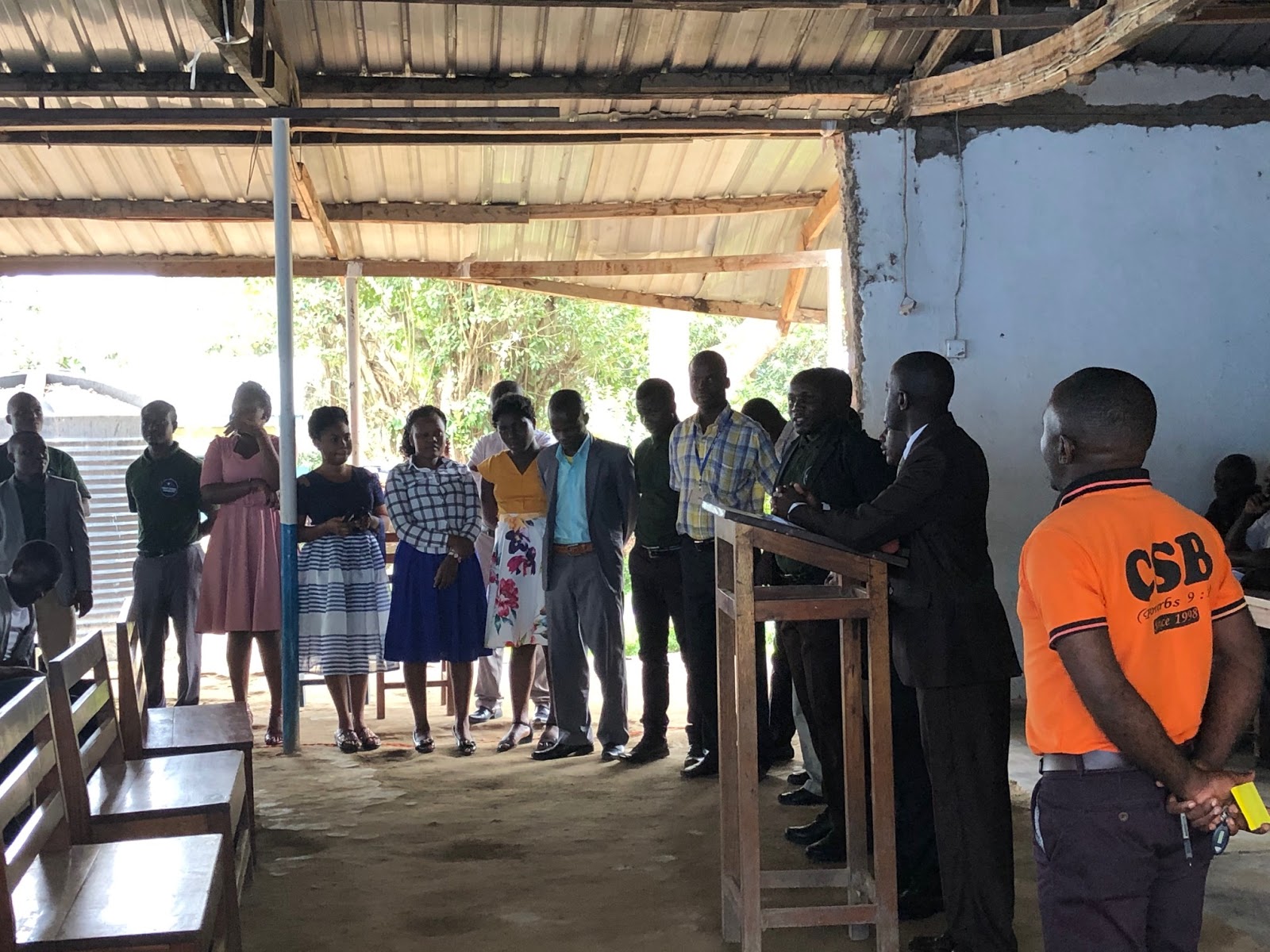
Then Friday, after a hurried morning to see some patients and get to the CSB end-of-term all-day Parent Meeting, we once again had reason to rejoice. The first and second term parent meetings were contentious near disasters, with divisive arguing, poor turnouts, rumors, student discipline issues. This meeting was an amazing feast of thankfulness for the peace that now characterizes the place, for the good performance, for the long list of improvements. We heard the PTA chairman affirm that "this is not a school for any one tribe or race, it is for all the people of Uganda . . . you are here to work with us to expand God's Kingdom." Our District Education Officer, the highest official for all schools in the area, came and spoke and affirmed that CSB is the best in the district and addresses "the head and the heart" with quality education. Where we usually have an hour or two of parents complaining or demanding, we had a brief request about getting more security guards and setting aside some of the need-based scholarships for merit-based. Only two parents stood up to speak, and both said, we are satisfied. It was pretty incredible, but again, if we had not been through this tough year we might not have felt the depth of relief of having such a good day.

(stolen from Julia's instagram) my miracle brother-in-law Steve with Micah, Caleb, my mom Judy, my sister Janie, and Julia


Today my brother-in-law wrote a long post about his year, about his thanks heightened by the experience of nearly dying in August. His time of need was dire, his heart had stopped beating effectively, and he was unconscious and helpless. My sister and niece acted quickly, the excellent and ready EMT services acted quickly, the hospital ICU care was effective, his family, friends, and community came to support, and while all of those things existed prior to his near demise, he can sense the thankfulness for them more deeply now.

So, while 2019 has been a year of struggle, this has been a week of thanks, and I know in my heart that it was the going forth weeping with our seeds for planting that let us come again rejoicing with the sheaves. And that this moment of rejoicing needs to propel us outward again into more giving, more sweat and tears and even some blood. 

Click here to go to this page at Serge
This year you have an opportunity to join this cycle of Thanks and Giving. Serge has devoted #givingtuesday, on Dec 3, this coming week, to support Christ School. Link to this page to sponsor a student and transform a community. We have been giving our literal lives to this idea for a couple of decades but most intensely, this entire year. Scott is at an end-of-year school staff meeting as I write this. Much of the thanksgiving of yesterday was directed to the unseen could of witnesses, the mercy of God through the supporters who subsidize school fees and improve the infrastructure for learning. As an example of how that pays forward, a former missionary here Rick Gray once helped a young man who had struggled his way to University but had no money to live on while in school. That man is now our District Education Officer, a believer who is working to serve children and families in schools all over Bundibugyo. You never know who today's teenager will become in ten or twenty years, and the impact of a place like Christ School reverberates through the far reaches of our roads and the far stretch of our years.

Giving thanks for those who give, thanking God in the words of Psalm 126: The Lord has done great things for us, and we are glad.

Sunday, November 24, 2019

Redemptive Disruption


As a team, we have been reading Bethany Ferguson’s The Mission Centered Life: following Jesus into the broken places.  Since we lived with Bethany in Uganda and Kenya, and visited her in South Sudan, the stories resonate and we are no strangers to her wisdom and insight. Last week though there was a line that so encapsulates our experience that it has really stuck with me. “He will disrupt our expectations, and that is a gift.” (P 62).  I invited team to share times their expectations had been shattered and then out of the resultant pain and chaos a picture of redemption, of good, had emerged. I shared a brief version of the story in the post before this one, a young man who thoroughly disrupted two days and how we therefore been treated to a glimpse of redemption, God working through the counter-cultural response of our Christ School alumni, to bring beauty.

Life last week included not only the challenge of a violent and psychotic young man, but: two children dying from cerebral malaria, one right in my hands as I tried pushing meds through an emergency needle into his bone marrow while also doing CPR, countless patients with complex stories of vulnerability, an all-day CSB board meeting spent debating the triumphs and trials of the 2019 school year and listening to the cultural lessons I could draw in the undercurrents, a day in court witnessing the absurdity of trying to pin down facts from people who do not think in those patterns, leading team meeting, bailing out a flooded house, meeting the District Health Officer with Dr. Marc and Dr. Amon, teaching, cooking, hosting more than half the nights, multiple distance meetings by internet-based calls. It wasn’t until yesterday that we even had a few hours to take a deep breath and sort out the final piles of boxes and bags from moving, make the final beds, hang a few curtains.  And as I looked around thankful for electricity (even if it’s intermittent) and our delightful clothes washing machine, for fresh paint, for comfortable chairs, for the pottery collected over years, for light and peace and air, a space to live . . . The phrase came back.


2019 has been a red letter year of disruption. 2019 has been a gift.

Last year at this time we were approaching our final weeks at Naivasha Hospital, and preparing to clean and pack up our rented house to put everything in a storage container for a few months. We did not know our Christmas Eve was going to include an engagement!  Nor did we think that we’d be in Uganda more than a few months. We anticipated sorting out a few issues at Christ School and supporting the team in transition, then deciding the best place (good internet, access to airports, manageable but meaningful medical work) to continue as Serge Area Directors. We thought we’d take a month Home Assignment when Jack graduated then move into a new place in probably Kenya by June.

Well, God disrupted those expectations, in the form of a complicated implosion of leadership of mostly Christ School but also this team. And in the form of listening to what people we were serving asked of us, and deciding to take a deep plunge back into a messy life that we thought we had finished. Selling our car, living in temporary quarters most of the year, engaging in spiritual battle left and right, and marching out to the edge of the fray, further from comfort. I won’t say it was always clear or ever simple, but by God’s mercy, the courage to follow this slope was supplied, and here we are.

And yesterday, as we hung those curtains, I thought, this is good.  Not just the best one can do in a hard situation, but objectively good. We love Bundibugyo. We are back in the house where we raised our family for 17 years. We have a sweet new puppy. We are engaged up to our last shred of energy in work that impacts a generation of people in a smallish place. We have teams across the Area soaring on, getting grants and giving hope, and we have a team of dedicated friends here in Uganda too. We have regular interaction with young men and women we’ve known since they were children, and get to witness them raising their own families and making their own counter-cultural choices because the Gospel has taken root in their hearts.


Yes, I wish everyone I love was at my fingertips, and that malaria and Ebola and measles were eradicated, and that my own heart was more gracious. It’s not all lovely. But it is good.

Praying you can see some redemption in your own displaced hopes in 2020.

Thursday, November 21, 2019

Psychosis and Sacrificial leadership: how to really multiply your Giving Tuesday to Christ School Bundibugyo (and why long arcs make the best stories)


On Saturday, I got drawn into a text chain about antipsychotic medication options and slowly sorted out that there was a young man in Bundibugyo town with a known mental health history who was wandering the streets attracting fear and attention to the point that people had injured him, and he was now at the police station. In a culture where evil spirits are widely feared, and disturbing communal peace quickly draws backlash, he was in real danger. And as the story unfolded, I realized I knew this young man. Nearly 15 years ago, he was a bright pre-adolescent the age of Luke, and he played with our kids sometimes. He was an orphan (both parents died) with minimal family support who excelled in school, but around that time he began having psychotic episodes and we diagnosed schizophrenia. There was a short period of time when I kept him at our house to preserve his life. I remember thinking, if one of my kids with their curious intellects and competent expectations woke up in this boy's life of nearly zero resources or loving connection, would they also lose their minds? What must it be like to be him? He got better with treatment, and later went to Christ School where he graduated. I had not seen him in all those years, but it turns out he joined the army and was out of the district most of that time, then suddenly showed back up in town in an agitated and decompensated mental state last week.

Which brings us to the weekend. What does the community do with an acutely psychotic man in his 20s who has been beaten by bystanders?

Enter the Christ School Old Boy-Old Girl (OB/OG is the name for the alumni) Association. Through the general way that news travels, calls fanned out, and it came to the attention of several that a CSB graduate was in trouble. One of them went to the scene and got the police involved to protect him. Others called for medical consultation, which led to us hearing. I remembered my soft spot for this kid all those years ago and got in the car, picking up one of the alumni along the way (thankful to note he was also young and strong, as I wasn't sure how much muscle we might need for protection). The patient had been released to a "guardian", someone in town whose parents had been distant relatives of his parents. When we arrived, she told us that she could not help him so had sent him to his "uncles" and she would show us the home. As we three got into the car, she called ahead and heard he had left the uncles immediately upon arrival and was wandering the roads again. She had the idea he'd come back to town and directed me down a dirt road short-cut.  Sure enough, within a few minutes we saw him, barefoot and shirtless in his torn jeans. We stopped the car, unsure how he would react.

"MAMA SCOTT!" he exclaimed with a smile, coming straight to my window. "Now you are here. I am safe." I told him to get in the car, and he did.  That afternoon he was dealing in some alternate realities but relatively compliant. We prayed, and I told him we were all here to help him. It took quite a long time and a lot of talking to get him to get OUT of the car at the hospital. We went and brought him a hot meal, and I held his hand while Dr. Amon put in in IV and gave him medication. It took the whole afternoon, but after the family (uncles/cousin) refused to contribute anything the alumni pledged to raise half the cost of an ambulance to the national referral mental hospital in Kampala and we agreed to raise the other half. We left him pretty knocked out in the bed, and the alumni had reached a relative who promised to come stay with him overnight.

Only the relatives had long since given up on this young man, and no one showed up. So when he woke up Sunday early in the darkness, in the unfamiliar hospital bed, he just walked out. By Monday the alumni were tracking him again. He was in town, moving about, much more agitated. Stones were being thrown. Dr. Amon and I got in the car again, and drove all over looking for him. It turns out that boda-boda drivers (the motorcycle taxis) are the best source of news, and we had multiple groups on the lookout.  When we finally found him in an alley, he was much worse. He was angry, scared, violent, abusive in his language and gestures.  But once again there was a deep part of his brain that recognized our history and he got in my car again.  This time it was much harder, with banging the windows, hitting at us, taking off his clothes, constantly threatening to kill himself or us. Honestly it was a bit traumatic. At the hospital we could not lure him in even with the food we bought him, and I had to get him into a point where three men could grab him and hold him to get an injection. He still wanted to hold my hand, though I did get a little scratched in the process. When he was naked he had grabbed my hospital coat in the car, so there he was sedated wearing the Dr. Jennifer Myhre Paediatrics coat only. Now we knew we had to get him to the psychiatric hospital 8 hours away immediately. How?
OB/OG executive at the 20th Anniversary

THE CSB OB/OG GROUP acted like his family. John coordinated raising the funds for half the cost of fuel the ambulance. And Sam, the alumnus who had helped me both days, said he would ride with him. That's a two-day trip. He just dropped everything else in life and went.

These young men and women were deeply changed by their time at this school. The rest of the community was throwing stones and hitting with sticks, laughing and chasing or fearing and reviling. And I get it, this was a frightening patient. But the OB/OG group responded with sacrificial care and concern. They acted out of responsibility which they did not have to assume. They gave of their time and money to help one of their group, to help someone whom the rest of the culture had discarded, someone who would most likely never be able to return the favor. That's the Gospel in action.

This experience highlighted for me the ongoing multiplicative impact of Christ School.  It is not just the 4-6 years that these young people are within the school gates. Once they leave, they see the world differently. So much so that on a random weekend, they rose to the occasion of danger and discomfort and bailed out a person who was otherwise without hope.

Giving Tuesday campaigns abound. This year, Serge has decided that our entire mission's Giving Tuesday fund will go to CSB. Like other organizations, there are some larger donors whose gifts are used to prompt the rest of us to give. But the real multiplication is here on the ground in Bundibugyo. We subsidize half the operating costs in order to keep tuition within the range that people living in poverty can stretch to afford (parents pay about $400/year in tuition for 3 terms, 12 weeks each, boarding, meals, and instruction) and we at Serge raise enough to reach the actual expense of education, which is nearly $800/year by the time we pay salaries and meet food budgets and buy books and on an on. We also raise all the capital expenses for infrastructure and equipment. Most years that comes to over $100,000 in investment . . . this past year we've put in an extra nearly $50,000 and we will continue to do that as God provides. That changes the lives of the 253 students enrolled now, the 300 we aim to recruit for next year, the 700 or so alumni out in the world, the thousands of families and businesses and schools and health centers where these young men and women live and work.
Scott with Michael and John, two OB's, at the CSB Board Meeting


This story is about the OB/OG network and how they responded, unprompted by us. We came alongside when THEY reached out to US, not the other way around. It's about the way investments in schools and students continue to grow as those people mature and change their world. We did not expect to be back living in Bundibugyo right now, so a side note to the story is this: in spite of all the hard realities of life here, it is a privilege to witness the maturing of these kids into adults I respect, admire, and love. Thanks to all who are part of this process from afar.  It matters.