rotating header

Saturday, April 11, 2020

Day 22 in #COVID-19UGANDA; Holy Saturday in a Saturday World, preparing the spices

We have now completed the equivalent of one full Ebola incubation . . . (21 days of health used to be pretty good news), with no clear end in sight because no one really knows the SARS-CoV-2 trajectory. A 21 day slow-down, per Uganda and every public health expert one can listen to, has slowed the inexorable march of infection.  Not before a global 1.6 million infected and 100,000 dead, though.
The orange line is our flattened curve, bought at the cost of much hardship, but as our president keeps reminding us, this is not about convenience it is about the lives of Ugandans.


 These maps of global flight patterns might explain our relative slowness to the COVID curve, even more than our strict social limitation measures. Turns out that China, Italy, and New York get a lot of movement. Africa, not so much.

Day 22 finds us beginning the next three weeks of constriction, of waiting, of uncertainty, on Holy Saturday.

Two thousand years later, we sort of get the story. Looking back to yesterday's grief: the injustice and the pain and the darkened ending of a life, a hundred thousand times over, the replaying of the terror, the feel of the limpness of that body being carried away.  And zero grasp of what tomorrow will bring. It is Saturday, and we don't yet know if it's an Easter Saturday, the eve of resurrection, or just another long day post-loss and pre-glory. We're caught in the midst of living the best we can with no idea of just which story line, the blue or the orange or one not imagined, we are on. Choices feel limited, and there is the numbing distraction of just how much energy it takes to do little more than be alive in 2020. Friday is behind us, we hope, so we should be productive. But on Saturday that feels impossible.

And it is not just our Saturday, it is a global Saturday, where our small losses seem unimportant and hardly noticeable in the context of New York City, of Lombardy, of Wuhan. It is a Saturday where we wake up and think, well, we could have died Friday with Jesus, but we're still here when others are not. What now? We thought we were on the cusp of greatness, talking about left and right hand seating and thrones. Now our horizon has narrowed down to the aggressively needy beggars or the hot stretch of tarmac from home to a pile of tomatoes or basin of milk, our interactions have resolved themselves into minutes of 2x2 cm squares on a phone screen, our work has a feel of inevitability, more of the same malnutrition and pus and fever. Contraction, the stone of the grave or the belly of the whale, seems to be the Saturday reality. No escape from the moment that is in itself, if we could see it, our escape.

How do we live in the reality of Saturday? The Saturday that has no certain 24-hour limit, that could be weeks, months, longer?

Preparing our spices, I suppose. The next necessary thing based on our Friday reality. That means we start with our daily routine. Psalms, every morning, preferably two. Coffee. Patterns where we can make them. Air. Work that depends on hope to have meaning, like planting seeds or feeding babies, work that projects forward, and especially work that is making meaning of the losses, like the preparation of those preserving fragrances to honour the dead. Art in general, and specifically Saturday art, that tells the story in the midpoint and doesn't insist on the conclusion. Dirty hands. Quiet. Space. Food. Lament. Pondering. Listening. Waiting.

Because Saturday is a day without answers, a day in-between, a day to let our narratives begin to shift. It wasn't supposed to be this way. We weren't supposed to be stuck here. To be separated. To be jobless. To be preparing burial spices instead of coronation clothes. We thought we were riding the wave and now it is breaking over us instead. We thought we were God's favourites and that meant things going our way, but now it looks like God's chosen loves still suffer, still lose control, and that God suffers right there with them, and the happy endings take way longer than we expected.

Saturday road, in spite of constraints, people are out to buy and sell

Work goes on, slowly by slowly, a new boys' latrine at CSB, thanks to our friends who donated for infrastructure

Thankfully Ike likes to ride this old mission motorcycle and can ferry mail and a few groceries for team

Normally this space would be packed with dozens of boda taxis waiting for passengers. No longer legal.

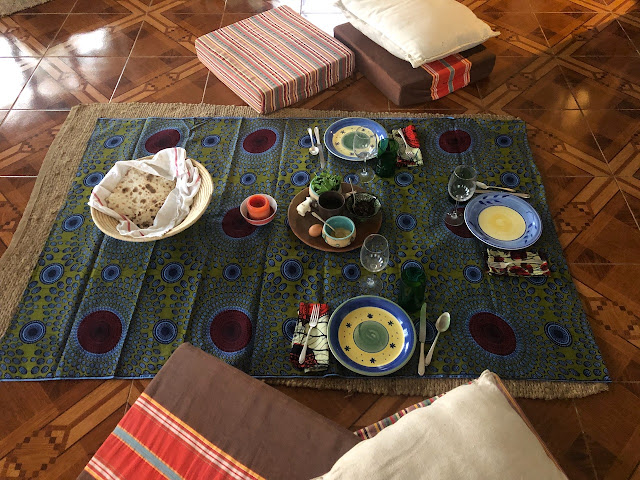
We made the unleavened bread for our team on Thursday, even though we all ate the meal in our own homes post-curfew.


We did NOT get a lamb slaughtered here, but this butcher has bone-splitting panga moves.
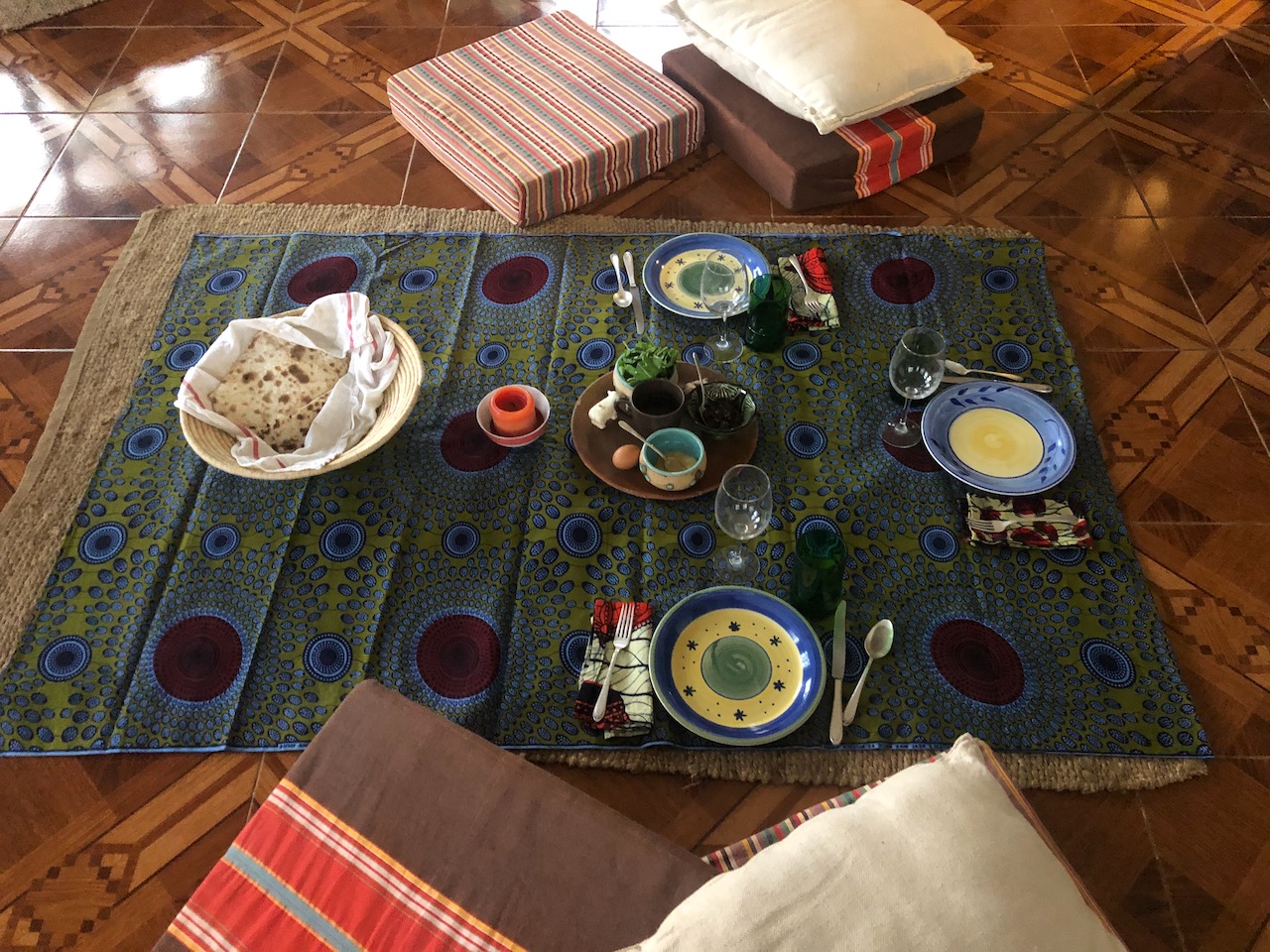
Passover for three: Scott, me, and Elijah (he didn't show, again)

A 2020 twist, instead of foot-washing we passed the alcohol hand santiser

The screen shows a few of the about 25 families that shared the Messianic Passover Seder meal together via Zoom.  Jason B dubbed it a Zeder.

If you could expand this photo you would see a family in our Area (the Robbins) celebrating passover with us by Zoom, Scott and I are on their screen.
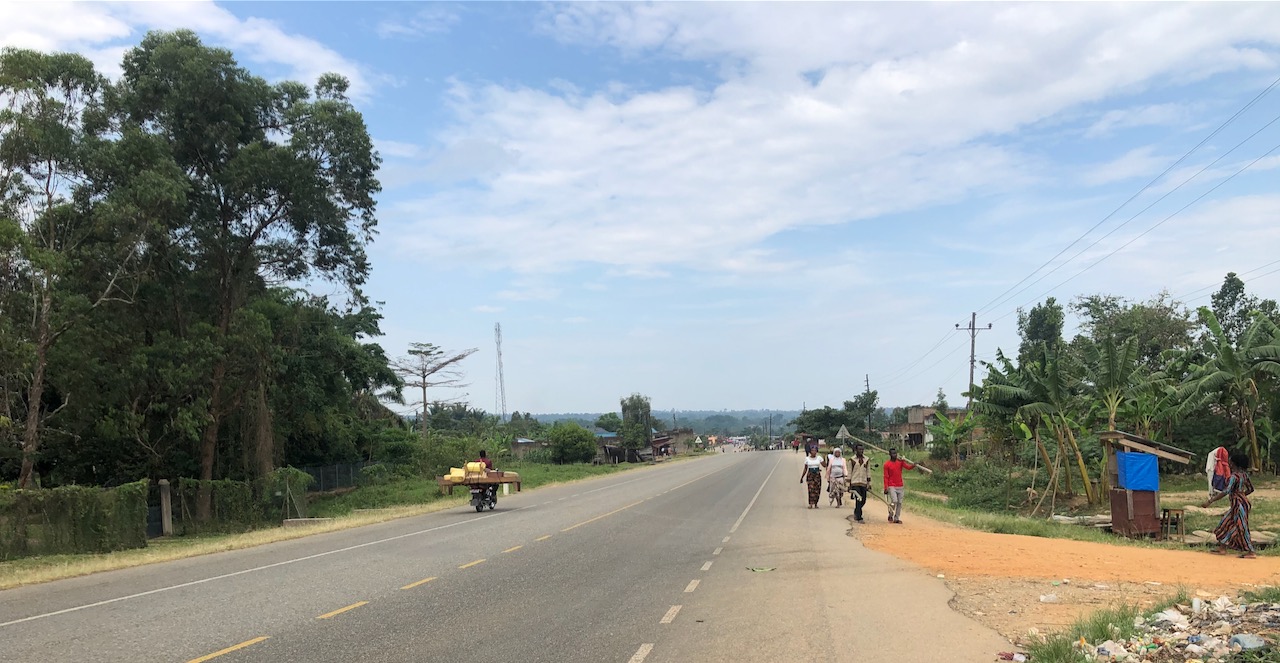
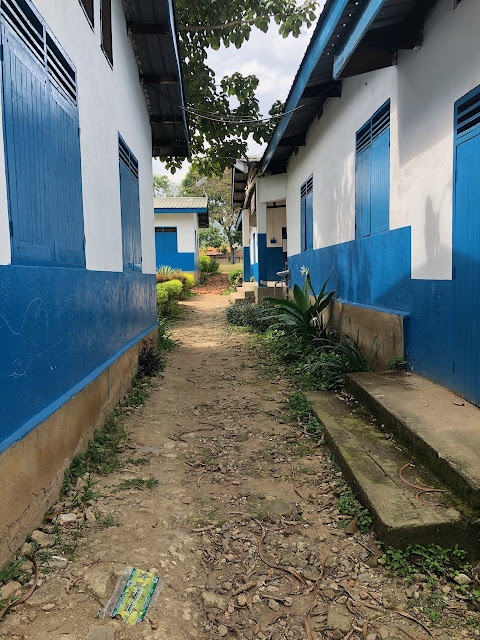
Quiet road in front of the mission, only bodas with cargo, and people on foot.

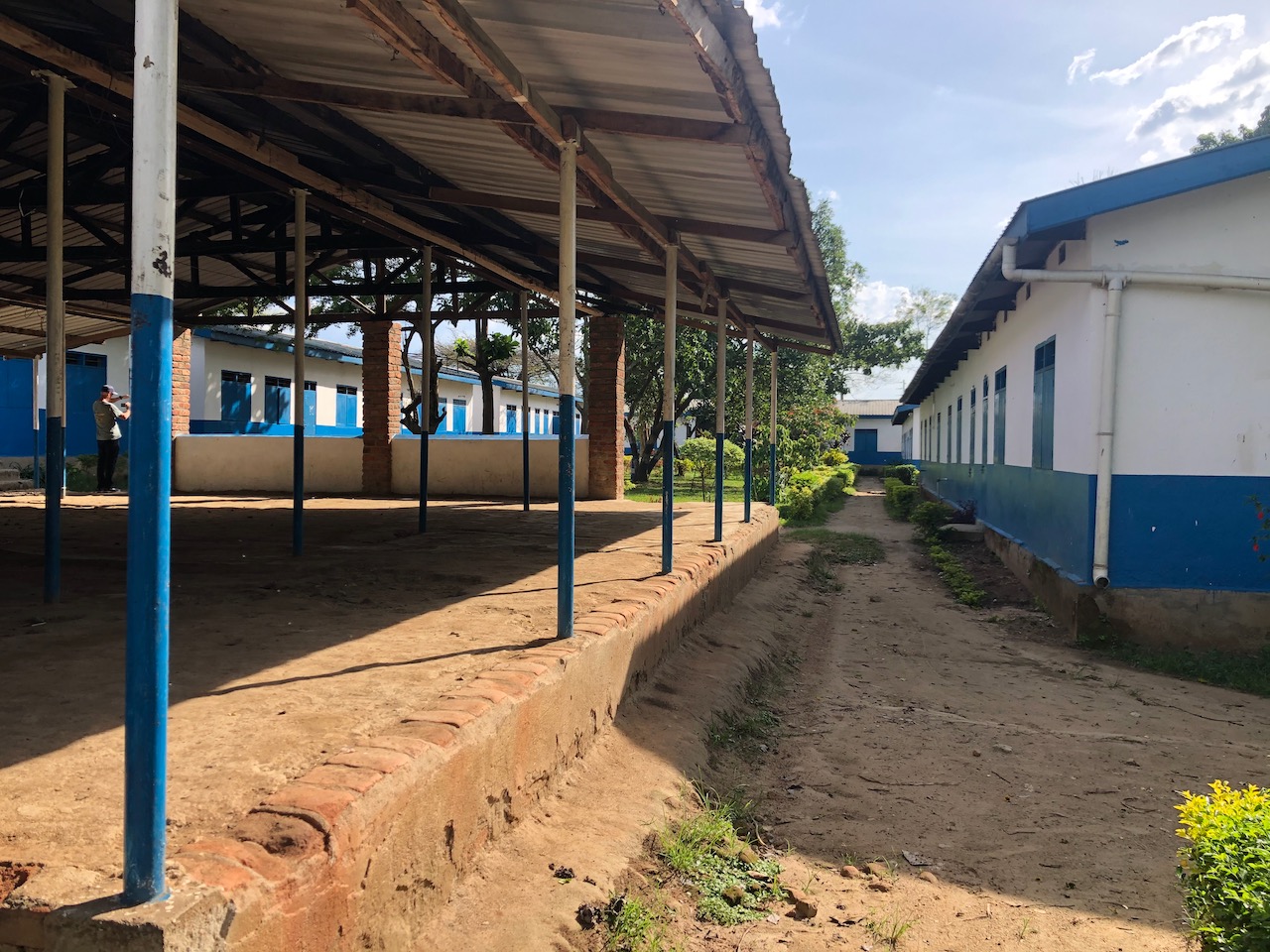
Quiet school, waiting on this indefinite Saturday.

Sometimes a moment to bring meaning into the long days of uncertainty, like leading the kids through the Stations of the Cross on Good Friday.

Spice prep work: walking, dirt roads, gathering food, Saturday.



Wednesday, April 08, 2020

Holy Week and #COVID-19UGANDA day 20; the Jerusalem path and the curfew meal

Don't go to Jerusalem, they said. 
Congolese cross art from my brief stop in Belgium last August

And with good reason, there was political unrest afoot, there was a rising cloud of tension and uncertainty, of threat or death. It was Passover time, a festival, a time of expectation, of crowds, of remembrance. Jesus who had remained relatively rural, mobile, difficult to trap, both gentle of touch and sharp of tongue, now spoke of impending death and walked directly towards it.
But first, a meal. A room, a limited gathering, a ritual connecting his small group of closest friends back to their history.  Like their enslaved ancestors, they were living in a time of oppression and longing for deliverance. And like their enslaved ancestors, they did not quite grasp how it would come. What they did know was to go into their homes at dusk, to break unleavened bread and dip in wine and put the blood of their roasted lamb meal over their doorpost. To withdraw as the Angel of Death moved through, the tenth plague in a series of increasingly disruptive and dangerous difficulties.

In ancient Egypt, the curfew and isolation ended with an entire nation being born. In first-century Israel, the evening ended with arrest and tragedy and execution of the hope, and then unimaginable redemption.

In 2020, we are too close to see clearly. 

Get out of Africa, seems to be the message we get daily from our embassies in various countries. Borders and airports are closed, yet every day or two there is yet one more email implying that perhaps a window will open. For some that needs to happen, for their own physical or mental survival. There is no one-size-fits-all path through this time, and anyone who thinks they can lay out a clear plan isn't reading Judges recently (where I happen to be). We all want to control God as being on our personal side. But if the stories tell us anything, it is that God's rescues don't always look comfortable or predictable in real time. Sometimes the army flees on its own, and sometimes the presumed victory does not materialise on time, and no one can say for sure which story we are in right now.

For the majority of our workers, we are here for the duration.

Partly that is like Jesus' path to Jerusalem, we are just doing our job, following our commitments and protocols, trying to be sensible and faithful. There is no safe place on the globe, and now we're more aware of that. If your path was towards Jerusalem, maybe it is best to keep following it. Pandemic or not, babies are still being born and some need a surgical escape route or a deliberate jump start to breathing. Malarial mosquitoes are still biting and someone needs to put in IV's and administer artesunate. TB still spreads insidiously until a canary-in-the-coal-mine toddler shows up with listless coughing and dwindling life, and needs a test and some medicine. Typhoid still punches holes in guts that need an emergency surgery. Hunger still stalks, and infants still need to be warmed and weighed and fed. Schools are closed but yesterday our staff at CSB still managed to finally get the home-work packets out to students, so they can work at home, no small task in a world without internet connectivity, without educational programs that can be decentralised. Some teams have been able to work with churches and groceries to provide food relief to the day-labourer majority of Africans who cannot stock up at Walmart and live off of a horde at home. Our Bible translators are working still, at home. Some are listening to neighbours share their anxiety, creating extra small jobs to help, or just giving help. Some are part of higher level planning in their area, purchasing equipment or doing training. Some are have taken in young singles stranded by the closed down public transport far from their homes. Some are praying.
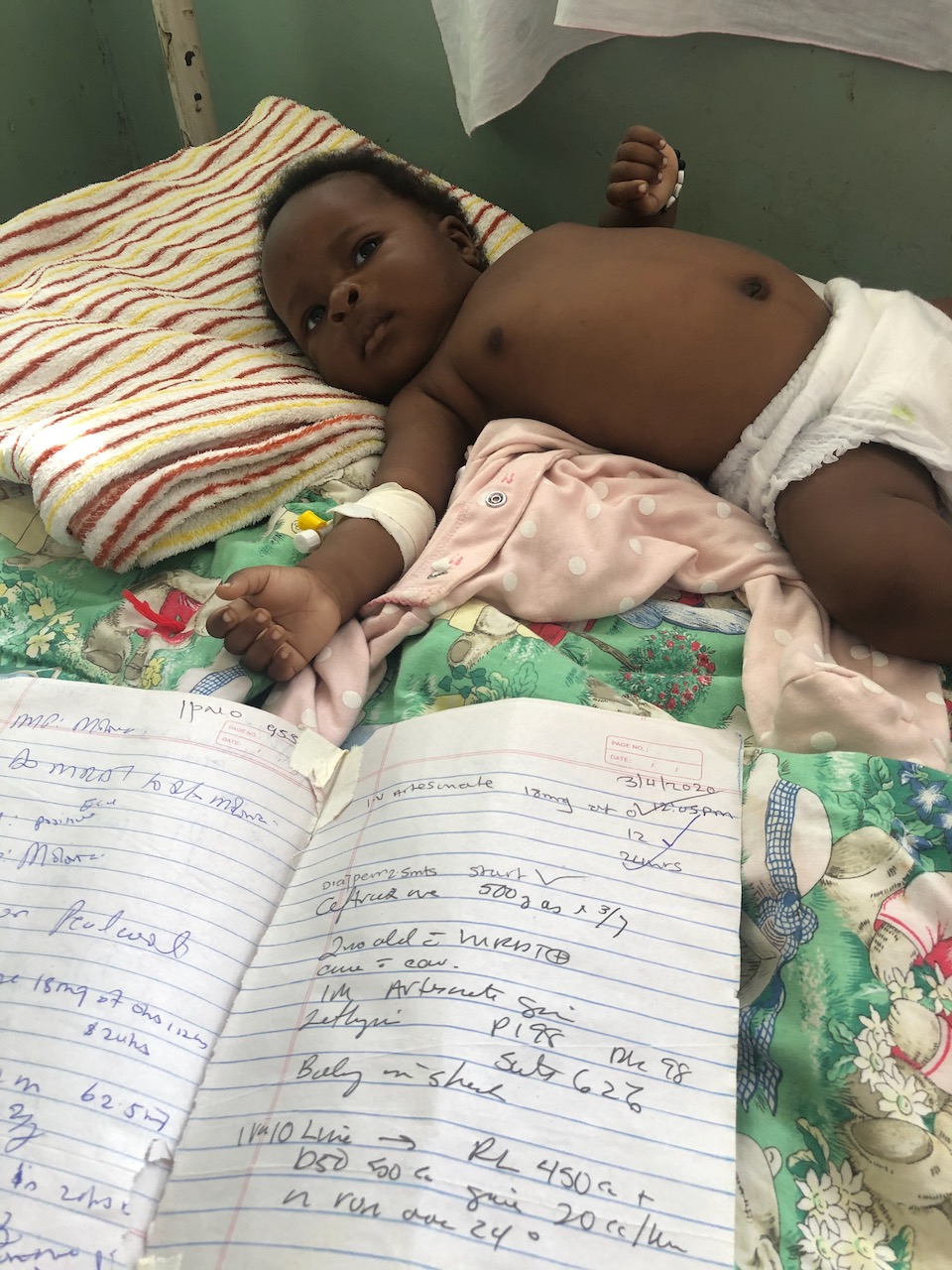
One day we were resuscitating this infant with severe malaria and ICU-level vital signs, the next he was looking pretty normal

This is why we stay.

Just in time for the little girl in previous picture, Jessie got therapeutic milk delivered on her birthday.


Staff are still doing their job, babies still need their care

In the USA and Europe, the pandemic has strained places with 1 doctor per every several hundred people. We have one per several thousands, even ten thousands. In the USA and Europe, hundreds and thousand of ventilators per city seems sparse. On this continent, we're talking zero to 20's per country.

photos courtesy of acting head teacher, as staff prepare hundreds of packets, thousands of pages, to go out into a district where people don't have books and TVs and computers. Thankfully cargo is still legal.


We feel the cross, and on good days know it is just the light burden of a cross Jesus has already carried. On other days, it feels weighty. Our entire organisation was on a rare rhythm of simultaneity because our quadrennial all-continent meeting naturally meant that every single family planned travel, perhaps a vacation before or after, perhaps a Home assignment or a connection with friends or family. We were all headed for a break in a little over a month. Instead we are all pretty tightly restricted to a small, needy, unstable place watching not only our hoped-for rest disappear but our normally stressful lives might double, or triple, or more in sorrows. The kids on one of our teams listed their losses, an appropriate way for believers to be honest with God. Not being able to play football with a hundred kids is real. Not being able to see grandparents soon is real.

Will that cross mean any literal loss of life? We pray not. But even though none of us can ever be sure what the next day will require, in this particular moment of history the truth is more stark. We believe we will be the ones in the house when the death passes over, unscathed. The odds are good for any one person that we will be. But small odds repeated hundreds, thousands, millions of times still add up to a pile of bodies. 

We have been here before. When the ADF kept up their cross-border terror, we sometimes ran and sometimes stayed, we lived in that tension of not-knowing. When Ebola came to our district, it found us here and grounded us here, exposed, still working. Did we always make the right call? No. But when our partners speak of us, those are the two times that they perceived the love of God. Solidarity in a shared danger. 

So day 20 of COVID-19 comes to us in Uganda, on the Thursday when we remember the passover meal. 53 cases have been tested positive here, and all are alive still. Over 3 thousand travellers have been tested, and there are still 18 thousand that the Ministry of Health intends to track down. If 18 thousand people from high risk countries in March (mostly returning Ugandans) fanned out over the country, if 13 of our 53 cases were already community-transmitted, how can we escape? Yet all over the world we're seeing that the social-distance protocols are slowing the disaster, averting deaths, so we continue. Every few days our president holds night-time broadcasts to reminisce about his fighting days and enjoin the country to endure temporary inconvenience for long-term survival.

Tonight at the 7pm curfew we will celebrate Passover by Zoom around our area, remembering the truth on which our lives depend. Jesus came among us as a human, lived through times as tumultuous as this one, faced the worst, and in his actual body absorbed all the hate and brokenness of the universe. His work constricted right down to a cave in the earth, a tomb. And then he reversed all the trajectory of sin and sorrow and injustice and loss, and walked out to lead us home.

Saturday, April 04, 2020

#COVID-19UGANDA day 14: collateral damage, collateral grace, deepened not diminished

This is how our days go: pushing curfew limits for a bit of exercise in the morning, coffee, Bible, prayer, urgent texts and emails that accumulate from other time zones, perhaps a knock at the door, a question or crisis. Into the car by 8 for the 8 mile drive to the hospital, hoping not to be stopped by the police as we don't have a "COVID-19 MEDICAL" sticker yet, but we do have a written permission from our district government. The oddness of a staff meeting, standing 2m apart, outside, hearing the overnight report, the latest Ministry of Health directives. Rounds, patients, assessments, procedures, all while breathing through a mask in the 90+ degree heat of wards with little airflow, all while spritzing hand sanitiser liberally and having various staff all "borrow" mine as the level keeps dropping. Connecting here and there with Jessie, with Scott, with Marc, with Ammon, with Isaiah, as we discuss patients. Early afternoon at some point between 1pm and 3pm we finish and take our masks off at the car, carefully folding them into a cloth bag that I put on the super-hot dashboard to bake. More sanitising. Friday we walked another half-mile through town to the bank, as the local government had hinted darkly at confiscating our car . . . didn't want to risk any movement except home to hospital in a vehicle. Walking is pleasant, it slows the pace, makes you aware, makes you part of the community . . .but it does also add an hour here and there to a day of work. Back to our house by 3 for two hours of meeting with team mates about work, plans, future, coping. Walk to Nyahuka, our closer town (half mile?) to check on CSB staff with a sick kid, to buy milk. Stop back at mission house for another 45 minute meeting/check-in. Back through our gate before the dusk 7pm curfew. First chance to do dishes, to make dinner, to listen to news. Eat, connect with family in USA via texts or calls, answer emails, listen to our Ugandan President's long evening speeches, work at computer until 10 or 11. Sleep.


morning walk with mountains, thinking Psalm 121
a few views of morning staff meetings with #social_spacing
the unsung heroes of COVID, the cleaning staff
the corridors between hospital wards
children are still malnourished no matter what the world is wobbling about; Jessie doing weights
a very sick baby, I did an LP, and actually got gram stain results. Not good news but at least we know what we're dealing with.
TB treatment, malaria treatment, malnutrition treatment, transfusions . . . must go on!

(pc Marc) a sweet moment Friday, Baby Flavia the 800 gram preem whose mom died late 2019 is now a fat and happy thriving 4 month old!!! thanks for prayers. 
Scott is happy to be back in the surgical theatre
discussing a difficult case with Dr. Ammon and Dr. Marc, thankful for colleagues
For my kids, a Man U fan dad and his kid named Rashford . . . 
post work walking through Bundi town to bank, living proof of presence
the bank is enforcing #social_spacing
 
stop in the market for passion fruit; we are still allowed to buy and sell food

waiting for the evening briefing
living in the reality of hanging on the words and desires of the leader

So at this point we aren't doing virtual museum tours or scouring for great podcasts, we barely have time to manage life.

Today I'm thinking a lot about the collateral damage of COVID. Only 48 cases in Uganda, and the zeal with which this country is tracing contacts and enforcing social space is pretty impressive. Because we are remote and poor, our exposure has been later and more limited. But that does not mean we are not impacted. In the 14 days since COVID came and restrictions ramped up, Scott has had four pregnant women with a ruptured uterus come to the hospital. It used to be 1/month was remarkably bad, now 2/week is a new normal. If you go into labor and things go bad, and you can't manage to get to help because there is no transportation, there is curfew, you're afraid, the health system is stressed . . . then the contractions lead to catastrophe, a dead baby, a dying mother. Friday he and Dr. Ammon spent the entire morning in the operating theatre with two complicated cases like this. We can't see most of the collateral damage, the malaria that kills at home, the sickle cell kid that doesn't get transfused in time. But once our first suspect cases tested negative, the Paeds ward started filling back up. We have a child who had surgery for hydrocephalus at a specialized hospital on the other side of the country, and now is experiencing re-accumulation of the fluid in her brain, but can't get back. Collateral damage abounds.

And there is more subtle collateral damage. The many people, especially men here (since women are still doing their unending labor of child care and garden work and cooking and washing) whose ability to earn, to provide, has been suspended. The impotence of that, the frustration, the unknowing, the fear. This hurts. The only mobile people now are the 17-30 year old males who can drive motorcycles. OK there are a few trucks moving goods too. But mostly women have been relegated to foot. This is a collateral message: women stay put, men can move. We saw a CSB teacher teaching a woman to ride a motorcycle yesterday, and that was a little piece of rare empowerment. Then there is the long-standing pain of turning human contact from a basic need to a potential fatality. All cultures need touch, need face to face communication, need gathering. How will we emerge on the other side? 

Where there is collateral damage, there will be collateral grace. That is the basic premise of the universe founded on love: God is at work to bring the fruit from the seed that dies, to bring joy from the tears that fall, and nothing can stop that. In March I happened to pick up Eugene Peterson's Under the Unpredictable Plant, a book about the prophet Jonah that had been impactful for us when we lived in Uganda before and still remained from our library. He talks about the contraction of Jonah's world into the belly of the fish, and how God often uses times of imprisonment, constriction, loss of freedom, for the greatest spiritual work. I think we are being globally disabused of our approach to spirituality as consumers who shop for the latest self-help.

We begin by insisting that askesis (his word for the constricted life) is not a spiritual technology at our beck and call but is rather immersion in an environment in which our capacities are reduced to nothing or nearly nothing and we are at the mercy of God to shape his will in us. . . Suddenly instead of mindlessly and compulsively pursuing an abstraction--success, or money, or happiness--the person is reduced to what is actually there, to the immediately personal--family, geography, body--and begins to live freshly in love and appreciation. The change is a direct consequence of a forced realisation of human limits. Pulled out of the fantasy of a god condition and confined to the reality of the human condition, the person is surprised to be living not a diminished life but a deepened life, not a crippled life but a zestful life. God-intensity begins to replace self-absorption; mature wisdom begins to supplant self-importance.

What if that is our global path in 2020? Facing our limits (YES we are doing that!) and finding depth, mercy, grace, goodness and love. We have a long way to go, but holding lament in one hand for all our sorrowful loss and hope in the other for God's love to still abound, is the only way forward.

empty CSB . . . our staff are still on site, some minor construction projects are ongoing, firewood procurement in hopes of students ever returning . . . we try to visit and encourage our friends with waves from a safe space distance

Saturday morning cappuccinos to lift spirits, also outdoors and #social_space

the little face we see in our door as we return home

trying to comply with science and with policy, a team meeting on our compound, outdoors and spaced

the rules

Rumors went out that we were all leaving on a helicopter yesterday; we walked through town to show we were still in the fight.

Thursday, April 02, 2020

#COVID-19UGANDA day 12: Ways in which this pandemic makes our life and yours similar, and ways in which we feel the burden is heavy


Some ways in which YOUR life in COVID-19 (since it was announced on the very last day of 2019 it got the 19 designation, but this seems a bit unfair to 2020, which is bearing the brunt of this virus) is similar to our life every year, or ways in which we are probably more equipped to live in quarantine:

  • We already talk to our parents and children by internet-based protocols. Group FaceTime is our go-to. We use What's App groups for much of our work communication, emails, zoom calls, virtual conferencing. So even though we are remote and have not always had phones or internet signals, we had a decade jump on the work-from-home digital life and the no-chance-of-human-interaction personal life. #social_space is how we live globally.
  • We already shop in weeks-to-months increments, we already live off of dried beans and rice and pasta and canned goods much of the time, we already do without access to ice cream or restaurants or movie theatres. We come back from trips to Kampala with boxes of oil and bags of sugar, with tomato paste and crackers and other things hard to buy locally, every couple of months. We have been rinsing our local fresh vegetables in a very dilute bleach for two and a half decades. We already plant gardens.
  • We know that electricity and postal service and running water and mechanical help and fuel and the general network of societal infrastructure is tenuous. Yesterday the power was out for almost 24 hours. We already have a couple of solar panels and a small generator. We collect rain water. We can walk to food shops. Africa is generally going to prove resilient I think.
  • We already have to ration, make do, make choices. We already know that we can't save everyone, that death is real and present. I'm not saying that's good or right, but yesterday I had two infants who both needed one oxygen tank. The first one's mom had been in a long hard labor, and the baby had not been realised to be in distress from a cord around the neck. Scott walked into maternity to find the baby looking rather dead on delivery, and called me and we both worked to resuscitate the very asphyxiated baby, which was successful, but he needed oxygen. Then a few hours later a mother come with a 17-day old baby that looked like he was in septic shock. As Dr. Isaiah and I worked to get diagnosis and treatment, I checked the oxygen levels, very low. So I moved the single available source to the 17 day old, then checked the first baby. Uh oh. That one had dropped back to danger again off oxygen. Frankly I felt the newborn had a better chance of survival, but I was trying to make phone calls, find the right person with the key or the wrench or the capacity to hook both of them up, when one of the nurses said, "I have the key to the NICU where there is another tank .. ."  So we could help both in that moment, but the point is, this kind of triage is constant.
  • We already can't go where we want or do what we want a lot of the time. We live constricted lives in some ways, with limited choice, small ranges.
  • And lastly, when the world constricts, we do have community. We live very close to each other. We have outdoor space, and we live mostly on one big connected compound, so for the last two weeks our team has still been able to interact with our 2m distancing. We have sunshine, and views of the mountains, and birds. I think our space at home is nicer than much of the world's. 

But here are some ways that we are still finding this COVID-19AFRICA a weight.
  • When our country does "stay-at-home", it means NO DRIVING AT ALL. We are expected to go to our gardens, to the market, to the bank, ON FOOT, and no crowds. This was instituted on Monday night, and Tuesday we were able to get an exemption for a few of us to travel TO THE HOSPITAL (12 km/8 miles so a bit of a long walk) only.  I think this has been one of the hardest adjustments for all of us.
  • Our rules are enforced by police with "canes". They walk around with sticks and regularly beat people who do not comply, so people are afraid. We also have armed military supervising the curfew. If you are out in the dark (7p to 6:30am) you are at risk of being harmed.
  • We have no real emergency room to go to, no ICU to back us up. This may be more of a psychological than real loss, since ICU survival for this virus is quite low. Still it is sobering (our new most over-used word, but hey, it IS sobering) to know that if we need anything more than a very limited amount of oxygen, God alone can save us. That is always true, but rarely felt. Now it is quite real.
  • We have no escape valve, no plan B that is sure, as we said above for medical but also for any political upheaval. With closed borders and zero flights, we are where we are.
  • We are surrounded by people who have even less options than we do.
  • We are surrounded by people for whom we have historically been a bit of a safety net, people whom we offer employment or education or health care or water. In this culture, we look to each other when times get tough, and we feel the weight of neighbours who have, and who will, look to us. How long can we keep paying salaries if our schools remain closed and no parents can pay school fees? 
  • Our rules are set by a single person with extensive powers, which in this global crisis will probably turn out to be good on a utilitarian scale of preventing illness and death, but still feels uncomfortably random at times as the implications of decisions are not always clear. Perhaps because of the no-go rules, we are experiencing the reality more than usual.
  • When our hospital staff meets daily in the morning, we aren't discussing how many ventilators to buy, or when the thousands of new PPE's will arrive, or how many of the hundreds of new doctors and nurses will be hired. We are discussing, literally, whether police or doctors should chase out people who come in to sleep on the benches in the outpatient department at night, or the family members who sleep under beds who should be limited to one and not two. We are discussing whether sweeping the dirt driveway is aerosolising virus. We are discussing that on the night shift, the maternity nurse had no gloves, no pitocin (crucial medicine to stop bleeding). We are discussing whether malaria medications can be re-assigned from other small health units because we are out. We are discussing the difficulty of patients getting to and from the hospital because of the total ban on motorised transport. We are discussing how long suture supplies will last, or blood in the blood bank. This is a fragile system that teeters on based on the hard dedicated work of some brave people who aren't afraid to get messy, to improvise, to risk. But it is so marginal.
  • I think everyone at this point is uncertain about what the next few weeks or months will bring, but for us there is an added layer of not just, how bad will the medical and economic impacts be, but how long can we hold on if our connections to our supporters dwindle, if something happens to family far away, if we personally become very sick, if the world order changes, if there is political fallout.
  • And related to the above, the mixed messages and second-guessing just wear us out. Travel is dangerous, and spreads the disease. Everyone should stay in place. The US told citizens living abroad to stay where they were. But then our embassy keeps sending emails to say, there might be one more flight, there might be an option to leave, register your interest if you want to go. These long-shot chances being thrown out over and over are wearing.
And here is a last vignette that talks about the way we are always sticking out, and possibly that is good.
  • We cannot blend in. In a district of 250,000 people, the only non-African-appearing humans are our team of 15 kids and 14 adults. Everyone knows what we do, where we go. And in this moment, we look like the humans from countries where coronavirus is skyrocketing. In some places that can be dangerous. So Scott asked a friend yesterday, whether he thinks people are worried about us walking down the road to the market. Should we send someone to get us food so we don't worry people? The friend replied, "Oh, doctor, you are wrong about why people stare. They are not worried. They comforted. They are glad you have not left. Please walk down the road!" So that was encouraging. 

Uganda is holding at 44 cases, still mostly from returning Ugandans (42) who were in Dubai, or UK, or USA, plus a couple of Chinese nationals. Kenya has accelerated to 110 cases and 3 deaths. DRC, 123 cases and 11 deaths. Rwanda, Burundi, 3 cases, Malawi, zero. 180 countries, almost every country in the world is now affected. Spain, Italy, and New York state are bearing the brunt of it right now. 

The photo at the top is a rainbow that prepared us for the stricter limitations on our movements this week. We are not going to get this thing completely right. We are going to make mistakes. We are in for some hard days. We are already experiencing grief on many levels. But God has not left us alone, God will not let this virus destroy us. 

Our team continues to move through Eric McLaughlin's excellent book, Promises in the Dark. Each week seems to find us exactly where we are in our struggle. This week we looked at the idea of mystery. We believe many things about God, and in fact we know God relationally as loving and trustworthy. But then we look at what we can see in this world, and is a huge tension between what we believe and what we see. We can resolve that gap with denial of what we see, or despair about what we believe. OR WE CAN RESPOND WITH DEFIANCE. Eric's choice of that word intrigued me and led us to Job. If any character in the Bible models how to live in that gap between what we believe and see, it is Job, who constantly takes his grief right to God. He struggles. He engages. He asks.  He laments. He defies the people who try to wrap up explanations in neat boxes, and instead chooses the greatest statement of faith: though he slay me, yet I will trust him (13:15). Job has the nuance of mystery, the avoidance of easy answers, and the defiant will to hold onto the one who holds on to us. Here is how Eric ends the chapter, and how we will close for tonight:
"Trust can persevere in the face of mystery because of a hope in a story bigger than what's visible, and because of the continued trustworthiness of God who's shaping the story."

COVID-19 has taken the story of 2020 on unprecedented paths, but we trust God's bigger story to bring a redemptive good that is bigger than what we see on our graphs.

Sunday, March 29, 2020

#COVID-19UGANDA day 8; on Fear and Charms and Ultimate questions

You know the "pan" is in pandemic when you find a diagram of the coronavirus on the wall of a home in Bundibugyo. I was intrigued by the personification of those eyes; the medical detail of the protein spikes; the smear of mud on mud to make it adhere.
The first sign made me assume that someone was doing a little teaching. The second and then the third made me curious.


Adherent to the front of the house, some kind of tag, warning, or an attempt to ward off the evil? I asked a lady I recognized who was greeting us, and she ran around the corner of her house and ripped the paper down, muttering something about the children, then turned to us and affirmed "Ruhanga enka."  Only God. 

We are all in this same boat. In Iran, we read today, a viral meme about whiskey-and-lemon as a cure for the common cold plus the confusing insistence on high-potency alcohol hand gel, in a country where alcoholic drinks are forbidden, has led to hundreds of people sickened and even dying from the ingestion of toxic industrial methanol.  The CDC had to warn Americans against purchasing an additive meant for fish in aquaria that contained chloroquine in the ingredient list, after reports emerged of toxic ingestions to ward off corona. We all want a way to feel safer. For many of us that's information. Reading the literature, checking the stats, examining who died and who did not, clinging to the reasons to assume ourselves into that 85% camp with an almost-assured recovery. For others the fear stokes latent anti-other feelings. Some African communities are threatening to harm anyone from other places, and we don't exactly blend in well. Some American states don't want anyone with out-of-state tags passing through. Yes we should respect the basics of hygiene and socially responsible (read, LIMITED), movement. Yes, we should embrace this season of the hibernation, the limit, the small. It is however heartbreaking to see the way that crisis reveals not only hidden generosity and goodness, but also darker realities.


But here on the edges, I can see the appeal of the evil-repelling charm, the bet-hedging poster. No one in this district is going to be on a ventilator, so if Africa follows trends of the North we could be looking at death we are helpless to prevent. Face to face with such realities, our neighbours aren't stockpiling toilet paper or calling 911. They are going down to the spiritual questions which matter. There is a new harm afoot, and how can we survive it. These are the questions that have faced humanity for millennia, though we do our best to numb them. Is God good? Does God care? And can that truth, if held, encompass the reality of COVID-19, or AIDS, or malaria, or war, or poverty, or corruption, or, or, or.. . . .?

Uganda's cases now number 30; all our neighbouring countries have slowly accumulating counts as well, except for a couple that are either very isolated or very reluctant to test or most likely, both, with zero. The five suspect cases from our hospital on Friday were all tested negative by Saturday night. So we still find ourselves in the peculiar position of brace. Of watching our families in the USA and UK become more and more hemmed in, surrounded. Of some of our kids working long hours in the hospital or garden; of other family members spending their days to protect the vulnerable by keeping our older or immune-challenged people set apart. While we wait for our environment to become like theirs, only without 90% of the response capacity.

In similar times, people of faith looked to the hills and asked, where does help arise?  And I think my neighbour already gave us the answer. Ruhanga enka. The maker of all things who never sleeps. Let's wash hands, and use every spark of wisdom to research better care, every spark of compassion and energy to save lives. Let's use all that God has given us to fight against not just this virus, but also fear and hate. But for now at least we have to do that while living in the tension that we can't control the story, but we know the one who is writing it can bring good yet. 

And while you're at it, remember the Psalms (like 121 above). This song echoes 126 (and Rev 21). I also keep going back to 46 and 23 and 27. And 42 with echoes of Jonah. Or Psalm 91. Post your favourite Psalms and songs for this time.