rotating header

Saturday, May 02, 2020

#COVID-19UGANDA day 43, Easter day 21: public health, justice, and the constricted life


We made it to May. Congratulations to everyone in the deep red circles. A third of the world's cases are now in the USA, and our hearts are with our country-of-origin. In the great levelling reversal of this epidemic, we tune in almost every night to Cuomo's press briefing, just as the world has often watched Africa on the nightly news. We follow partly to grow with empathy, partly to learn where we might be in another month, or another six months. The map strikes me as a graphic of the first shall be last and the last shall be first.

Here in Uganda, I have to hand it to the public health mindset. This is a place that has soldiered through AIDS, Ebola, and war with very limited resources, yet generally outpaces its neighbours on measures of delivery of preventive type services. As our current cycle of sort-of-lock-down reaches its limit on Tuesday, we await the next plan. Right now the rules are: borders closed except to cargo trucks (no planes, no buses, no public crossing), no public transportation in the entire country, no driving a private vehicle anywhere, no churches, no schools, no public gatherings, no weddings or funerals of more than 10 people, no outdoor exercise at any time, curfew in place for no movement at all even by foot 7 pm to 6:30 am. Market sellers are supposed to sleep in the market and not move back and forth to home, as are factory workers. Food and medicine can still be sold, but all other shops are closed. Hospitals are open, and the top government official in each district authorises limited transport for patients and health care workers to and from the units. The ideal expectation is that each family is hunkered on their own compound of small houses and working daily with their hoes and machetes to garden food. The reality is that small groups of people move up and down the road on foot continuously, people sell piles of tomatoes or onions or matoke from mats on the roadside or tables under their eves, motorcycles zoom around with bundles of wood and packages of bread, kids roam and neighbours visit, patients have crowded back to the hospitals, and our work is as busy as ever without the conveniences we used to lean on or any sure timeline of a break.

Nevertheless, we have only 85 cumulative positive tests out of 33,818 tests done. Almost all of those are either Ugandans who returned from working in the Middle East in March and have now recovered, or Kenyan and Tanzanian truck drivers who are moving cargo. That's 0.2% positive tests (# positive out of all tests done), representing 0.0002% of population positive (# positive out of Uganda's 43 million people) after testing approximately 0.08% of the population (# tested out of Uganda's 43 million people). In the USA those numbers are 17% positive tests, representing 0.34% of the population positive after testing 2% of the population. America has tested 30x as many people relatively, but has almost 2000x the relative infection proportion. Because all the numbers are still so low, it is hard to know the truth. Uganda is testing returning travellers and truck drivers mostly, not just symptomatic people. America is testing hospitalised people mostly, not travellers, so it makes sense to find more illness. To help account for this, Uganda has embarked upon a country-wide sample to assess hidden community spread. This is going to bring in more helpful information.

Kenya has more cases, and most of theirs are community-transmitted. Even within East Africa inequalities abound. Burundi is our most hard-to-reach country, with fewest cases and a reluctance to test; Rwanda, Tanzania and Kenya are more connected, with more cases. Uganda is in between. DRC has many cases in the Kinshasa area but few in the East near our border, similar to South Sudan. Again, the great reversals of the Kingdom: if it's a hard-to-reach hard-to-stay place it is less likely to be overwhelmed by coronavirus yet, but more likely to have little ability to fight the disease once it takes hold. Therefore the strict measures to try and keep it out. The East African Federation is floating ideas of a self-sufficient region connected by trade via cargo trucks where the truck drivers have their own designated non-mingling safe houses along all the routes.

And as the pandemic machinery grinds on, money flows. Mostly of course to pharmaceutical companies eager to develop treatments and vaccines, trying to appear objective and community minded though we should all maintain healthy skepticism. But also it trickles even to Bundibugyo. Though other teams have been able to begin some quiet relief distributions in the face of economic stress (Nairobi mostly), here in Uganda the government decided to control all perceptions of largesse, so any funding has to be given to the government.  43 days later we hear that trucks of food will arrive soon, and there was a near revolt amongst health workers over the perception that risk-pay salary bonuses might be distributed unequally based on risk-taken rather than given to any and all whether they work or not. The values of this culture are very very strong for sharing benefits, and very quick to protest any perceived reward that is not whittled down to everyone getting a piece. On a macro level, the medical journal The Lancet in April published a commentary on the economics of this pandemic, noting that the US and Europe have poured money into their own economies while quickly fleeing from emerging markets to the tune of $83 billion, the largest resource shift ever recorded. The answer has been to expect IMF and World Bank to take up the slack, which they are doing by advising more loans with more interest, more cutbacks to services and salaries in low and middle income countries. Even money earmarked for health care will largely flow to private companies. The authors conclude: For decades, international financial institutions have pursued policies that undermine public health systems, allowing billions of people to remain without adequate health care. The COVID-19 pandemic is an opportunity to do things differently.  

So that is where we stand on a cloudy Saturday on the edge of the rainforest, picking up mangos and avocados from our trees, watching the world, wondering what is true, and returning once again to the basics. 27 out of 29 people on our team have been sick in the last few weeks with yet another viral crud, not corona. The good news is that most everyone is improving and we probably flattened our little crud curve from days to weeks; the bad news is that in spite of thinking we were taking precautions like meeting outside, chairs far apart, canceling events, trying to keep sick kids inside, not having shared meals, not having team worship . . . this team lives like a big family. In a time of social constriction, we have stayed spiritually and emotionally connected but at a considerable physical cost, and we soberly admit that once corona comes, as abnormally as we are living now it is going to get even harder.


In the meantime, Josh has embarked upon the huge task of rebuilding the main water system destroyed in the landslides. Ike works on mission infrastructure and occasionally arranges fresh vegetables or other staples to be delivered by motorcyle. Mike is beginning to delve into helping John with accounting and administration, while responding to a request to deliver a written sermon to our locked-down church members in the community. Jessie, Kacie, Marc, Scott and I join our Ugandan colleagues (when well) to keep delivering food for the hungry kids, malaria treatment, safe deliveries, titration of feeds for prematures, soaking of wounds and measuring breathing, slogging through long rounds or rushing into emergency surgeries. Ann has re-organized the library space and encourages anxious visitors who come to her for comfort. Lindsey, Alexis, Anna and Patrick teach kids when enough are well, and plan for next year's school plus mentor CSB leaders. Patrick has taken on the CSB communication role, and we know funds will be needed since we are still paying staff as a matter of justice even though parents are not paying fees. Students have received their second round of home-delivered packets of work, and our kitchen/grounds staff are working in the CSB garden. Stephanie's literacy program teachers are reading books on the radio, and teaching phonics songs on-air. Lubwisi language helpers still slip onto the mission to teach our newest team mates. Neighbours still come knocking every day with their stories of high food prices and unpaid salaries and needing loans. We still pray in staff meetings and on wards, still point to Jesus as our source of help and hope. When we walk up and down, we receive cheery greetings, and hope and believe that the small humble inputs and the continued presence of this team communicates a bit of global Kingdom solidarity, and the love of God.

Like the rest of the world, we are constricted to this small space and time. We don't know what next week or month holds. We don't know when we will get a respite, or more coffee beans, or mail delivery. We don't know what we can do if a real emergency arises. We don't know when coronavirus will trickle its way into larger portions of our environs, so we live on alert and in the dark. We make decisions as best we can, we embrace waiting and praying and reading and hoping and serving. Which is, in effect, embracing a life. Even a small one can be a deep one.

Another view of the project beginning, note the height!

Back to filling up the floors . . . 

Don't forget that malnutrition is a much bigger problem in the world than COVID-19

So many kids with sickle cell anemia, in pain, with infections, often doubly damaged by malaria too

Happy client, her 4 month old life nearly ended but now she's going home
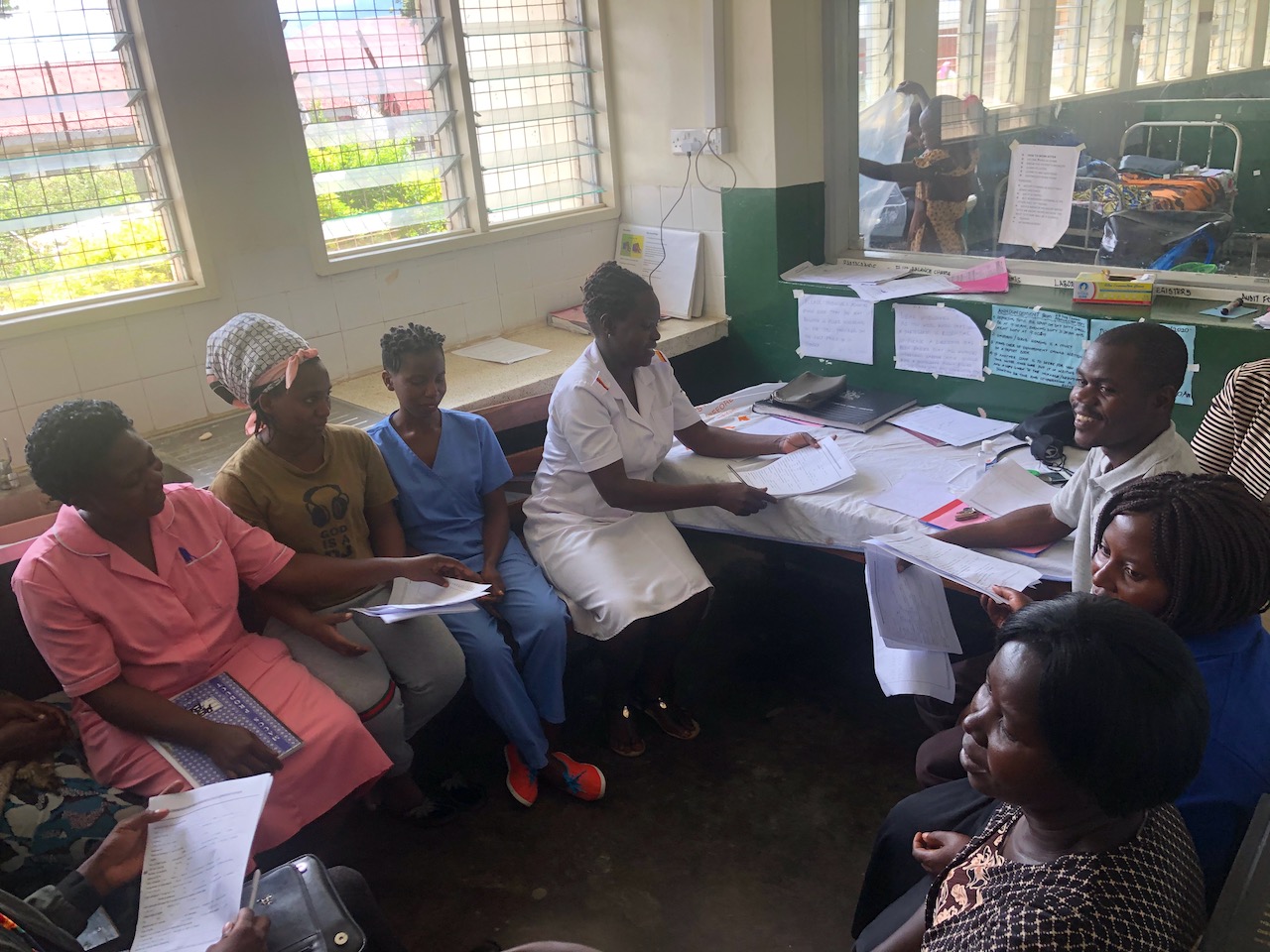
This is a NOT SOCIALLY DISTANT staff meeting, but it did generate some good improvements in NICU care!

Nursing station

Admin is tedious, but it is necessary to track patients and justify receiving more nutritional supplements.


Because rescuing puppies is always a good idea, even moreso in times of crisis. 

Almost every day a life is saved when Scott, Isaiah, Marc, Ammon, Obwot do a C-section, often two, in this case four: Scott delivers triplets. 

Triplet girls at 33 weeks. Names are Nyangoma, Nyakato, Kiiza. These are traditional names for "first-born girl twin, second-born girl twin, and the next sibling to come along after twins". Triplets that survive are rare, so most Kiiza's are a sibling a few years down the road, not a few seconds. Praying for these three, who would be our second set of surviving triplets in 2020. 
And our first set in the new NICU

you've heard of face-masks; this is mask-face (lines etched after a long day of continuous N-95)


Tuesday, April 28, 2020

#COVID-19UGANDA day 39, Easter day 17: finding truth in a time of wilderness

While this news article is enough to make anyone pause--large numbers, dire warnings--it was the stock file photo that caught my attention. This looks like my mom and sister. It is NOT, but it could be.

My sister had a birthday Sunday, and like all birthdays in this era, she cooked her own dinner and went on a socially spaced walk, while caring for her husband and son and receiving greetings by facetime. She's a hard-working woman who serves others. My mom, and Scott's mom, are troopers staying carefully low-profile, in their homes. For weeks. And more weeks. They are resilient octogenarians with a good grasp of science and a willingness to sacrifice. It's been a marathon and it's not over. One of our kids came home to police cars on the street; the next day the neighbors told him that one of their room-mates shot himself. The toll from the virus and from the fear and isolation is high in our country of origin. Much of America has experienced excess deaths from mid-March to mid-April, half known coronavirus and half unexplained (some actually are coronavirus but not known because of lack of testing and diagnosis or choice to remain home rather than be alone in a hospital, others are fear of accessing health care leading to late presentations of other common illness, dysfunction of parts of the overwhelmed health system, or coronavirus insidious effects that we have yet to delineate, or the mental health strain of a restricted existence, so many factors). A few areas have actually seen fewer deaths as roads emptied and crime plummeted. The models spoke of the hammer and the dance; we have been hammered with restrictions and they flattened even the steepest NYC curve. Now we are asking how to dance, how to ease up a little and see what happens. Cuomo today talked of cautiously opening valves and reading dials. Soon some places will relax restrictions, and then cautiously watch.

The world hit 3 million diagnosed cases. Uganda hit 79. Tomorrow will be 40 days in the wilderness for us, longer for some others.

There is no way to know if opening the schools, or the restaurants, or manufacturing will do more good, or more harm. There is some evidence that the closures did some good. But the evidence is still to be gathered, the conclusions still to be drawn. We're living in the middle of the largest scale experiment of our lifetimes, and we don't have the answers.  This is how science works. We observe. We think and ask questions. We design ways to get answers by setting up intervention and control groups. We gather data. We analyse. It takes time. There are truths that are given by God and handed to us by our traditions, of which we need to remind ourselves. My favorite this week was posted by Eric McLaughlin: " The final secret, I think, is this: that the words "you shall love the Lord your God" become in the end less of a command than a promise.  - Frederick Buechner". I would add, love your neighbor as yourself to that. These truths remain a bedrock, and through this enforced time of restricted options, we are coming face to face with their necessity and comfort. And there are truths we have to discover like the relationship between force and velocity, or between virae and death.

So as I look at that picture and imagine my mom and my sister, separated by glass, wearing masks, wondering what is true, let's remind ourselves to rest on both kinds of truth. Base your actions on facts proven by peer-reviewed science. And base your actions on the truth that loving God and loving your neighbor are in the end what matters. Love requires sacrifice. My heart is pained by the fingers on the glass. But that picture of separation is not the end of the story. Here is one more quote from a Rohr meditation today:

To heal from our suffering—not merely to ease or palliate it, but to transform it into the source and substance of our growth and wisdom—requires a journey through it. 

Here we go, on towards day 40.

Saturday, April 25, 2020

#COVID-19UGANDA day 36, Easter day 14: When prosaic steadfastness becomes global poetry

Perks of being the last person to finish work: On Friday, the whole team ended up finishing ward rounds with me. We had to capture the moment because 4 doctors, a dietician, a nurse, and an assistant all in one spot represents such a significant percentage of active medical care in the district for a morning it was remarkable. In my defense, my first four patients of the morning were all ICU-eligible, only we don't have an ICU, we have three tables in the front of the room near the outlets for the oxygen concentrator and the window into the nursing station and with poles to hang blood transfusions. The first was actively convulsing from cerebral malaria. The second had a respiratory rate of 110. The third was a listless girl with sickle cell anemia unable to be transfused because the blood bank was out of her type. And the fourth was an infant with oxygen saturations ranging from the high 60's to the mid 80's as he struggled to breast feed.
Our "ICU"

New admission with malaria and decreased level of consciousness, quick check that she wasn't about to expire from anemia .

After that there were the usual kids draining pus and sweating fevers, dwindling with diarrhea, suspected of TB, with unexplained jaundice or persistent vomiting. Scott had planned to deliver triplets by C-section he discovered when doing an OB ultrasound this week, but that case had to be bumped back to Monday so the operating theatre could rescue a woman in urgent need of a C-section for obstructed labor, another with an ectopic (tubal) pregnancy, a man with a perforated bowel. Drs. Marc and Isaiah were introducing our new flow sheet for feeds and fluids and antibiotics in the NICU, and Jessie was weighing every patient and starting the most malnourished on supplemental milk or ground nut/soy paste. 

Into all that mess, the prosaic and unremarkable work of steadfast, quotidian, routine care.  Dextrose and diazepam and an LP, drawing blood for hemoglobins and crossmatching for transfusions, calculating feeds and fluids, instructing parents about what medications should be given at what time (nurses are overwhelmed, so parents have to initiate), reviewing wounds, changing dressings, doing ultrasounds, listening to hearts, checking pulses, probing abdomens, connecting oxygen, listening to concerns and giving reassurance. There is nothing very high tech or very remarkable in any of this. It is very basic medical care. We have no fancy monitoring systems, no ventilators, very limited drugs. But we take what we have like the epitome-of-prosaic loaves and fishes, and hand it out. 

Of course, after prayer. The morning staff meeting with our distance outdoors always ends with prayer.
Our kids sent me a link to a Peter Cottontale -Chance the Rapper song called "pray for real" that has stayed in my head. I pray for vision, I pray for wisdom, I pray for weapons against the system, I pray for freedom to free the victims, to heal the brain, no pain inflict'em, I pray for real, I pray for real, I talk to God then wait for real, can't fake the fall, can't fake the feel, I pray for fun, I pray for real, I pray for ya'll . . . Prayer is part of that prosaic steadfastness. After the staff meeting I always start rounds with prayer. I mostly say the same thing, every time. I ask God to come and heal the children because God can, and we cannot.

For five weeks and counting we have been living a severely restricted state, watching the world-wide pandemic escalate, reading all the news and medical literature with dread. But more and more, it seems that the basics are what we need. Africa has much to offer the world on grit. We can isolate, we can screen, we have brave ambulance drivers and medical officers, we can wear masks and wash our hands, we can be humanly present to comfort, we can try to keep up with oxygen and blood, we can trace contacts and make reports. We can develop a sense of shared community in the effort, we can put the present troubles into a bigger universe of spiritual perspective. We can determine not to neglect the real killers, malaria and TB and complicated labor, hypertension and diabetes. We can be mundane and plodding but still walk through the valley of the shadow of death.
This quiet nurse Amos fills out the discharge forms and gives pills and instructions to the parents every day, unglorious but essential work.

Olupah is our charge nurse, and she gets things done!

And down the road, CSB staff are working on our second packet of homework for students. With care to spacing, with obedience to limited transport, but with that same commitment to the small tasks that add up to service. 


And our RMS teachers are in the final weeks of the year's curriculum. Moms still make meals, draw baths, monitor conflicts. Our accountant John is plugging away at his spread sheets. Josh got permission to begin essential work on the Nyahururu water project, at the epicenter of the December landslides, one of the systems that was completely destroyed. His truck of pipes was allowed to pass from Kampala yesterday, and today's he's up at the site directing the first steps after months of planning. Neighbors stop at the gate, sit on the porch, bring news that Bundibugyo's government salaries will not be paid in April affecting all the teachers, health workers, etc. Electricity is intermittent, lines being repaired. Uganda has two other plagues at the moment, a swarm of locusts larger than any in decades landing on crops in the north and east; and rampant water hyacinth islands blocking the Nile's power generating dam.  Prices for cocoa, our main cash crop, have dropped. But we see lots of people with hoes and pangas, trooping off to gardens, and right now plot after plot with the early grassy green shoots of rice. Ramadan began yesterday, and even though curfew and COVID have stopped the blaring music at night we could hear our neighbors in their compound celebrating their iftar meal. Life going on, people adapting, and the heartbeat of all of that is the common daily inglorious work that is the core of what we do.

The very nature of the simplicity and tedious-ness is part of what connects us all. I learned a new word on an Africa-CDC COVID-19 webinar this week: concatenation. The chain that links us together. Day after day, week after week, we begin to hit the wall where the adrenaline of crisis has ebbed and the draining work of stepping into each new day continues. But as we do that, we are not alone. We are linked. 


And perhaps by doing that, day after day, the prosaic takes the shape of the poetic. Psalms. Praying for real. 


Saturday, April 18, 2020

#COVID-19UGANDA day 29, Easter day 7: Do we want NORMAL?

For the first few weeks of this pandemic, we were mostly just waiting for life to get back to "normal". To be able to drive, to go further than a couple of miles from home, to hug neighbors and greet friends, to look forward to reunions and vacations and milestones. The pandemic pandemonium would, we thought, be a little blip on the ever-upward-trajectory of growth, and a shared milestone of some suffering that we could reminisce about for decades to come as we lived our old lives again.  It is now slowly dawning on us that there is no way back, only a way through, and we need to choose what the new normal will look like. And that for much of the world, the old-normal was not always appealing.
In terms of the origin of the pandemic, do we want a world where intensive mass-scale animal agriculture leads to the kind of crowding and stress where pigs and poultry become the source of disease? Or where smaller farmers keep getting pushed to the periphery, where interaction with wildlife and the cross-over of pathogens becomes more and more likely? The evidence is mounting that COVID-19, like more virulent strains of Flu, or Ebola or AIDS or other diseases, are not random events. Their emergence can be directly tied to the choices we make about food, about consumption, about land. When those choices harm the majority-world poor but enrich the powerful, there is little public will to change them . . . but now that everyone is suddenly vulnerable, perhaps it is a good time to, in one of our favourite movie phrases, "re-evaluate our decision-making paradigm".
Favuorites in one bowl, all local plant-based: g-nut sauce, gonja, beans, sombe, and rice.
In terms of the propagation, is there any limit to the benefits of the transportation of humans from place to place? As a human whose life involves roots on two continents, that is a difficult question. But people like us brought this virus to almost every country in the world, in a very short time. Sitting in Africa, I can hardly blame people for questioning the justice of the very places that pillaged this continent's resources now turning their backs to us in a time of pandemic brought to us by them. And by them, I mean, me. Workers like us who decimated the Americas and Africa with smallpox. We didn't think it would happen again, but here it goes.
In terms of the response, do we want to keep having a world where healthcare is a commodity that goes to the highest bidder? Where decisions about health rest in the hands of for-profit corporations? Has this pandemic led us to question the wisdom of assuming that our final metric is growth, consumption, spending, wealth? It has been interesting to see the world grapple with this, and there are no easy answers. Poverty kills. The coronavirus kills. Isolation measures have increased poverty and prevented coronavirus death. Which has been more significant? The jury is still out. Who should measure, who should decide? Has unbridled embrace of decentralisation and continuous mistrust of government been helpful? Or does this pandemic point out the need for coordinated action on behalf of the common good?
In terms of the impact, we are already seeing the way underlying disparities affect outcomes. On an individual level, people of colour in the USA have had disproportionate mortality. On an international level, now Africa is projected to have as many as 300,000 deaths (we have usually 400,000 per year from malaria, so we still can't forget the big killers). 60% of urban dwellers live in unplanned settlements with poor access to clean water, and zero ability to isolate themselves. Rural populations represent the majority on the continent, and cannot work or study online without electricity and internet connections. Much press has gone to the number of ventilators or lack thereof, with the USA bemoaning only 1 for ever thousand or two thousand people .  . . when Africa has one for every 200 thousand to 20 million people. Since up to 80% of the people put on ventilators even in high-resource places die, maybe we should focus on the basics. What if this shake-up allowed us to commit to clean water? To a strong public hospital system with good malaria care, with oxygen plants, with basic antibiotics, with safe deliveries?
why we need the basics--a totally fine recovery from malaria with deathly-levels of anemia
And so as we pass the month-mark soon of COVID-19 in Uganda, that is what we are doing. Plugging along at justice. Encouraging our political leaders, speaking with our public health system, supporting our excellent medical superintendent. Augmenting oxygen. Doing one more ultrasound, one more C-section, one more infant resuscitation. Working our way through annual review meetings with our teams. Planning. Listening. Because the world needs faithful hard work, tenacity and grit in the face of suffering, people just doing their job over and over with kindness. That is how the Kingdom comes. And that's the new normal we hope to see.

Two people with tenacity and grit, our friends at market.

And two more who once went to school with our kids and now are worried about their survival in the dangers of America--love to see the global leveling this time brings

Trying to improve care for infants, don't let that one fancy incubator fool you, we have a LONG way to go

The most vulnerable, a malnourished toddler and her mentally-challenged pregnant mom

Linsdey prayed Thursday for relief from the heat, and we got quite a rainstorm that night. It probably dropped from 90 to 75 degrees on Friday morning, prompting this winter outfit.

As I was leaving Friday I found an escapee

Confirming a healthy pregnancy in a young lady

Just walking into the next needful thing


Wednesday, April 15, 2020

#COVID-19UGANDA Day 27, EASTER Day 5: the Paradox of the hidden sprout

Easter is more than a day, it's a season, a resurrection way of life. When I think of the open tomb, I imagine blinding light, angels, fireworks, glory. A dramatically visible moment of unmistakable turning, where everything starts to become new and true, the sadness undone. However, the only people who experienced it that way were the guards who went unconscious and were later easily bribed to change their story. So much for irrefutable drama. The actual witnesses were women walking in the dark, going about their hands-on menial labor, puzzling over mystery, encountering a humble gardener one on one. 

So we reach day 27 of living on a broken edge that got extra hard, and day 5 of living in the feast of celebrating how it's all transformed and healing and hopeful, and the two don't seem to fit together very well.


Doreen, RIP

My sickest patient, Doreen, who just broke my heart with her starving little body, her too-soon-pregnant-again mom, the lethargic inability to turn the course of that dwindling life, died on Good Friday. I suppose the timing was a small gift from Jesus to bring meaning. Four children died the day before. Monday is a blur, Tuesday night two more died, and Wednesday morning as I was starting in the NICU I heard wailing from the Paeds ward and got a message that yet another had succumbed, a toddler who had not woken up from cerebral malaria we had been treating for days. This is the baseline reality of life here, and without comprehensive ways to count and track, I can feel in my gut that there is some COVID effect but not really prove it. At least four recent deaths were from respiratory infections--but that can be a thousand different viruses and bacteria, and since our first five tests (all negative) were taken to the national lab we've been told we don't have the proper swabs and can't test any more. Mostly our deaths are malaria, malnutrition, and sickle cell, and often all three. Or prematurity, neonatal infections, difficult oxygen-starved births. And when no one can move except on foot or by the limited ambulances, there is a curfew, people are terrified of getting the disease that is killing even rich well-resourced people, schools are closed so blood drives have faltered and life-saving transfusions are becoming harder to arrange, supplies have run out for key medicines, women in labor are stuck at home . . . we KNOW that our baseline struggles have only been augmented. (SIDE NOTE: Most years, over 400,000 people die of malaria in the world. So far, 137,000 have died of COVID-19 since December . . . which is a pretty similar monthly toll of 30-35,000.  The difference is, for malaria it is 95% African children far from the cameras, and the rest of the world has no fear of the disease reaching them. And admittedly, malaria is treatable and stable and COVID-19 is still escalating and likely to exceed the average malaria toll soon.)

I want to walk into each day as if Jesus' tomb exit is still good news, and having impact. But then dozens of dysfunctions fly up in my face and there are jaundiced prematures not getting their feeds and fluids and lost lab results and confusing communication, and I quickly forget all about Easter. Where are the trumpets and power? Why is it all so hidden and slow, so yeasty and sprouty when I feel we need miracles with exclamation points?

Easter to Pentecost, 50 days of a new world, get very little print. The arc of the spinning-into-decay universe changed to a direction of justice and wholeness, but quietly. Jesus walked around with his scars and cooked fish; he didn't bring an angel army to grab the throne and set everything in order. Like the proverbial seed that died, there was a sprout that one only sees by looking closely, moving some debris and dirt away, noticing.

At the beginning of Lent which feels like 6 years not 6 weeks ago, I was going to practice the discipline of noticing resurrection. Instead I found myself by yesterday just spiralling into woe-watch, seeing the gaps and loss, and wanting the Jesus who throws the tables in the temple instead of the one that speaks peace to the hurting. I know I was not nice to be around. And I suspect the pressure of most people's lives, unaccustomed patterns, extra work at home, uncertain endings or unattainable relief, the friction of continuous closeness, monotony, grief, have often led us to look for something proximate to lash out against (where is the nurse! why was the medicine not given!) in place of a vague cloud of pandemic and sorrow that we can't do a thing about.
me with Kacie heading to the last task
My last task of the day was to find the Medical Superintendent to talk about our malaria medicine supply, as I had been buying stop-gap amounts of 10 vials here, 10 more there, over and over and we were completely out of it again. I was still in my table-turning mood, I admit. As Kacie and I walked towards his office, he was coming in another door with a few staff and a big smile. Before I could launch into my concerns, he told me, we just got 1,500 doses of artesunate from the National medical store! The chances of that intersection of need and supply and question and answer were so slim, I knew right away this was a glimpse of resurrection. A kind reminder from God that the seed is sprouting in hidden places, fragile shoots.

So, go out looking for Easter, even though we're still living in lockdowns. The week after the real resurrection, the Romans still ruled oppressively and the religious establishment still orchestrated a cover-up, the believers still hid in rented upper rooms, and even the chosen few still doubted. Don't look for fireworks, look for the tiniest green leaves. And pray for us to have eyes wide open, to look past the rising numbers (more than 15,000 COVID-19 cases now in Africa), the decision to cut off international funds like the WHO, the struggle to even treat relatively simple problems, and to have faith.

Here are some of the last few days of sightings:

Some functionality--our district has recognised the difficulty of getting patients to the hospital and now has an ambulance schedule!

Benjamin and Lindsey . . babies are always palpably places of hope

World Vision comes through with bleach and megaphones

Flowers for Easter

Dressing up for Easter even with no where to go, a cheery Forrest Faith.

We still get plenty of patients coming . . . thankful for the nutrition team and the Paeds team!

Morning mercies, sunrise.

Dr. Isaiah puts up with my angst, and even helps moms learn Kangaroo care

This baby is my high point, we actually got an LP, a result, a diagnosis, a treatment, and we're half-way to healing from serious meningitis and healing. (Kenya friends, note the post-dehydration rash!)

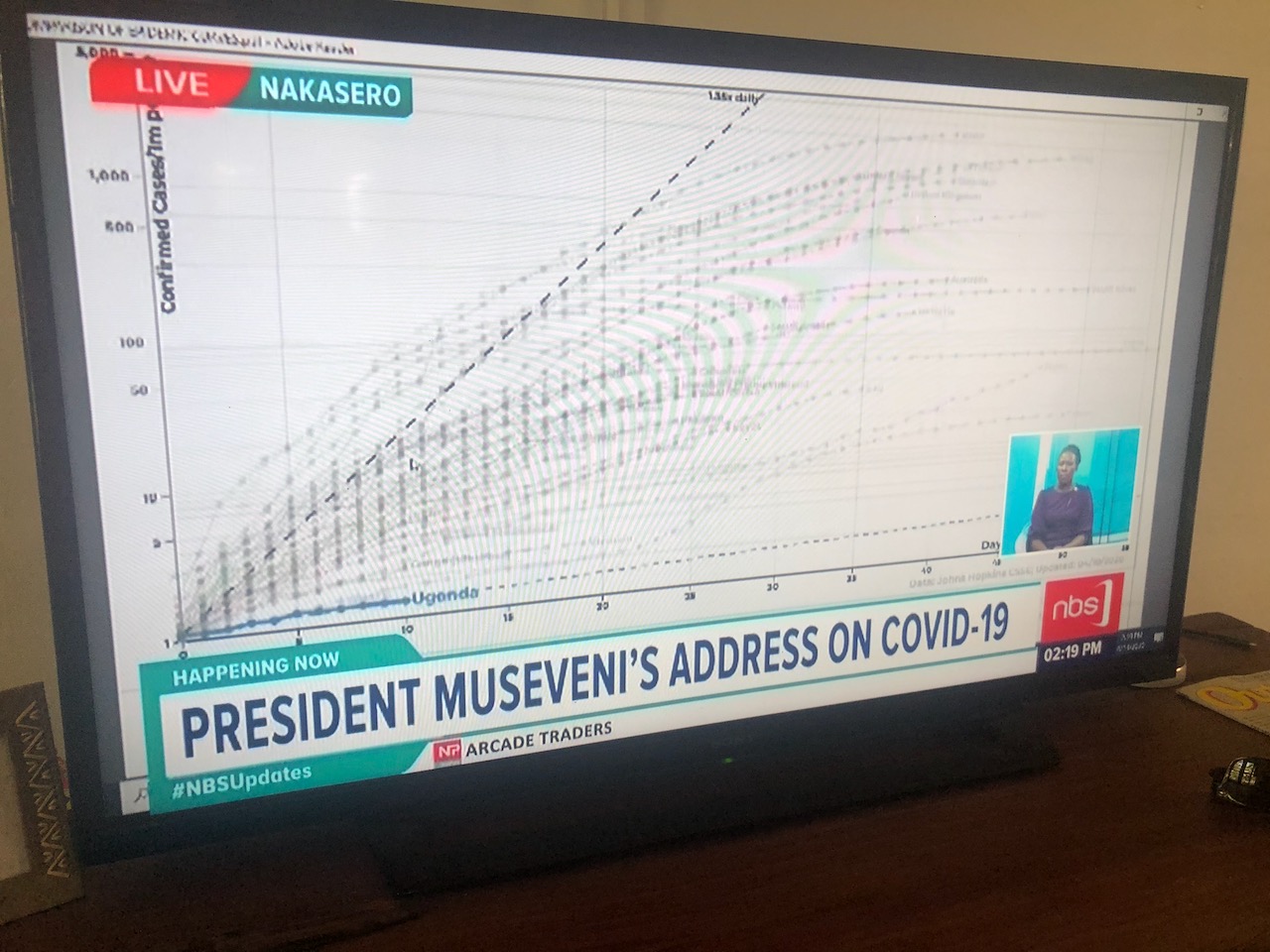
Uganda is the blue line at the bottom, which is the hope that the isolation and contract tracing is working to at least delay the disaster . . .