rotating header

Sunday, November 05, 2023

Of ancestry and fire, deep roots and difficult dangers

 How does a team, a group, a community, become a family

team praying together for a needy colleague
Dean Desmond preaching today at CSB on Luke 21

As the CSB year draws to a close, the reference to the school's collection of teachers, staff, students, workers as a family has surfaced several times. The seniors said goodbye this Sunday, having completed the gruelling  month of nationalised standard exams, one or two half-day papers per subject for 8-10 subjects. The education system in Uganda is evolving to incorporate more innovative hand-on projects and ongoing grades but until this point, these exams are the sole determinant of performance, the sole measure to sort out who gets to proceed on a university or job path. Tomorrow they will check out of school, but today they led worship in chapel with a song that repeated a chorus of thanks for each teacher by name. They were genuinely celebratory of all they had received. Their class teacher, Dean Desmond, who after 20 years here carries the vision and mission more deeply than any other staff, gave the sermon from Luke 21. Like Jesus, he did not promise them a glorious path of ease, in fact he told them the truth, that they would look back on their years here as amongst the best as they go out from here to face hardship, hunger, conflict, thieves, witchcraft, jealousy. But the assurance of Luke 21 and Lamentations 3 is that when the Lord is all you have, you have enough. They go out in faith knowing they will not escape troubles, but they will never be alone.  The foundational connection of shared faith, shared roots, shared geography, shared experience, unites.

Auntie Jennifer visiting baby Hammond

A week ago, that same teacher had traveled across the country back to his home village to bury his mother, and while he was gone his wife went into labor with their third son. Hard to imagine a more stressful week in a place where labor and delivery too often end in tragedy, where the greeting for a new mother translates "thank you for surviving", for working your way through this danger. While we were still in Burundi, the school staff came together and in spite of extreme distance and the ongoing exams and rainy season and limited funds, decided to send the deputy head teacher to take several cross-country bus connections to the burial to be with Desmond and his extended family. And the school nurse and others accompanied his wife here in Bundibugyo to the hospital, stayed with her through labour, and brought her and baby Hammond back to their home in the staff apartments.  Once Desmond finally made it back to Bundibugyo, he sent the whole staff a long and heartfelt acknowledgement that this community stepped in like a family, to fill the gaps when there was need. It struck me that this CSB staff has come to function just like we try to encourage a Serge team to be: they live and eat and worship and work together, but more than that they are the reliable first line of provision when emergencies arrive. That sounds like a family.

Common roots in ancestry and the interdependence forged by challenges in life make a clan a family, and make a school staff or a Serge team a family too. We call God our father, and we hold each other up in the storms.

CSB Chapel in the rain this morning, CSB board at the end of our meeting Friday below


Senior Four boys singing out their thanks, a glimpse of why it's all worth it

a shot of one of the many reports listing the good done by CSB this year . . another glimpse 

Scott listening and explaining and advocating and compromising . . it's a tall job to be chairperson Board of Governors

Preaching to ourselves, because it's been a stormy week. The seasonal rain drenches us, but we hit the ground after the Burundi trip with a drenching of sorrows. That is the nature of living in a place with fewer barriers to insulate one from poverty, so that daily encounters with broken things, hungry people,  sick children, thwarted plans, just keep pounding down. Our CSB board held it's second meeting of the year, and while that is encouraging in many ways as we pour over the annual reports with parent and political representatives, teaching and administrative staff, and missionaries representing the founding body (our enrolment this year of 255 students is 49.4% female, our kids went on a richly immersive "geography" trip, our girls' football went to nationals, 7 of 8 students who qualified for university scholarships from our district were our grads, we have upgraded our computer lab and improved security, and so on), a significant part of the 8-hours of board deliberation includes the general sentiment that fees are too high for parents to afford while at the same time complaining that the school should buy a bus or build more buildings. All good things, but not humanly possible to accomplish. We struggle with funding, accounting, deficits, rising food costs, and a thousand details, with cultural understanding and trust. And that's just this local team, the 11 teams in 6 countries that we're supposed to supervise and support all have similar struggles.

As we begin a new week, we know we wouldn't be bobbing along in this stormy mess without family. Our Ugandan colleagues and Serge team and area, our Serge leadership network of life long friends, our financial and prayer supporters, own kids and siblings and mothers who cheer us on. Scott's mom Ruth turns 91 today, and our daughter Julia is there baking her Nana and friends a lemon meringue pie and taking her to church. If a family comes from a common root and a trial-by-fire life, we take today to be thankful for both.


The birthday girl a few years ago feeding her firstborn . . . 

And a few yers after that with her husband Dave at her parents' farm


And a few months ago with us in Half Moon Bay


Monday, October 30, 2023

The paradox of lament and hope: to Burundi and back

Burundi, Bundibugyo, and Ituri/North Kivu provinces of the DRC are contiguous areas of the Albertine Rift, sharing overlaps of rainforest and culture and language roots, of equatorial heat and volcanic heights, of distance from the colonising coasts and from the centres of commerce and development, of political insecurity and injustice in recent years but also of eagerness for change and life. We have teams in all three areas, and just spent this past week visiting the Serge team in Burundi. This visit marks 10 years of our team's service and was timed to work on a new "Memorandum of Understanding", the documents that outline and define our partnerships on the ground.  That might sound administratively dry or tediously straightforward. But anytime you throw two very disparate-background groups of people into an intense work and life environment and have thousands of people to serve and hundreds of thousands of dollars to account for, the paperwork is far from dull.  

Our team leaders spent days in a working group prior to our arrival to create a draft, and then we spent a day preparing with them followed by a solidly long non-stop 8 hours around a table with the chairman of the church's board, the Rector of the University, and a legal advisor, combing through word by word, asking questions, expressing intentions, debating composition of committees or supervision of projects, making sure we understood each other and agreed. The next day we set aside to celebrate, to give speeches and look at numbers and marvel at what God has done. 


Ten years in a country that has known Burundi-level suffering must acknowledge lament. Our work has not been perfect, and our team has spent that decade face to face with some of the highest maternal and child mortality, hunger, poverty, and limited options, in the world. Our families were caught in the trauma of an attempted coup, and one experienced a violent break-in, robbery, assault. Every step forward seems to be followed by one or two back. Our partners have seen so much death including the loss of the Bishop we began our whole relationship with, and have faced the incredible risk of trusting foreigners who look like the same sorts of people that brought division and war to their doorstep. We lament together the lingering effects of conflict and COVID, of famine and failure. 

And yet a ten-year arc of story carries a hopeful weight of glory. The Kibuye Hope Hospital has treated 300,000 patients and performed 30,000 surgeries in that time, each an inflection point of a life beset by injury or disease that could have otherwise ended in permanent loss. Thousands can testify that God sees them and cares about their needs. 300 new doctors have been graduated from medical school, a noticeable inflection point upward in the graph of health care over time. The Rector's final comments focused on how these new doctors not only have excellent training in medicine, they have been shaped by the atmosphere of asking questions, going the extra mile, praying to God, creating community.  And that doesn't even mention the more visible, concrete (brick actually) evidence of a decade of good: power, water, wards, offices, homes, food. 

After our days in the capital with our partners, we drove up to the more central village where the team lives. Which is always a highlight, to not just banter documents and speeches, but to walk into life. To accompany rounds, talk to the kids at chapel, join in the pizza-evening tradition, listen and pray with various groups. The new Paediatric building draws the most complex kids from around the country. It was encouraging to welcome one doctor back from a national association of surgeons, where he collaborates with Burundians about the training and services all over. And get a demonstration of 3D virtual reality from another, for teaching anatomy. That perfectly highlights the spark that an outsider with surgical and computer skills can bring to remote central Africa while it's still cutting edge for the most prestigious schools in America.  These families labor in construction and accounting, in treating cancer and malnutrition, in teaching preschoolers and residents. 


The day we left, Team Leader Eric's article about his real-life Good Samaritan story came out in Christianity Today magazine. Read if for a more in-depth ponder of the toll of responding to a neighbour's need in the midst of our own neediness. This is the life Jesus modeled, and now empowers. We celebrate the seeds of change and growth and joy, but we do so with a sober view of our difficult reality. Lament and hope, gratitude and grief. On to the next ten years.


Saturday, October 14, 2023

Two trips, two countries, 30 years: in the wilderness leaning into grace

 Thirty years ago today, we touched down in Entebbe with 8-month old Luke and our trunks. Those were the days before cell phones or internet, so when no one met us at the airport, we sat on those trunks on the curb for a couple of hours plotting what to do next. Swarms of lake flies surrounded us and I envisioned them being malarious mosquitoes that might end my baby's life before we even found our place. We knew the only way to make a phone call out of the country was a phone booth in the Sheraton Hotel about an hour away, but by the time we were ready to hire a taxi to find it, John Wilson Atwooki pulled up in a truck. The family who had planned to meet us was all sick at the Church of Uganda guest house in the capital, and he had been deputised to take us there. 

And so the themes were set for the last thirty years.  Atwooki has continued his occassional timely rescues (just a few months ago he saved us with a broken down car), we have continued to be blessed by the Church of Uganda (which just this year established a diocese IN BUNDIBUGYO and the new Bishop is speaking at CSB tomorrow!!), sicknesses both tropical and typical continue to throw up many of the day to day barriers to our plans (already consulted on one sick kid this morning, and exchanging emails with a family that has to travel for extra work up and care), and we continue to stumble through new travel experiences where we're a bit lost and dependent upon the kindness of others and the grace of God.

This past week, Congo (DRC).

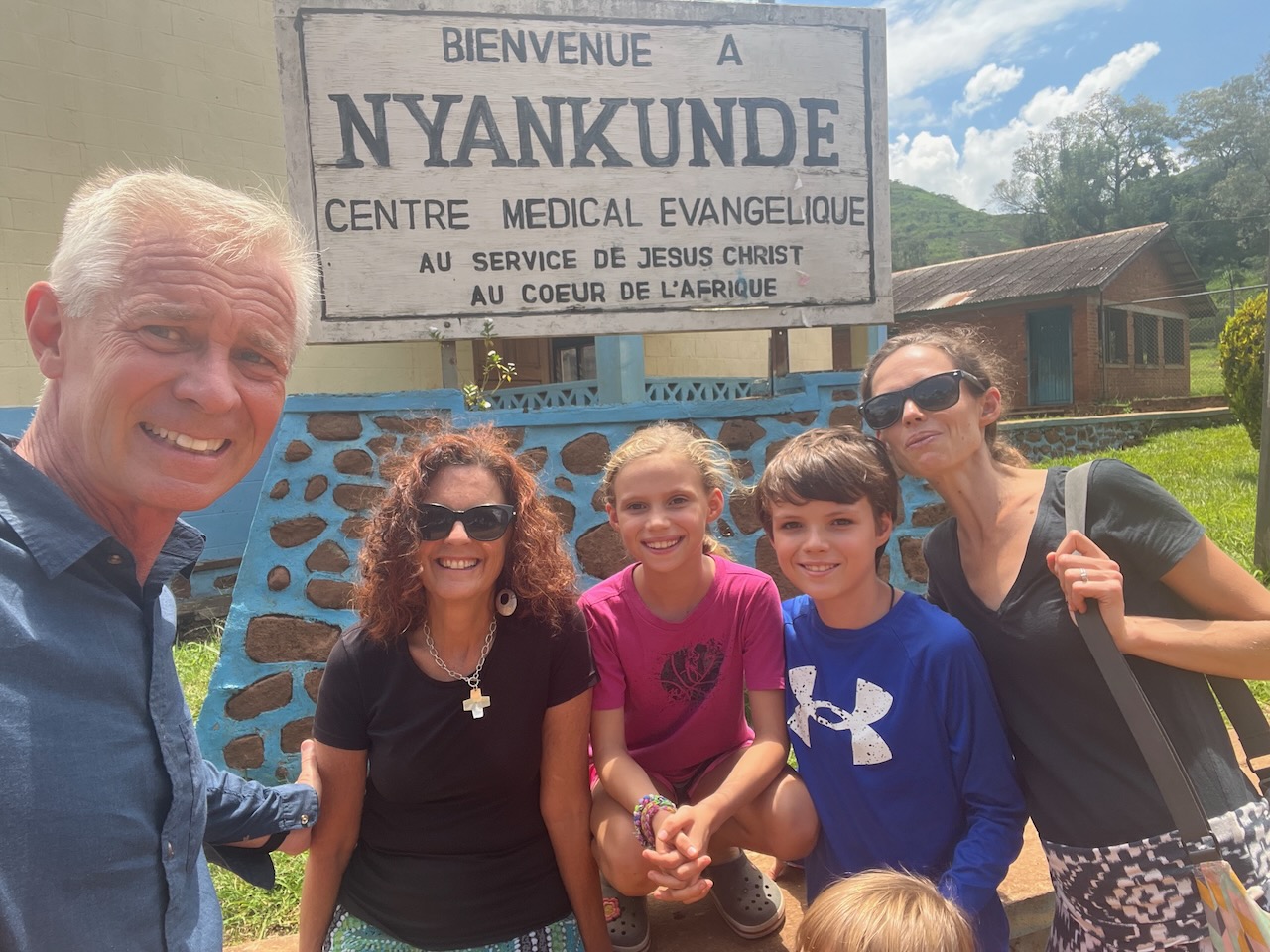
Actually, more than 35 years ago, we had formed a team of college friends in America to go to eastern Congo to an area that had been identified by other missions as needing Bible translation, and had almost no church presence or health care. . . .but in the process of trying to get there we learned that the Babwisi of Bundibugyo were related to the Congo tribe over the border, spoke that same unwritten language, and that Serge had started to work in church and health on this side and needed us to join in. So we did. Our Uganda team has continued to care for patients and refugees who cross the border, and enfold church leaders from Congo in training, and about 5 years ago we added a team in Nyankunde to Serge. Between insecurity there, COVID border closures, my accident, and the strain of life, we hadn't visited that team in too long. Last month when we were in Kampala we stopped in the Congo embassy and paid for visas so we could make a visit in October.

Can you see our boat waiting? Note the photos below of the process .. 


Bunia is only 70 miles as the crow flies from our home in Nyahuka. But that's 70 miles of no real passable roads and of villages frequented by rebel groups, so it's not easy for us to get there. We've gone by a circuitous road route in the past (150 miles), crossed the Semiliki in a little canoe to meet a MAF plane once, flown from Entebbe into Bunia too. But recently a couple of small companies started running a "high speed ferry" (a 20 ish foot long boat with bench seating in a glassed-in central area and a motor that crosses in about 1.5 hours) across Lake Albert. Our team leaders, the LaRochelles, tried it out, and it sounded so much easier than driving 8 hours to Entebbe to fly back across Uganda . . . so this trip we took the boat too. Long day into a short story, we haven't learned a LOT in 30 years. . . .once again the timing was ambiguous, finding the right people and procedures tedious, the departure point in Uganda is about 2 hours from us and the arrival point in Congo nearly 2 hours from our team, so it's still an all-day effort. But all went well. We moved with only small daypacks and our visas, and were well cared for by our team.

The main highlight of 5+ days in Congo is the Congolese. For a people who have known some of the worst colonial injustice, some of the most intractable and devastating war, and some of the most lethal diseases (King Leopold, Mobutu, and Ebola are all pretty rough but accurate words for Congo), the atmosphere in person is incredibly welcoming. We had six formal meetings with partners, and without fail they thanked our team for expressing the solidarity of presence and the practicality of love, and asked us to stay. We shared meals and toured camps and hospitals and listened and prayed. 

The second highlight was the team. The LaRochelles (in about 2015) and the Staffords (in about 2020) came as Samaritan's Purse post-residents to Nyankunde and in spite of multiple evacuations and sorrows remain committed to blessing the people of Congo. They live in a hard place, difficult to access, with little capacity to share the work loads or find respite. But they both carry a strong vision for the world's good and God's glory, for restoring all things in partnership with Jesus who is making all things new. Inspiring words that obscure the hourly reality of a jolting unpaved road, unpredictable access to water or power, the lurking threat of skirmishes between armed groups, hungry kids and patients in advanced stages of problems that should have been addressed months or years before. 


One of our meetings opened with a Congolese security advisor saying "you know, Congo is a conflict zone." One of the driving urgencies of our visit was to assess the complex interplay of a hundred tribally based militias, a couple of larger international rebel groups, a national army, the UN's long and less-effective-than-hoped-for peacekeeping mission which the DRC government has asked to draw to a close, thousands of people displaced from home, upcoming national elections in December . . . all as a background to our faith-based NGO and a few others as well as western government-funded aid trying to forge some safety nets.  

In this world you will have trouble, Jesus said. The DRC would not dispute that summary of life. But be of good cheer, I have overcome the world, Jesus concluded. Over and over God leads people into wilderness to lovingly teach them to lean on grace. You can pray for our team's stamina to keep pouring out for the needs of Congo, to keep living the hard story of the Gospel. And pray for us and other leaders to wisely embrace a holistic, long-term view of bringing hope into that place.

This week the DRC might not even seem like an important story in light of rumbling horrible aggression in the Middle East, Europe, elsewhere. God holds all these tears in a bottle, cares for every sparrow that falls. Deaths in the last year or last week, compared to USA losses in 2001:

    DRCongo civilians in Ituri/North Kivu killed by rebel militias this year 1,800 (6 million in 20 yrs)

    Ukrainian civilians killed in Russian invasion 9,614 (military combatant numbers too obscured)

    Israeli and Palestinian civilians killed in this week's attacks 2,300 and climbing

    USA civilians killed in 9-11 attacks 2,977 people

    USA civilians killed annually by guns (both suicide and personal aggression) 48,000

We all need the good news, that love is stronger than death.

Come Lord Jesus.


Sunday, October 01, 2023

On being a peg

 No matter how many times I read the Bible, there are always new phrases that pop out. One day this week the lectionary assigned Ezra 9, and as the prophet laments the state of exile and failure he says in verse 8 says that for a little while grace has been shown to give us a peg in the holy place. A tent-peg, a pin that holds the temporary shelter anchored in a storm.  

That captures some picture of what we are here. Not super strong or beautiful or famous, but still a reliable little wedge that holds on in the muddy realities of life. 

This week back after the glories of the mountaintops (see previous post) has been a challenging pace of problems, not unexpected after a few weeks of deferred engagement. But in the middle of things falling apart we had two full days of celebration. On Thursday, Dr. Isaiah Kule married Masika Emily. Isaiah entered CSB as an orphan and graduated in Caleb and John's class, his determination and good will catching the eye of Dr. Travis back then who advocated we include him in the Dr. Jonah Kule scholarship fund for medical school. He came back after graduation and worked on the paediatric and neonatal wards with me here in Bundibugyo until he became convinced he needed to do a Paeds residency, which we also sponsored (along with some government help). He's just finishing his final thesis project to graduate with that master's degree (residency in Africa) and decided this was the time to marry Emily (whom he went to university with, she's a pharmacist) in the church. Isaiah gathered a wide net of support for this huge party, not just us but the CSB alumni, the hospital, the mission, his residency colleagues, his uncles, etc. His integrity shines, and his joyful face through the many hours of the ceremonies and celebration. We pray that he and Emily have a partnership to pour into the neediest places in this country with their lives and skills.

On Saturday, the Christ School candidates party pulled us into another day of music, dance, speeches, food, and hope. The Senior Four and Senior Six classes will begin intensive weeks of exams, sitting for 3-4 hour papers every day or two in many subjects. There is no "graduation" with a diploma, because everything about their future comes from the exam results which won't be released until early 2024. So before the gruelling testing period each year, the kids get a day to dress up and dream big. 

On both these occasions we are the only foreigners and probably among less than a handful of people over age 60. It's not our party. . . . and yet we sense that our presence brings that tent peg anchor of stability that the young people seek. We've been around their lives since their birth (longer) and so represent continuity and consistency, a steady foundation in a changing world. We also represent being seen by distant places in spite of living at the end of the road. And we try to represent the loving connecting community of God's family that transcends age and ethnicity. 

So here's to being old tent pegs! Prayers that we can stand firm.


Sunday, September 24, 2023

114 miles of sabbath, and September news

 September began and ends in Bundibugyo, but the three weeks in the middle saw us travel out to Kampala, meet our Burundian partners, fly to Serge leadership semi-annual meetings for a week, take a ten-day off-line off-work real leave by hiking in the Alps, and then return into the usual fray.


This post is in praise of rhythms of reflection, and of rest. Not as the ultimate goal, but as the nod to our frail and limited humanity. God set 3 different week-long festivals of gathering for feasting and worship and memory in the ancient calendar . . . which makes more and more sense. And not that we had a grand plan, but the requirement of the meeting led Scott to propose that we return to the hike we started for our 30th anniversary 6 years ago that we aborted to be with his parents as his dad died. No regrets that we left and were able to spend Dave's last days with him and Ruth, an honour. And this year is still a 30th, not of marriage but of life in East Africa (we moved to Uganda 30 years ago in October). 

The juxtaposition of the meeting and the hike hits the beauty of a break from two directions. First, in the meeting we were with 17 Serge leaders, some of whom we've worked with those entire 30 years. And we had been tasked to gather data from all 11 teams/6 countries in our Area, which led to deep reflection on God's mercy and grace. We spent hours praying together, and reading Scripture, and sharing meals and stories. And hours generating strategies to bring our teams into the years ahead. I read today that a "sacred space" is like a circle, everything relates to a center and exists in the now, with distractions falling away . . which is true of these meetings. So while a week of required leadership work is not exactly rest, the focus on what matters with people we love, getting away from normal life, did make it a bit like a festival.


But the ten days following were the other side of true rest: we were outdoors, largely in wild high regions, unplugged and fairly solitary, climbing and walking and praying and meditating and occasionally talking, gasping for breath and watching for footing and awed by the views. We circled Mont Blanc, daily ascending and descending the roots of the mountain, ending in quaint towns with inns each evening and scaling precipitous ridges or strolling through meadows each day. The trail was more challenging than I had imagined as a person with brain injury impact, though I'm thankful for Scott's patience and my sturdy hiking poles. We were pushed to the limits (mine at least) physically and gifted with peaceful quiet and stunning views of glaciers and forests and rivers. It is a rare time in life to disengage for ten days and walk with God. And doing that on a mountain made the journey reflect life. Not easy, right on the edge of possible, but good to encounter both the dangers and the beauties together.


Last night we pulled back into the home where we have lived longer than any other, welcomed by our team and our dog Lindi. Ahead we have hard decisions and paucities of wisdom and energy and clamours of need and clouds of obscurity. But behind us we have the solid memory of a leadership team of real friends, and an Alpen route of true wonder. And a re-set spirit to remember that God is with us.