And along those lines, please pray for Scott's dad today, who will be undergoing a heart catheterization procedure to eliminate a potentially dangerous area of tissue that stimulates abnormal rhythms. It is possible that a burst of irregular beats precipitated his recent bike accident. He's amazingly strong and resilient but we hate being so far away at important times. Thanks for all who extend our family into the world by supporting us in prayer.
Wednesday, May 27, 2009
More on celebration and sorrow . .
Not long after the post was written blow, in a moment of post-hard-soccer-practice, pre-dinner-hunger-and-tiredness, there was a brief whole-family meltdown in which Julia sobbed: I MISS MISS ASHLEY AND LUKE AND ACACIA!!! This had nothing to do with her immediate brother-frustration which triggered the storm, but was insightful. The wear and tear of daily life occurs against a hidden background of loss when those we love deeply are far away.


celebrations and reunions
 Laura May, who has taught the Chedester kids and at Hope School in
Fort Portal all year celebrated her 23rd birthday with us last night!
We knew she wanted to come for a goodbye visit with our team before
her term ends in June . . but the birthday was an unexpected honor!
She was accompanied by Amy Hudson, who finished her term as a teacher
here about a year and a half ago. Amy is traveling with friends who
support orphans in the Kampala area, and carved a few days out of her
trip to reconnect with us here in Bundibugyo. A few hours later
packages arrived from PRAGUE for the knitting club Julia participated
in, sent by former team mate Joanna. Another former team mate sent a
package for baby Jonah, and yet another has been emailing involving
potential recruits. These team connections that persist over time are
heartening. They speak to the long-term nature of relationship forged
by shared experience. They make more sense when our colleagues
function as extended family than as fellow-employees. Scott and I
have been processing about that lately. What is the nature of team
and relationship, of the servant-leadership we are called to with our
fellow missionaries? For many people who pass through our lives for
months to years, the team pulls around them the way a good family
should, offering meals and prayer and wisdom and empathy, or at rare
times caution and concern and protection. And this makes missing
milestones lonely, not just our biological family's events but
important things like Lydia Herron's upcoming wedding. We are
thankful for all we have learned from our own parents, and though we
miss them we enjoy passing on some of their love to our extended team
family here.
Laura May, who has taught the Chedester kids and at Hope School in
Fort Portal all year celebrated her 23rd birthday with us last night!
We knew she wanted to come for a goodbye visit with our team before
her term ends in June . . but the birthday was an unexpected honor!
She was accompanied by Amy Hudson, who finished her term as a teacher
here about a year and a half ago. Amy is traveling with friends who
support orphans in the Kampala area, and carved a few days out of her
trip to reconnect with us here in Bundibugyo. A few hours later
packages arrived from PRAGUE for the knitting club Julia participated
in, sent by former team mate Joanna. Another former team mate sent a
package for baby Jonah, and yet another has been emailing involving
potential recruits. These team connections that persist over time are
heartening. They speak to the long-term nature of relationship forged
by shared experience. They make more sense when our colleagues
function as extended family than as fellow-employees. Scott and I
have been processing about that lately. What is the nature of team
and relationship, of the servant-leadership we are called to with our
fellow missionaries? For many people who pass through our lives for
months to years, the team pulls around them the way a good family
should, offering meals and prayer and wisdom and empathy, or at rare
times caution and concern and protection. And this makes missing
milestones lonely, not just our biological family's events but
important things like Lydia Herron's upcoming wedding. We are
thankful for all we have learned from our own parents, and though we
miss them we enjoy passing on some of their love to our extended team
family here.
Monday, May 25, 2009
Working hard and practically
 Scott found this article in the NYTimes called " Working with your hands" :
And it gave us some satisfaction, to know that as Scott comes in soaked with sweat and grime, he's living out the new American dream . . ..
The author, Matthew Crawford. finished a PhD in political philosophy and landed a prestigious job in Washington DC. Then he realized that he was being pushed to do and say things he did not particularly believe in, and that he really loved the intellectual challenge and hands-on satisfaction of motorcycle repair. So he moved to Richmond and opened a shop, and now he's written a book called "Shop class as soulcraft: An inquiry into the value of work". He promotes the value of education designed to give people skills for serving others as plumbers and mechanics and cooks. And I think that is part of the lure of missionary medicine. A very hands-on and practical profession, we are always touching broken people and making do with what we can, sometimes with needles and scalpels, sometimes with books and articles. But because of where we live, we also end up making bread and ice cream, or cutting down trees and fixing chain-saws (read Jennifer's day and Scott's day in the last 24 hours, for example). One can spend a morning hour delving into the nature of forgiveness in the face of war, then the next milking a cow or making yoghurt. We can apply ourselves to programs for nutritional education, and then actually hand out food. I'm sure Adam and Eve had such a balance, walking with God in the Garden of knowing, then digging their hands into the soil.
So here's a plug for shop-class and soul-investment, for living fully as humans.
Sunday, May 24, 2009
Distance and Belonging
I will be blogging occasional thoughts from a tremendous book gift from Bethany F, entitled Exclusion and Embrace by Miroslav Volf. Let me say this is, so far, a challenging read but well worth the effort, even though I'm only a quarter of the way in. The themes of culture, conflict, identity, are presented in the context of the author's context of a war-torn Croatia and his wrestling with the theology of the cross as a professor at Yale. So the quote for today:
Both distance and belonging are essential. Belonging without distance destroys .. but distance without belonging isolates.
This applies to us as missionaries. We do not erase our own background; we live out of who we are. But we do so in a way that connects us to the culture here. We look for ways to be authentic and yet to lay down our will in order to approach others. Always a dance, a give and take. Volf points out that in creation God separates and binds: separates light from dark and land from water, but then binds all of creation together in an interdependent and complex web. In marriage we leave and cleave. In parenting we raise children to independence, but we do not cut off relationship. So much of the task of life is to discover who we have been created to be as separate from others, but also in relation to others.
In this culture the belonging is protected by an extreme distancing from anything aberrant. I am humbled by the task of crossing the distance without erasing it, of belonging without completely assimilating. And as a parent of teens I want to help them develop a healthy sense of distance, of identity . . while giving them the solid foundation of ever-belonging to our family. When these two forces proceed imbalanced, we can see the wreckage for years down the road. And when it works, it is beautiful, such as the dreaded reality of boarding school turning into a strengthened loyalty. Lord, have mercy.
Friday, May 22, 2009
On Language and Learning
Here is a link to a well-written article on Uganda's policy that local languages be the medium of instruction in the first three years of primary school, switching to English in P4.
The issues are extremely relevant to Bundibugyo: teaching primary literacy in Lubwisi and Lukonjo has long-term potential to enhance the neural connections that will allow students to love reading and become life-long learners. However in the immediate future, it could put our students at a disadvantage when competing with children who have a multi-year jump start on English. Last night we invited a few friends for dinner. One of our sponsored medical students described his primary school experience learning to read in Lukonjo. He is a bright and poised man who is headed towards leadership and responsibility. His colleague, another sponsored student, also talked about how he walked over the mountains each school term to attend a better primary school on the other side, also in Lukonjo. But we also had seated at the table a child of a CSB teacher whose primary language is English, his parents choosing to ground their children in that tongue since infancy. And the teacher herself has spent much of her career in the field of linguistics, with a great interest in the connection between language and learning.
Certainly my kids spend HOURS of their days on break absorbed by books. I can't imagine the impact on their lives if all the printed material available to them was in a language they struggled to understand. Sobering and fascinating.
Elections
Elections were held yesterday in Nyahuka, which used to be a sleepy
crossroads when we moved here, and is now a rapidly growing and
organizing town council in need of a mayor. There were a half-dozen
contenders, but the top two were a relative of our member of
parliament (think, insider, lots of clan pressure to keep the money in
the family) versus the local businessman who originally hails from a
neighboring country and a minority religion. Since the latter is
perceived to be a bit lighter-skinned and a relative outsider (in
spite of decades of residence) he ran under the nickname, Obama.
Really. People connect him with Obama, and he's been quite popular.
People respect his business skills and hope he'll be less under
pressure from local interests. Initial returns had him in the lead by
a 2 to 1 margin, and people began to celebrate. But the news of the
morning was that the other man won by 73 votes (in a city of
20,000 . . but maybe only a thousand voted, not sure). And the gossip
on the street was that the parliament-connected politician was paying
about 2 dollars per vote. So Obama and his supporters zipped off to
Fort Portal to protest. I believe the political process probably has
the greatest potential for good, or evil, than any other grouping of
people here. So we pray for clarity and justice.
crossroads when we moved here, and is now a rapidly growing and
organizing town council in need of a mayor. There were a half-dozen
contenders, but the top two were a relative of our member of
parliament (think, insider, lots of clan pressure to keep the money in
the family) versus the local businessman who originally hails from a
neighboring country and a minority religion. Since the latter is
perceived to be a bit lighter-skinned and a relative outsider (in
spite of decades of residence) he ran under the nickname, Obama.
Really. People connect him with Obama, and he's been quite popular.
People respect his business skills and hope he'll be less under
pressure from local interests. Initial returns had him in the lead by
a 2 to 1 margin, and people began to celebrate. But the news of the
morning was that the other man won by 73 votes (in a city of
20,000 . . but maybe only a thousand voted, not sure). And the gossip
on the street was that the parliament-connected politician was paying
about 2 dollars per vote. So Obama and his supporters zipped off to
Fort Portal to protest. I believe the political process probably has
the greatest potential for good, or evil, than any other grouping of
people here. So we pray for clarity and justice.
In the meantime I arrived this morning to learn that Nuela had taken a
sudden turn for the worse around midnight last night, and died. I
would like to picture her now in the rich brocade robes and nose-
diamond-stud of Ezekiel's story, a beloved young woman of grace and
wholeness. I would have liked to say goodbye to her grandfather, whom
I may not see again. Very sad.
Thursday, May 21, 2009
Ezekiel 16
Is the passage I meant to refer to in the post below. The story of Nuela made this Gospel-picture come alive for me. Read it.
Wednesday, May 20, 2009
Trench Slogging to Hope


So, a few glimpses of glory. First, Nuela, a little girl from Congo whose name refers to her being born at Christmas, though her grandfather is uncertain WHICH Christmas it was. I'm guessing she's about 4. When her father died, his relatives shunned her mother and her, and her mother ran away. Then the paternal relatives sent word to the maternal grandfather who lived in Uganda to come and collect the child who was very ill. So in a counter-cultural move (children belong to the father's family in patrilineal descent) this somewhat elderly lone widower of a grandfather carried this terribly ill girl whom he had never before lived with back to Uganda and to our hospital ward, and there they are. She is listless and swollen and scabby and miserable. But I find it remarkable that her grandfather is making this effort and pray it is a story of redemption ( ).
Second, on community, Jack was invited before the first day of school this week to visit one of his best friends, Ivan, who lives pretty much on his own in a small room in Nyahuka. Ivan had saved back some of his school money and bought eggs and cabbage, and he and Jack cooked themselves dinner on the charcoal segili, then played cards until dusk. While many friends hang around our house, it was rare for one of our kids to be invited to someone's home, alone, as a human being not as part of a missionary family, just to be a guy. He had a great time.
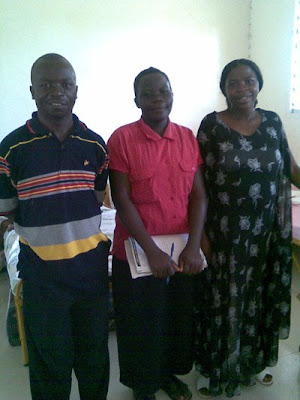
Third, partnership. Though I dreaded this week with several of my missionary co-workers gone. . . Ugandan colleagues have shone. Our nutrition workers Pauline and Baguma Charles have been fantastic. And I realized this morning I was rounding with three of my favorite nurses! One is about to begin maternity leave any moment, the second is a mature lady (like me!) whom we sponsored to become a nurse years ago, and the third is an energetic and capable young man whom we sent for training after seeing his faithfulness over the years, who just finished his course. And to top that off, one of the three medical students we sponsor from the Dr. Jonah fund is here for a week of his school break, a breath of competence and a hope for the future.
It strikes me that these themes: prayer, community, partnership, compassion, emerging leaders . . . are the core of what we've asked God for this year. And in a week that seems mired in evidence of evil, those payers are being answered.
Monday, May 18, 2009
ICU and CSI
This morning, I was trying to run an ICU and Scott was trying to run a CSI . . .
Well, we were wishing for those two things. An Intensive Care Unit conjures images of glistening equipment, beeping monitors, tangles of IV lines, humming oxygen. Picture instead, a listless cold baby in shock, wrapped in a filthy cloth, unconscious and grunting, on a bare mattress with a litter of spent IV cannulas as two nurses use a razor blade to shave his scalp and a rubber band to try and pop up his empty veins, his mother and aunt seated on a low wooden bench anxiously watching. When they were unsuccessful after ten minutes, I decided to try an intra-osseous line. In a baby the tibia is not all that hard to penetrate, and inside the bones there is a spongy sinus of tissue that absorbs fluid well. The trick is to jam a needle into the bone, which takes more courage than fine motor skill. I do not have any more sturdy short needles designed for this task . . . so instead I used a lumbar puncture needle and merely held it in place in his floppy leg, trying to keep clear of the copious and odiferous diarrhea flowing out. We also don't have any syringes bigger than 10 ml, so it took 45 refill-and-push refill-and-push procedures, counting out loud, to get a half litre of fluid into his body. When we started I could not feel any pulses, by mid-way his heart was racing, and by the end he actually put out a little urine and began to move his arms, warming and looking a little more life-like. All the while I was praying him back from the edge. At first his mother claimed he had become sick only that day . . and I worried about cholera, which can rapidly kill. But towards the end he vomited a brown mixture of herbs, and I slowed down enough to look at him more closely and suspect that he had been dosed from above and below with local enemas which are part-witchcraft and part-local lore. Delick still may die, but I left him on antibiotics and anti-malarials and with a bag of blood warming for transfusion. And he was next to another baby with severe malaria (an advanced case with very high parasite counts) and another with severe anemia (from sickle cell disease), any of whom would attract a bevy of specialists and thousands of dollars of care if they walked into an ER in America, but who will hopefully limp through on a ward of 30 patients staffed by a couple of nurses and me.
Scott, meanwhile, was investigating a crime scene, as if he had nothing else to do with half his day. The thievery spate continues with this time someone who KNEW THE COMBINATION opening a lock in a temporarily vacated house. Interestingly the thief "borrowed" a bicycle and pair of crocs to lug the loot, and Scott and others were able to follow the characteristic tread in the muddy road (it rained hard last night) for about a mile up the road before losing the trail. The mud-caked bike and shoes were returned, and the door closed and locked by morning. We had already initiated a night-watchman plan (which starts tonight, unfortunately too late to prevent last night's episode) and invited the local community leaders and police chief to lunch on Wednesday to express our collective team distress.
These two mornings starkly remind us what we are up against: our enemy is not the desperate parent who nearly kills her baby with herbal enemas, or the desperate person who takes sugar and a mattress and dishes from a house full of much more valuable things. Our enemy is the force of evil itself in this place, the strongholds of disease and ignorance and greed and jealousy and hatred and laziness and fear. And our enemy is not only external, but we have to deal with our own self-righteousness and self-protection and entitlement and judgmentalness. A tall order for sure, which is why the cross had to be so gruesome and bloody, so serious and painful. God's ICU for our own CSI.
Sunday, May 17, 2009
REAL missionaries . . .
As part of yesterday's hooplah, the pilot of the AIM-Air plane ended
up hanging out at our house, and in between driving and supplying
snacks and water I had the privilege of doing my own interview. It
was RVA that provided the connection, I find that it is a way that
most missionaries in East Africa are somehow related. But as we sat
and talked I was awed by the real commitment and experience of this
family of AIM missionaries. The pilot's grandfather entered the
Belgian Congo in 1922 in a canoe with CT Studd, one of the pioneers of
19th and 20th century missions. His grandparents served over 40 years
as did his parents, and he and his wife are on their 26th year . . .
with four kids who will probably follow into this fourth generation.
Makes our saying "we've been here over 15 years" sound pretty paltry.
I was fascinated by first-hand accounts of Congo when it was a
functional empire of railroads and order, as well as by first-hand
accounts of the rampant corruption and deterioration that make it
almost impossible to survive there now as an outsider. But more so I
applaud the quiet heart of mission aviation, to connect people with
gifts to share in preaching, healing, teaching, etc. with those in
very remote and difficult terrain. It is often Africans ministering
to Africans these days, but the plane still enables those with more
opportunities to reach those with less. It reminds me that we are a
young mission, and I humbly soak in the history of those who have laid
down their lives long before we were born.
up hanging out at our house, and in between driving and supplying
snacks and water I had the privilege of doing my own interview. It
was RVA that provided the connection, I find that it is a way that
most missionaries in East Africa are somehow related. But as we sat
and talked I was awed by the real commitment and experience of this
family of AIM missionaries. The pilot's grandfather entered the
Belgian Congo in 1922 in a canoe with CT Studd, one of the pioneers of
19th and 20th century missions. His grandparents served over 40 years
as did his parents, and he and his wife are on their 26th year . . .
with four kids who will probably follow into this fourth generation.
Makes our saying "we've been here over 15 years" sound pretty paltry.
I was fascinated by first-hand accounts of Congo when it was a
functional empire of railroads and order, as well as by first-hand
accounts of the rampant corruption and deterioration that make it
almost impossible to survive there now as an outsider. But more so I
applaud the quiet heart of mission aviation, to connect people with
gifts to share in preaching, healing, teaching, etc. with those in
very remote and difficult terrain. It is often Africans ministering
to Africans these days, but the plane still enables those with more
opportunities to reach those with less. It reminds me that we are a
young mission, and I humbly soak in the history of those who have laid
down their lives long before we were born.
Subscribe to:
Posts (Atom)