Friday, July 08, 2011
The 9th of July
Happy Birthday to South Sudan! We join with our team there in rejoicing over the end of decades of civil war, and the palpable sense of hope for the future. We also grieve that some ethnic groups continue to be targeted by violent aggression, particularly on the North/South border. Please pray that the launch of this new country would usher in a peace that allows children to survive, families to unite, villages to thrive, and a whole nation to taste a glimpse of the righteous rule of Jesus. And remember our team, on the ground in Mundri as witnesses to this birth.


Sunday, July 03, 2011
Stories
Sitting in the front yard, wrapped in Julia's purple Maasai blanket as clouds pass over, Star at my feet the perfect company. Caleb's guitar strums from the house, it is Sunday afternoon and I hear an occasional voice as everyone putters around for a while doing their own things. Ibis squawk, poinsettias flame, a breeze moves leaves in the muted cool daylight of the southern hemisphere "winter" (60-70 degree days feel positively arctic after acclimatizing to a Bundibugyo life, and when it rains and dips to the 50's we shiver). We're back from an outdoor service at RVA where 18 young people were baptized, most of them missionary kids who have been challenged to own their own faith as teenagers apart from their parents. Eighteen stories, each a unique variation. Someone found her life was not her own but God's while she was held hostage after a carjacking. Another sensed God's love when peers sought him and pulled him out of a protective isolation. Another had to confront her emptiness when her family's move to Africa landed her at RVA without access to drugs and alcohol. Another realized even "nice" kids can be obnoxious. Another confronted his cruelty in the way his peers were damaged by his abuse. They mentioned loneliness, neglect, bitterness, bulimia, cutting, deaths of friends, feeling ugly, feeling on the outside. They also mentioned peace, scripture, caring friends, involved adults, and the compelling presence of the Lord. All took the opportunity to make public their commitment to Jesus and their desire to follow Him. And all were pulled up out of that water with spontaneous smiles.
It's good, it's faith-pushing, to remember that we're in the middle of the story. Even inside the RVA fence, protected from much that is evil, kids are in process, and many are facing life-pivotal-moments. Depression stalks, pressures abound, and yet love breaks through. When Scott and I see these kids in clinic, we want to honor their journey, remember that they will reach graduation more fully themselves than they were in the years before. When I see obnoxious attention-getting behaviour, I don't want to label that kid, but see through it to the person who might be giving next year's testimony. I am convicted today of how easily I label and box, and how crucial it is to see beyond to the glory that will be revealed.
And reminded that the current US Ambassador to Kenya attended RVA, as did his wife.
Several calls from "kids" in Uganda this week, people we care about . . . who have their own stories. Parents separating, destructive effects of alcoholism, gossip, jealousy, anxiety, and the struggle for getting needs met. Frustrating to be powerless, for them and for me. I am convicted again of the importance of believing, taking the longer view of glory.
So, how to pour into these stories in a way that peels away the crust of the Fall and reveals the wonder? Sometimes just by being present, and bearing witness.
Yesterday the rugby teams, Varsity and JV, traveled to a school near Thika, to play a match that had been delayed and rescheduled and confused all term, and so it felt like a last-minute addition. It was the last game of the season, coming just before exam week, and against the number one school in the league, a large well-known Kenyan institution that emphasizes rugby and trains year round, with a professionally qualified coach who works internationally. It was a school that beats us, and pretty much everyone else, decisively and repeatedly. Some of the varsity seniors chose to quit the team rather than play that last game. Plus it was over two hours away, in road-contruction-mass-confusion Nairobi outskirts traffic, to a dusty acacia-studded field, where about 500 opposing students chanted and massed on the sidelines, laughing loudly at our mistakes, taunting. At that distance, on second-to-last weekend of the school year, the supportive crowd was thin. Me and three other parents and two young siblings, to be precise. It wasn't our teams' best games, by far. JV lost 36-10, and Varsity something like 26-0. I did get to see Caleb kick a penalty for 3 points, which was a significant percentage of the total points RVA scored, but he also was frustrated with himself for a few errors, not his most heroic game. But the boys walked away satisfied, declaring that they had had fun, they had supported each other as teams, they had stuck it out to the end. The lone parent-car that went had errands to do on the way back, so I ended up on the bus packed with sweaty, scraped, dusty, thirsty kids. And I didn't hear one word of complaint. They recalled plays and tackles, they joked. (There was one kid that gave me a scare on that ride by falling into a deep sleep and slumping onto the floor, which made me worry that he'd had a head injury in the game and was now progressing to coma, but when I pried his eyes open he answered questions appropriately, and in spite of my nerves walked off the bus smiling when we got back, saying he's a solid car-sleeper . . ). They demonstrated sportsmanship and resilience.
The stories that will be told of these kids, including my own, will be long and often harrowing and intermittently hysterical, and involved scattered hard-to-reach-hard-to-love spots all over this world. Perhaps if we could see where they are heading, we'd be more willing to invest in them now.
Friday, July 01, 2011
Jubilee
A week ago, I entered my year of Jubilee. Most likely my only one, unless I live to be 99, which is not very likely. 7 x 7. I think it's supposed to be about rest, which is ironic, because I haven't even had a moment to think about it until now. Last weekend's call blended into one of those Mondays that ran into another call on Tuesday that spilled over into a Wednesday morning when the other paediatricians all had extenuating circumstances and so I found myself with the terrible responsibility of stopping unsuccessful CPR on a 1 1/2 year old boy and then turning around and taking his soon-to-follow 1 1/2 year old room mate to the ICU where I intubated her. I had to tell two families within 12 hours that their child had died, which is as always a holy but wrenching moment. I also spent solid portions of both Sunday's and Tuesday's call on a punky preemie, one of those babies who just keeps teetering on the edge of existence, including sitting several hours by her bedside and ventilating her until I was about to give up and she miraculously started breathing. Thankfully Mardi stepped into the picture on Wednesday afternoon. Since then, RVA clinic, a long morning hospital meeting, a couple of hours tracking down xrays and an ortho consult for Luke post-accident (persistent shoulder pain and limited motion, but seems to be all muscular, which he was certain of but at least I fell better about it now), some admin work, clothes-patching, and major cooking--two dinners for young people--one night two of Luke's returning classmates, and last night two young Kijabe doctors, all delightful people.
Which brings us to Friday at last. To quiet and journaling and reflection and prayer, to the inhale that has to be deep enough to last for through the craziness. To the beginning of Jubilee, a week late. To Leviticus 25. To more thoughts to follow, but here are some initial ones. Jubilee is good news in the middle of life. Jubilee is course-correction. After 49 years of divergence from perfection, Jubilee is the time when God restores the broken, recovers the lost. Inequalities are undone. Resources are redistributed. Grace is real. Jubilee calls forth faith, the faith to live on God's provision only, the faith to refrain from striving, the faith to let go of what seemed like gain, to accept what seems undeserved. Yes, there is some rest, for the land mostly, which reminds us that it belongs to God and not to us. But liberty is the clarion call of Jubilee. It is an act of proclamation, which culminates in Jesus as the incarnated Jubilee, proclaiming the year of the Lord's favor, good news for the poor, healing for the brokenhearted, liberty for the captives, open prisons for the bound, comfort for those who mourn, beauty for ashes, the garment of praise for the spirit of heaviness (Is 61 fulfilled in Luke 4).
So perhaps the first week of my Jubilee isn't so far from a true celebration. Breath for the flagging, fluids for the parched, encouragement for the youth. A change from the past many years, a relocation, a letting go of most of my former work and responsibility and satisfaction. The challenge will be to live on God's provision while still living out Jesus' mission, to live in rest in the midst of a restless world. To return to what God has given, to be without a push to do. To celebrate Jubilee personally without letting down a community that expects so much. To balance the rest for my soul with the proclamation of liberty for others. I'll get it wrong, most of the time, but that's the whole point here: God steps into the 50th year and makes it all right again.
Monday, June 27, 2011
on blogging: rich human compost
Frederich Buechner (Telling Secrets), on encountering God in the concrete details of our actual lives:
Precious
Precious in the sight of the Lord is the death of His saints. (Ps 116:15)
A precious child died today, the extremely premature baby boy of dear friends of ours in Nyahuka, a couple with whom we have a parental relationship. His mother's life is still on the edge as she lost a lot of blood. All weekend as her saga unfolded we have carried the burden of caring about her and her young husband, worrying about them, and sadly being far away. We're thankful for Isingoma and Christine, and Travis and Amy, who stepped in with wise counsel and timely medical care. Please pray for the Isingomas and the Johnsons, who are stretched in so many ways, to have spiritual refreshment and stamina, and to keep investing in the lives of younger people. And pray for our friends in their grief to turn to God and find new depths of faith in Him, and trust and comfort in each other. It's been a rough few months for them, and they desperately need a fresh hope.
At the same time in Kenya, I was caring for another precious child, this one a 1 1/2 year old girl NAMED Precious. When the intern and I decided to admit her to the hospital, it was largely because her mother had brought her to the clinic about four times in that same week, and so even though she did not look as ill as most (she had a normal temperature, breathing, heart rate, no history of vomiting or diarrhea) I felt like her mom was sensing something more was wrong, and it would be prudent to figure it out as in inpatient. Precious had rickets, a common form of malnutrition here, and was slow in her development. However when I was called to the hospital that evening for a code, she was about the last patient of the MANY on the paediatric ward whom I expected to find being resuscitated. She had spiked a burning fever, and possibly aspirated (choked) as she weakly attempted to breast feed. By the time I arrived she was completely flaccid, with no effort to take a breath, though her heart beat had returned after CPR and adrenaline, and we treated her with fluids and strong antibiotics for presumed septic shock. Then I had an excruciating decision. Our ICU resources are very limited, and if she had been pulseless for more than 5 minutes she would be unlikely to ever recover fully. Her motionless body and unreactive pupils were did not give me much hope. Yet it is hard to stop breathing for a patient that still has a strongly beating heart. A wise ICU doctor came to my aid when called, and suggested we ask her mother what her wishes were. And she said "This is my only child, please do everything." Ah, the name now made sense, Precious, the only baby. We intubated her. And before we could take her upstairs, she started to breath a little on her own. This morning she opened her eyes. She has a long way to go, and she may or may not recover. But I came so close to stopping what looked like futile therapy. Because though I care about my patients, they are not as precious to me as they are to their own mothers.
Then I got my turn this morning to move from doctor to mom. Luke had a pretty serious motorcycle accident riding on a rough road down in the Rift Valley on the way to interview Maasai traditional healers for his research project. He lost control after a bump, skidded to the side of the road, where his bike stopped abruptly into a boulder and he flew off and hit his head against a rock. Thankfully his borrowed helmet saved him. He ripped his clothes and had a bloody scraped side, but no serious injury. When he messaged us on rounds I was eager to run home and just be sure he was intact. He's precious to me.
Our Medical Director reminded us this morning that God our Father waits for a glimpse of us, delights in us just because of who we are, His children. This is how my friends feel about their tiny, unviable fetus. This is how Precious' mother feels about her with her ventilator and tubes and fever and listlessness. And how we feel about Luke, accentuated by the risk of near-disaster. A parental love does not flow because the baby has done anything, it exists because the baby IS. I know I have a hard time believing this is God's passion for me.
Sunday, June 26, 2011
Weekend DIY
 'Tis the season of goodbyes. Last Sunday afternoon there was a tea for the Bransfords and the Riches, with a combined years of service something like 60. Jacqui and Sue created a spread fit for a magazine from local fabrics and flowers, and everyone contributed homemade cookies and fruit.
 Yesterday Jack's 8th grade class had their celebration, a rite of passage to high school. No catering, no restaurants, so here you see many parents and students in the RVA school cafeteria kitchen (an impressive facility, pretty new, my first time behind the scenes) doing food prep. We served salads, breads, a main course of grilled beef fillet, linguine alfredo, and parmesean tomato. Then for dessert . .
 I did mousse duty with Jacqui, creating 50 mousses from local chocolate bars, cream, and eggs. I had never made it before but by the time we worked our way through four double recipes I got the hang of it.
 Jack at his table, wearing Scott's tux jacket from college over his best shirt (we didn't really get the formal aspect until the last minute). The kids did a drama and Jack was the star of act 3, a talent I suspect we'll see more of in the future. After kitchen duty in the afternoon, I worked as a server in the evening. I did leave a little early to get home by 8 for the birthday dinner Scott and Luke had cooked me! DIY celebrations.
 Caleb was on choir tour all weekend--here is a preview shot from church last week. He is not yet back from the third straight day of going to schools, churches, slums. They are presenting a drama based on Job, with music. DIY entertainment and enrichment.
 Caleb's class party: all the girls got to choose (somewhat athletically, like a major capture-the-flag week-long contest where the girls trap boys and tie a scarf on them) a boy to be their costume partner. Caleb's was pretty fun and benign, as Mr. and Mrs. Santa, pictured here with Peter Pan and Tinkerbell. DIY costumes.
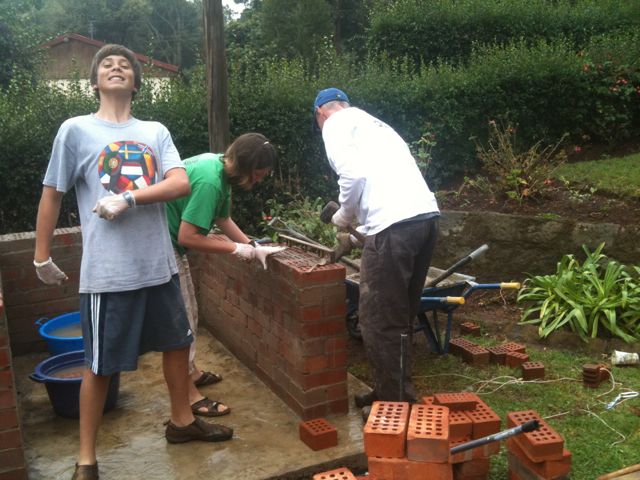 The latest on the pizza oven, Scott with the kids, enjoying the project and the time together. DIY pizza, someday.
 Tomorrow we have another goodbye party . . . and everyone is supposed to bring lasagna. So here is DIY lasagna in process. Ricotta made two nights in a row from two days' worth of fresh milk, tomato sauce made from scratch this afternoon, pasta made by hand, and local sausage and cheese.
 Rolling out the pasta.
The pictures are from my phone, which explains the low quality . . . and I do not include the approximately 16 hours spent in the hospital Sat and Sun (so far) . . including middle of the night last night . . . DIY doctoring.
One of the challenges of missions is that if you want it, you have to make it. It's also one of the joys.
Rolling out the pasta.
The pictures are from my phone, which explains the low quality . . . and I do not include the approximately 16 hours spent in the hospital Sat and Sun (so far) . . including middle of the night last night . . . DIY doctoring.
One of the challenges of missions is that if you want it, you have to make it. It's also one of the joys.
Friday, June 24, 2011
Life is Iterative
Luke just buzzed out of our drive on a motorcycle, with notebooks in his back-pack, heading down into the roadless Rift Valley to interview Maasai people about their use of traditional herbal medicines. He and his good friend Thomas developed a research project based on the observations of some Kijabe doctors that patients were coming in with difficult-to-explain symptoms that might be caused by unintended effects of these plants. He had hoped to be much further along in the project by now. But the original Maasai questionnaire confused people, the motorcycle transport was not ready, the local partners serving as guides and translators have at times had their own agendas, the randomization by overlaying a grid on a Google Map projection of the valley and selecting quadrants by random number table can make some of their target areas fairly inaccessible . . . it's a daily process of adapting in order to move forward. Qualitative research is supposed to be iterative: you take what you learn on day 1, and follow that lead on day 2. Most people are not comfortable with that. We'd like a plan that is laid out in advance, tested and true, and then the task is simply to get it done. But life is not that way.
Last weekend I was covering for another doctor and got called to see a lovely little baby girl who had been born with a meningomyelocele (defect in the lower spine/spinal cord) and was not breathing as well as she should have been. We admitted her to the ICU nursery, in an incubator, with CPAP to assist her breathing, and a full court press of medicines and monitoring. But she continued to deteriorate, and by 48 hours later it was clear that her brain lacked the capacity to regulate her breathing. Her somewhat fix-able spinal cord problem was only the visible side of a deeper and fatal nervous system deficit. We consulted the neurosurgeons, the chaplains, the parents, meanwhile reviving her multiple times in order to keep her alive. In the end the baby was discharged to go home to die. Her parents lived many hours away, and the intensive care had been expensive for them. But it would cost more to transport a body than a live baby-in-arms on the bus, so they were eager to get started on their journey before she died. Should we have let her go at the very beginning? Perhaps. It might have saved grief, time, effort, resources if we'd had a clear prognosis and plan to act on from day 1, instead of a several-day process of groping through a dim perception of her survival chances only to have to give up. But life is obscure at times, a process of trial and error and correction and change.
A similar story on Tuesday, though with a shorter course. I was sitting in nursery marveling at how calm and quiet the afternoon had been when nurses from the women's ward next door rushed in the door with a bloody little bundle of cloths and said a preemie had just been born, as it turns out in the mother's bed, from a precipitous labor (she had not even been in labor on admission for a urinary tract infection, so no one was prepared for the baby). As we unwrapped the cloths we found a blueish limp ball of baby, low heart rate, and went into gear for bagging breaths into his lungs, turning up oxygen, warming and drying. But a quick look at this baby showed he had many severe birth defects. Legs scissored up over his head, no openings for his urethra or anus, only a rudimentary tag of a penis, no hip joints, another meningomyelocele of soft fleshy cauliflower of skin on his back, a contracture of his arm, peculiar little clovers of split thumbs. His lungs were hard to expand, and we suspected that all his lower-body defects might be associated with absent kidneys, which would mean little amniotic fluid, which would man poorly developed lungs in utero, which would explain his blueness. But like the baby above, at that moment we didn't know if he could live or not live, and on the principal that God values every life equally whether it is contained in a perfect body or a crippled one, whether it lasts 30 minutes or a hundred years, we kept working to keep him alive until we could more clearly outline his anatomy. As it turned out our radiologist was able to come do an ultrasound which confirmed that he had not developed any kidneys. No one can live without kidneys. I went to get his mother, who almost broke my hands squeezing in pain as she was still dealing with bleeding and clots and stitches post-delivery. She didn't want to see him, to have a picture in her mind forever of a less than "perfect" infant, but her sister-in-law came with us to the nursery briefly to see him alive before we stopped resuscitating him. Then he died, quietly, winding down. Later I was the one to break the news to his father, which is always a holy and terrible moment, telling a parent that his child has died, trying to testify to God's love at a very bleak moment in someone's life. Again, this was not an outcome that was anticipated or smoothly planned for. We had to react to what we found, try therapies, adjust, make decisions. It would have been kinder all around to have realized the need for an antenatal ultrasound, to have known ahead of time and made a plan, but life did not work that way.
So this week I'm thinking a lot about this reality: life is iterative. The veil over glory, over reality, over the future, is thick. We walk out a few steps, then look around and adjust our course. Every day brings mistakes, from which we learn, and redirect. This is true on the scale of individual tiny lives of hours to days, as well as on the scale of two-month survey projects, or programs that represent the investment of years and lives. We gave a lot of responsibility to a head teacher once, thinking this was the best thing, who later turned out to be unable to lead the school in the direction we hoped. We started programs in nutrition that blessed many lives for many years, but later had to be suspended due to lack of personnel. A new team built very communal housing for survival, and later grew to value a bit more independence. So many times in life we cannot see far enough ahead to anticipate the outcomes of our actions, we attempt a rescue, invest in what looks good and right, only to find out by living a few more months and years into the process that we have to change course. New surveys, intensive care, hours of agony, closing programs, funding buildings, all these course corrections are costly to someone, on some level. It is natural to then assign blame somewhere, perhaps to God in particular, for not preventing our mistakes, for not protecting others from our painful learning process.
But somehow in the sovereign order of the universe, we walk by faith not by sight. We are called to hand over our two fish and be stripped of all our resources, without knowing if the multitude will be fed. We set out for a land unknown, without a road map. We pour into others' lives, without knowing which of the young people will break our hearts and which will become pillars of the Kingdom. We fiercely apply a face mask and squeeze the bag of oxygen, sometimes only to regret prolonging the inevitable. We get it wrong, and all too often the very people we meant to help are the ones to pay the price. The human condition seems to require this learning-by-living process. Life is iterative, but grace fills in the gaps and wrests some good out of every iteration.
Monday, June 20, 2011
Reflections on the Cesarean Section

"Cesarean Section: a surgical operation for delivering a child by cutting through the wall of the mother's abdomen."
I first wielded the scalpel in a Cesarean Section (C/S) as a resident while rotating at the Harbor-UCLA Hospital in 1990. Since then, my opportunities to operate in Bundibugyo were limited by competing demands. But Jennifer and I are refreshing and refining rusty skills with the help of encouraging colleagues here at Kijabe and the hope of using those skills for the good of the patients at Kijabe and beyond. My experience as a surgeon doing the C/S over the past month has resulted in a few conclusions about this particular procedure.
Chiefly, I have determined that the C/S is an absolutely unique surgery. No other surgery issues life in the same way. A new life is released, set free. While most surgery falls into categories of either resection, reconstruction or repair, the C/S is ultimately a rescue. The baby inside is either trapped by an inadequate escape route or suffocating for the lack of sustaining blood flow. Like the Chilean miners who were trapped in the dark recesses of the earth and waited patiently for an external extraction, so are many trapped inside of their mothers. This extraction, this salvage, also parallels the release that Christians find in the gospel as symbolized in baptism. When a believer is baptized, the complete immersion in water represents burial (Romans 6) and then the believer rises from the water into new life, a rebirth, a resurrection. In the same way, a fetus is immersed in fluid and rises to life, gasping for breath as he emerges from the womb. The water and the blood flow abundantly (no sprinkling here) as the baby surfaces. So, much so that under our surgical gowns, we wear a floor length rubber apron and rubber boots!
Like many Myhre vacations, the C/S is both exhilarating and terrifying at the same time. A technician can learn the basic steps of performing an uncomplicated C/S in a short time. However, to progress from technician to surgeon, is to progress from rote mechanical execution to a responsive management of treacherous complications such as severe hemorrhage, adherent placenta, or fetal malpresentation.
I love everything about the C/S. The sharp dissection through the many layers of the abdomen, the incision into the uterus and the immediate fountain of amniotic fluid, the extraction of the gasping blue infant, the restoration of the bleeding uterine wound, and ultimately the mending of the abdominal layers and skin. There's a lot of art and science, planning and preparation, thinking and doing, manipulation and judgment that go into the successful completion of the operation. But beyond the combination of dexterity and discerning which I must bring to the table, I am principally thankful for the opportunity to participate in small way in God's ultimate creative process, that of crafting a life.
Friday, June 17, 2011
A Toast to Nathan and Sarah, of battles and banquets
(Very early this morning, as in 4-something a.m., we got out of bed to answer a skype call. Heidi had graciously set it up for us, so we could offer a toast to Nathan and Sarah, at their rehearsal dinner. Scott had only come home at 3:30 from the ICU, but he managed to offer the toast below anyway. Sarah and I were both teary-eyed, and it was frustratingly short and awkward to connect this way, but still a great blessing to us. In this life it is a great joy to be part of two people coming together and we were grateful to be allowed to greet them on this occasion). Here is the toast:
Isaiah 25
O LORD, You are my God.
I will exalt You,
I will praise Your name,
For You have done wonderful things;
Your counsels of old are faithfulness and truth.
For you have made a city a ruin,
A fortified city a ruin,
A palace of foreigners to be a city no more;
It will never be rebuilt.
Therefore the strong people will glorify You;
The city of the terrible nations will fear You.
For you have been a strength to the poor,
A strength to the needy in his distress,
A refuge from the storm,
A shade from the heat;
For the blast of the terrible ones is as a storm against the wall.
You will reduce the noise of aliens,
As heat in a dry place;
As heat in the shadow of a cloud,
The song of the terrible ones will be diminished.
And in this mountain
The LORD of hosts will make for all people
A feast of choice pieces,
A feast of wines on the lees,
Of fat things full of marrow,
Of well-refined wines on the lees.
And He will destroy on this mountain
The surface of the covering cast over all people,
And the veil that is spread over all nations.
He will swallow up death forever,
And the Lord GOD will wipe away tears from all faces;
The rebuke of His people He will take away from all the earth;
For the LORD has spoken.
And it will be said in that day:
"Behold, this is our God;
We have waited for Him,
And He will save us.
This is the LORD;
We have waited for Him;
We will be glad and rejoice in His salvation."
We raise a toast to Nathan and Sarah tonight, of wines on the lees and choice marrow-filled pieces. Isaiah 25 is breaking into our world right now in this gathering.
If there is anyplace on earth less conducive to romance than Bundibugyo, we don't know where that would be. It is a place of frequent death, heat, discomfort, complete lack of privacy, cross-cultural stress, intense ministry demands, and much heart ache, not to mention a context of strict mission rules and pressure to not upset the balance. The veil lays thickly over that valley. And yet there in Bundibugyo, Nathan and Sarah found beauty in the midst of sorrow, and joy in each other in spite of the difficult context of their lives. In the mud of poverty and hard work a seed of love was planted and grew. This is more than just a lovely story for the two of them, it is a tangible picture of the way God's Kingdom comes, improbable, against-the-odds, persistent, with much waiting, we find that we are finally rescued from the heat and noise of the war to enter the feast laid out on the mountain.
This evening, and tomorrow, and the rest of your lives, may you look back and see that you waited on the Lord, and he came with salvation and gladness. May your entire lives continue in this pattern of waiting through impossible odds, and then tasting and seeing that the Lord is good. Of battle and banquet.
Tonight is a foretaste of the final feast of the Bridegroom and bride. The veil is torn so we can see the shadows of the ultimate reality, but it is not completely removed. Otherwise we would be there with you instead of trying to greet you by skype from the Kenyan highlands at 4 in the morning! We love you Nathan and Sarah and count your friendship as one of the great gifts of our life in Bundibugyo.
May your marriage be a place where death is swallowed and tears wiped, in anticipation of the ultimate marriage banquet that ends all death and tears.
To Nathan and Sarah, battles and banquets, Bundibugyo, team, and love!
Tuesday, June 14, 2011
Simon
Most of my patients are less than a month old, and less than a few kilograms in size. Today though I was called to the outpatient clinic to help the excellent Dr. Sarah there evaluate a very complicated patient, Simon. This 9 year old found his way to Kijabe to see the also-excellent plastic surgeons, because of an apparently erosive lesion that was destroying his face, thought to be cancrum oris (a nasty bacterial infection). His desperate situation had attracted the help of someone who hooked him up with a Safaricom sponsorship for surgery. Only when he came, and our doctors evaluated him, it turned out that the lower left side of his face has not been destroyed by a tropical disease, but by his own picking and scratching. He's mutilating himself. And the surgeons did not want to operate until someone tried to stop this behaviour. Me? Not likely, but it you're known as the paediatrician, then the desperate cases come your way. I admit that I entered the room and saw a child that I assumed was completely devastated since birth, and I was only thinking of how to get back out, wishing I knew of some magic-buliet-sedating drug to put this kid on.

But I didn't know any magic medicines, so I sat down with Dr. Sarah, and started to ask questions. Shockingly, this child was completely normal until two years ago. He was a 7 year old in second grade, with friends, playful, and learning to read. He was cared for by his single mom, and no doubt the center of her life and hope for her future. Then he came down with TB meningitis. He escaped with his life, but lost his vision, and use of his left side. He's blind, partially paralyzed, and has a shunt for post-infection hydrocephalus. To survive, his diminutive mother sells charcoal near her house, but when she does, she leaves him there alone. And when he's alone in the darkness of his world, and hungry, he starts to pick at his face. The sensation was an antidote to the boredom and hunger, and became addictive. Now his jaws are scarred so that he can barely open his mouth to eat. And his dear mother, who looks like she doesn't weigh more than 90 pounds herself, became more and more desperate to help him, and carried him here on her back.
When I realized Simon was blind but not deaf and not mentally impaired, I took his hand and introduced myself and started talking to him in Swahili. And he answered me in perfect African-school-English, "how are you?" He tried to smile some, and to answer questions from Dr. Sarah. He likes chapatis and avacados and balls and listening to the radio. Belatedly I realized we are dealing here with a little boy, a person, locked into his blind and immobile world, and desperate for attention. I called the nutritionist to come and help hook him up with fortified porridge and plumpynut to get calories past those clenched teeth. We made a plan with the mom for music (which she had noted stops his self-mutilating), toys, things to do and touch. We made a plan to use rewards for time periods when he doesn't touch his face, a positive feedback system. And we'll see him again in a month to see if any of this is helping him heal enough for surgery. Dr. Sarah, competent and caring, thinks she can get the same Safaricom sponsorship to perhaps hook him up with an organization for disabled people, to find out if there is any school for the blind he could attend. I was reminded of Kabajungu Grace, the little blind girl that several years of Bundibugyo summer interns and I bonded with. She and Simon would have made great friends.

Something about this weak but sincere mother and her trials really touched me. Or about Simon himself, a normal little boy trapped inside a sightless and still body, with a frighteningly skull-like disfigured face but a soul that reflects God's glory as much as mine or anyone else's does. Praying now that he turns a corner back towards life and health, and longing for the full-healing touch of Jesus to make all things (his brain and his face) new.
Subscribe to:
Posts (Atom)