rotating header

Saturday, June 21, 2014

Danger

Kenya is a dangerous place.  Travel warnings, terrorist attacks, road traffic accidents, diseases, violence. We have made headlines recently with the latest round of death:  vans of armed men attacking World Cup viewers last Sunday on the coast, then setting fire to hotels and the police station.  Sad terrible deaths.

Which then leads the US to advise against travel, tour companies to pull out plans, embassies to relocate staff.

As I read the last travel advisory, I decided to look up some comparison numbers.

In the last 18 months there have been 83 terrorist incidents in Kenya, leading to "over 100" deaths, all Africans.  This is from a population of nearly 45 million people.

In the last 18 months there have been 63 shootings in schools in America, leading to 110 deaths.  There are about 45 million American children enrolled in schools.

So why does travel in Kenya seem so much more dangerous than going to school in America?  Is it the illusion of the foreign? Why would people not hesitate to have their child be one of 45 million in a school, yet question the safety of being one of 45 million in Kenya?

Of course I would wish that no person could take a gun into a school in America and kill children and teachers, and no person could make IED's or wield machine guns indiscriminately killing Kenyans.  The world is a dangerous place, but the Kingdom comes, slowly and quietly.

End of the Season

RVA lost to Strathmore in Rugby quarter-finals today.

They were a big, fast, expert team.  We played hard, and so did they.  Yes we made mistakes.  Too many it turns out.  We traded tries but ran out of time as they had the last score on an intercepted pass. So sad for these boys who played hard and well.  Jack had a great game, good tackles, smart strategy, a quick tackle that set up our first try and another try that was called back for unclear reasons.  He did his best.
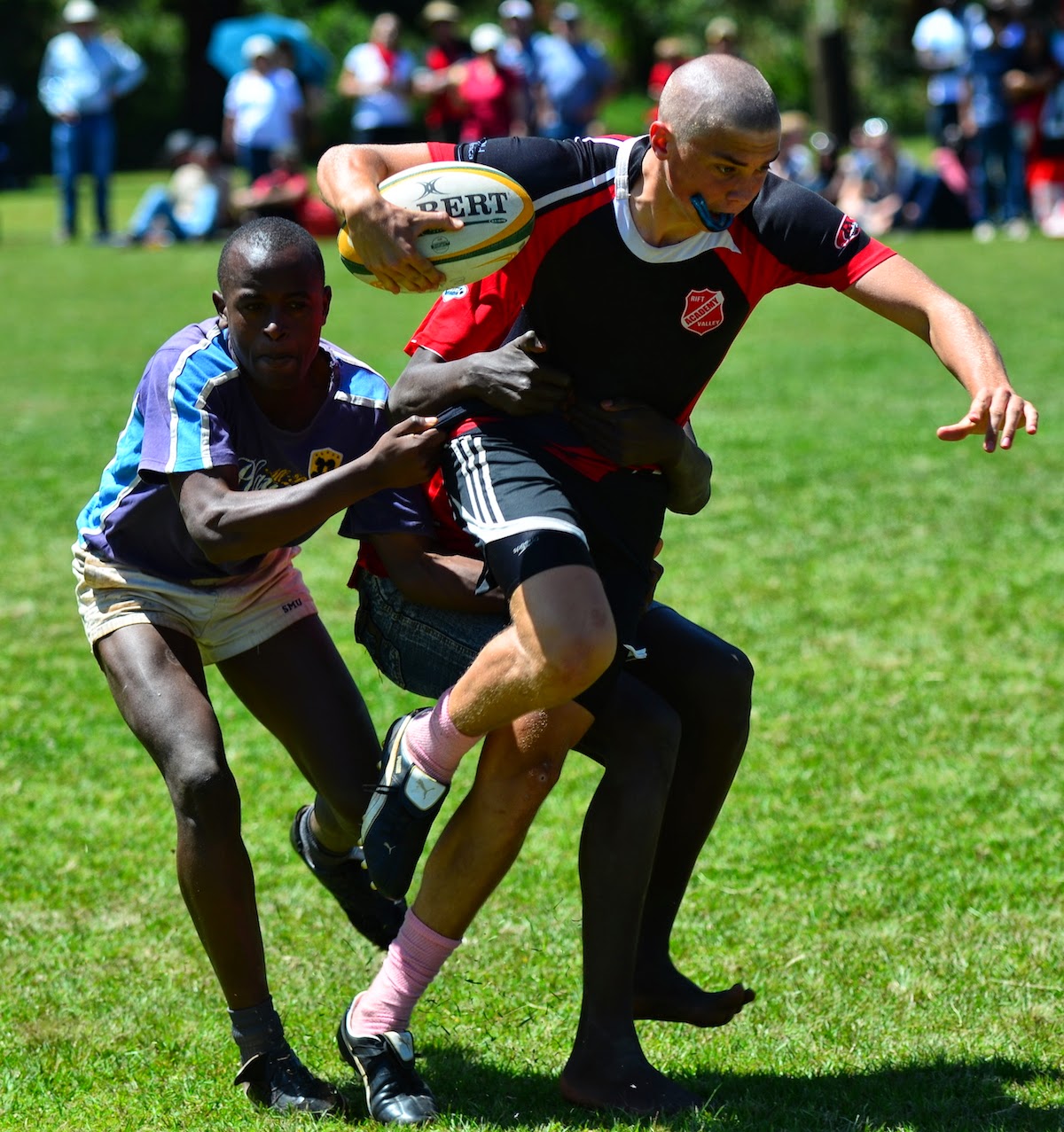
This picture was from the last season group-play game, a victory.  I think it captures some of his intensity.

A small part of me is relieved that he and the team are emerging mostly intact, no horrible injuries.  But mostly it is sad to come to the end of the season.  His coach will be on furlough next year, so that will be hard too, having a new person for both football and rugby.

I think one of the primary joys of parenthood is seeing your kids try something hard, and thrive in the challenge.  I love seeing the way Jack pours himself into rugby, just as I love seeing the others in their passions.  Sometimes I'm sad that my Dad never lived to see this sport, since he was a huge American Football fan (in the simpler days when we all cheered for the Redskins because of a loyal proximity with no qualms about the implications of the name).  He would have loved watching.

So here's to the end of a great season, winning the Blackrock tournament, making it to quarter-finals in the league.  And here's to the hope that senior year will be even better!

Keeping the "World" in World Cup

I love my multicultural kids.  And having the oldest home for a week brings a lightness to life.  Yes, he's hungry and on his own schedule and opinionated and whenever he is here it is like a whirlwind that draws the rest of us into his orbit.  He's also funny and creative and I love to find him immersed in a book or fixing something or socializing.  He's just a great person to have around. And now that son two is out of his military enclave we can SKYPE which leads to leisurely conversations and sharing pictures and tales of North Africa.  Child three, the only daughter, is a month from graduation, making cookies in the afternoons, spending time with friends, and dreading final class projects which seem to pile up.  Then there's number four, who manages to do homework horizontal in front of the fire and the TV with music in his ears, and then manages to play with passion and insight on the rugby pitch, all-out scoring and tackling and kicking.

The World Cup is an interesting time for a family of TCK's.  None of the teams are from East Africa where we live.  I wondered who my kids would root for, and the list was as follows:  US because you have to root for your passport country, any African country because that's home, any team with a Manchester United player, and then whoever is the underdog.  OK, makes sense.  Football is their sport.  They watch every minute that they can stay awake for.  The last three nights we've had German neighbors over to see their team, Australians to see theirs, and Americans to cheer for the USA.  World Cup is the common topic of conversation, in the hospital as well as the family and the school.

But USA vs. Ghana was, well, complicated.  We took brief naps and got up at 1 am full of anticipation and excitement.  The US went out ahead and we cheered; Ghana equalized and we cheered again.  And as the night went on, one of the lived-in-Africa-all-his-life kids became more and more conflicted in his loyalties.  First he just wanted a good match, but the more the American friends jumped on the America bandwagon, the more he gravitated back to the Africa one.  In a crowd of Ghanaians, I suspect they would all be American.  In a crowd of Americans, they aren't quite so clear.  I watched the dynamic evolve, a little uncomfortable, wishing that friends could understand what it means to be an American by parentage and an African by experience.

The World Cup is about world talent, world football, a peculiarly unifying event in which country loyalty is heightened and yet at the same time muted.  When home is complex and not limited to one continent, when interests span borders, the World Cup becomes a showcase of world-thinking.  So we keep cheering for the US and Ghana, Cote d'Ivoire and Nigeria, Costa Rica and the Netherlands.  Places where we have friends.  

Wednesday, June 18, 2014

Dangerous Orange, sailing over love, and other tales of the day

In light of the Netherlands' victory, dangerous orange could easily refer to Dutch National Football.  Though Australia gave them a solid run, and we enjoyed watching with the loyal Steere family.


But a more dangerous orange was the one a 10-month-old previously well baby was munching on this morning.  He coughed and began to turn blue.  Within thirty minutes his parents had reached Kijabe hospital and our alert team had deduced from his wheezy breath sounds, dusky color, and collapsed lung on xray that some part of the orange had lodged in his respiratory system.  I had the privilege of watching over visiting Paeds surgeon Drew's (former MK from Nigeria I might add) shoulder as he guided a bronchoscope down this toddler's trachea and into the left bronchus.  Sure enough, there was an orange seed, which he then used remote-controlled forceps to pull out.  Pretty satisfying, and definitely not something that can happen that quickly and expertly and life-savingly in many places on this continent.


In that same vein, I had the joy yesterday of introducing a miracle mother to her miracle twin girls.  Mama W had come into our maternal-and-child health clinic on Friday nearing the last month of her difficult and miraculously precious pregnancy.  But everything had gone wrong.  She was barely conscious, with severe hypertension.  By the time Scott rushed her into the operating room it was not clear if anyone, she or her babies, could be saved.  He began the surgery as another missionary anesthetist struggled expertly to revive her.  As Scott cut, he saw that she was hardly bleeding at all.  Which was because her heart had stopped beating and the team was doing CPR.  Scott said he had never done surgery during CPR before, but he got those baby girls out fast.  Our team revived them, and though they needed a big of oxygen and care they are both healthy, just a bit small.  Meanwhile the mother's heart restarted, and she went to the ICU with little hope of recovery.  We took care of the twin girls in the nursery, snuggled into our twin cot, crying and being fed by nurses.  The family was too focused on the potential loss of their mother to help much.  But by Tuesday she had moved into the High Dependency Unit, sitting up, talking, and looking 100% better.  After rounds that day Scott mentioned that she had not yet even seen the babies she nearly died for, so a nurse and I carried them up to her bed.  She named them Blessing and Favor, and together we prayed a thanksgiving prayer.  Again, this is one of the only places in Africa, let alone Kenya, where the threesome could have emerged alive.  And the effort took dozens of people doing their jobs, from the clinic to the theatre staff, anesthesia, medicine and OB, paediatrics, nursing, call coverage, biomed for equipment, and on and on.  

Which is why this place is a magnet for last-chance-efforts.  This morning I walked around maternity to check on the moms in various stages of labor:  A woman in her 4th pregnancy (all 3 previous ending in 2nd trimester deaths) who arrived threatening to lose the 4th at 29 (out of a normal 40) weeks, a woman at 26 weeks fully dilated with a baby that could pop out any second lying on strict bed rest and hoping, another at 25 weeks who seems to be quiet now, two at 34-ish weeks who were being induced to deliver after premature rupture of membranes, and a woman at 33 weeks whose baby was barely growing, stressed and small and lacking amniotic fluid.  We kept tabs on them all as we worked to care for the 20-some babies already under our care.  Each a story of potential loss, of a close shave with disaster, of coming almost-too-late, of serious malformations and infections and danger. Each hanging on by drops of fluids and carefully measured shots of medicine, by effort and prayer.


One of the 34-ish week babies emerged mid-afternoon pink and lovely, a perfect petite little girl.  And then at the very end of a long post-call day, a difficult C-section for the lady with no amniotic fluid.  Scott stepped in again to help the OB trainee who was struggling, and they pulled out a tiny little boy.  One kilogram exactly, about a month-delayed in size.  So he was improbably wailing and flailing like a more mature baby in a miniature body.  This mom had also lost 1 of her other 2 babies.  I held him up for her to kiss, and then whisked him to nursery.

A day of work and miracles and joy and risk, so let me end with this passage quoted by Eugene Peterson in Tell it Slant (chapter 17, reference to Hans Urs von Balthasar, Prayer, 1963):

 We "let ourselves be gripped by this primary truth, namely, that the whole compact mass of created being and essence and the everyday world we are so familiar with sails like a ship over the fathomless depths of a wholly different element, the only one that is absolute and determining, the boundless love of the Father."


Tuesday, June 10, 2014

The Poor Have Good News

For about 30 minutes out of this non-stop day, I sat with a cup of chai and three Kenyan colleagues for a meeting.  We talked about converting containers to housing, about chaplaincy, about funding for surgeries, about staffing changes and construction deadlines. But the highlight was listening to one, a neighbor and friend who has spent two decades in administration at Kijabe and BKKH, wax eloquent about the mission of this hospital.

We don't need to be another private hospital for Kenyans with jobs, he said.  Those people can afford the upscale institutions in the city.  Kijabe should be known instead as a place where any person, no matter how poor, can come for care.  Yes, we will talk to you and work around constraints on your resources and ours.  But no one will be turned away.  This is the way Jesus would work in our world, and this is how our world now sees Jesus.


And now as midnight approaches and I think over the last few hours, I feel some satisfaction that his vision is reality.  A mom, pictured above, took home a surviving baby after losing three.  It was a long course, touch-and-go, to get this preemie to make it.  A twelve-year-old boy falls out of a tree in Somalia, and after three months of pain, transport, fear, borders, paperwork, suffering, he finally rolls into our casualty on a dark night with both legs broken and displaced.  Along with a one-month-old also from Somalia, wrapped in a thin blanket, cool, with her stoic, thin mother.  She has a neural tube defect, and will be operated on by our neurosurgeons.  Next to them, a Kenyan 2 year old with sickle cell disease and severe anemia.  Which would be enough of a hurdle to survival, only he has also suffered fractures from child abuse, and his mother murdered the abuser in front of him, so now he's in an orphanage.  The caretaker brought him along with another little boy, presumed around 1 year old, abandoned and malnourished, with rickets and a cough.  Across the aisle a 3 year old with cerebral palsy, a frazzled mother, anxious.  And I break off from these to run back to nursery and see a one-week-old who thankfully could not afford the poor care he was receiving elsewhere in Nairobi so abandoned ship and showed up in the afternoon in kidney failure, dehydrated, with fever and seizures and jaundice.  Who is only slightly sicker than an earlier admission who has a viral crud and severe respiratory distress, and oh yes by the way also has spina bifida and malnutrition.  Seven admissions this afternoon/evening, and every single one is either a refugee, an orphan, a child with a severe birth defect, or too poor to afford care in another hospital.


It is quite possible that not all these children will survive.  A little girl I admitted on my last call died over the weekend.  She had a typically lethal genetic defect in DNA repair, so that something as simple as sunlight caused her to have early skin cancer.  She was only two and came with a foul ulcer that had not been helped at other hospitals.  I have been in Africa over 20 years, but I almost fell over when I took off her hat and saw the open wound crawling with maggots that squirmed to burrow under the edges of her skin.  But I had to look, and to care, and even though her condition was probably beyond helping, I knew that we could at least give her parents accurate answers and the dignity of knowing they had tried.  The sadness of her death is tempered by the assurance she is no longer suffering.

So tonight I believe the dream of Kijabe is being realized.  The poor find their good news in caring people, in adequate medicine, in careful monitoring and affordable operations.  In open doors.  In offerings of hope, and even when hope is elusive, in the quiet support of compassion.

Monday, June 09, 2014

Crater Lake Game Sanctuary

Family, like nature, abhors a vacuum.  Julia is on Senior Safo (the senior class trip to the coast south of Mombasa), swimming in the Indian ocean and socializing with her class mates.  Luke is spending two weeks trouble-shooting and organizing after moving a storage container of hand-me-downs to a farm house in West Virginia we are fixing up as a home base, finding time for river-swims and startling a fawn in the forest in between car repairs and plumbing woes.  Caleb is in Morocco on a summer language intensive (Arabic), having just slept on a sand-dune accessed by a camel ride, and pouring over difficult script eight hours a day. Which means we are down to only Jack at home for this mid-term weekend.  We worked Friday and spent Saturday in Nairobi where he took SAT exams along with 80 other Kenyan hopefuls, the only pale-skinned kid amongst a certain elite who will end up in American universities.  But that left us the possibility of an overnight adventure, taking Sunday/Monday off.


And so we pulled together a trip to the Crater Lake reserve on the southern rim of Lake Naivasha, about a 1.5 hour drive away.  And we pulled in the Masso remnant (Michael is in South Sudan and Acacia is visiting classmates in Eldoret) of Karen, Gaby, and Liana, and a family for whom we act as guardians while they work in a stressful pioneering situation, whose boys parallel ours in age, grade, sports, interests, personality.  Which led to a very refreshing overnight get-away, Scott and I setting up the tents at the campsite with four boys while the other parents/daughter stayed in the lodge.


Kijabe friends, I'm a fan of this sanctuary.  We hiked Sunday afternoon around the crater rim, and Monday morning through the sanctuary to the lakeside.  Both were 2-plus hour hikes of 5-10 km, with spectacular views, and on-foot close-up views of buffalo, giraffe, gazelle, impala, eland, wildebeast, warthogs, zebra, birds, colobus, baboons.  I love the slower pace of walking, the engine-free sounds of the whoop of a zebra, the surprise of a startled animal jumping up through the bush.  Jack probably made our guide a little nervous when he chased giraffe and zebra on foot, but what a thrill.  From the high cliffs we could see across the lakes to Longonot.  Friendship, conversation, outdoor air, a break from routine, campfire and chai and frying bacon, books and hammocks and exercise and more sun.  The campsite I must say was very unimpressive, a fenced area with scrub brush, latrines, cold water, and too much trash.  But the lodge area (permanent tents lakeside with bathrooms) and the restaurant were lovely, and the reserve itself was crawling with wildlife and chock with views.  Expect to spend about $20/person (less for kids) for camping and entrance fees.  We ate dinner at the lodge which was just over $10.  The guide for hiking came to about $3 per person.


Saturday, May 31, 2014

Repenting of Jet-Lag-Righteousness

A certain person in our family coined the phrase:  "I don't do jet lag".

Of course he didn't do sleep either, at least not as much as other kids.  And yet his general jump-in ignore-sleepiness and just-go attitude does seem to help him adjust quickly, and he goes back and forth between continents pretty regularly.

When we flew to CT a couple weeks ago, and then back to Kenya, I felt like I was embracing his mantra.  I stayed awake in the daylight and slept hard at night.  I did wake up early in America, and I was a bit tired back in Kenya, but the combination of call nights prior to departure and then delayed flights on the way back made me tired enough to just jump into the new rhythm.  I thought I was doing great.  I felt a little sorry for Scott who was waking up in the night.  I felt a little righteous about being able to travel so well.

Then Friday I felt a little tinge of indigestion, and thought, that's odd, but I guess I ate too much pizza and this is how people feel who can't deal with pizza.  Hope that isn't becoming me.  It is my admin day so after a 7 am meeting I came home and had coffee, but I wasn't too hungry.  I was feeling more and more draggy but forced myself to take the dogs for a jog because I'd had no exercise all week (it is so hard to fit in!).  The jog slowed to a walk, I threw up twice, and then got goosebumps.  This is not normal.  I barely stumbled home in time to shower and fall into bed.

Shaking chills, aching bones, semi-conscious, unable to eat or drink or think, I laid there all day long.  Scott came home and took a blood test from me for malaria since we went to Uganda recently.  Negative.  Before I got sick I had been communicating with our Bundi team, which is perhaps why when my temp topped 40 (102) I morphed our mosquito net hanging above my head into an angel who then turned into Lucy W (sweet little girl on that team) who was showing me a large glazed donut and admonishing me never to waste money on such pastries because they had holes in them.  It was some fever.  About 10 pm it broke, and I ate a bit to stomach some ibuprofen and then sleep again all night.

I feel WAY better today, and am thankful for Mardi taking my rounds and call.

No idea what that mystery fever was, but I suspect that a time-change turn-around of a week, work, call, school activities, and the emotional drain of goodbyes, all played a part in giving me zero margin.

I think next time I'll do a little jet lag instead.

Monday, May 26, 2014

Remembering Memorial Day

Memorial day takes on a new meaning with a soldier son.

I have seven uncles who fought in WW2--five in Europe and two in the Pacific.  All came home alive but the scars of that war stayed with them throughout their lives, rarely mentioned.  I visited one of them briefly on this last trip.  His generation is passing quietly away, the men who did what they had to do without complaint, who spent lifetimes of generosity, common sense, practical know-how, hard work.  We also visited my father's grave.  He was in the army for two years in a clerical job in Fort Knox, KY. I grew up among patriotic people, who decorated with American flags and believed implicitly in the goodness of the American brand of freedom.  Memorial day was about parades and picnics and the beginning of summer, vaguely about feeling proud for being from the USA.

Our kids have a different background, a bit more world-aware, a desire for service and justice, for putting right, for doing the hard things, for sacrifice, that is not fueled by an America-is-always-right opinion.  They saw real war, real bad-guy rebels, real good-guy soldiers who were actively saving our lives.  They have lived (and still do) next to refugee camps, in the vicinity of bombs.  So the fact that one of them is headed to a deployment on a base in the Middle East and will be studying in a language intensive in North Africa should not come as a surprise.  Yet it is not an easy walk for him or for any of them, to hold onto ideals that are not quite politically-correct in liberal or conservative circles, that are their own.

Memorial day to me is now about the reality of sacrifice.  The stakes are real.  To change this world, and to stand against evil, costs lives.  This is the cross.  And that puts my stomach in a knot.

It hit me last weekend at Yale's graduation.  We came out of the Baccalaureate service and Scott and Caleb went to find a restroom, leaving me in a marble hallway.  I started noticing that the walls were engraved with names.  Hundreds, thousands of names.  So I looked more closely. They were the names of Yale grads who died in WW2 and other wars.  Young men, class of 1940 or 1943, death in 1941 or 1945.  Pilots.  Kids, in other words, exactly like mine.

So today is a sobering day to remember that a world amok is only put right by a cost, and it is often our young men and women who pay that cost with their lives.


Sunday, May 25, 2014

You know you're back home when . . .

First, it was no easy process to get home.  Our flight took off from Virginia after an idle hour on the runway.  Which was just enough time that when we ran pell-mell through the airport in Zurich, practically stomping on elderly ladies, we reached our gate for the Kenya connection after the doors had been shut.  The plane was there.  The agents were immovable.  This is Switzerland, land of rules and schedules.  They preferred to have all of us stand in an hours-long line at the transfer desk and laboriously and expensively dole us out to other airlines.  Thankfully by agreeing to go to Frankfurt and then fly on a no-name budget airline called "Condor" (don't, enough said) we still made it to Nairobi by 5-ish am on Saturday morning.  Sure, we lost a planned night of sleep.  But we did walk around Zurich, happen upon a medieval street fair, drink coffee and view the alps.  And we did make it into Nairobi as shops opened, do our grocery shopping, fuel up on more coffee, and go straight to Blackrock.


 So the first sign of being home:  going to the biggest sporting-event day of the year at St. Mary's school in Nairobi, the annual Rugby tournament.  Slathering sunscreen, finding our kids, hugs, anticipating, waiting, cheering until we were hoarse, as Jack's RVA Varsity team won the whole tournament.  This is RVA's first time to win it all since 2007.  Jack played very well, smart plays, fast running, strong tackles, multiple scores.  It was so fun to be outside, to chat and relax with hundred (s) of RVA fans, to witness the victories.  Not a single try was scored against our team the whole day.  Our JV boys also did well making it to semi-finals in the second tier.  (Also I should explain that school tradition dictates that all the Varsity team boys shave their heads for this day.  So they look a bit like a prison team, which is intimidating I guess.)

After a full day we pulled back into home at dusk, so sign two of being back:  thrilled dogs, shaking and barking and groveling and celebrating.  Piles of produce from the grocery, spilling suitcases, telling stories, having a workable phone again, and staying up til after midnight to watch an exciting Champion's League final.

And then there's the jet lag sign of being back.  I'm normally a morning person.  But I had no problem watching soccer at midnight, and then could barely get out of bed at 9 for Sunday School.  Still there's nothing like severe sleep deprivation to ease one through jet lag.  It was pretty easy to sleep Saturday night when the last time we'd seen a bed was Weds night.

You also know you're back home when . . .  the girls came to Sunday School breathless with the news that a leopard was prowling around the dorms.  It turned out to be a caracal, another wild cat, which was removed by the Maasai guards.  Earlier this month it was 4 buffalo that had everyone local afraid to walk on the well-trod paths through the woods.

And to feel really at home, we agreed some time back that today (Sunday) was the only possible time to have the tennis team over while their coach was still here so instead of unpacking this afternoon we were making mounds of dough and cutting up toppings and stoking the fires to prepare.  The tennis team is a great group of kids and we enjoyed hosting them.

So pizza, wild animals, rugby, sleep, community and worship.  It is good to be home.

Wednesday, May 21, 2014

Yale Graduation, Part Two

Sunday and Monday the marathon of festivities continued.  Sunday is known as "Class Day", for speeches and awards.  Monday is the actual "Commencement", the parade of professors and graduates and the conferring of degrees, using formal language, scepters, bands, and flags.  These two events are massive, thousands of students and even more spectators filling the large grassy center of the Old Campus, surrounded by those ivy-covered buildings, row upon row upon row of plastic folding chairs, sunshine, shady trees, jumbotron screens, loudspeakers.  These mass events are followed by receptions and ceremonies in each of the residential colleges, which is part of the brilliance and appeal of Yale.  Six thousand students are divided into 12 colleges, each with its own square of dormitories, library, dining hall, grassy quad; each with its own master and dean who know the students by name. I suppose it is a mercy that the entire graduation event is partitioned, since each huge group ceremony takes a couple of hours, as does the individual residential college ceremony.  In Africa we would power through six or eight hours of speeches and song and dance, all in the blazing sun and hungry.  And we would save the most prestigious speech for last.  And the guest of honor would be hours late.  But not so in America.  The most important speech was first; the events ran like clockwork; there were tables where free bottled water was being distributed; there was plenty of seating.  


So a brief recap of each event.  Class Day is a curious mix of tradition and fun.  The students enter in their gowns, but instead of traditional mortar-board graduation caps they wear their own choice of hat.  Some are outlandish creations of flowers, sculptures, ribbons, colors.  Some are just meaningful.  Luke wore a Kenyan cap.  The main speaker was Secretary of State John Kerry.  He was funny and engaging.  The class speaker who beat Luke in the final selection was a 40-something single mom who had a moving story of overcoming fear to come back to school.  She was lovely and inspiring but personally I thought Luke's speech was better and more relevant to 99% of the graduates.  His and several other student writings were published in a "Graduation Anthology" handout.  We arrived early and had fantastic seats.  Afterwards the thousands of people churned through a few archways to receptions at each Master's house, a shuffling line of dressed-up parents shaking hands and smiling and vying for fruit and cheese.  We took Luke and a friend out to dinner and then left him to party and pack.  

Commencement on Monday began earlier.  Each undergraduate college marched in with their own banners and regalia, then each group of graduate students with their color-coded hoods and tassels.  This ceremony was more ancient, more structured.  The band led the way, there was an ornate scepter and a formal wording of the conferral of each group's degrees.  Twelve honorary doctorates were handed out to fascinating people including the INVENTOR of the World Wide Web, the neurobiologist who discovered the cause of Rett's disease, a musician whose banjo-bluegrass style has epitomized American music (he wrote "A man of constant sorrows" featured in Oh Brother Where Art Thou).  

After the group commencement we re-sorted ourselves under tents in the quad of each of the residential colleges.  Luke's college, Davenport, had the unprecedented honor of winning the triple-crown of Yale undergraduate life:  three competitions for highest average GPA, highest science GPA, and best intra-mural sports record.  Luke did his part in all three.  There were hugs and pictures, milling families, smiles and congratulations.  Then we sat and clapped as each student's name was read and they received their degrees.  They did not know ahead of time where the Summa, Magna, and Cum Laude grade cut-offs would be set since they are based on honoring a certain small percentage (about 5 each of the 120 kids graduating)  and not an absolute standard.  We were very proud of Luke as "magna cum laude" was announced after his degree.  Another dozen or more kids had this award and that award for specific achievements or future plans, including a Rhodes scholarship for one of his friends.  We teased Luke that if they gave an award for being sociable, and having amazing friends, he would win it!

Being parents who did not plan ahead, we were delighted when Luke's room mate's family included us in their post-graduation lunch.  We joined them in a private dining room in one of the nicest local restaurants, toasting our two sons. Jhamatt's father was a Singaporian diplomat who met and married his New York mother, and he grew up between the two places.  He is a brilliant, serious, wise kid who walks his own path and heads from here on a fellowship to perfect his Chinese, which includes some sort of culinary school in Taiwan.

We spent the later afternoon packing up the rest of what Luke wanted to save and loading it into the car, then drove back to Westport for a lovely celebratory dinner with the Gendells.  I can't say enough about their hospitality. I wish upon every slightly dazed and displaced missionary family such gracious friends.  They had champagne and crab claws ready, the grill fired up for steaks, warm congratulations and conversation, all topped off with a cake with Luke's name on it.  It was a perfect end to the weekend.  Caleb drove Luke to the train station to head back up to Yale, where he probably didn't sleep at all before his 4 am departure to Utah for a week of backpacking with friends.  We packed all of Luke's worldly goods (3 cardboard boxes of books and the espresso machine and sacred objects, a trunk holding his charcoal grill, a plastic bin of clothes, and a guitar) into our Volvo with our own suitcases and Caleb's and then slept until 5 am when we headed out to La Guardia to drop Caleb off for his flight back to the Air Force Academy.  And from there we drove about ten hours to Sago, West Virginia, but that's another story.

Perhaps a day and hundreds of miles are useful for perspective on all the Pomp and Circumstance which is graduation.  A few parting thoughts.  First, wonder.  Wonder that our kids, who sat on benches in mud-floored classrooms, who read books shipped on containers and passed down from family to family, who were little pale faces in a sometimes hostile crowd, have been able to stride into this world of privilege and sharpness and survive.  More than survive.  They have held their own with the best students in the world.  Literally Yale is a polyglot place, one is surrounded by families from around the world, and the Air Force academy draws the best from each of the states. They have found that they have what it takes.  Second, admiration.  Luke figured out how to make friends.  He entered the global health world and took advantage of fellowships and seminars. He chose his classes and learned from the best.  He pulled off good grades with decent effort (he described his experience at one point this weekend as breezing through college which is probably a bit optimistic but he knows he will have to work harder in the next phase) without being consumed by it.  We missed the final dinner for Gospel Choir, the final practice for Club Soccer, places where he invested time and leadership and where the kids reflected back to him thanks for the impact he had on their lives.  Caleb has also formed solid friendships and poured himself into Officer's Christian Fellowship, and works very hard on his studies (he is already pushing himself to the limits in a way that Luke anticipates in med school).  I admire their choices, their consistency, their independence of thought, their loyalty to relationship.  I admire the way that the large and small losses in their lives are working an eternal weight of maturity and hope.

And thirdly, grief.  Grief for a phase completed.  Grief for the brevity of the weekend.  Grief that our main glimpse into Luke's life comes as this chapter closes.  Grief that he had to navigate the competition, the intensity of people who are promoting themselves and launching careers of wealth and fame.  In fact that is one of the main surprises for us in spending time with our boys this weekend.  They are both immersed in cultures of success on a level that we do not remember.  When we were in college, we spent a summer working at a summer camp because it was fun and we made some pocket money.  We spent summers in Africa because we believed in what we were doing.  I don't think either of us had the resume pressure that kids feel now.  When some of the awards were read out, they could not have sounded any more extreme if they were parodies than if they were real.  So-and-so basically published new research, cured cancer, saved the world in their spare time while earning perfect grades and performing piano professionally for royalty. I applaud my kids for their sincere effort to cling to what is real, to step into experience for the sake of knowledge and goodness and to try to resist the culture of promoting their own stars.  It is a fine line.  They must wrestle with learning and accomplishing without being driven by perfection.  With serving without being driven by earning points.  With friendships that are not tainted by networking.  Luke was one of the only kids in his social groups that did not join a "society".  He decided that he could not afford the considerable fees or the time which he spent on work-study jobs to earn income instead.  Still these are difficult decisions, difficult lines to discern and walk.

Ironically my Bible reading (and commentary by Eugene Peterson) this morning was Jesus' spontaneous outburst of praise that the Kingdom is not revealed to the wise.  The Kingdom is an undercurrent, a transformation, an unexpected way of working.  It comes to Yale and the Air Force Academy; it comes to alley-ways and farmhouses and islands and hearts.  It comes in success of graduations and it comes even more clearly in the painful daily grind of trusting and holding on that makes a weekend like this possible.  It comes in the supportive community that carried us along and in the deep friendships across time and culture.  It comes in diplomas, but even more so in the scars of survival and faith.  For all of this we are thankful, and though another goodbye tears our hearts again, we believe it is not forever.