rotating header

Monday, November 09, 2015

Rich Conversations, Many Miles


As I type this, we drive east on Route 50, the sun having just disappeared below a leafless fringe of wooded ridge behind us.  We’ve been on the road 13 of the last 15 nights, in two big loops for two big conference events.  We’re spent.  In a good way, but spent.


The first was the Serge Vision Summit in Florida, an event where our organization invests heavily in extending the same relational and creative energy to our supporters that we expend upon our teams and fields.  Rich conversations, stories, music, food.  Bridging the gap between the frontline teams and the concerned homefront, people who pray and give.  We connected with old friends and made new ones, enjoyed the warm gentle surf of the gulf coast, and soaked in great teaching ourselves.  I had never heard Dan Allender before, and resonated with his humble, articulate stories of shame and redemption.  Our ED Bob had called Steve Brown the voice of God, and we were mesmerized by that bass-toned wisdom.  Scotty Smith was the closer, candid and deliberate.  And when you throw in PhilKeaggy as a one-man-wonder on the guitar, seeing for the first time the flying fingers and intricate loops that we first heard in the 70’s when we were teens discovering the first trickles of modern Christian music, well, it was memorable.  I (Jennifer) gave a speech for the “Restore” pillar of Serge’s Renew-Reach-Restore mission. 


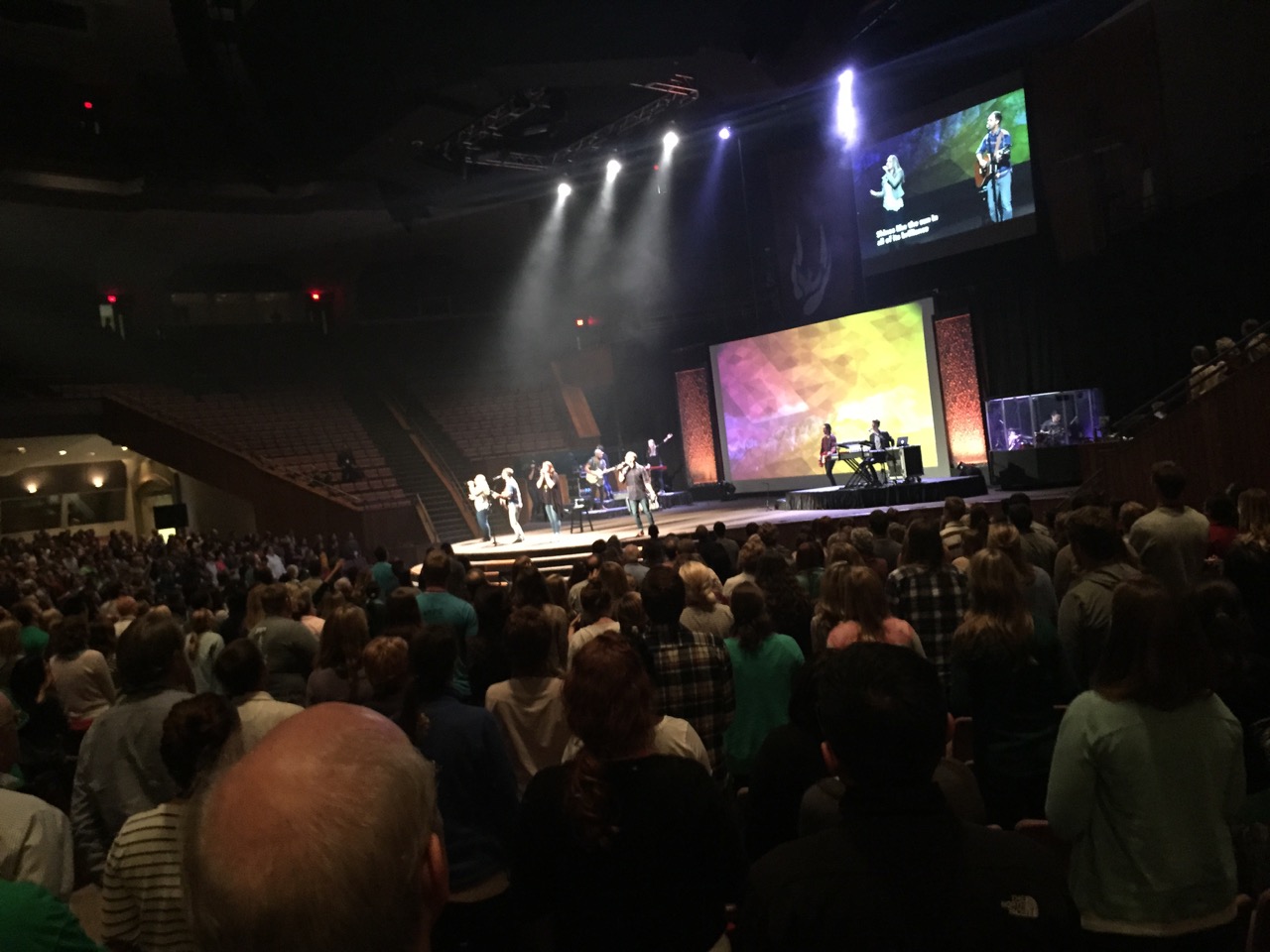
The second loop was west, to Louisville KY and Cincinnati OH.  A mega-church in Louisville started an annual Global Mission Health Conference sometime after we left for the field, and it has steadily grown to become THE event of the year for American medical missionaries. We had no idea of the scale until we arrived.  It was our first real mega-church experience, the 21rst century cathedral, the medieval fortress translated.  Offices, education, a restaurant, chapels, art, music, auditorium.  Worship with lights and mist and screens and TV-like cameras.  A complex as sprawling as a city block.  And completely capable of holding five or six thousand people for this conference.  Banners and themes, displays and nametags.  A well-oiled machine able to absorb the flocks of students from across the country, the returning missionaries, the organizational recruiters, the residents and program directors.  And our favorite student group, the UVA CMDA chapter, included our favorite medical student.  Processing the experience with him was an unexpected bonus.

We were given one of the seminar blocks to speak in, and since there were dozens and dozens I had thought we would have sparse attendance.  But that’s because I had no idea of the sheer volume of attendees.  Our room seated at least 250, maybe 300 and it was packed.  We presented for an hour on “The Sparrow and the Kingdom:  Integrating curative and preventive health care in missions.”  It was a fun topic, one we are passionate about, pulling together examples and stories and evidence to make a case for the synergy of caring for the individual as well as the population. 
 

But the main point of the 3-day conference was for our Serge team, which included Mobilization workers Matt and Joanna as well as fellow medical missionaries Eric, Rachel, Rhett, Derek, Carlan, and even SWill, to interact with young students and trainees, to answer questions, to give our testimonies of God’s grace and encourage them along the way.  We’re recruiting for doctors and other professionals to teach Family Medicine residents in Kenya, to do surgery in Burundi, to provide antenatal care and deliveries for refugees in Nairobi, to provide basic public health in South Sudan. 
 
Though we both score on the introverted-side of the scale, I have a strong mix of extroversion, so this kind of thousands-of-people incessant-conversation craziness is exhilarating up to a point.  We are also both on the old-side of the scale too, but we still felt inspired by those few whose faithfulness further down the path shines a light back our way.  Our favorite speaker was an 85-year-old Australian nurse who had established a TB Sanatorium in Jordan 60 years ago, and still works there.  Spunk, humor, and straight talk about sacrifice and joy.
 
And as great as it is to breathe in the sparks of vision that crackle like static electricity in the sea of globally aware attendees, I go back to the phrase “up to a point”.  I suppose I came away with some concern that the conference itself can be the lightening rod that discharges the accumulated tension of wrestling with the needs of the world and the compelling love of Jesus.  A tide of interest in global health that most certainly did not exist a few decades ago when we were in school is building.  Let us be prayerful and careful that this surge of interest crests and breaks over into majority-world places with scant resources.  Let’s not let the two-week annual visit become the norm for medical missions.  Short term surgical teams, short term regular relief pitchers for long-term docs, provide essential services.  But we still need people who are willing to let go of safety and wealth and prestige, and walk obscure paths among the nearly invisible poor, for years and decades.  Please pray this week that those God is stirring to consider lives that go against the grain of the mainstream do not convince themselves that they imagined that call.  Pray they would sense the thrill of it, the potential, the significance.  

Pray for our mobilizers who now begin pursuing the dozens of contacts we made, helping them discern the trajectory of their story in the big picture of redemption.  We can use some help.


 Saturday night we drove from Louisville up to Cincinnati, into the waiting graciousness of a couple whose home and hospitality felt like walking into our own parents’ houses 15 years ago.  And this morning Scott preached from Psalm 13 at three services, and wedged into that we also led an Adult Education hour sharing our video and answering some pretty tough and insightful questions about how our faith has matured in our years overseas and why the world is as broken as it is.  We were embraced by this congregation where Scott grew up.  It is not a common story anymore, this village-within-the-city, with its historic homes and excellent public education, where neighbors were schoolmates and went to church together and many never left.  We took a nostalgic drive around before heading back east.


So this sabbatical stretches past the quarter-done mark, with 4 of our 7 churches visited, with many reconnections and a variety of speeches for many contexts.  And as rich and worthwhile as it has been, we’re looking forward to a couple of weeks to hunker down.  I have my recertification exam in 9 days.  Yikes. 


Saturday, October 31, 2015

All Hallows' Eve

Another little surprise of America 2015:  Halloween is HUGE.  Now our personal experience as small children involved low-tech home-grown costumes, paper bags (Jennifer) or pillow cases (Scott) for candy collection from neighbors, with the most terrifying story being the titillating possibility of a razor blade in an apple.  It was a one-evening neighborhood-based activity for kids.  Mid-childhood we switched to a reformed church with some healthy skepticism about the pagan origins of the old neighborhood trick-or-treat traditions, so we then had Reformation Day Harvest Parties at the church, which still involved dressing up but this time historical church figures were preferred.  Fast-forward 30 years, and we find a commercial holiday involving elaborate lawn decorations, weeks of hype, expensive costumes for all ages, pumpkin-everything, and night-after-night of zombie movies.  Halloween dominates October almost as thoroughly as Christmas stretches back through December.  People of all ages are expected to invest in costumes, and colleges pepper the students' emails with instructions on what is appropriate.  You can dress up, but not as another culture, race, gender.  You should stick with  non-human super-heroes or cartoon characters, provided they are not a Disney rendering of a non-white person if you're white.  I'm not exactly sure of the rules, but if there is one thing the social media of 2015 polices well, it is every possible grey zone of offense.  Which one must applaud for the sensitivity to others that we have historically lacked, but one must also admit that the anxious search for ulterior motives takes some fun out of a dress-up holiday.

So how did we get to the point of a global permission for carousing in costumes on a church holy day?

I am not an expert on this, but it seems to make sense that the early church co-opted some pagan traditions and synthesized new ones, building on culture while imbuing it with new meaning.  A celtic observance of the harvest, of the end of the year, of remembering the dead, becomes a Christian holiday to pray for those who have died and honor their memory.  And when the Christian version became so exploitative and corrupt that Martin Luther could no longer stand silently by, he chose this day to nail his 95 objections onto the door of the Wittenburg chapel, sparking the Protestant Reformation.  A half-millennia later, we're all pretty confused, and the holi-day has been all but divorced from any holiness.

So in the spirit of embracing the culture as it evolves, here are a few thoughts about the day:
Let's agree that the world is more than meets the eye.  This is one holiday that acknowledges the existence of spirits, of events that can't be explained by Newtonian physics, of true evil.  Let's agree on that.
Let's remember and honor the saints who have gone before us, and the party that we're going to have together.  We stand on the shoulders of the church in glory, the throngs around the throne.  My Bible reading this morning came from Revelation 19:
Then I heard what seemed to be the voice of a great multitude, like the osound of many waters and like the sound of mighty thunder-peals, crying out 
'Hallelujah! 
For the Lord our God the almighty reigns
Let us rejoice and exult and give him the glory,
for the marriage of the Lamb has come,
and his bride has made herself ready;
to her it has been granted to be clothed with fine linen, bright and pure'---
for the fine linen is the righteous deeds of the saints.
And the angel said to me, "Write this:  Blessed are those who are invited to the marriage supper of the Lamb."
So this is a holiday, a party, a blast.  And our costume is pure and shining and as beautiful as a bride's wedding gown.
While we wait for a defeated Evil to be completely routed out, let's not be lulled into complacency.  I think what bothers me about Halloween is not that it is too evil, it's that it's not evil enough.  If we mock devils by creating costumes, if we imply that skull-faced ghouls are make-believe, we pacify our fear by hiding from reality.  If you want scary, watch the movie discussed below, because the real life true horrors that go down in this world are nothing to laugh at.

Meanwhile, Scott and I are dressing up as what we call our James-Bond like America-personas, where we look clean and together and spiff, and not very much like the grungy doctors with spattered coats we have been most of the last 22 years, as we testify to God's work at the Serge Vision Summit.  Whatever you're dressing up as tonight, don't forget to turn back your clocks.  An extra hour of sleep is surely a fitting commemoration of the saints!


Thursday, October 29, 2015

Beasts, latte, and tear gas


A few nights ago, we were staying in a friend's house with Netflix, and had the opportunity to watch this film.  I had actually heard about it and watched the promo and was deeply ambivalent about it.  95% of me wanted to refuse to watch a movie in which African children are titled as beasts.  5% of me wanted to be informed as we bump up against the 3 million people who have already watched it.  Then I read that the title came from the book on which the movie is based, written by a privileged Nigerian student at Harvard, as his thesis.  So the Nigerian kid himself chose the title.  I decided we should go for it.

The film is dark, and not particularly redemptive.  It is set in a fictional unnamed country, but the cadence of the speech is very West African, so the plot would fit with Boko Haram in Nigeria or the last decades of war in Sierra Leone.  The initial scenes establish a believable family trying to make a decent life in a buffer zone protected by international peacekeepers.  When the rebels and the government threaten to clash in their town, there is an agonizing scene done very believably where the protagonist boy can not board the taxi with his mother and younger sibling, but has to stay behind with the men.  I won't give the story away from there, but you can probably guess that disaster ensues, he ends up running into the bush for his life, and is sucked into joining the rebels and coerced into committing unspeakable crimes.  

This is, in short, a nightmare, and I can feel my stomach knot up just remembering the scenes.  A nightmare made all the worse by the fact that it is so archetypically true.  

Why watch it?  Because we must not be lulled into thinking of evil as an imaginary devil, or a puritanically created boogeyman.  Halloween is not too scary, on the contrary it is not scary enough.  Because, if this story happens to even one child, our world should weep.  The fact that it is a current reality for several hundred thousand makes a blithe unawareness unacceptable.   Because the developmental needs of a child to belong and to trust adults, and to prove themselves, and their inability to truly imagine their own mortality, make them perfect fodder for unscrupulous schemes.  Because crumbling societies leave children vulnerable.  Because we know kids in Uganda and South Sudan who have been forced and lured into this life.  Because the entire community where we work in Mundri has been caught between the injustice of the military and the ruthlessness of the militias rebelling against them. Because one of my best friends works to help kids recover from trauma.

A student from Yale also won the Individual World Poetry Slam this week, and one line from her poem sticks with me.  She speaks of people "Who'll take their politics with a latte while I take mine with tear gas".  Being uncomfortable may be, at times, an important requisite of being human.  

And the movie and the poem express in art a reflection of the broken world that our young man R experienced this week in our old home.  He was beaten by soldiers it seems, had the back of his head cracked so hard that he was unconscious and bleeding and feared dead.  None of us are ever completely innocent, and even if he was out at night during an election-imposed curfew, the reaction of the military was dangerous and unjust.  We poured out our lives in Bundibugyo and a handful of kids escaped some of the bleaker options in their lives, some of which were not dissimilar to the movie.  But even now they are both vulnerable and culpable, and that makes me sad.  He has been discharged home, and we believe he will recover, but he almost didn't, and that is real.

I did not love this movie.  Blood Diamond has, for me, more hope.  But if you can stand the raw aching sorrow of a child who slowly loses his inner compass in the face of a power-hungry man caught in the grip of capital-E Evil, then watch it, soberly.  I don't think it is too much of a spoiler to say that in spite of everything the boy manages to connect to his own humanity by remembering his relationship to his family, and by the friendship he establishes with another child soldier.  Though the movie does very little to point this out, even in this darkness the flicker of love is not completely snuffed out, and that gives all of us hope.  

There is a remarkable resilience that love creates, defying the sub-human non-belonging appellation in the title.  Waiting with baited breath for the healing of beasts to boys, of exile to Kingdom.


Wednesday, October 28, 2015

East Coast Community, and some prayers


 First stop on this two-week tour:  Baltimore, where 31 years ago I moved into the roach-and-mice infested dorms across from Johns Hopkins Hospital, walked halls that were home to some of the greatest scientists of the last century, peeled back formaldehyde-soaked grey layers of cadaver tissue and entered the world of medicine.  In those sleep-deprived years of wonder and grit, my soul was tenderly cared for by the folks at Faith Christian Fellowship, where a young family took seriously the words of Jesus and moved into a troubled neighborhood to stake their lives on the hope that the Gospel could break down racial barriers, and heal streets torn apart by drugs and prostitution and many other sorts of dehumanizing violence.  In my third year of medical school I moved into a house a few blocks from the church, and Scott and I worshiped there again in the two other years we lived in Baltimore, before leaving for Uganda and during our MPH back at Hopkins.  Worship held hands with after-school tutoring, and decades later this tenacious counter-cultural signpost of reconciliation remains.  In spite of a congregation that is largely poverty-level or students, they continue to support us and pray for us.  We spent Saturday afternoon and evening catching up with our friends Pastor Craig and Maria, then getting to know a little better our hosts Ananda and Sahayini who chair the missions committee.  Sunday we saw that though the faces have mostly changed, the Spirit remains the same.  Wonderful music, a solid encouraging Jesus-filled sermon, and then a potluck lunch where those who were interested came to hear us speak.

 
Besides FCF, we were thankful in Baltimore to catch up with Ethan, a young man Luke’s age who grew up on the same street I did (only a generation later) and is now an innovative PhD student in biomedical engineering . . . and Emily, who went to Ireland with her parents years ago to run Serge’s MAP program and now is an MPH student at Hopkins as well.  A fun perk of getting old certainly has to be witnessing the ingenuity and genuineness of our peer’s kids.
 
From Baltimore, we drove south to Charlottesville, where we both went to college (and where we met on a street corner when Scott gave me a ride to church 35 years and 2 months ago), and where Luke now studies medicine.  Our main event there was an evening with the CMDA group at UVA, a gathering of a few dozen medical students with a sprinkle of residents, faculty, staff, who graciously let us talk about what it means to be a missionary doctor in this 21rst century.
 

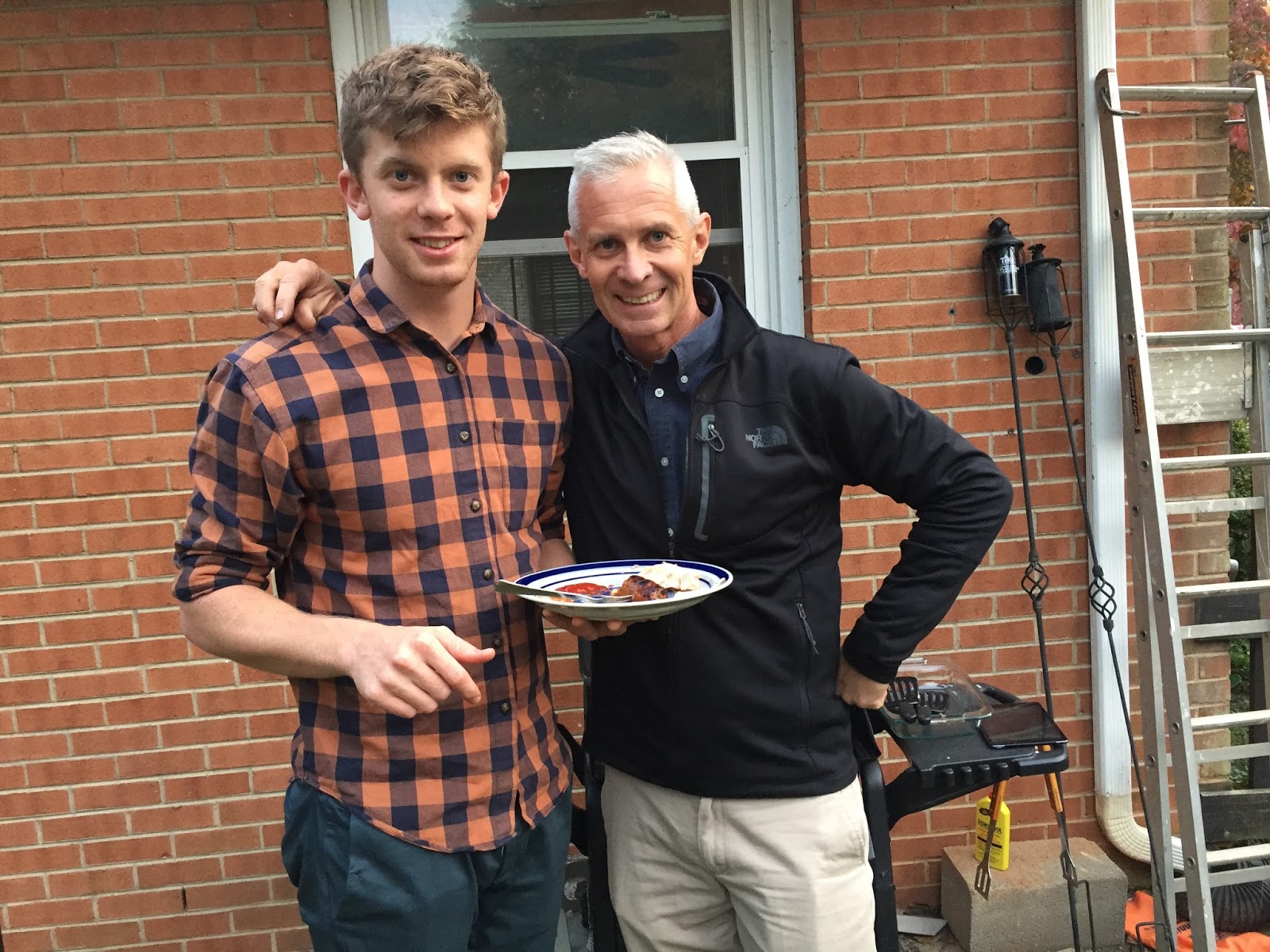
And since we were there, we also took the opportunity to load Luke up on groceries then prepare a grill-out stand-in-the-yard-around-the-firepit dinner for about 15 as the full moon rose.  I can’t overstate how precious it is to meet our son’s housemates and friends, to associate faces and names, to get to know these kids in a more natural context.  And as a bonus, our former-Bundibugyo-missionary friends Nathan and Sarah dropped by.  A Kingdom party of food and fellowship.

Sadly we left Luke sick with a flu (?) and facing an exam, so pray for him to recover both his health and all the time he devoted to our visit.
 
One of the purposes of this year is to make personal connections with supporters, and Eileen who went to college with us came to spend a morning with her youngest daughters, catching up.  Eileen prays with informed precision and a lifetime of faith, and we are grateful.

Thanks for those who have been praying.  One of our leaders, Josiah, reminded us that it isn't really what WE say, but what the Spirit makes people hear and remember that counts.  So even in this job of speaking, testifying, meeting, writing it is your prayers that make this all significant for the Kingdom.  Now we're in Florida for our Serge Vision Summit.  Would you continue to pray for the Spirit's movement in and through us?  

Lastly, please pray for our foster-son Richard Bamwaturaki, who finished high school at CSB then went on to excel in an electrician training program.  He was jumped by thugs walking home at night last night and was in critical condition.  The latest we have heard is that he is improving, which would be a miracle.  Please pray for his healing.  Protect us from the Evil One.  This is a kid who has been redeemed, and now he is under attack.  

Thanks.


Friday, October 23, 2015

Never too old for new tricks

Today, I had a new experience:  I was on talk-radio.

My publisher (and it is very weird to use such a phrase) works with Litfuse, a firm that promotes books.  So I now have a web page, which my mother can access here, an interview page which I really liked and you can read here, and they asked me to make a "day in the life" blog (about which I am ambivalent, but for what it's worth you can see it here).  Then today I talked to a very nice guy named Rick on a radio show as if I was a real author, which feels incredibly presumptuous with the grand experience of one book.  My palms were sweaty.  I know that I am much more articulate in writing than in speaking, but I muddled on.  As it turns out, when you are on the radio as a call-in you have to use a real land line, and we only have cell phones, so I drove into town and used my aunt's phone.


Which was a treat, because then she went to lunch with me and on errands, and I heard a few old stories I'd never heard before, and was reminded of the privilege of landing here where my family's roots were once so strong.


Marveling daily at the turning leaves and soaring hawks, mixing concrete, visiting neighbors, seeing an owl fly and just missing bears over the hill on a bike ride, studying for boards, concocting a dish very close to a southern French cassoulet,  preparing presentations, hours of skype with colleagues in Africa . . . and being on the radio . . . well, here's to new tricks in mid life.

Tomorrow morning we head out for:
Baltimore, Faith Christian Fellowship (presenting about our work at a luncheon after the second service Sunday)
Charlottesville (speaking to the UVA CMDA group Monday night)
Florida (speaking and fellowship at the Serge Vision summit Tues-Sunday)
Then a brief return home for laundry and re-packing and then out to:
Louisville (speaking and recruiting at the Global Health Mission Conference Thursday to Saturday Nov 5-7)
Cincinnati (Preaching and speaking at Wyoming Presbyterian Church Nov 8)

So more new tricks, and prayers for these old dogs much appreciated.

Wednesday, October 21, 2015

America 201: Tribalism, Gambling, Complexity, Jobs, and Grace

Three months into sabbatical, which is a full term of school, so we're moving from the 101-level of learning into the next level of advanced classes.  As insiders who became and outsiders and came back again, we continue to ponder, marvel, sigh, and puzzle over this place in all its diversity and luxury and pain.

So here are a few more observations, from this week.


First, America exhibits much of the same tribalism that drives fear and violence in Africa.  The conversation here has become so shrill and polarized.  Positions are entrenched, and offense is easily taken.  Perhaps this relates to an impending electoral season, or to the bombardment of opinions on social media.  But the tenor of the loudest voices seems to be the same old tribal fear: if we don't fight for ourselves, the other group will take what we need. There is a prickly defensiveness that makes dialogue very difficult.  Note this exchange between President Obama and Author Marilyn Robinson (Gilead, Lila):

Robinson:  But fear was very much—is on my mind, because I think that the basis of democracy is the willingness to assume well about other people.  You have to assume that basically people want to do the right thing. I think that you can look around society and see that basically people do the right thing. But when people begin to make these conspiracy theories and so on, that make it seem as if what is apparently good is in fact sinister, they never accept the argument that is made for a position that they don’t agree with—you know?
The President: Yes.
Robinson: Because [of] the idea of the “sinister other.” And I mean, that’s bad under all circumstances. But when it’s brought home, when it becomes part of our own political conversation about ourselves, I think that that really is about as dangerous a development as there could be in terms of whether we continue to be a democracy.

Secondly, we notice the pervasiveness of gambling.  When we left a couple decades ago gambling was a fringe activity, relegated to certain geographical enclaves (another story of complexity as corruption, how our country relegated this continents inhabitants to reservations then promoted drinking and gambling there).  Now we pass billboards announcing lottery totals, and see advertisements for fantasy football leagues not as a matter of pride or sports acumen, but as a temptation to gamble money.  A scandal broke last week when the employees of the company running one of them made off with the winnings.  Gambling would not be a great business if the average person really benefited.  It is a way of luring those who don't have the margin to lose.  Yet it is growing in availability and acceptability.

The next trend I am calling complexity as corruption.  In other words, many of our systems are so complicated that only the elite can afford the expertise to sort them to their advantage, which entrenches injustice for the average person.  Taxes, laws, finances, rules in general have so much fine print and differential application that the end result is that the silent majority over-pays to fund the advantage of those who can afford to game the system.  A certain person dear to our hearts, for instance, just received a surgical bill that is astronomically high.  A hundred-times-higher, or more, than where we work.  There will be a murky process now with the insurance company (thank God for Anita, as I said in an earlier post), and we won't know how much money actually exchanges hands between them, but we will be left with a deductible and a percentage based on the initial ridiculous total.  Meaning that our dear person will empty the savings we and he have accumulated to pay his school fees to THE SAME INSTITUTION.  It's legal, but it's not right.

The fourth observation I am not sure whether to categorize as a problem or a solution, but we've noticed the rise of self-serve and self-checkout and the decline of entry-level jobs.  Restaurants that would have had wait staff a decade ago have moved in a fast-food model, and expect you to order at the counter and clear your own table.  Grocery stores and home improvement stores (our two main go-to's) have lines where you scan and bag your own items.  At the gas station, you not only pump your own gas, you fill your own drinks.  If an interaction with a human can be replaced by a card swipe and a keyboard, it will be.  Efficient, yes.  But also, well, in a literal sense, dehumanizing, and I wonder what jobs teenagers can get.
Fear, injustice, betting, isolation . . sounds bleak.  So we turn to the best for last.  Here in this rural enclave, we are breathing in grace.  Our church averages an attendance of about 70; the pastor moves between several rural congregations so half the time the service is led by lay people.  This is a state with some of the highest levels of poverty in the country, and with high rates of alcoholism, addiction, and unemployment too.  But when we walk through those white wooden doors, we sense an incredible welcome.  As we are inevitably late, at least two or three people get up and come over and hug us.  For no reason.  We are smiled upon, drawn in.  I think being on the other side again, after years in leadership, gives us a new wonder at the power of simple kindness and inclusion.  Americans, deep down, are welcoming people and we sense the power of grace in the posture of this country church.

Which gives us hope.  Because if people who live in this town where everyone know everyone for generations can walk over and hug the peculiar missionaries from Africa, then there is always hope.  In 1 Timothy Paul warns against endless tedious disputes (1:4) and states "Now the purpose of the commandment is love from a pure heart".  The purpose is love.  Love is the only power stronger than fear, and the only platform that will build community.  Love breathes grace, and America at the street level is full of people who love.


Saturday, October 17, 2015

My eyes to the (West Virginia) hills, or the paradox of sabbatical and the chipmunk's response

How can one post this blog about the suffering of our friends in South Sudan, and this one about the joys of having kids home for Fall Break, in the same week?

This is I suppose a microcosm of the paradox of living on sabbatical, or living most anywhere on this earth.  Sorrow and brokenness, so tangible and pervasive, yet beauty and redemption flood our souls too.

The juxtaposition at this particular moment tends to make me feel guilty.  I revel in the crisp sunshine, the palette of orange and gold, the wholeness of just standing in a kitchen flooded with light and watching a no-longer child study, the secret wonder of hiding a couple hundred daffodil and tulip bulbs all over the lawn and forest edge to surprise us in Spring.  Yet my heart also breaks for the people of Mundri as I imagine them slogging through rainy-season mud to find a place to camp for the night, distant gunfire, the frightening thud of a helicopter rising over the trees, while their government dissolves.  Or for the people of Burundi as  civilians are murdered, with conflicting reports blaming either the police or terrorists, and the African Union considering intervention. Or for our Sergers all over eastern and central Africa, bombarded by need and loneliness and ants and unrest, risking protests and poor roads and misunderstanding.  It's a rough world out there, and it feels disingenuous to sit out this year's crises.

A few weeks ago I was swimming in the river, alone.  This swimming hole is a stretch of deep water before the river bends, with a sandy bank. Boulders and circling hawks, freezing purity of the water like a repeated baptism.  As I crossed to the far side and paused to tread water, I saw a chipmunk twittering and scurrying on a branch overhanging the water.  Now you have to know that chipmunks remind me of my dad (as do so many things around here), because one time we went on a National Parks vacation out West and he took so many pictures of chipmunks (in the days when every photo was developed into a slide and projected), that he was teased about it, and it became a symbol of either wasted film or the simple delight he took in nature, depending on how you looked at it.  Anyway that moment, that chipmunk, that holy place, brought an epiphany of two truths.

First, I was marveling at the bittersweet truth that my dad would have been so happy to see us enjoying his West Virginia hills.  A huge part of his life poured into provision.  For my mom, my sister, and me.  And we are living in that now, on the acres he left us, in the house he began to rehab, in the town where he was born and grew up.  Nothing would have made him more deeply happy than to see us finishing the roof, planting fruit trees, living life in this spot.  As a father, his joy would rest in seeing US enjoy the place he made.

So the second truth that came from the chipmunk's chirp over the river was this:  if my dad would take such delight in us being here, then how much more does God revel in our grateful gulp of this slice of creation?  Surely God, as parent, provider, lover, friend, smiles on this time.

Somehow that glimpse of God taking joy in our joy helped me come to terms with the paradox of this season.  Yes, God calls us to take part in the restraining of evil where the poor bear the disproportionate burden.  But as today's Psalm, 121 (also my dad's favorite) says, we lift our eyes to the hills and remember that it is ultimately God's work of redemption, and as a parent and commander he can both support our courageous forays into the fray and smile upon our respite.

And we as the people of God can hold onto the polar points of this world, the gritty reality of evil and the wholesome goodness of beauty, both.  Not either/or . . . but both/and.  Not finding a compromise middle where we are mildly comfortable but never too hungry or too exuberant.  Not choosing one extreme and rejecting the other.  Holding onto disparate realities, both legitimate, and living in that mystery.