rotating header

Tuesday, September 13, 2016

Two Days in Istanbul


A few months ago, traveling Turskish Air through Istanbul for a Serge meeting in Greece, as the least expensive option, sounded quite reasonable.  And having never been to Turkey, why not stretch the return connection for a weekend exploration?  That was before the wedding bombing and the Ataturk airport attack, before there was an attempted coup in July, before Turkey sent troops into Syria, before a summer in which hundreds of people died from terrible violence.  Oh, and did I mention that our return flight was on 9-11? 

Nevertheless, when your support account is only marginally on the positive side, once you buy tickets you want to honor them.  Turkey, like Kenya, has responded to the escalating risk with tightened security.  So on our way back from our meetings in Crete, we stopped over in Istanbul for 48 hours. 

And how thankful we are.  This is a world city, rich in history, diversity, commerce, life.  The helpful Turkish Airlines stocked the plane seat-pockets with a magazine-length explanation of the attempted coup.  Hour-by-hour logistics with compelling photos, extolling the resilience of the Turkish people who took to the streets, stopped the tanks, saved the day.  Reassuring, and inspiring in many ways.  The flight attendant asked us about prior visits, and seemed genuinely incredulous that this was our first.  How anyone who could afford an airline ticket had not been to Istanbul was beyond comprehension.  Whether it is the unbroken line of written history, a strong family connection to an admirable culture, or a Mediterranean bravado, in both Greece and Turkey there is a refreshing confidence that comes of being convinced they are the center of the world.

We arrived on a Friday evening just before sunset, and took the convenient and inexpensive bus service to Taksim Square.  This section of the city has been upgraded in the past century, providing a large open space that is the favored location for demonstrations, thankfully not at the time we arrived. From there we followed thousands of milling Friday-night locals, strolling down the nerve-cord of the city, a pedestrian mall that stretches a couple of miles from Taksim down to the Galata Tower.  Perky red carts sold roasted chestnuts and pretzels, aproned men hawked doner kebabs from their shop-fronts, dramatic ice cream sellers with long spoons delivered cones with a flourish.  Food, we learned, is a theatrical production.  Friends arm-in-arm, women in full hijab (rare) to women in shorts and tank tops, families pushing strollers, the full gamut of society.  The atmosphere was friendly, festive, alive.


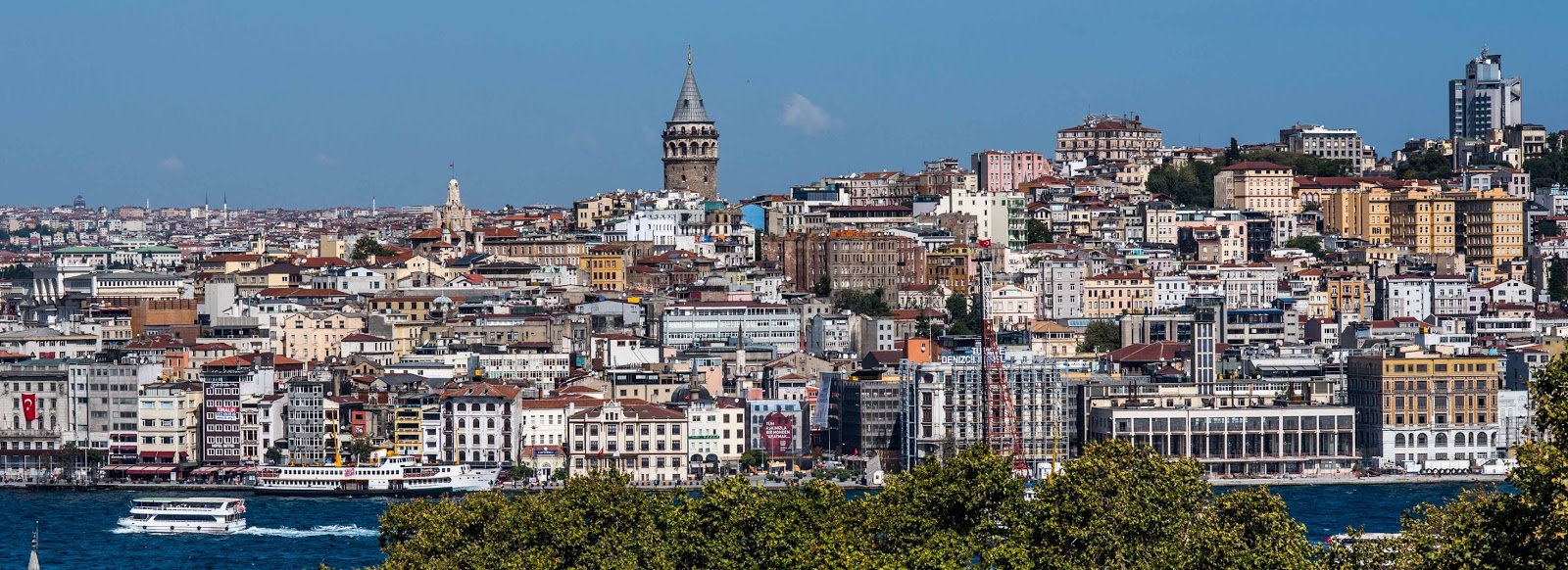
Our Airbnb turned out to be a tasteful refuge with 12-foot (or more) arched brick ceilings and a comfortable bed/bath/living room in the old Venetian district a block from the Galata Tower (Vildan's place, if you're looking).  The tower was built in 528, upgraded in the 1300’s, and several times since.  Originally a testament to Christ, then a fire-watch point, then a military base, now a tourist monument that is surrounded by artsy shops and small cafes.  Late dinner on a terrace in view of the tower, and we called it a day.

Day One
Saturday we walked the two miles or so across a bridge spanning  the “Golden Horn”  waterway and through narrow twisting cobblestone streets to the Sultanahmet district, the most historic area of the city.  We spent most of the morning at the Topkapi Palace, which is basically the equivalent of the Smithsonian museums.  Pottery and cauldrons from the 1400’s to the 1800’s are displayed in the kitchens, weaponry, clocks, calligraphy and other artifacts fill the rooms of this complex of buildings that once housed thousands of people.  There are spacious rose gardens, intricately tiled “kiosks”, throne rooms, and a harem.  One section is decidated to the most precious relics the Ottoman Empire collected:  pieces of Mohammed’s beard, his and his followers’ swords, not to mention the purported staff of Abraham, sword of David, and turban of Joseph, all displayed with reverence while an imam continuously reads aloud from the Qu’ran over loudspeakers. 


The Topkapi palace is situated adjacent to the Aya Sofya (Haggia Sophia), which was the largest cathedral of Christendom for a thousand years.  Completed in 536, the full name really refers to the 2nd person of the Trinity, the Holy Wisdom of God.  As we walked through, I thought of the chilling parallels to Rwanda in 1994:  when the Ottomans conquered the Byzantine empire in 1453, many Christians took refuge in this church and even attempted to continue services while the conquerors were allowed three days of unchecked rape and murder (which was not dissimilar to the actions of the Western European Crusaders in the two preceding centuries).  For the next half-millenium the Aya Sofya became a mosque, with many Biblical mosaics destroyed and Qu’ranic writings added.  But the secular state of Turkey decided to change the structure into a museum, so now one can see the juxtaposition of the Virgin Mary holding Jesus surrounded by Arabic script extolling Mohammed.  The massive scale, the span of history, the witness to suffering, and the mingling of East and West, Christian and Muslim, makes this spot of ground something like Jerusalem, a geographical confluence of spiritual significance. The mosaics which remain are haunting in their simplicity and timelessness.  Evidently even this place remains vulnerable to religious posturing though, as calls for a return of the structure to the Eastern Orthodox church have been met with a resumption of the call to prayer from the minarets for the first time in over a century.

The Ottomans were not satisfied with adding minarets to a cathedral, so a couple hundred years into their rule they also constructed the Sultan Ahmet Mosque across a fountained courtyard.  The scale is similarly vast, but here the interior remains unscathed, intricate patterns of mosaic with a blue predominance (hence the “Blue Mosque”).  Tourists are given long skirts, long tops, and skirts if any of those parts of their dress are lacking, and a plastic bag to hold their shoes, so they can enter the mosque even as non-tourists kneel and pray.  I am not an unbiased observer, but in spite of the beautiful tiles and domed architecture, this place lacked the gravity of the Aya Sofya for me.

By this time it was mid-afternoon, and after asking a few of the hawkers who stand in front of the dozens and dozens of small restaurants that spill into the streets, we located the one place showing Premier League football so we could eat a late lunch while watching the Manchester Darby.  Nothing like football to connect with locals; we and they were equally crushed by the match’s outcome.


We chose a route to walk back that took us through the Grand Bazaar, a remarkably clean and orderly maze of small shops under a roof that spans several blocks, selling carpets, ceramics, clothes, shoes, towels, kitschy tourist junk, artwork, belts, you name it.  Then through the “Egyptian Bazaar” which is outdoor and more basic, wooden spoons and charcoal stoves and rope and suitcases and rather like Owino in Kampala. 

For dinner, we checked yelp to find Karakoy Lokantasi, which was packed with locals, a 12 minute walk to the waterfront, and delicious.  Certainly the above tour could have been stretched over several days, but the cluster of history we saw is certainly accessible in one or two days with a bit of walking.  We bought individual tickets to the palace, Aya Sofya, and Galata Tower, but it was only a couple dollars more to have just bought the Istanbul pass and in retrospect that would have been simpler.

Day Two
Sunday we set out to sample one of the two coffee-roaster-cafĂ©’s we had noticed in the neighborhood.  Only one was open, so we sat down for a much-appreciated cappuccino (though the chocolate croissant was acutally just nutella spread on a croissant).  Our walk to church was quick, so we had time for a second more authentic Turkish coffee (thick strong rich espresso - but the bottom third is a thick sludge which necessitates the small glass of water for the post-coffee rinse) with variations on pistachio/filo/honey pastries.  The English-speaking service we attended has been held since 1857 in the chapel of the Dutch embassy—a small collection of international workers who worship together and reach out to immigrants. 

Since most of the historic sites are on the European side of the Bosporus, we had yet to cross to the Asian half of the city.   short walk to the waterside again took us to the ferry, which serves as public transport, so for just over a dollar apiece we enjoyed the brisk winds and scenic perspectives across the strait.  On the other side we found another neighborhood of narrow streets and bustling shops, persuaded after a few blocks to sit at sidewalk tables next to a display of freshly caught fish while a sea bass was grilled just for us.  Back to the ferry landing, and we secured a return trip on the top deck, with views of the old train terminal (built to help pilgrims complete the Haj), massive stacks of shipping containers at the port, scores of boats going about their business, the bridge which spans the two continents, and the sprawling silhouette of Istanbul punctuated by domed mosques with their slender minarets, and modern skyscrapers.

Our last visit was to the top of the Galata Tower for its 360-degree city view, and then it was time to return to the airport.  Rather than lug our now bursting carry-on bags to the metro or bus (yes, I fit a new bedspread in my handy North Face small duffel) we splurged for a $20 taxi back to the airport.  Which was about as entertaining as any other aspect of our 48 hours.  First, there were no functional seat-belts, but our affable driver assured us that his stingy boss was about to upgrade him to a better car so we shouldn’t worry that this one looked so old, he’d just drive slowly.  Or not.  As soon as he determined we were Americans, he began to gush about George Bush.  “Oh, George Bush!  Like Rambo!”.  Did we know George Bush?  Well, we explained the president now is Barak Obama.  “Oh, Obama, he (incomprensible Turkish word).  You know (incomprehensible Turkish word)?”  No, we didn’t, but no problem, as he sped through intersections he spoke into his mobile phone to Google Translate....which rendered the English translation:“Funky!  Obama he Funky!  You know this word Funky?”  Which goes to show that a lot of politics is perspective. If you border Iraq and Syria, you might prefer Rambo as your president.

In spite of the inauspicious confluence of 9-11's 15th anniversary, a war in Syria, an American connection to the purported mastermind of the coup last month, and the eve of the Eid al-Adha, the holiest festival of Islam which signals the end of the Hajj and the commemoration of Abraham's near-sacrifice of (in Muslim teaching) Ishmael . . . we felt at peace in Istanbul, surrounded by that majority of people in most places whose concerns lie more with family, business, health, and life than with harming others.

So, we left wishing Turkey well.  It is no small task to be attempting an integration of Muslim faith and Greco-Roman-Byzantine heritage, of a thriving trade and European influence alongside ancient near-Eastern values.  To placate neighbors who do not tolerate tolerance to the east, and neighbors who do not tolerate intolerance the west.  To embrace education for women and allow freedom for some to choose the hijab.  Istanbul is a microcosm of today’s world, and if they can figure it out, there’s hope for all of us. 


Friday, September 09, 2016

Our week in Crete


Crete exudes the pride of an ancient civilization, which comes across as an absence of the frenetic and a satisfaction with the present.  We arrived a week ago for our semi-annual Serge leadership meetings.  Generally the Executive Leadership Team and all the Area Directors meet in January and September for various tasks in the annual planning cycle, doing the SWOT analyses, refining strategies, moving projects forward, discussing the metrics our teams have collected, addressing problems  . . . and most importantly, praying intently for each other and those we serve and delving into God’s word together.  In January we shiver in Pennsylvania, but in September we usually find a sunny spot with low-season rates that is more central to all participants.  This time it was a dusty rocky southern Mediterranean island with over 5000 years of recorded history.


We arrived a day early so we could rest from the all-night flying, and do a bit of exploring.  The excellent archeological museum in Heraklion was only a few blocks from our hotel, so we spent a half-day poring over the reconstructed pottery fragments, reading about the legends of King Minos and the Minotaur, admiring the civilization that laid the foundation for European culture.  These were the contemporaries of Moses and David, and the clay urns for wine storage probably reflect those that Jesus used to turn water to wine.  We found figurines of women giving birth that demonstrate some of the same positions and techniques we use today.  The careful craftsmanship, the artistic rendering of marine-life themes, the delicate beauty, the awareness of the eternal realm, the quirky insights into sports like vaulting over charging bulls or wrestling. . .  all helped paint a picture of ancient life.  From there we took a bus to Knossos, site of the ancient palace.  After touring the ruins we followed a dirt road on foot into the surrounding hills for the view, then walked the 5 km back to Heraklion passing through olive groves, past grape arbors and gardens.   All of which we enjoyed in meal after meal with fresh tomatoes, cucumbers, feta cheese, olive oil, thick yoghurt, honey . . the Greek diet is pretty great.


Most of the rest of the week we were in a basement conference room focused on data and discussions, or praying.  We did get out in the early mornings to jog on the long pier that shields the harbor.  Twice we jumped into the salty waters of the Mediterranean.  And sometimes during a break we’d wend through the crooked narrow cobbled streets to find gelato or great coffee.  


Thankful for the men and women who hold on in faith to see the hard places in this world transformed by a breathing in of God’s grace, a breathing out of His love.  Thankful for the friendships that grow meeting by meeting with our wiser and godlier colleagues walking this road a few steps ahead of us.  Thankful for spaces in life to step away watch the sun rise, to sit on the rooftop and feel the breeze.  Not sure if we’ll ever reach Crete again, but hoping that we carry away some of the sense of identity that comes from knowing one’s roots, the relaxation that comes from not having to prove one’s worth over and over, the peace that is found in a culture centered on family and food.


Monday, September 05, 2016

On Fairy Tales and Kenyan School Books


This week we progressed through some Bible stories, medical role plays, and the children’s school-book “Mama Mwizi.”  The title is a dead give-away that this isn’t a sanitised American politically-correct story where our minds are broadened to accept any lifestyle choice as legitimate, and where everyone ends up friends.  If you aren’t up on your Swahili, the translation is basically “Mrs. Thief.”  Two children are left home alone on a Saturday while their parents travel to a party (which in Kenya would be an all-day affair).  Their father gives them strict instructions to not open the door to anyone they don’t know.  But they venture out to spend a dime on candy, and on the way back fall victims to a well-planned scam.  A car slams to a halt and an apparently pregnant woman is shoved out the door.  She lies helpless, crying as the car speeds away.  The gullible/tenderhearted children help her to her feet and as she wails of injury, they escort her to their rural home.  One runs to find the taxi-driver in the village to take her to the hospital, and the other runs to find a local nurse for advice.  Meanwhile the woman calls on her accomplices to come to the house with a lorry, and they systematically empty the contents of the home, from the radio to the clothes to the furniture and appliances.  The shocked parents return to a ransacked, empty house, followed soon after by the kids, the nurse, and the taxi driver.  Luckily the thieves have been stopped by the police not far away for a “random” shake-down, and when they can’t show the police any receipts for the items in their truck they are apprehended.  The story ends with the goods returned, and children sobbing in front of an angry father, who lectures them for disobedience and then cancels his promise to take them to the game park in the future.

Perhaps this sounds harsh for a 1st or 2nd grade picture book. 

But the plot reminded me of many fairy tales, where disobedient children run into potentially fatal consequences.  In the old days, and in modern Kenya, the point of these stories was not to calm or delight or broaden the young minds who read them.  They were/are cautionary tales in a world filled with danger.  A child could not be assumed to avoid some of the world’s harsher realities, like lying thieving con artists, or child traffickers, or HIV.  So obeying some rules could be life or death.  Bad things, really bad things, happen.  Kindness is not always rewarded. 

Our generation tends to trivialize evil, to deny any such category, or to glorify it, or to spew it forth with such repetition we become numb.  Our story lines become cartoonish, with self-absorbed angsts and occasional unavoidable random misfortunes.  Or become prurient. But we need fairy tales, where creepy goblins lurk and where witches cast spells and where choices must be made.  And where all of the evil has not been explained or tempered into a bland universe of shades of grey.

Truly terrifying evil on the order of a Biblical universe with hellish beings has some merit, though it is most often relegated to the fringes of horror movies and paranormal books.  I think David Mitchell and Cormac McCarthy write evil properly.  Small doses are all I can take, for sure, sort of like immunisations, to help us make sense of the Cross.  True confession--besides Mama Mwizi, this is on my mind because a friend who shall remain unnamed got us watching Stranger Things.  We're a few episodes in, and I can't vouch for the whole series, but it is truly terrifying in the Fairy-tale genre of other-wordly evil creeping into a small-town late-70's looking place that reminds me of my childhood.  This thoughtful essay about another movie I haven't seen grapples with the same phenomenon, finding truth in fictional horrors, and the way such stories help us live in South Sudan (the author of the essay just evacuated from there to our former church in Baltimore) or treat malnutrition or counsel the sorrowful.  It's a reason I liked the Hunger Games series as well:  adolescents conscripted to fight on behalf of corrupt all-powerful regimes sounds awfully close to real life.

So if you're an 8 year old in Kenya, you better know about thieves and scams and the importance of locking your door.  And if you're a middle-aged doctor in Africa, you might need some TV series and novels that take evil seriously.  And if you're thinking of giving the next book in the Rwendigo Tales series to someone you love, be warned that rebels and abduction and human trafficking make an appearance.  Evil is part of all these stories, but not the end of any of them.


Sunday, September 04, 2016

Angel-Vision Goggles


This haunting photo was posted by our photographer friend David last week, from a National Geographic site.  It immediately conjured images for me of Mt. Doom in Mordor, the smoldering hours and days after the ring was destroyed.  The cost of redemption cannot be denied in this scene.  The landscape, eerily devoid of life.  The embers still glow, the merest hint of the raging fires that once spewed forth.  The world is saved, the fire quenched . . . and yet the world is ash, the work of rebuilding looms so large as to seem impossible.  Certainly the main characters in the final chapters bear scars that attest to the reality of the battle, even as they turn their attention to pints and songs and love. 

So I went on line to find out where the photo actually came from, and the Lord of the Rings connection was not far off.  This is a mountainside which once seethed in the unstoppable flames of a wildfire.  Now it has ben tamed by firefighters and God and time.  The war is won, but the battles continue.  Mopping up any sparks that threaten to accelerate.  Then replanting.  Rebuilding.  Reclaiming.  Restoring.

Perhaps if we had the ability to put on something like night vision goggles, only they were angel-vision goggles, the world I normally see (Mt. Longonot from the Sorley's porch) like this:


or this:


Would be revealed to ACTUALLY look like the National Geographic photo above.


Revelations 12 gives the angel-goggle view of history.  Our world, scorched by the dragon’s destructive hate, pauses, pulled away from the brink of immolation by the blood and innocence and love of a child.   The sparks still smoulder, the pain of that costly battle still extracts a toll.  But the restoration has begun, and God’s people plant the Rift full of acacias and olives and wildflowers once again.   

Thursday, September 01, 2016

First Day of School Pics


Perhaps this isn't the photo you expected?  Keep reading.  Late August, always a time that turned our focus back towards school, now fills our Facebook feeds with smiling children perched on front porch steps, toting backpacks or lunch bags, dressed to face the new year.  Little "L", above, is no exception.  She's 6.  The photo on the right if from fb last week.  The one on the left is her about a week after she was born here at Kijabe.  She had hydrops fetalis, meaning a severe heart failure and swelling of her whole body in utero.  The mortality rate even in the most modern hospital is over 50%, and can be up to 98%.  We struggled with her pleural effusions (water in lining of lungs) for weeks, and after too many chest tubes to count the paediatric surgeon got down to the last chest tube in the hospital, and we knew this was it.  If she needed another, she'd die.  But against all odds, she not only survived but is a cute, smart, normal 6 year old going to school.  I guess if I had more former patients whose parents posted on fb (not exactly my usual population) I might see these miracles more often.  But L's photo this week made me very, very happy.  Happy for my Kijabe colleagues who worked so hard 6 years ago and still do.  Happy to see this story unfold.  Happy that NO ONE who watches L walk into her first days of school would every dream of her nightmare appearance at birth, her weeks on death's doorstep.  Mardi hunted down the old photo, and so we get a time-lapse of redemption.  

The next photo you'll have to imagine.  Just up the hill, 4 young men the age of my own college kids have started Bible School at Moffatt.  They are studying Counseling, and Community Development. And they are another snapshot of redemption.  Because their entire life has been spent in civil war in South Sudan.  A few months ago they were facing bullets and starvation.  LAST WEEK they were shot at by thieves on the way to the airport for this course.  They have all lost family members.  Their life experience is nearly unimaginable.  But after our team had to evacuate, they did not stop trying to help the people they had grown to love.  Yes, there are thousands and millions more who did not get to escape.  But for these four, a season in a country at peace, at a school, amongst people like the Massos who care about them, getting counseling themselves from our excellent and skilled Bethany, studying the Word of God, gaining skills they can take back . . . surely this is another first-day-of-school snap where the smiling faces represent triumph over very dire circumstances.

And lastly, two more first-day snapshots close to my heart.  You'll notice a theme:


Jack returned to Duke for his sophomore year in Engineering; Julia was being dropped off in Washington DC where she will launch Saturday into a 3-month 3-continent comparative global health study abroad.  They both flew into Charlotte a week apart, and my 80-year old mother drove them each to their programs and helped them settle in.  They've been seriously ill in their childhoods, though not as sick as baby L.  They've been shot at in their childhoods, though not as many times as the South Sudanese Bible students.  But even for them, the first-day snapshots show a smiling and comfortable facade that would belie the struggle and trauma they have seen.  They are embarking upon challenging semesters, with parents 7000 miles away, which is never a small thing.

I could go on and on, Ivan starting a bachelor's in nursing in a new University, Katuramu waiting for the Ugandan MOH to settle on internship arrangements, Luke plugging through his Neurology rotation, Caleb spending hours in 100-degree heat learning to fire a machine gun, Biira the daughter of the late Dr. Jonah starting a law degree, Noah my nephew starting college, Tanya my Kenyan colleague's daughter entering British school for two years because of her dad's surgical training.  So many kids stepping into places they have never gone before, with no assurance of success, but with hope.

So this first-day-of-September, let us salute students everywhere who have overcome some steep challenges.  Who have perhaps left their families or countries.  Who have physical or mental or emotional hurdles most of us can only imagine.  Students whose smiles and health seem to blend in with the crowd, because we may not know even a tiny portion of the struggle that has brought them to this point.  It is the very poignant cost of their progress that will make them great, I know, but my heart wishes I could smooth each of their paths.