rotating header

Saturday, April 06, 2019

Bundibugyo-origin wonders, or, where does chocolate come from?

fermenting cocoa beans
When we moved to Uganda in 1993, this district's main cash crop was coffee, and one of our team's goals was to enable fair trade for the small scale coffee farmers by a co-op transport to more central markets, freeing them from the vagaries of beholdeness to middle men. That plan ended tragically in a fatal accident involving the transport truck, soon followed by war disrupting all trade in the area, soon followed by a coffee blight disease that wiped out most of the crop. The silver lining in all that sorrow: Bundibugyo switched wholesale from coffee to cocoa.  Over the last 20 years, much of the agricultural land in this valley has been planted in cocoa trees. It turns out that we are in the sweet spot for chocolate: within 10 degrees of the equator, in a tropical rainforest, humid, low elevation.

Cocoa grows on trees, trees that were indigenous to central and south America but now dominate in West Africa and the South Pacific.  East Africa with its high dry savannas has relatively little cocoa production. But it turns out that the very climate that kills Bundibugyo with malaria and sickle cell disease makes us perfect for chocolate.  You can see the green oblong cocoa pods angling out from the tree trunk above. This is the fruit of the tree, which is picked and split open to remove the beans or seeds, surrounded by a white pulp.
the pods left after removing all the pulpy beans
And here is where Semuliki Forest Chocolate, produced by Latitude Trade Company, comes in. This is a new fair-trade cocoa export company that has moved into Bundibugyo. For nearly two decades, farmers have been harvesting their beans, drying them on tarps on the ground, and selling them to large-scale exporters. Jeff, Justine, and Max met working on fair-trade cotton in Kitgum. Two of them are American entrepreneurs and one is a Ugandan agriculturalist. They want to provide consistent fair prices, right at the peripheral small-scale farm, to produce a higher quality single-origin chocolate.

the normal trade, not Latitude

Justine offered to show us around the Latitude site, and so Stephanie Carrigan planned an RMS field trip and invited interested team to tag along Friday morning.  We drove up to Bundibugyo town where the fermenting and drying plant has been established.
Latitude buys from farmers around the district four times a month, though in most places harvesting cocoa is only permitted on set days twice a month. This is to make it more difficult to steal the cocoa off the trees . . yes, in a desperately poor area, a cash crop can be pulled right off the trees at night or when no one is watching, so the government and community decided to limit harvest to the 14th and 29th of the month (Latitude has negotiated 7th and 21rst in some areas as well). This also lessens the days kids miss school to help. Unlike the larger companies based in Kampala, Latitude buys the wet beans fresh on the day of picking, pulp and all.  On those days, they send trucks to various collection points and pay farmers cash on the spot.

The beans are heaped into two-compartment wooden boxes, packed down tight and tucked in with banana leaves and burlap. Natural yeasts in the air begin the fermentation process, which continues with naturally occurring bacteria.  About every day or two for a week, the beans are moved from one side of the box to the other to aerate them. The mass becomes hot as fermentation progresses, creating an acidic environment that chemically matures the beans. 

When Max determines the fermentation is complete, the beans are moved to long screen-based tables under transparent tarps. Bundibugyo sun provides plenty of heat for the drying process, which continues for another week.


The beans are raked and turned, moved from one rack to another, sorted to remove debris. Besides the many farmers who grow and sell the cocoa, a dozen or so people are employed to do this hefting and spreading of the cocoa beans.
At last, about two weeks post-harvest, the beans are poured into burlap bags where they sit another week or two in a warehouse breathing or settling or something that evens the flavors. The final step involves sealing them in green plastic bags and then putting the sealed pack into another burlap bag with the Semuliki Forest label. Here they will wait to be transported to Kampala, loaded into a container that goes to Mombasa, to a ship, to Amsterdam, to the world.

Legend on our team is that the first missionary from our organization to move here (who lived in tents with his family until housing was built) did not allow the team to bring chocolate bars here, lest they inadvertently corrupt the culture with outside ways. Now this district is a producer of chocolate. Ironies abound . . though most people who farm cocoa have still never tasted the final product. Getting a chocolate bar out of dried beans is no small task.  Latitude produces some on a relatively small scale in Kampala, sort of a side business to promote their major income generation from exporting the beans. Actual bean-to-bar processes involve a need for continuous electricity, roasting, milling, mixing, pressure, ingredients, refrigeration . . things that would be difficult here.
Still, many years ago a certain missionary kid did a "Bean to Bar" science project and basically did this entire growing/picking/fermenting/drying/roasting/hulling/milling/mixing process from his own tree to a taste of chocolate right here in our home. We have long dreamed of a fairer trade, justice for Bundibugyo.  Is Latitude the answer? Maybe it's a start. 

Single-origin chocolate can sound like a stuffy millennial gimmick, a way to make more profit. Fair-trade, on the other hand, can sound like a generous and sacrificial redress of wrongs, an attempt to primarily benefit poor people across the world.  The truth lies somewhere in between. Being a consumer that is willing to pay $8 or $10 instead of $1.50 for a really nice bar of chocolate from a specific region where real people farm sustainably . . well, that's a good thing.  It transfers some value to the point of origin, it reminds us all that quality costs, and it encourages small tastes and enjoyment rather than mass consumption. It also discourages the kind of massive forest-destroying single-crop conglomerate-agribusiness whose economy of scale sacrifices sustainability and quality for cheap prices and huge sales.  However, it does not automatically turn Bundibugyo into paradise. The prices paid to the farmers are still low; they still see only a tiny fraction of that profit. Fair-trade businesses have a bottom line of making money, not social welfare, though of course they believe they are doing both. Cocoa production has displaced food production in the district, turning us into a net importer of food. Cash for school fees benefits children; lack of kitchen gardens however exacerbates a chronic problem with malnutrition. The cocoa profits can bring life, or can fuel evil. In short it's a complex equation with potential for good, but the good comes in a mixed bag. 

Cocoa is here to stay. Latitude Trade Company chocolate is really really delicious, it has an earthy nutty flavor of the land from which it grows. You can look for "Semuliki Forest Chocolate" in other brands, since 90% of the beans ship to Europe, America, or Asia to artisanal chocolatiers. And there is a South African company doing a similar single-origin bar. And if you really LOVE chocolate, agriculture, justice, and Bundibugyo, maybe you should move here with Serge! We would love to be advocates for the farmers, balancing the profit-motivated companies with the hunger-motivated kids.


Between the lines: the ins and outs of normal days

In between the postable photos of football drama; most of life happens.

Medicine: though Scott has graciously stepped away from direct medical care for a few months to focus on Christ School, I (Jennifer) still try to keep a part-time finger in our primary profession. Since  arriving in Bundibugyo in January  I've been trying to spend two days a week rounding on the Paediatric Ward at Bundibugyo Hospital. Picture 40-75 patients with parents/siblings/attendants in metal beds and strewn on mats and mattresses across the floor, a pile of worn books or charts in no particular order, best case scenario so far two nurses one of whom might round with me while the other sits in a side room and waits for patients to come and ask for their medication, no vital signs, no assessment by anyone other than the admitting clinical officer or me/Marc on rounds, no charting beyond a check mark which may or may not be done when a medicine is given. And yet also picture the resilience of the staff and the parents, the will to plow through, to put in lines, to give some of the medicine . . . in fact most do get better and go home. We are a malarial jungle, an epicenter of sickle cell disease, an incubator of goop, an outbreak multiplier of measles, a no-rules safety nightmare of motorcycle taxi accidents and children stumbling into boiling pots and open fires, a low-protein culture where malnutrition stalks. On a good day I can feel some sense of purpose when I find the boy with an acute abdomen and send him for surgery, or the infant with hypoxic saturations and connect to oxygen, or the child with dissolving blood cells who never got their malaria meds and can be saved with that and a transfusion. This week I actually got a gastric aspirate and got the lab to run it and we diagnosed our sickest mystery patient with disseminated TB. To find that handful requires hours of sifting through the entire messy press of humanity. Dr. Marc and Dr. Ammon are gems; they work hard and have good ideas. Alisha, Jessie, Bahati and Clovis provide invaluable support with nutrition. But this system is infuriatingly dysfunctional and we all need fresh infusions of prayer, grace, stamina, direction to nudge it towards a path of healing.
This boy had an acute abdomen, and after begging the theatre staff to take him without an extra side-payment (!!) . . his life was saved when they found a perforated cecum. 

Our very own Ndyezika, back in the lab on a break from his upgrade-qualifications course

Malnourished twins and their smiley sister; after several weeks they put on about 25% increase in body weight and went home!

Administration: If you're following the tragedy in Mozambique, a group of citizens appealed to the international community and said, send us an accountant with every group of disaster-relief aid workers. The point was that for money to do its work for the poor, instead of lining the pockets of the powerful, a strong system of transparent accounts is essential.  We are super-thankful for John in our World-Harvest-Uganda office, and Michael the bursar of Christ School. But administration is a huge burden on us. Scott spent hours and days on the budget and now we are both trying to understand flows of money in and out. We're going to court next week for the next step in a land dispute case. We have a long list of administrative tasks undone related to permits, car, immigration, licensing.  The NGO established here has become more and more tedious to run.
this is what our lawyer's desk looks like, he's behind that wall of files as we discuss the case. Pray for us on Tuesday the 10th as the plaintiff makes their case against us.

Leadership: modeling and mentoring, working with staff, developing relationships, having meetings. Our goal is to NOT BE the leaders but to empower the leaders, which we can use prayer for! That applies to this Bundibugyo team, as well as Christ School, the hospital, everything we do . .

Relationships: Related to the above, but recognizing that we have a lot of life and history here, and not nearly enough time and energy to give the attention to each that we would like. Still, we try to have meals or reach out, to invite, to listen, to affirm.
Moments like this make it all worth-while . . lunch and fellowship with two of our young men who are walking paths of integrity and service.

Area Directing: This involves leadership and administration and relationships for sure, but not just here in Bundibugyo but for 10 teams in 4 countries and another country/team in gestation. In February and March this meant some long trips and great connections, some teaching, some meetings. In April this will mean annual reviews with all the team leaders we supervise. In between, there are daily issues handled by emails and calls, and we have a dozen or more 1-2 hour distance meetings a month.  This also involves some dedicated prayer time for each of the 47 family/couple/single missionary "units" in our care. On Thursday, we also met with all the other Area Directors and the executive leadership of Serge for a 2-hour distance-tech conference call. There are always ideas and projects moving forward globally.

The Gospel: the good news makes inroads through all of the above, sometimes when we get to pray for the sick, or share a scripture, or preach, or teach. Most often when we get to represent the truth that God sees and hears the people at the edges, that God sends love through people from near and far.
This was our view at the end of an encouraging call with some new missionaries raising support

And what is not happening? Quite a bit of what we do still care about, like writing, like research, like time with our families. Throw in some market shopping and cooking, cleaning, exercise (well, not recently, but in theory) and a daily rhythm of devotional time. Throw in no power for three days, lugging a generator back and forth to give tiny boosts to the office and home, putting up a little struggle against rats and insects, destructive storms and a prolonged viral crud. And there you have life.


Friday, April 05, 2019

Tear Gas and Soul Searching

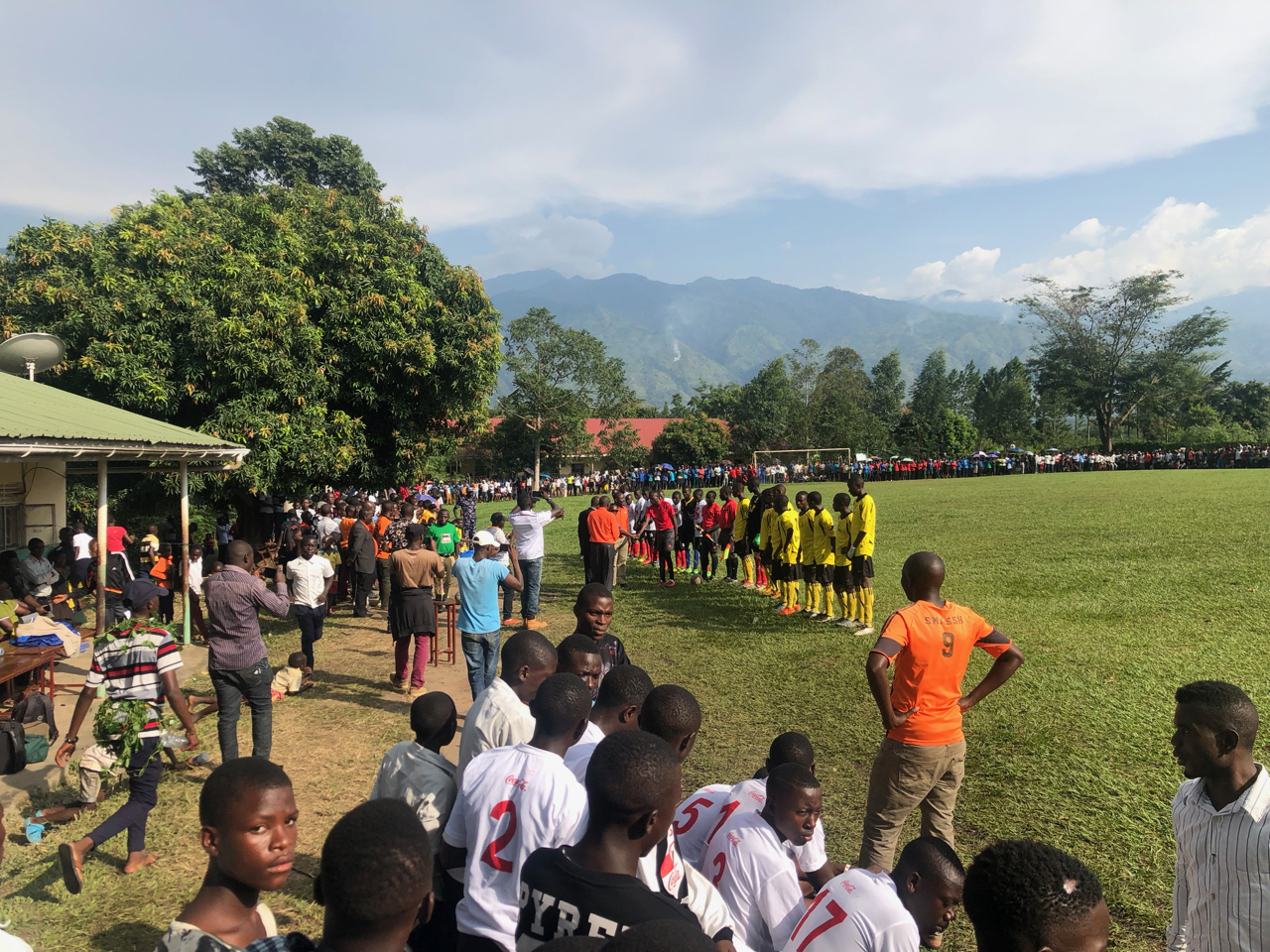
Wednesday saw the culmination of the boys' football season for secondary schools in Bundibugyo district.  A quick week of group play, play-offs, and quarter finals had whittled the field down to 4 teams from the 23 secondary schools serving this area of 250,000 people. The plan was to play both semi-finals in the morning at Christ School, then the finals in the afternoon a half-mile up the road at St. Mary's Simbiya.  One team for the first semi-final showed up 4 hours late, so the second semi proceeded first. CSB won that one 4-1, back on stride, playing like a team. The second semi was won by St. Mary's Simbiya, meaning we would all troop up the road to their home field for the final. This is a school that has, for two decades, used intimidation and violence to express their desire to win. Still, we all had hopes that the veneer of organization and the growing skills, equality, collaboration would win the day.


The final match started after 5 pm. CSB students gathered in a group near one of the goals with their incessantly loud vuvuzelas and a handful of hovering staff to keep order. We were near the center field, dutifully behind roped lines with 4 apprentices (one with strong ear drums elected to hang with the student group), cheering and craning to see the plays as more and more people seeped under and around ropes right up onto the lines of the field. Our head teacher had brought UPDF (army) and police for security. There were officials from the district, from the sports committee, from the Coca-Cola sponsors of the national tournament overseeing fairness at the district level. The first half ended 0-0, which was a reasonable outcome as the teams are pretty evenly matched and the officiating quirks were pretty evenly spread. Simbiya students ran the perimeter of the pitch wrapped traditionally in vines and leaves, chanting. Our students huddled in their area blowing their horns. Another thousand people smashed around the field and into the road. A couple of disinhibited men under the influence said rude things.  In other words, kind of normal.


However, after the half-time break, the Simbiya coach and another Simbiya teacher/administrator came out blazing.  As the teams lined up to begin, these two men were shouting loudly in the faces of the onlookers and the officials, claiming that "the bajungu have paid off the referees".  We were five feet away as this hateful angry speech about us was being used to rile the crowds. The uproar delayed the game another 15 minutes or so, with the police saying "just let the kids play, this is their match, stop ruining it" and who knows what the officials were saying. Finally these two men stopped shouting and we began, but the atmosphere was now very tense.

About 15 minutes into the second half, the refs called a foul on Simbiya at about mid-field and gave us a free kick. Our boys played that masterfully and converted it into a goal, the first score of the game. Our students erupted in joy, running onto the pitch and then back over the end line as has happened with every goal in the entire week of the tournament on every side. As they returned, the Simbiya keeper grabbed ?one or two of the CSB girls, and a CSB female teacher Madame Pamela intervened.  She got between the irate goal-keeper and the students.  So the goal-keeper punched Madame Pamela in the face. Bleeding copiously, she was then rushed off the field in the midst of pandemonium.

I ran with Pamela and a student to get out of the crowd and seek help, followed by a the Coca-Cola rep who very helpfully was a head taller than everyone around, very strong, and had a car.  A quick exam of Pamela did not show any lacerations, just a profusely bleeding nose, but she was so shaken and the Coca-Cola organizer really wanted to get out of Dodge so we got in his car to take her to a clinic, blood on our hands trying not to ruin his seats. He had to jump back out numerous times to push rioting students off the vehicle to get out of the gate. We finally made it to the road and sped to Nyahuka where the clinic was manned by one of our old friends and colleagues, who kindly and professionally administered first aid and let us wash off our bloody hands.  I walked Pamela back to the safety of Christ School then proceeded back up the road on foot alone.  I suspect the Coca-Cola guy had fled the district, I never saw him again.

Meanwhile at Simbiya, things went from bad to worse. While we were fighting the melee to get out of the gate in the car, Simbiya scored an equalizer, upon which the field was overtaken by the crowd and the referees feared for their lives.  They abandoned the game, pulling off their uniforms to blend in. Scott gathered the apprentices, Ken the headteacher had all the CSB team and students sit in one spot surrounded by army. The army fired off five tear gas cannisters and fired shots into the air to disperse the crowd. People trampled the fence down into the road to get away from the tear gas. CSB students were coughing and crying. The CSB group stood to march out with the army escort, as Simbiya students threw stones at them. All the way down the road CSB students were falling down overcome by the tear gas, looking for water to wash burning faces, protecting themselves with arms and clothes. Army were chasing ambushes by rock-throwers.  Staff were trying to keep the students together. Scott felt like someone was going to get killed.

But no one did.  There was rock-throwing into the CSB compound into the night, there was increased awareness and security, but a heavy rain dampened tempers and the night passed without further trouble. And in the light of day, we're all wondering, WHAT WAS THAT???  Just rowdy enthusiasm for a game, a craving for victory, an assumption that any score against your team is illegal? Was it the natural consequence of rampant indiscipline amongst restless young men with too much alcohol and time on their hands? Was it simmering rivalry seeking an outburst? Or something deeper?

Are we doing anything that exacerbates the tension? Yes, just be being here and being different, we are DISRUPTIVE. Christ School gives scholarships based on need and potential, not family/political connection. That sends a ripple through the system. Christ School does not tolerate teachers trading grades for sex, or beating students, or holding multiple jobs and never showing up for class, or bowing to the chaos of disgruntled teens, or cheating by smuggling test answers to students.  That disrupts the way things usually run. Christ School asks for accountability, not popular.  But are we doing other things that disrupt unnecessarily, in our attitudes, our manner of relating to the district? Are we communicating superiority or pride? I know I have that attitude and we all need prayer to not despise and judge our neighbors.

On Sunday, Desmond preached to us to love our enemies and to seek to be a blessing to this place.  Now that we've been punched, gassed, and stoned, the challenge is upon us. We hope for the district sports committee to bring consequences, because it is not merciful to allow bullies to ruin the day for children playing football. But most likely, it will all be swept under the rug and the violence will resurface. So how do we move forward in this place, trying to protect our students and do the right thing . . . but not perpetuating division, growing scorn in our own hearts and giving room to hatred in others?

Sunday, March 31, 2019

Why football is so much more than a game

The football season for secondary schools in Uganda is upon us.  And by football, of course, we mean the game played with a ball and your feet, namely, soccer. In the majority world, football reigns as the most universal sport. Kids can make balls out of wads of plastic bags and string, or dried banana leaves. Goals can be as simple as a couple of sticks. The pitch might be a street, a dusty plot, a goat field, a beach, an alley between houses, the lawn around a church or school. Shoes are strictly optional.  The very accessibility of this game, the inclusion of it, the (albeit rare) possibilities for stardom plucking a village kid to become a millionaire, lend a magical allure.  Pretty much everyone has a favorite major team, knock-off jerseys are found in the remotest places, crowds gather around any device that can broadcast a European match. 
So it is no exaggeration to say that the brief but intense school football season garners the biggest crowds of the year, a festive, rowdy, engaged atmosphere. The word "season" here is a bit confusing. Bundibugyo now has 23 senior secondary schools. And true to form, it has taken almost two months of the 3 month school term for most of those schools to pay the dues needed for the sports association to manage the games.  So the season for the boys has consisted of 4 games in 3 days, all played at CSB (other locations were operating simultaneously for other schools) in a modified group-stage play-off.  This narrows the district pool down to 8 male teams for quarter finals (to be played Monday) then semi-finals and finals (both planned for Wednesday!).  Then the girls get their chance, two days of games Thursday and Friday. It's a one-week, nearly every-day (sometimes more than once-a-day) marathon of games.
Madame Illuminate, who has worked tirelessly to organize the whole district season!

Our team looks good! At the beginning 20 years ago, the district only had a handful of schools and we regularly went to nationals.  Now the competition has increased, and there is a regional layer between district and nationals. Most recently we have no longer been winning the district, and THAT CAME UP ON NEARLY EVERY SURVEY SCOTT DID WHEN WE ARRIVED.  Staff took the football losses very seriously.  But this year we have a former student who is coaching, Happy, and we have some kids who've been in the program a couple of years and learned and grown. They control the ball, pass, play as a team, exude confidence.  The first three games we won 4-0, 5-1, and 9-0.  Scott asked Ike one of our new Serge Apprentices to make a score board, and that was a huge hit and focus of celebration. Our students surrounded it and sang the school anthem!
Our pitch, teams shaking hands before game
Match days start with horns and shouts at dawn as teams warm up. Classes are rescheduled to occur early mornings or late evenings so every student can come out and watch the games.  Probably a thousand people or more come to watch. There are vuvuzelas, a la the South African world cup.  There is marching, chanting, drumming, animated coaching from every sideline, jubilant screams from supporters, face painting, concessions. There are uniformed police officers with long sticks trying to maintain the onlookers at least a few inches off the side and end lines; and UPDF soldiers with massive guns. After one game our teachers had to help get the ref's off the field safely when angry losers stormed towards them.
see if you can pick out the camo and gun 
The intensity built through the first two days to yesterday's "playoff" between CSB and a school recently started by former teachers who broke away from CSB to do their own thing.  They were better than the first three teams we played, and we were rattled, a completely different team than we had been. The refs were calling offsides on people dribbling the ball towards goal, and once when our player intercepted a goal kick done by a defender with the keeper at his side. It was not a pretty game, and ended 1-1. Which prompted a penalty shoot-out, the crowd pressing in towards the goal, the players taking their shots. We ended up winning the shoot-out 4-2.
coaches preparing team for shootout with a pressing crowd of onlookers
the shootout in process

We were happy for the win, but the painful reality was that the students clearly saw that the crowd was against the school.  When our players hit their penalty shots, the only cheers came from our students. When the other team scored, the entire crowd went wild. It was our "home field" (we have by far the best pitch in the district) but the lack of community support felt sad for the kids.
the boys' team doubling as a choir, showing leadership at chapel!
Which brings us to chapel this morning, and a stunning sermon by Desmond the math teacher who is the longest-serving staff member. We've been studying Exodus.  He chose three texts, and I will try to do justice to his points.

  • Exodus 4:1-14 when God calls a reluctant Moses and gives him signs, then brings Aaron in to be the spokesperson. Desmond applied to the CSB community by saying, you are in a community that does not fully trust and embrace you. Like Moses, we humbly tell God that we feel inadequate to the task. We appreciate times when God dramatically helps us and marks us with His favor, and we acknowledge that we need each other as a team just as Aaron and Moses complemented each other.
  • Mark 6:1-6 when Jesus explains that his hometown, Nazareth, rejected him. Desmond pointed out that hometowns want to keep us all level, even Jesus' neighbors were skeptical and eager to cut him down to size. It should not be shocking to students to face the same challenges that Jesus encountered. Of course there are many who love and support the school too, parents and leaders, but there will also be a significant crowd who cannot wish us well.
  • Isaiah 61:1-6 the prophecy about being sent to bring good news to the poor, freedom to the captives.  Desmond said, you might feel like this community is your enemy. But Jesus says to love your enemy. This school is not just here to be a great school or enable our students to get ahead in life.  This school is here to bless the entire community. Whether we feel liked or not, our mission is to live the Gospel. To model humility and respect. To turn the other cheek, to play and study and then use our gifts to help everyone around us. This slowly brings transformation.
What a powerful way to bring the reality of the football experience into a loving focus. Not a message of "God is on our side so we must always win" but of "we are here to serve God and our neighbors". 

So, football is much more than a game in Bundibugyo and I suspect many places.  It is a training ground for teamwork and discipline. It is a gathering point for wholesome community passion and fun. It is an opportunity to build confidence and loyalty and to begin writing new stories for kids who have always felt themselves to be at the bottom of the world's pile. And it is a learning lab for embracing the Gospel, responding with love and vision to a community that does not always cheer our way.


Saturday, March 30, 2019

Simple to say: there is gash, then balm.

This line from today's poetry on the Biola Lent readings site (Temple Gaudete by Lisa Russ Spaar) captures the arc of history.

And the season of Lent simply stops us from slathering on all the substitute salves for six weeks, living in the reality of that wound and waiting for the true healing ointment. It is like washing off a year's accumulation of self-protective comforts, inward focused anesthesia. There may be some bleeding as the wound is cleaned, but that friable surface becomes the site of new growth and eventually, a sturdy scar holds us together.
Chagall captures the gash and the balm

For us, the 2019 Lent has many layers. This season has coincided with a return to Bundibugyo with all its beauty and brokenness. The journey up is a journey down. Literally, into a rainforest tropical valley, redolent with cocoa and echoing with birdsong. It's a place that could have been the Edenic cradle of life, only it has also become a lightning rod of the curse, an epicenter of malaria and sickle cell disease and excessive infant mortality and malnutrition and, historically, Ebola. A complicated undercurrent of fears stirs up conflict. Once isolated and suspicious, and now rising with more confidence. Yet there remains a thick spirit of hiddenness, passiveness, clinging, lethargy, desperation that drags people down. It is painful to watch our friends suffer. It is painful to hear our team doubt.


It is difficult to write fairly and inoffensively. It is easy to sound overly dramatic, except that when you look back over the trail of people chewed up and spit out, or talk to Ugandans who have lived in many parts of this country and enter this one with such hesitation, you can't deny this valley has some serious shadows. My equanimity falters when faced with ?50 ?60 ?more inpatients, a disorganized pile of mixed files and frayed exercise books, kids on mats on the floor between beds, staff hours late and more than half absent, medications not given, labs not done, plugging person to person to take my own vitals, history, exam, write briefly scribbled assessments and orders that probably won't be completed, eye out of the masses the five or so life-threatening-today kids in the crowd. A wasted pale twin who needs an urgent blood transfusion, a 1-year-old admitted for diarrhea who is hypoxic with pneumonia and needs oxygen, several with racing pulses and untreated infections, a deeply jaundiced 4-day-old, and a 14 year old boy who has bounced to us from several other clinics because no one has recognized his appendicitis. These are all things we should be able to treat, if there is the will, but I recognize that my will is also faltering in the face of so many walls. Later we try to untangle the complex web of stories that tangles us in school issues. We sit and listen, we pray and enjoin. It's hard to know whether that helps. Haven't we been holding this line long enough? Pushing back against these particular evils? Maybe it's just the second knock-down sickness of the month edging me to darker thoughts, maybe it is having Caleb in the unknowable limbo of Special Forces tryouts, or Luke and Abby working day and night through internships, or Julia looking for a job so she can survive on the part-time church work she's doing, or Jack about to be the final Myhre launching from college.

 Everything in the world tells us that the answer to "shouldn't this be easier" is yes, in one's later 50s after over 25 years in this work, it is time to have reliable electricity, functional systems, temperatures that don't drain the life out of you, the possibility of sitting on a porch uneaten by swarms of insects, reasonable options to buy groceries or refill airtime or get to an airport. It seems sensible to think that specialized experience should garner some position where people listen and learn? Is this a strategic place to invest so much? Would this team's gifts go further if they were poured out in more receptive climates?

Then the season reminds us, this is the path of the cross. 

Oh, the gash. 

This Bundibugyo team, and the partners we have in Christ School staff, BundiNutrition Staff, medical colleagues, the construction/compound team, the Bible translators, the accountant and administrators, these human beings are all living sacrifices. If you've read this far, please pray for them and us. For willingness to do hard things; for belief that in that moment the balm will come. For willingness to put down roots in a difficult place; for belief that in that clinging we will find Jesus. For choosing to love a place that wounds us; for belief that in so doing, God's balm will be enough.

CSB girls cheering the football team on to victory

Stephen and Basime running the concession stand

The football team, so far 3 wins/0 losses with a goal differential of 17 . . playing again in a few hours

Mary, Pamela, Susan, Topista at CSB

Dramatic skies to match the mood

Spent an afternoon teaching Serge Apprentices on "Unsettling Cultural Situations"

Bundi team courtesy of Stephanie taking photo, after an evening Ultimate Frisbee game. Love these people and hopeful for prayers to sustain us all!