rotating header

Saturday, March 21, 2020

We don't know what to do . . . COVID-19 and 2 Chronicles 20

Here are some words written several thousand years ago, but applicable today: "For we have no power against this great multitude (or virus) that is coming against us; nor do we know what to do, but our eyes are upon You."

When God's people were backed into a corner, with no hope, facing annihilation, this is what they said.

I don't even know how many times a day we have to make a major decision based on very little information, conflicting reports, impossible projections, with grave consequences. We don't know what to do. Or the times, here and there, when the weight of losses and the gravity of potential sorrows just feels overwhelming.

So here's what it's like at the end of the road this week, in one of the few countries left that has not yet reported a positive test.

We supervise 79 adults and 72 kids for Serge East and Central Africa. Two of our four countries have had low numbers of imported cases reported, two have not. Yesterday the US Department of State issued their most dire, war-like, travel warning ever: If you're an American on a trip, come home now. If you're an American that lives abroad, stay put and don't travel. Which means that there was a sudden calculation by and for 151 souls, do I live here or am I visiting? What is my risk? Should I leave? And these are not simple questions. A delay of a day could mean flights stop and borders close. We had already made sure our only over-65 people were off the continent, not because the rest of the world is safer, but because IF THEY were in critical condition there were NO OPTIONS for them to be in an ICU. But even younger people can have critical disease. Where do we say, your life is valuable, we want to protect you, it's our job to get you back to a place where the health system might be able to support you? And where do we say, your choice to shoulder this risk speaks of the Gospel to your community, and we want to allow you to stay in the long tradition of the church and pandemics? These are not simple questions. They have multiple right answers. We don't know what to do, our eyes are on You.

In most of our life here in Africa, we have a hidden privilege. When security deteriorates, when Ebola arises, when family at home is ill, when we are weary, we can usually pick up and take a break.  But not now. After 9/11 felt similar to this. It is a whole new level of faith to live in a place of poverty and margin, when you can't leave. Our colleagues are cognisant of the fact that if a treasured grandparent dies, if an adult child breaks a leg, if a two-year-old needs a special surgery, if any one of a thousand crises arise related to coronavirus or not, we most likely cannot go anywhere. Today my mom called with the news that my Aunt who is nearly 90 fell and hit her head and is in the ICU with bleeding in her brain. I hope I will see her again, but it is quite possible I won't. On that note, a shout-out to all our parents who are strictly quarantining. It is a tremendous relief to your distant family to know that you are sacrificing your freedoms, you are giving up movement out and about, to protect yourselves. We are so grateful. We don't know what to do, our eyes are upon You.

Usually, we live in rhythms. After a few months, there is a. break. We look forward to conferences or trips. The day to day slog of heat and need can be wearing, the distance gets draining. It is a whole new layer of difficult to not know when we might see our kids again, or our parents, or many others. Or even when we might see our other teams. Or get to a place with swimming or quiet. We don't know what to do, our eyes are upon You.

Africa is braced. Our country shut down schools, churches, bars, gatherings, sports. We spent time scouring up some facemasks and hand santiser.  I taught a CME for the hospital yesterday on the novel coronavirus. Teams are researching the best approaches. Our hospital set up handwashing stations outside every ward (since water and plumbing is not always reliable, these are refillable jugs). But once in side the ward, there is extreme crowding. All but two of our teams have a core of medical work. When the world stops moving, and people stay home, almost all of our missionaries in Africa are in a different category of essential workers. We are watching Italy on the news and wondering, if they had hundreds of deaths yesterday, how can we possibly not be even worse? Our population is malnourished. We have immune compromise from HIV, we have lung damage from TB, we have a high prevalence of malaria. We have about 9 oxygen cylinders, each of which will give a low flow for one patient for about 24 hours. We have no ICU. No ventilator. No oxygen plant. The ratios of health care workers to population where we work is among the lowest in the world. Options are so limited, for our neighbours, for all of us. We don't know what to do, our eyes are upon You.
These are the measures Uganda announced this week

This little can of water with a spigot is our defense against the pandemic

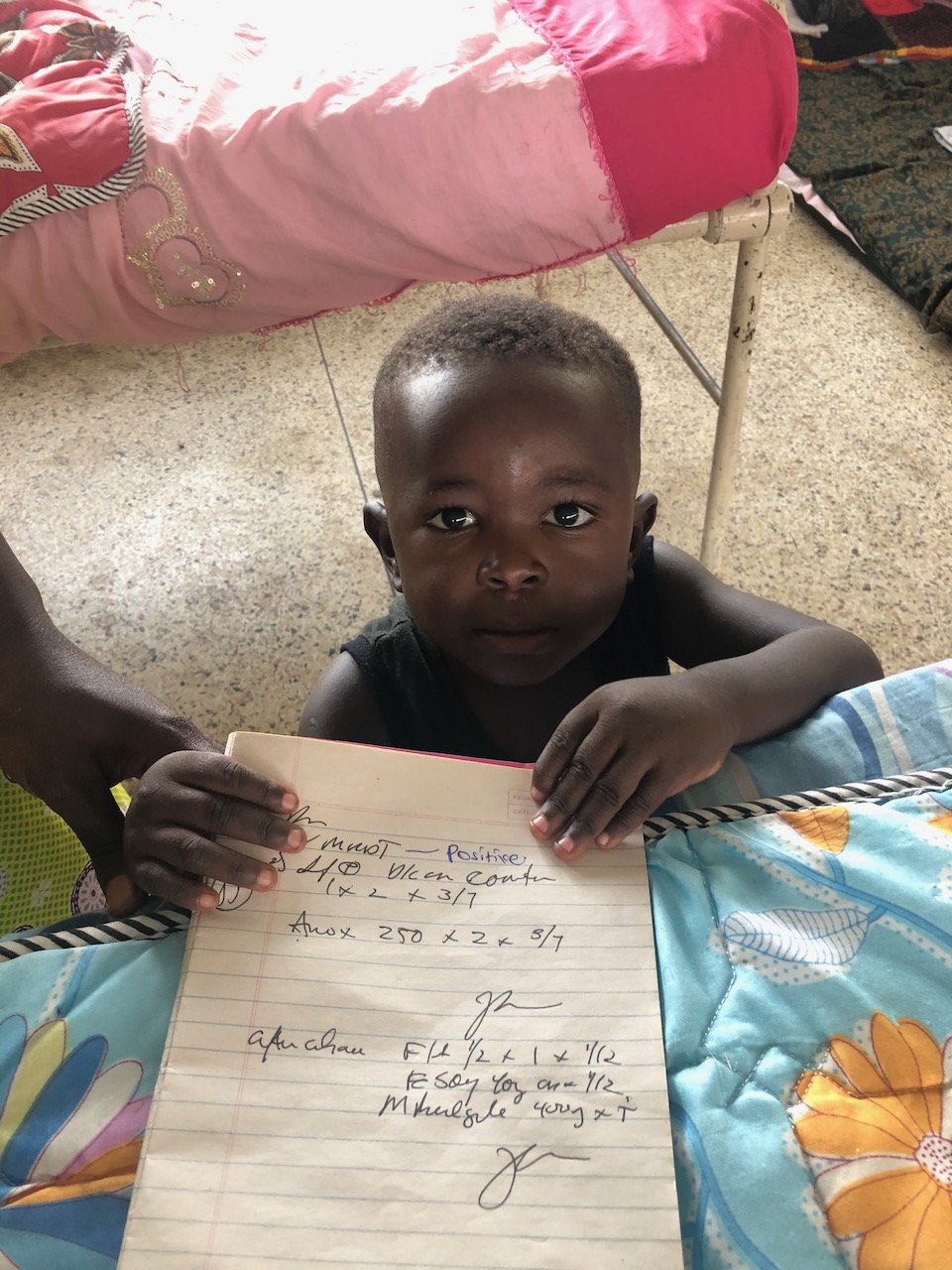
Collateral damage. This child from yesterday is swollen from lack of protein, a mom who was too soon pregnant again, no good food options without breast milk. When the pandemic hits, what happens to kids like this? 
 
Teaching CME. Everyone usually sits physically touching; it was our first time to space ourselves out like this. But this is a team who has worked through cholera and Ebola and untold crises. They can do it.

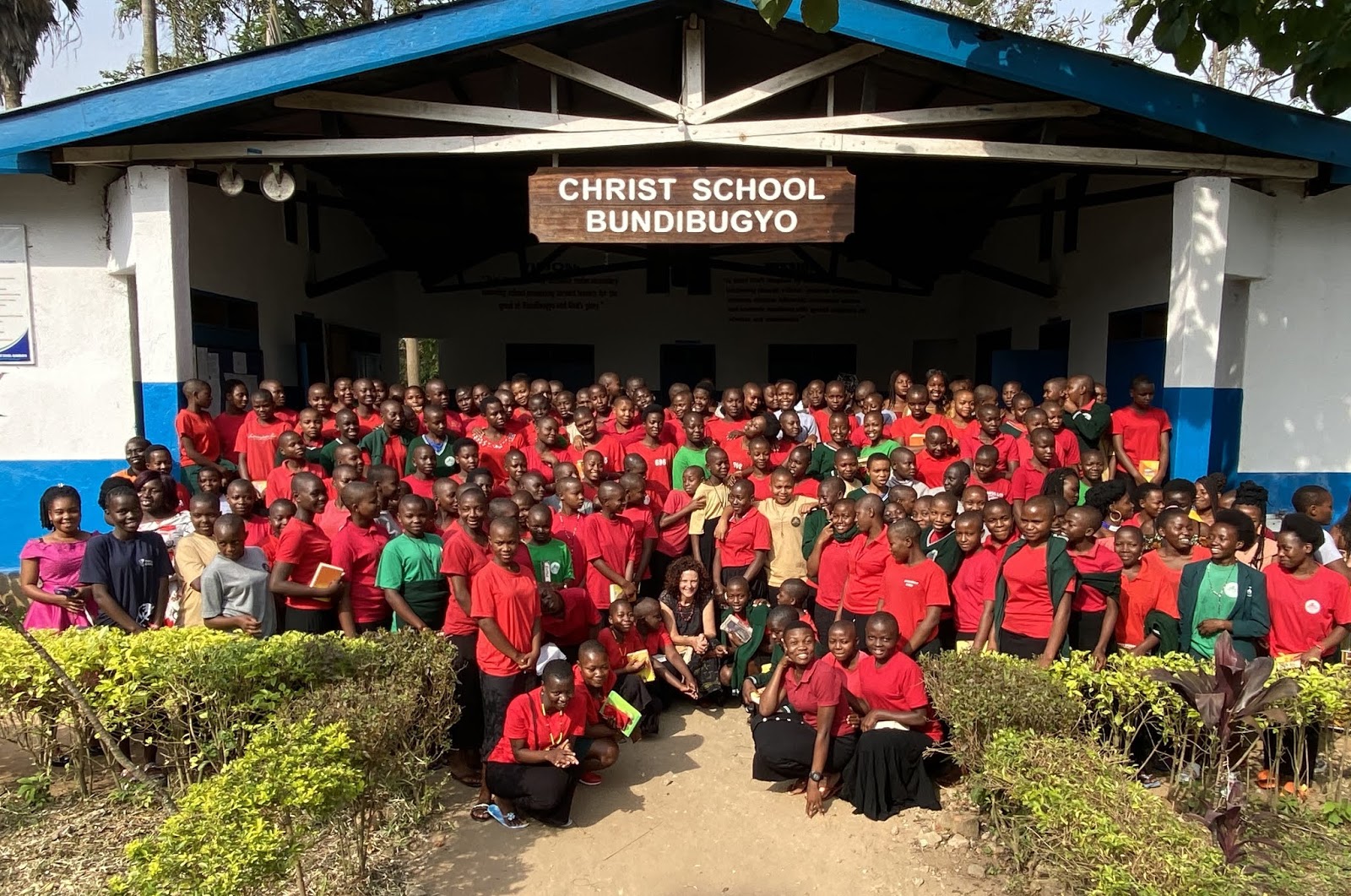
Christ School closing, all schools closing, hits Bundibugyo hard. Our students don't have internet access. There won't be online anything options. They are returning to homes which have no books, no electricity, perhaps even limited food. We struggle to keep up with the national curves even with all our school days; doing so with half the term canceled (or more??) will push us to the limits. The teachers are staying around to create a packet of work sheets since no one has texts. Monday Scott and Patrick will meet district leaders with a plan to teach on the radio, a gesture of good will, a way to come together in crisis and bless kids from many schools. With no church, no sports, no school, no books, few outlets, what will the impact be on this generation if this lasts very long? We don't know what to do, our eyes are upon You.

And so the days go, dozens of texts, hundreds of messages and emails, calls at all hours. Trying to stay alert and empathetic. Giving grace to various people in our orbit to make different choices. Wanting everyone to feel seen, cared for, supported. Then long days of the normal work of serving sick kids and their families. The disorienting feeling, is that cough evidence that the new coronavirus is already here? Is that fever potentially dangerous? Should I start using precious masks or wait? If we can barely make it through the ward where the patients cover not just the beds but the floor now, what will it be like in two weeks? In a month? We don't know what to do, our eyes are upon You.

In an era of distance, the group was giving me "roses", picking them from the air and throwing them to me to receive after teaching, rather than a clap our hand shake. 


We are praying for our world. For God's powerful rescue. For a 2 Chronicles 20 story, where we find out in the end that God was with us all along, that our worst fears are already defeated, that we are going to be all right. That in the end, because our eyes are on God, all shall be well.


Tuesday, March 17, 2020

The 80/20 rule of Coronavirus, Kindness, and antidotes to fear

As everyone but a dedicated hermit must know by now, 80% of people infected with Sars-CoV-2 aka the coronavirus that causes COVID-19, our pandemic respiratory infection, will have mild infections. It's the 20% who get the disease in older decades (like, gulp, ours) or who have chronic debilitating health issues, who get very sick.


I learned from my Kenyan colleagues, who are used to massive numbers of patients in the public health system, that as a doctor we need to find the 20% who are most sick and give them 80% of our attention. That is no less true now. MOST of our concern, effort, preparation, needs to go to our most vulnerable. In this year of pandemic, that means that 80% of us have to alter our behaviour to protect and love the 20% who are at risk. People are changing their lives, overnight. Giving up freedom. Travel. Habits. Churches and schools, closing. It's a massive effort by the relatively well to protect those most vulnerable should they become sick.

And some people are doing so in a very inspiring way. I love the videos of Italians, and Spanish people, on their balconies singing and clapping. They are social distancing physically, but not emotionally. Zion Williamson, the Duke basketball phenom who went to New Orleans, decided to pay the salaries of the arena workers whose jobs would be impacted by the shutdown of the basketball season. He's a 19 year old; his trajectory to wealth was so rapid he hasn't forgotten. Julia's church farm is providing food for people, and started a program to cook up large batches of nutritious broth. Luke and Abby had to give up their long-delayed honeymoon planned for April; Luke is back on straight night shifts next week for emergencies after having already put in his two-months of that in January and February, because that's what's needed as the health system narrows down its focus. Abby is working extra shifts, and both of them already have COVID-19 patients in their hospitals. Our moms are in isolation hoping as 80+ people to avoid the virus altogether. Friends are lamenting the loss of time with children or grandchildren, the honing down of wedding lists, the inability to celebrate milestones. Yet I see people posting ideas on how to help your neighbour, how to be grateful and generous which is an antidote to fear.

There is another 80/20 rule at play.  On a global scale, the poorest countries are those 20% vulnerable. It is not just age and pre-existing health conditions. It's other pre-existing conditions. Like poverty. Like a health system that doesn't even have ICU care or much in the way of oxygen. 155 countries are now reporting cases. Amongst the handful which are not? Uganda, and Burundi, two of the places we work. Yes, they are remote to get to and perhaps slow to receive travellers, but more likely they just don't have enough testing to really know what is happening. Interestingly there is only one state left in the USA without reported cases, West Virginia. On the WV:USA scale; or the Bundibugyo and Burundi : Africa scale, there are similarities. A study found that WV had the adult population with the worst health in the USA, so when COVID-19 hits, they will be severely affected with minimal resources. We anticipate the same here. No one knows the impact of HIV prevalence mixed with this pandemic. Or malaria, or malnutrition.


So here we are for a couple of days in the capital. (We were called to the State House's office on Land Matters because of the 6-year law suit trying to steal back land bought 20 years ago. That turned out to be an unpleasant morning of being told by a young lawyer that, and I quote loosely but sadly pretty accurately, we might lose our lives over this but hey everyone dies whether it's a bullet or old age, so just trust the courts. . . . the meeting was miserable but seeing the support of the community who sent multiple witnesses to explain how the mission's work was of value to them, and how they all feared the injustice being perpetrated, was pretty heartening.) Our couple of days here consist of scouring pharmacies and calling contacts who know the market from 25 years ago (no lie, the same guy who used to help us procure flour and rope and fuel when those were rare items today came up with some N-95 facemasks and hand sanitizer, no easy task when some enterprising person sold all of Uganda's supplies to China a month or two ago) for medical supplies. We're shopping but not for massive amounts of toilet paper (we LIVE NORMALLY in increments of months between access to groceries, so we generally stock up on peanut butter and beans and popcorn and cheese . . and one or two packs of TP). In between life-maintenance and medical-supply searching, we answer emails and talk to our people. We supervise dozens of adults and dozens more kids in four countries. Some are older than others, some are pregnant. Some are anxious. Many are health care workers. All of us have always had the sense that worse comes to worst, we can probably evacuate. We don't have that anymore. We are coming to new normals of facing an impending pandemic with inadequate supplies, of looking for weeks or months of being isolated from our origins. And the peculiar experience of being visibly indistinguishable from whomever brought the virus to our countries. We're in the guilty minority this time.

One more day and we'll head back. None of us know what the next weeks and months will hold.

But God does. We don't have ventilators or chest CT scans, labs or blood gases, high flow oxygen or access to tests. But we do have communities that would come to Kampala to testify for the good God is doing in our homes. We do have a genuine team of people in East and Central Africa sharing information and praying for each other. We do have some simple energy to care for the sick, to comfort, to support. We do have a few facemasks and bottles of sanitizer to stem the onslaught of virae. And we do have a promise, that nothing can separate us from LOVE.

This is today's paper. If our schools close tomorrow, please remember these kids will return to homes with no books. No computers. No online alternatives. They will not be fed at public lunch programs. They will be severely impacted.


All entrances in Uganda in the city look like this--hand sanitizer and warning posters.

The group that came from Bundibugyo to support us.


Kenya announced cases and a closing border but by the mercies of God this family was able to get from Eastern DRC where the Ebola epidemic is waning, to Kenya where they can more safely deliver a baby in May. Praying for them!!


Saturday, March 14, 2020

Pre-Coronavirus Realities on Friday the 13th

Friday the 13th, as America declared a National Emergency, our Serge organisation met to discuss travel policies, lots of phone calls and texts to make decisions and cancellations, the first case of COVID-19 in East Africa was diagnosed in Kenya in a person who had traveled from the USA . . . and life went on in Uganda. Meaning 8 am at the hospital, finding a young child who had been admitted the day before with a viral lung infection (presumably NOT coronavirus, there are so many virae), been on oxygen and convulsing overnight, and was now having intermittent agonal breaths. The shift had just changed, we did what we could which was not enough, and she died.  The morning staff meeting, the realisation that no other doctor was in the hospital today (politics, interviews, post-call exhaustion, planned travel). Bouncing between a packed ward and the newly opened NICU. Premature twins on day of life 3, doing what preterm twins do--getting jaundiced and losing a little weight but otherwise vigorous. But a baby admitted overnight whose mother had delivered a twin on the way to the hospital but not been able to get this one out. No records to say how long it took to get a C section or what the apgars were, but the baby was limp, blue on CPAP, with unresponsive pupils. Also dying.

Then back to the ward, facing what the records said was 81 patients but probably was more like 70-some, with what felt like no help. No vital signs charted. No one charting much of anything. Just bed to bed, mattresses on the floor, scribbling in exercise books, talking to parents, doing exams, making decisions, ordering labs and medicines, trying to find the sickest but salvagable. There was something about starting with two deaths and unexpected aloneness in the context of a pandemic that just threw me into despair. I texted a few team mates to pray. Scott sent back an encouraging message.  And by grace, we plugged on.

Once I just set myself to see the patients one at a time, to look at the little humans as humans and their parents as parents, to not worry about doing it ALL but just focus on doing the next thing, the day changed. I wasn't alone. There was a nurse in the injection room giving meds, and one in the office writing discharge papers. Later another came to help me get more kids on oxygen. Clovice our every-cheerful BundiNutrition aid was there, and even though he's not medically trained he's faithful and dependable, and recognized two of the sickest patients to call my attention to.

So here is a glimpse of rounds, on a normal day.

Typical section of the ward, when the beds fill patients just add mats and mattresses to the floor.

Ants enjoying the dripped IVF, evidence I suppose that the dextrose label actually DOES include dextrose.

Looking for lab results, discovered dozens from the last few weeks jammed into this drawer.

As if being under the Ebola into poster wasn't bad enough, this kid accidentally cut his heel down to bone FOUR DAYS AGO, came to the hospital two days ago and happened to get tested for malaria, which was positive. His hemoglobin was very low as blood poured out of his heel and parasites attacked what was left. Evidently his hand-carried record book got displaced, so until I found him bleeding away nothing had been done yet . . .

She survived malaria with vomiting blood, and a hemoglobin of 1.4 on admission (normal 12). In spite of exceptions like the kid above, we have made good strides on malaria and transfusions. Our nurses can inject artesunate (and ampicillin) and hang blood transfusions. Those three things save a lot of lives actually.

Malaria is so endemic that we try NOT to let anyone go home that was not tested. This boy was ready for discharge, his pneumonia better, but he had a palpable spleen. So I had to finally march him into the appropriate blood testing area and insist, and wa la, malaria. So he'll go home on treatment. Yeah.

More patients. At this point I was about half way through the ward. Malaria, malaria, malnutrition, sickle cell, pneumonia, lots of viral syndomes, abscesses, burns, hit-by piki, and so on.

Don't let sickle cell disease ruin your fashion sense. This hat and smile were so cute.

Sometimes a story just grabs me. A one-year-old wakes up screaming in his home at night, and the mom sees a big black snake. Snakes sometimes come into poorly sealed homes and look for warmth, and when you sleep on a floor mat . . .then the baby moves, the snake panics, and there is a bite. This child's arm was swollen and tender up to the shoulder and we could see the double fang marks. But by Friday she was much better and able to go home. The snake escaped, but hopefully that little reptile brain was scared enough to stay away.

Another fashionable cure. Little girls and spangles. Mirror image G?? 

This 7 year old is a twin, whom we have followed for several months. She has signs of Kwashiorkor (swollen feet and face, skin lesions, listlessness) which is not typical in her age group. Though she improved a bit on her first admission getting food and malaria treatment, now she has some pneumonia findings, so we decided to treat for TB. With an unaffected twin, it seems to be more than just hunger. 

The first NICU admissions were a set of preterm twins . . this one getting some natural phototherapy in his home made incubator (thanks Dr. Marc for all the work into getting this set up, and Kibuye/Tenwek/Caleb Fader for the incubator design). There was a bug floating in the CPAP but the baby looked great.

You might be surprised to know the typical topic of conversation these moments when I am trying to distract and calm an infant or toddler long enough to check their oxygen saturations and heart rate. The mother is usually saying something to the baby like "see your wife here? Are you going to marry her?" and we are all smiling because this is the normal way infants and grandmothers relate. I am not making that up. Literally many times a day I hear proposals from one-year-olds via their mothers.

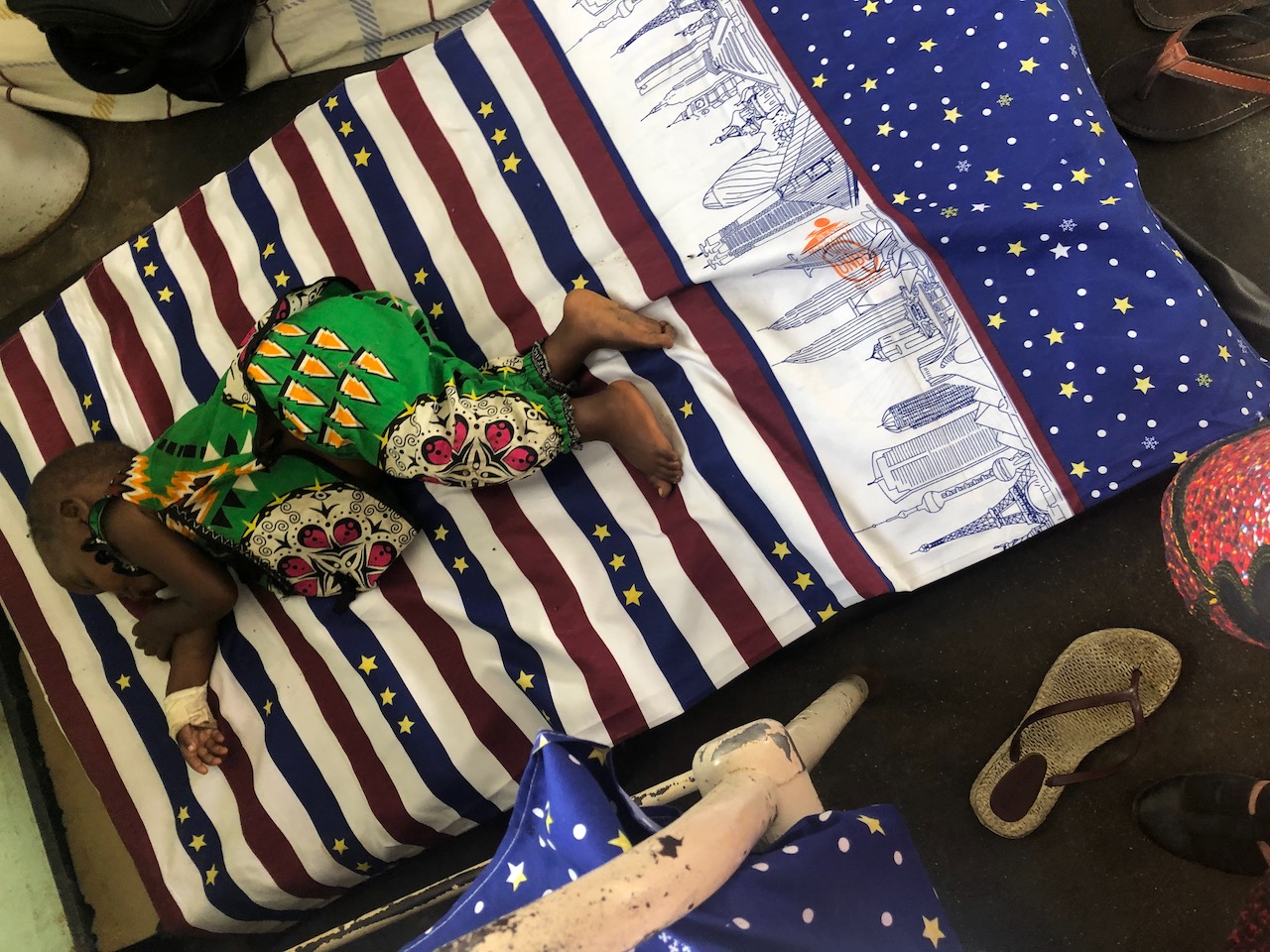
This is the newest fashion trend sheet, I probably saw four on Friday. Sort of an American nod with the stars and stripes, but a few snowflakes for good measure and a global skyline.

And so we go. Examine, talk, think, write, make a phone call, check a dose, lead the patient to the nurse's room for a blood draw or injection if it just doesn't seem to be happening. On a good day, when someone is praying, I can make eye contact and feel empathy and take time to force my tongue into Lubwisi to explain, instead of rushing and feeling overwhelmed and frustrated. I try to go over the sickest patients with the nurses, to do some teaching. I make lists, and communicate with the doctors who might come over the weekend. It takes about 6-7 hours to get through rounds, meetings, treatments, etc. In between each patient, a generous splash of alcohol hand sanitiser.  We only have one oxygen tank and one concentrator. I have to choose which two of the four hypoxic patients get the oxygen. All of this is baseline. Before coronavirus.

We have three young boys with chests like this, consolidated pneumonias on one side. They are breathing at twice the normal rate or more. I can see their ribs as they work hard. This is before coronavirus, as far as we know.

Social distancing, hand hygiene, suspension of travel and gathering . . . these are methods to slow the spread of the pandemic so that the health system can adjust, can cope. But what if your health system already isn't coping?

Today's words from Deuteronomy. This is a global season of wilderness.  This is a time we can lean only upon God's provision. And this is a walk of faith that God will bring some good in the end.


This street sign is painted a few hundred meters down the road from us. "Born to win" street. Africa may not have resilient health systems, but we do have resilient people. And always, hope.

(And for another view of life in Bundi, read this blog about our Orphans and Vulnerable Children scholarship program. Or this one about cross-cultural realities from our BundiNutristionist.)

Thursday, March 12, 2020

Tropical Coronavirus, pandemic views from the African continent

Africa is generally last to the table. Last economically, last in health indices, last in control of resources, last in accessibility to education or electricity.

But at this moment, being last is being best. Unlike times of Ebola, when the rest of the world is frightened of any contact with Africa . . . this time, for now, the only reported African cases are from travellers (mostly from Europe), and African countries are blessedly dark on the coronavirus map. Which is a good thing, but also a tricky thing for those of us with a foot in multiple worlds.

So here's some of the complexity of watching a pandemic from afar.

Being on the edge of a current Ebola epidemic (which is now almost over, and had 3444 cases and 2264 deaths) and having had a massive measles epidemic (which killed more Congolese children in 2019 than coronavirus has world-wide so far, at least 300,000 cases and more than 6,000 deaths, which we as a human society didn't get too alarmed about sadly) . . . we are not strangers to the importance of paying attention to disease and its prevention. So when the WHO and the CDC and numerous universities issue warnings, and when Lancet starts publishing studies that are peer-reviewed and sobering, paying attention is a matter of life and death.  The key facts we know are

  • The coronavirus that causes COVID-19 is a new one, probably from a bat reservoir that crossed into humans in China. 
  • It is different from common-cold coronaviruses in that no one was immune, and it causes a severe illness in up to 15% of people infected, particularly older adults and people with chronic underlying diseases. Unlike many diseases, infants and children are not the most affected. 
  • The infectivity of this virus is pretty high, it stays on plastic and metal surfaces for days and is easily transmitted by coughs at proximity (6 feet or less). Touching hands transfers the virus person to person, and then touching your face (eyes, nose, mouth) lets it enter your body.
  • But the infectivity measure is not a fact of nature that can't be changed. Right now it varies depending on the behaviour of people. In most places we are using a number of 2.5, meaning each person infected then transmits to more than 2 more people. That's why the graphs slowly slope up then suddenly shoot to the ceiling. 1, 2, 4, 8, 16 . . . the momentum grows until you have a thousand becoming 2 thousand and quickly tens of thousands. 
  • If a disease has an infection multiplier of 2.5, it will eventually infect 60% of a population. Think about that for a minute. That's a lot of people. So even if the rate of dangerous or fatal infections is relatively low (much lower than Ebola, or possibly even lower than measles), just the sheer extent of the spread can make it a big-impact disease. 1% of millions of people is still a lot of deaths. 
  • If we change our behaviour, stop traveling, massing together, hugging and touching, coughing into hands, etc. WE CAN GET THAT NUMBER DOWN. 
  • The most important measure we can take to protect ourselves is washing our hands with soap and water or using an alcohol hand cleanser, again and again throughout our days. 
  • The second most important things we can do are: stay home if you're sick, stay away from people who are coughing and sneezing and febrile, clean surfaces touched by a lot of people, etc.
  • And all of this should be particularly done in care of the older people in our societies, who have much higher (up to 15% in the oldest groups) risks of death from this virus. Trying to INCREASE the time it takes for 60% of the population to be infected spreads the timeline out, which allows the health systems to remain functional, or gives time for investigational therapies to become available.

So, those are the facts.

Now, there are admittedly a zillion things we do NOT know. For instance, when a country reports a case, or ten, or thirty, is that how many cases truly exist or just a factor of the number of tests done? Sadly it seems to be more the latter.  For every death, there are probably a hundred or more cases in the population. Another thing we don't know is the exact timing of an infected person being able to infect others. It looks like that timing may include the day or two before symptoms appear. Meaning that well people may be well, or may be a day away from sickness and still able to make others sick. We don't know how long it will take to reach the rest of the world, what the impact will be of all the information blitz and the travel restrictions. We don't know the health impact of the economic downturn. 

And we don't know how long Africa can hold out. Uganda has banned arrivals from 16 countries including the USA; anyone who insists on coming is required to self-quarantine for 14 days. This continent's main advantage is that half our population is under age 15, therefore less likely to get severely ill.  Our older people might be healthier than most continent's older people, just to have survived. Poverty might mean less lung damage from smoking. Temperatures routinely get over 30 degrees C, 100 F, which decreases the virus's lifespan on surfaces. 

All that might be outweighed though, by our fragile health system capacity.  In the best of times we don't have enough oxygen to supplement kids with pneumonia; what will happen if large numbers of people need it? In the best of times we lack ICU care. IN the best of times our ratios of doctors and nurses to population are frighteningly small.  People live in close proximity; social distancing is definitely a counter-cultural stretch.

Besides the facts, what we know and don't know, there is also the vague cloud of instability.  To me this feels like the days after 9/11.  We were here in Africa, and felt safer than our families were. It was hard being far away. The wobble of the world was such that there would always be before and after. And that made it hard to think very far ahead. Would travel stay unsafe? Would we be able to see family in the coming months? Similarly, now, our Serge Africa friends are feeling the punch of restrictions.  Visitors are canceling. Plans we had for an every-four-years- reunion conference in late May have been canceled. The intersections with our kids and mothers most likely won't happen this summer. These kinds of losses are huge.  We feel the exhaustion of decisions, of care, of predicting, of vigilance. We feel the weight of making a mistake that could make us the vectors of bringing disastrous consequences. We feel the likelihood that a crashing stock market will translate into less generous capacity for giving, less funding for Christ School, less emotional space for people to pray for us and care. We feel the anticipatory sadness that further pressure on African systems will mean further instability and death.  Most likely, we and our teams and our families will all hunker down and find a new normal and pull through just fine. But the months ahead look trying.

That's the pandemic view from Uganda tonight, in the rain, with news playing in the background. Tomorrow we'll be back to rounding on too many patients, meeting with staff, struggling for justice, gently caring for the sick, praying for others, and finding the new normal.

And we will be reminding our own hearts, and yours, that God is with us.


Monday, March 09, 2020

A glimpse of R-E-S-P-E-C-T

Here is a video glimpse of the day-long celebration of International Womens' Day at Christ School-Bundibugyo.


We are incrementally pushing a boulder up a hill and by God's grace the lives of our girls will be different.  They will be hired, be respected in their marriages, do what's right and stand up for justice.

We still need partners to support tuition subsidy we provide to every student.

A dollar a day can subsidize one student for a year.  JUST CLICK HERE TO GIVE.

Saturday, March 07, 2020

Numbers Matter: on leadership, sacrifice, and the God of details

Numbers is the book for early March in my read-through-the-Bible plan. 
Numbers are also required by our Serge leadership as we monitor and evaluate our work.
This is my Bible and it happens to be sitting on a document about metrics . . . 

And my computer this am.

And numbers are a big part of our daily life in a world of epidemics. We are looking at data on Ebola, measles, influenza . . and COVID-19, frequently, writing guidance for our Area, interacting with other leaders, making travel decisions, part of two different crisis committees.

From this particular read through the biblical Numbers, I am struck by the incredible attention to detail. Individuals matter. Persons count, one by one. The exodus of a nation of hundreds of thousands of people through a desert required attention to public health: rules about rashes and molds, rules about hygiene for sex and burials and animal slaughter.  Numbers alternates between repetitive counts, poetic blessings, and gripping stories.  There is artistry in the golden candle stands and tragedy in the attempted coups, lament in the plagues and provisions for the parties.

And chapter 7 details a leader from each of the 12 tribes bringing their own specific sacrifice to the newly dedicated mobile worship tent, the artistic tabernacle. Each day for twelve days, a specific leader from a specific tribe brings a sliver platter of a specific weight, a silver bowl, fine flour and oil, a gold pan filled with incense, a young bull, a ram, and a male lamb, a kid goat, two oxen, plus five more each of rams, goats, and sheep. And like a children's book, each day the same tally is repeated and recounted.  It's a very long chapter. At the end the entire twelve days of offerings are tallied up, and the final verse describes the voice of One speaking from above the mercy seat to Moses. I have read a lot of very helpful and good resources about leadership, but this chapter rings most true. A foundational aspect of being a leader is being required to offer to a level where we feel the impact. For us, that is rarely silver or goats (though to be honest this week the we donated a goat to the CSB staff for a party to celebrate exam results!). But it is time, attention, walking down to someone's house, prayer, study, research, advice, lugging boxes or cooking meals.  It is distance from family, or uncomfortable circumstances.  It is lack of freedom to do what we want. It is downward mobility in the organizational chart, or late nights still at a desk. It is absorbing blame or dissatisfaction, it is letting go of the expectation of justification. It is a lot of things more difficult to count, it is the tears that God numbers in the bottle (Psalm 56:8). 

At the end of it all, it is the presence of God that we long for. That presence is convicting and exacting; even Moses who sacrificed more than we can imagine, who was offered multiple times by God to just give up on the recalcitrant mob and start over, paid a high price in the end being denied entry into the promised land. But the One who asked so much spoke to Moses of mercy, met him in the desolate places, "gathered him to his people" (which is the most beautiful word for death, and should be on more tomb stones).

So this week I'm thinking about numbers and leadership and sacrifice. There were between 137 and 180 patients in our theoretically 100-bed hospital this week (which we now know because we started having morning reports), 60 or more of whom are on the theoretically 25-bed Paediatric ward (rounding on 1/3 to 1/2 of the hospital validates the feelings of exhaustion?). We had two deaths on our ward this week, one because we could not transfuse fast enough when a very sick baby with malaria came in anemic and we lacked the blood type needed, the other because we could only give oxygen to a few of the kids with pneumonia and not all. Clovis and I have been retelling the Jonah story to our inpatient families, and I counted 75 on Friday morning listening to the Gospel of faith from the fish's belly, hope while still in the darkness before healing is sure. We have 357 students now at CSB, and those numbers have meant a lot of Scott's time sucked into projects to make new beds, new desks, new budgets. Our team now has 14 adults and 15 children.

And while the COVID-19 numbers explode around the world, East Africa remains a territory where either the virus has not reached, or the testing is not being done. Our health systems are fragile and stretched and it is entirely possible on this continent to not distinguish one viral epidemic from the next . . . I think. But we are bracing for the impact of another wave of illness and death, soberly aware that there may not be oxygen to go around and we KNOW there won't be intensive care. Meanwhile it is now 16 days since the last positive Ebola case in DRC over our border, and our team there starts to breathe a cautious sigh of relief. The background of bigger problems remains: malaria, more malaria, sickle cell, AIDS, road traffic trauma, diarrhea with dehydration, malnutrition, premature births, obstructed labor. These will kill many times more people around us in the coming months than coronavirus will, but all are important, all are worth fighting against.

In all of this our hope is in a God who sees us, who knows the numbers, who cares for the details, and who is at work in all things to bring good and glory.

INDIVIDUALS WHOM GOD SAW THIS WEEK:
Team tweens hanging out on the slack line

Dr. Ammon and his wife Nurse Esther, preparing the new NICU to open (gulp!!)

Anna is a real woman: carrying two at a time . . . 

B from the McClure fam making friends at CSB

These two devour books

Numbers we don't like to see--plummeting weight in a malnourished child

Our newest team cuties with their freshly imported colors

The above-mentioned goat party, celebrating good exam results with the teachers who made it happen!

The number 4 is approaching for this one next week

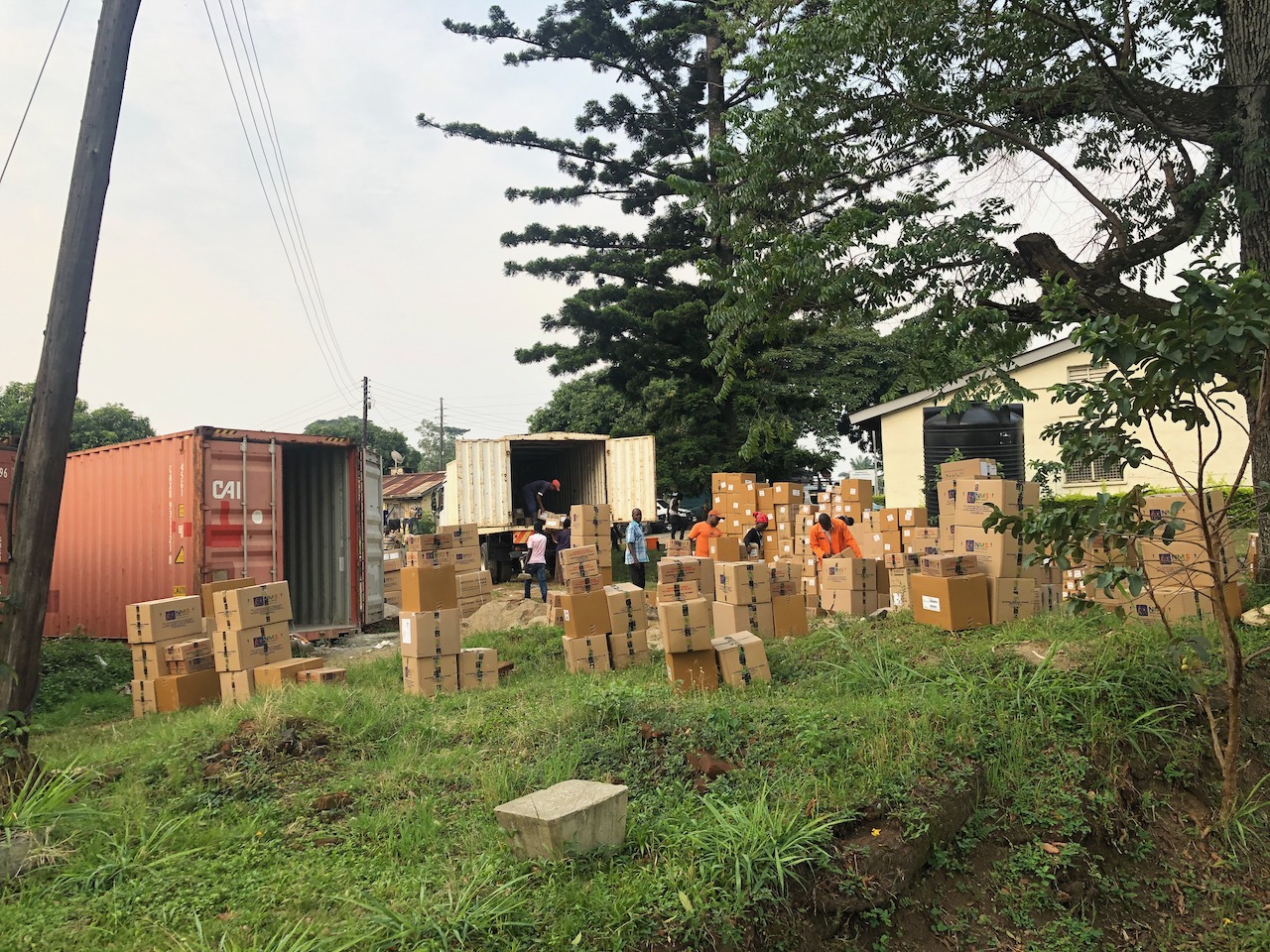
National supplies of medicine, much delayed, much welcome

Helped a tiny bit as Dr. Isaiah moved to his new apartment (one of the doors in this courtyard). He is one of the dozen Kule Leadership Fund scholars, now blessing us all.

Burgeoning student numbers means more desks had to be constructed!

This clinical officer was teaching our weekly CME on HIV care for adolescents. The highest risk age group for new infections? Adolescent girls. 

She's just the cutest, and this rug makes me happy. Babysitting team kids is a perk of the job.

When you invite a team kid to help you paint a shelf, good idea to choose this one.

Just snapped this because the snowmen in USA-flag gear juxtaposed with a mom showing me her baby's distended abdomen was so . . . paradoxical?

Thankful that Jessie's mom Janet came for a visit, and thankful for the delicious Ugandan food cooked by my neighbor Asita.

A view from the back of chapel of what 357 students looks like

One of Uganda's favorite numbers: two. Twins abound. And when one gets malaria, better check the other one.

Scott found our old dominoes this week, which made it into several fun kid times, and reminded me of my Dad.