rotating header

Sunday, June 14, 2020

Cameo roles to prevent power-blindness, while plodding along through #COVID-19UGANDA day 86

"Culture crossing is about getting out of your story (where you/your people/your values play the main character), and getting into someone else's story where they are the main character, and you realise you're just a cameo, your culture a caricature. It is to move from the centre of your story to the periphery of someone else's . . .

Power-sensitivity needs to be an essential part of the cross-cultural Christian's armoury. Power-blindness is unacceptable in the twenty-first century. Those who assume that the world is a level playing field, that everyone's opportunity is equal, that history does not still exercise power in the present, are naive, dangerously so."
(from chapters 6 and 7 of our current team study, Global Humility)

this photo is from several years ago, but it does contain a starring cast. Pictured are the future of Western Uganda, including electrician, businessman, accountant, lab technician, three doctors, nurse, librarian, teacher, clinical officer,  gardener, engineer, personnel manager. Seven are also parents now.

Blogging is dangerous. Speaking is dangerous. Every flow of words tells a story that can be unfair, lack nuance, be blind to power and history.

The best we can do is to listen, be humble, bear witness, serve, and try. We are scattered people who have an outsider perspective. The barriers of language, culture, class, education, habit, understanding mean we have to work hard to enter in, rather than assuming we know. And yet. . . . every day I think I know more than I do. Sigh. Prayers needed.

Still, as cross-cultural workers, we want to play the cameo roles well (over a decade ago the books I wrote for my kids have all African characters; western foreigners appear as extremely brief supporting roles in the first and the last only. But even then we want to be supportive characters not villains).

So here's the witness to bear this week.

In our story, the main characters this week have been struggling with broken systems that have left medicines undelivered for two months. Power off today preventing light therapy for a baby with severe jaundice. A C-section delayed because patients have to run around trying to buy a tiny vial of atropine or oxytocin to be used in the surgery. No x-rays. Some days, no blood to transfuse. The faithful few still at work, scurrying to put in IV lines and do malaria tests and dress wounds with no access to guaze, tape, and most antibiotics. No schools meeting and no students receiving online classes; only our Christ School students are getting the printed materials from Ministry of Education (because of donors, we pay for them to be downloaded and copied) plus extra handouts from our teachers (because of donors, we are still paying their salaries).  Neighbours are making bricks from clay, or hoeing their cocoa, or weeding around their banana trees, looking for a living in a time of limited options. The crew of the water project very industriously and creatively came up with a jerry-rig power-wash to clear out debris from heavy rains and ongoing mud last weekend after a delayed part delivery put the project behind schedule and suddenly vulnerable to ongoing downpours. Massive bags of cement were finally hauled on site and the major structure of the intake basin poured. The church printed up two pages of verses to counter fear and bring hope, and distributed them to home-bound congregants.

I am always impressed by Dr. Amon's capacity to gently problem solve

Team at work on Jessie's last day with us in BundiNutrition

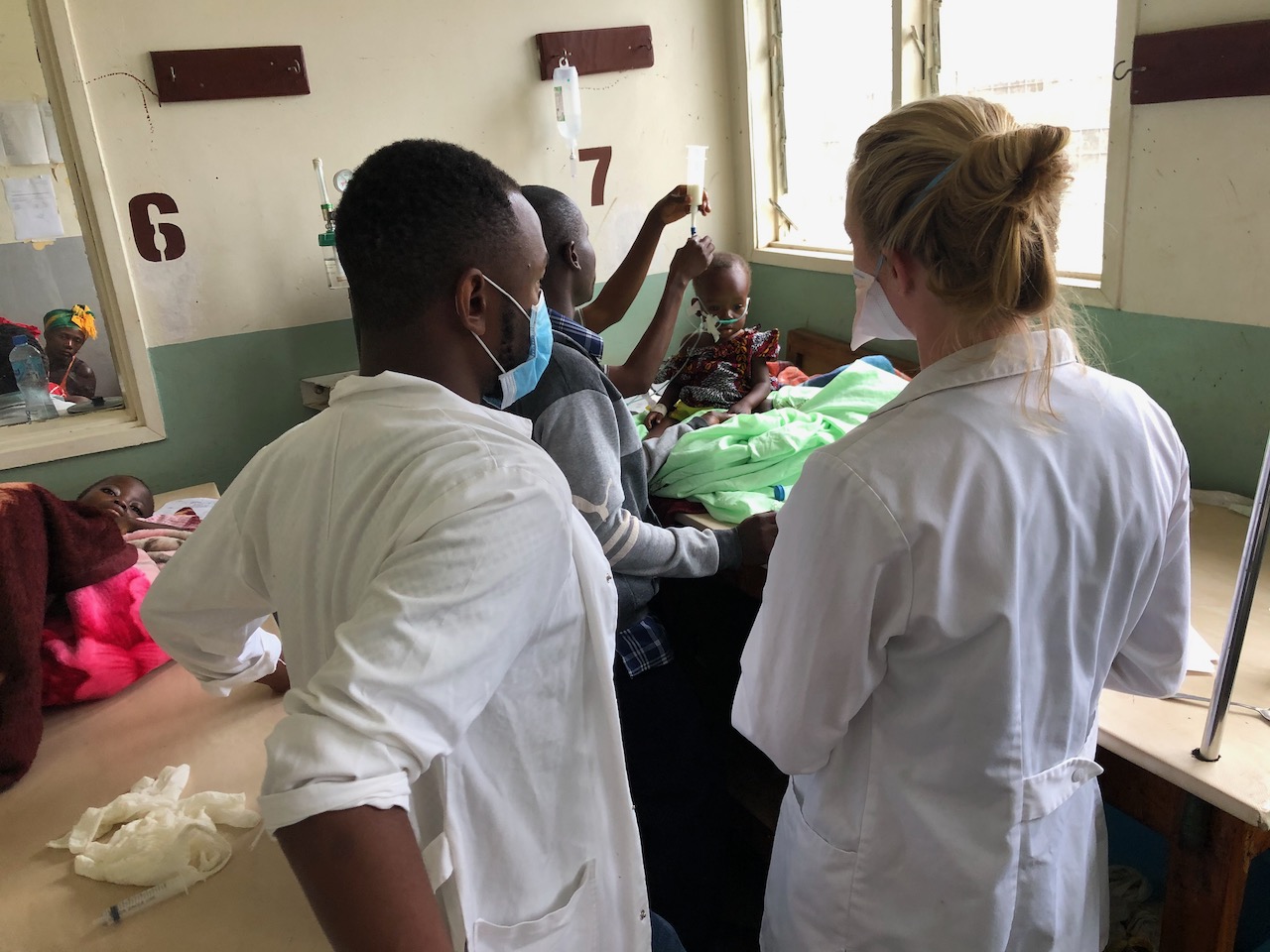
One way to play a good cameo role: teaching. Here Jessie is working with Ivan, who is almost finished with nursing school, about NG feeds for a critically ill child.

Just a pretty mom and baby who are unsung heroes, because this child survived being born 2 months early weighing just a few pounds and is now triple that at 7 months!

Listening. Serving. 

And in our story, besides coronavirus shut-downs, and economic roadblocks, we have also thought a lot this week about the police. In this context where behaviour is primarily driven by fear/power and shame/belonging dynamics, the guilt/law dynamic of just wearing a mask or not riding a boda because that was announced on TV a few months ago is not quite as compelling. Enter the police and military. Masks and movement suddenly enforced with uniformed and armed officers, using sticks to beat the non-compliant. Over the last week, even as the whole world marches against police brutality, excessive force, systemic racial bias . . . here in Nyahuka we had two opportunities to see the local system up close. We started the week debriefing with a close-to-us young man who accidentally hit a girl with his car. It was low-speed, in the rain, she ran out into the road with an umbrella pulled down over her head and didn't see him. Never-the-less, he spent the night in jail on the floor alone until he could raise money to pay the family for her thankfully minor abrasions and medical care, plus inconvenience, plus the police. We ended the week with Scott spending hours and hours back at the jail again, after we were tipped off that unauthorized persons were cutting down 20-year-old hardwood trees on the disputed Christ School farm land to sell as boards. We definitely received more than our fair share of deference as the party stolen-from, but it was jarring and uncomfortable for Scott to be put in the position of protecting the school's interests by watching a desperate young man suffer in jail. The field was not level; we had the power, and tried to walk a tricky cameo-role line of not extracting much from the thieves, but also not giving up school assets. Lots of advice was needed.

Perhaps the point is, to prevent power-blindness, you have to open your eyes. And when you open your eyes, it helps to be on a periphery, with people who are suffering, who can tell and show a story that we might otherwise miss. Of course living far from where you were born is no guarantee of being awake to reality, but it is a good jarring jolt that might start the process.

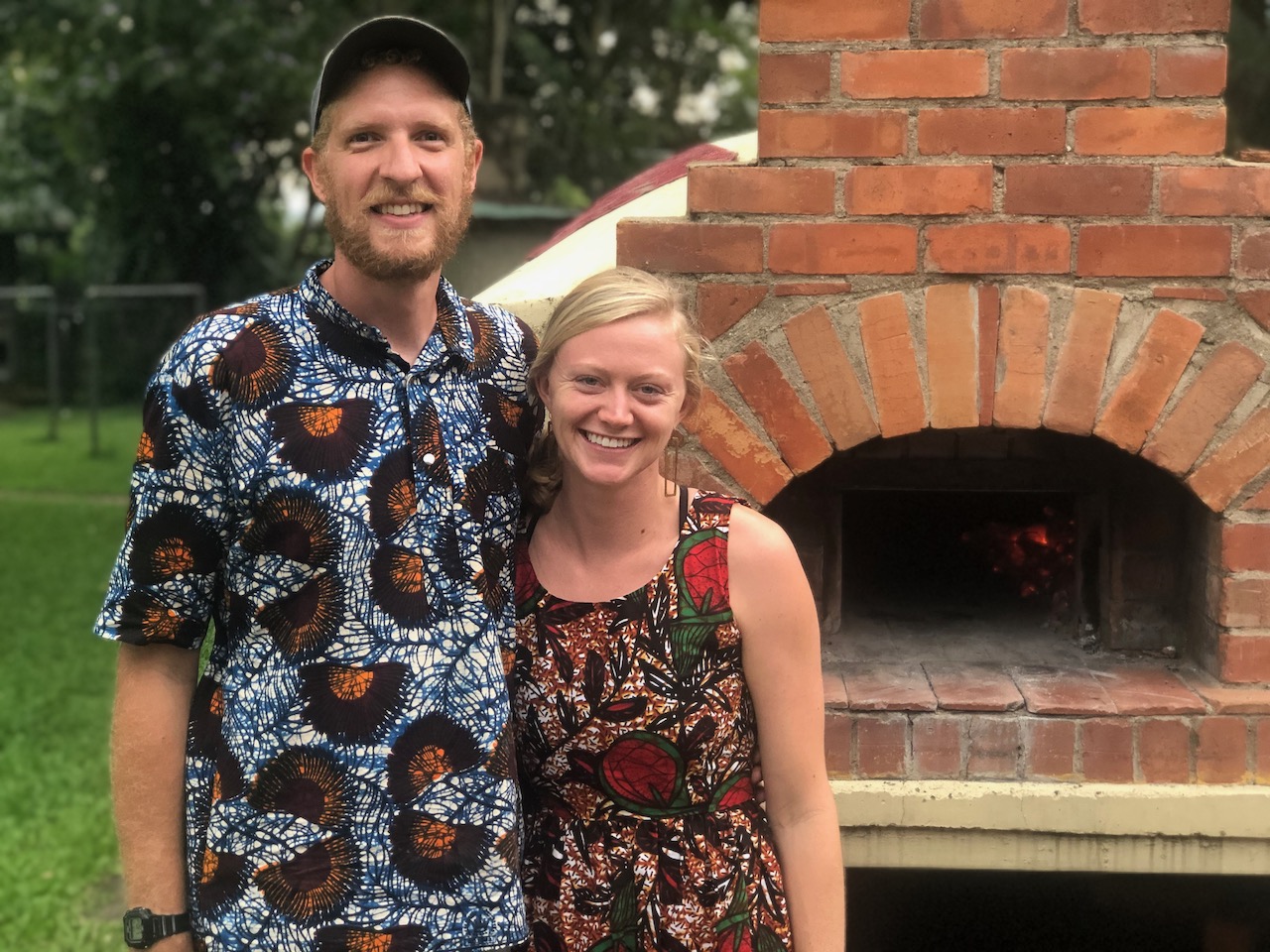
If you need a jolt, let us know. These two are leaving us bereft . . . finished their Serge Apprenticeship term of 18 months in project management and nutrition. Sorrowful to say bye.

We relaxed our isolation rules (since no COVID in Bundi and we've not left for 86 days seemed like a risk worth taking) to say goodbye. Here Anna is reading a sweet message of appreciation.

Photo Jessie took as we wrapped up, from in front of our house. Remembering the mercy of the Lord endures forever.


Sunday, June 07, 2020

99 sheep and an expanded heart: #BLM as periphery and pivot on #COVID-19Uganda day 79

Watching in awe as the world takes to the streets with the #BlackLivesMatter. And in some ways feeling disconnected from the crucial turmoil of the land of our birth, 1.9 million known coronavirus infections, 109 thousand known deaths, cities too numerous to count filled with popular uprising, articles and posts and advice and rage and prayer and lament and grief and hope.

But then I remember, our entire life rests on a foundational truth that Black Lives Matter, to God and to the world and to us. And that public health matters, that racism and poverty and disparity kill, that mercy and truth hold our hands and lead us forward.
We were both happy to get a treatable diagnosis, for an otherwise fatal disease (TB) thanks to the good work of our lab and clinical team.

The past week's view from the continent of Africa has been one of wrestling with the simultaneous sense of periphery and pivot point. 

Periphery, because the unseen forces that drive the response to malaria or sickle cell, or make policies about education or trade, or direct flows of minerals and resources, cannot be captured on 8 minutes and 46 painful seconds of video, even though they are just as deadly. Injustice personified has helped spark appropriate reckoning; but also could lead us to forget the pervasiveness of the problem. Periphery, because we live in the bizarre reality of being a minority and having privilege, working in a difficult unpopular job where we can be both targeted and excused. Periphery, because we learned from and invested in multiracial church and community in Baltimore and Chicago in our training years, but left that behind to come to Africa. . . . and now we are both proud and nostalgic to see the massive crowds demonstrating support for justice.

Pivot point, because I can see African posts that look at the 400 year theft of humanity from these shores as a grievous loss of progeny, an inexcusable disruption of the lineage, a dangerous untethering of souls. From a place where the patrilineal connection to ancestors is centrally important to identity and negotiation and culture and power, the idea that 12% of the USA population had that systematically destroyed by human trafficking and the subsequent stamping out of family ties by separating and selling children is unfathomable. Where are the elders, the nations, to speak up for the rights of these descendants? And pivotally too, almost every life we intersect and partner with and extend ourselves toward is Black.  1.3 billion people, 16% of the world lives on this continent, and the highest rates of growth are here. Much of the world may not consider Africa pivotal, but as the likely garden of human origin and the likely future centre of innovation and human flourishing, maybe it is.

So bear with us. A few thoughts in a crowded arena of processing. Because the best thing we can all do for each other is to share our true stories, to connect on a human level, to do the hard work of understanding diversity and embracing it.

And for some people right now looking at life, there may be a desire to position one's trajectory such that pandemics and politics find you doing justice, loving mercy, and walking humbly (Micah 6:8, the verse we chose for our prayer card). If so, this is what it might look like.

First, the humbly part. WE MAKE MISTAKES. In this decade or the next I have no doubt that our eyes will be opened more and more to the extent of the harms we have engendered. Money spent out of frustration rather than intentionality, judgement rendered harshly of difference, pushing of our own agendas. In the thousands of voices right now, ours and others will say the wrong thing because we are wrong. We have to acknowledge that. Humbly means listening and learning, day by day, our whole lives long. Humbly means working small-scale and unseen, one patient, one student, one neighbour at a time. Scott about a week ago described his job on the maternity ward as finding the one sheep out of a hundred that was not going to make it into the fold of life. I think that's a good visual of the war-zone like chaos of many of our hours. It's not glorious and often not immediately obvious that it is even helpful, but over time the little acts of healing accrue into redemption. I listened to a TED talk interview with the founders of #BlackLivesMatter, three women who started the social media campaign in 2013 after the killer of 17-year-old junior-in-high-school Trayvon Martin was acquitted of murder. In it one of the women said that justice can't trickle down by focusing on the haves, it must bubble up in effervescence by focusing on the have-nots. That sounds very Biblical.

37 days in the NICU and taking all three baby girls home. Triplet survivals are not common. Small unseen faithfulness of a mom, a family, nurses, cleaners, a well-wishing hat knitter, and a couple of docs.

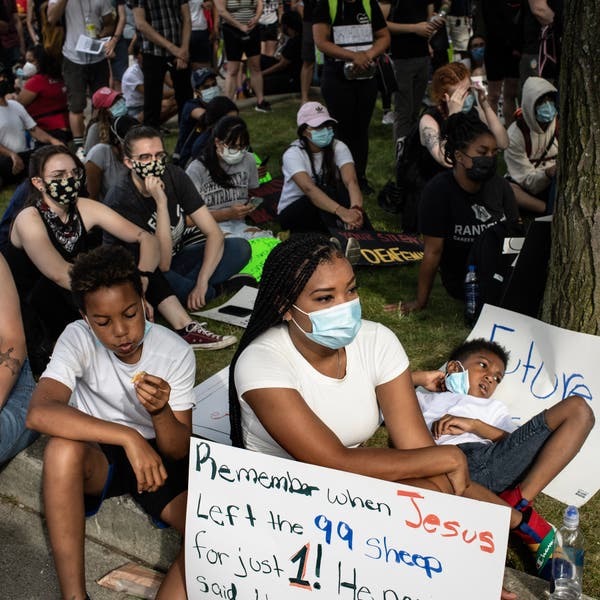
Apologies I screen shotted this off a news story because the connection to what we had been feeling was so perfect. Caring about the 1 sheep is what #BlackLivesMatter is about.

In the middle, loving mercy. A call to love in a time of sorrow is not simple. Here are the verses that have challenged me this week, from Psalm 119: 28-32.
My soul melts from heaviness;
Strengthen me according to Your word.
Remove me from the way of lying,
And grant me Your law graciously.
I have chosen the way of truth:
Your judgments I have laid before me.
I cling to your testimonies:
O LORD, do not put me to shame!
I will run the course of your commandments, 
For You shall enlarge my heart.
Loving mercy means, it is not just about what we do, it is about who we are becoming. As we butt our heads agains the walls of evil day in and day out, a weary heart can easily become cynical, cold, constricted. Honestly just about every day I end up pushed to the edge and beyond and my faith drops off into angry defensiveness. But in this passage, even though the poet is pouring out a melted heavy soul of grief, is struggling to choose truth over lies, is clinging to God and feeling the impending threat of shame . . . the hope is this: in the struggle, God will enlarge my heart. Rather than protecting ourselves from videos of aggressively violent police or from daily interaction with hungry and hurting children, let us run the course while God enlarges our hearts.
Sickling cells plug up the small vessels and lead to excruciating pain. It is tempting to minimize or look away, to quickly treat and move on. Today's Kate Bowler broadcast with Wes Moore said that sympathy is a love that sees pain and feels sorry for the other person, but empathy is a love that feels your pain as my own. That is a Spirit-gift that we need.


And most importantly, the primary goal of life according to the verse: DO JUSTLY. The emphasis, grammatically, is on the DO. I think that has echoed in many posts this week. Don't be performative of empathy, get into the trenches somewhere and get sweaty, take risks, hands-on with skills or willingness. Get trained. Get experience. Let go of safety nets. Whatever calling one has, look for that marginal place to bubble it up into redeeming change. Whatever metric one has for decision making, make sure the adverb JUSTLY applies. Missions could be another word for Reparations. Freely we have received, freely give, because there are places and people who have been pushed down by the forces that propelled us towards degrees and health. In this year of loss and reckoning, if you are thinking of where to put your shoulder to the plow, here is a good place to start.

A resurrection never gets old. Wednesday she had a heart rate of 200, was hypoxic and convulsing. Septic shock. The staff got her the right fluids, antibiotics and oxygen and on Friday she was just a cute little girl in a frilly pink dress. 

This team needs help. The Carrigan family (not pictured, medical and literacy) left a few weeks ago at the end of their 5-year term, and the Shickels (center photo, nutrition and project managing) are leaving in one week at the end of their 18 months. We are posing (with a little social distance) on Martyr's Day, a reminder of the rich history in Uganda of the Jesus Path, drinking the cup of suffering and finding the joy of redemption.


Sunday, May 31, 2020

BLM and Jesus and Pentecost and Protest: COVID-19UGANDA day 72, Easter Day 50 and out

If anyone has staked their life on the premise that Black Lives Matter, it is every mother, every doctor, every teacher, every missionary in Africa. That phrase is a particular situational paraphrase of the Gospel: For God so loved the world, God gave everything to defeat evil and bring us life. Human beings matter and the Bible over and over speaks about God's particular love for the oppressed, the imprisoned, the lame, the sick, the orphan, the widow, the poor. The signs of the all-things-new that Jesus promised will first be seen in the transformation that begins on the margins. That is justice in real time. Yet living out the day to day slog of work and chaos in a place where a billion mostly dark-skinned people and mostly poor people live and die seems far removed from the Black Lives Matter movement this week in America, the land of our citizenship and origin.  In fact 2020 has been one long year of watching America reel from one crisis to another.  Scott was born in Minnesota, and before this week I doubt either of us would have anticipated that state being an epicenter of injustice. But, it turns out, the deep wounds of our country are being exposed.

Which medically speaking, is a painfully necessary step towards healing.

Maybe the lock-downs of COVID-19, the particular availability of social media right now, created the necessary conditions for truth to get attention. Ahmaud Arbery a jogger filmed being shot by two men who assumed the right to judge and condemn him, Breonna Taylor a young medical worker shot in her bed in the middle of the night by police who raided her apartment looking for drug-dealing evidence which did not exist, the less violent but sharply chilling power imbalance in a filmed encounter between Christian Cooper, a bird-watcher in NYC, and the woman who used a 911 call to police to intimidate and threaten him with arrest even though she was the one not keeping the law, then the stomach-wrenching 8 minutes it took to suffocate George Floyd as he gasped "I can't breathe" and later "Mama" while 4 police officers, one kneeling on his neck and two others on his back, turned a misdemeanor arrest into a reason to kill. All stories in quick succession where people in power are white and assume their right to control people they fear and suspect, who are black. In 3 out of 4 cases, they wield that power fatally.

Today is Pentecost Sunday, 50 days from Easter, the moment celebrating abundance, harvest, fruit, that God chose to send the Spirit out to explode belief from one cultural group to all.  This is a day that showcases diversity of culture and tongue, ironically.

Our Sunday podcast happened to be from Genesis, we are on chapter 9, finishing up the Flood narrative, and as CNN broadcasts pictures of burning buildings and our medical kids in Utah prepare for mass casualties to add to the COVID-19 trauma, it didn't feel relevant. But it was. It is one of the PG-13 stories that get skipped in Sunday School, where the hero of the previous chapters ends up drunk and naked and angry, and curses one of his sons. The rainbow of grace and the fresh-start of earth don't even last a generation until one segment of humanity decides to condemn another segment to servitude. Somehow this story, rather than being one about the fragility of human heroism, the dark seed of sin we all carry and need to be rescued from, the human tendency to divide and suspect others, the generational misery of cursing and justifying violence . . . became a proof text for slavers. Europeans who wanted cheap labor to exploit the agricultural opportunities of the Americas began shipping Africans across the ocean and ignored the entire message of the Bible, choosing rather to see Africans as descendants of Ham who deserved to be crushed.  Greed and self-promotion at the expense of others, the opposite of the message of carrying blessing to others. Lord have mercy, we are all guilty of that.

And because the national entity of the USA rests at least in part on this foundation, no matter how much we want to cover it up, the wound is not going to heal without light.

Our former pastor from Lawndale in Chicago posted a quote from the Rev. Martin Luther King, Jr., today, that helps explain why the riots of our childhood (I remember driving through Washington DC and seeing the boarded up and broken shops in 1968) and the riots of today make some sense:

"Let me say as I've always said, and I will always continue to say, that riots are socially destructive and self-defeating . . .But in the final analysis, a riot is the language of the unheard. And what is it that America has failed to hear? It has failed to hear that the plight of the Negro poor has worsened over the last few years. It has failed to hear that the promises of freedom and justice have not been met. And it has failed to hear that large segments of white society are more concerned about tranquility and the status quo than about justice, equality, and humanity. And so in a real sense our nation's summers of riots are caused by our nation's winters of delay. And as long as America postpones justice, we stand in the position of having these recurrences of violence and riots over and over again."  Dr. Martin Luther King, Jr., 1967

Fast forward 40 years; here we are again.
Rewind 2000 years; we've been there before.

Jesus cared about the foreigners whose space in the outer courtyards of the temple was filled with money-changers, cared about the oppressive economics of temple-as-market that hurt the poor. So, in John 2, his opening miracle of water-to-wine prefiguring a feast, is immediately followed by a one-man riot. He takes a whip, turns over the tables, and drives everyone out. Property was definitely destroyed, money was definitely lost. But Jesus' priority in this story was righteousness and justice and access to God, instead of merchandise. He was speaking the language the unheard speak to power. And it cost him his life.

None of us can protest like Jesus. All of our attempts to redress the structural evils of this world will be mixed with mistakes, pride, power. Our daughter's roommate works for a small start-up socially conscious restaurant in Greensboro that employs people with disabilities. They were looted last night too. That is also sorrowful.

No easy answers here. Injustice that has been festering for a half millenia won't be drained in a weekend, or a week. But we do have to ask, is order the pre-requisite for justice, or justice the pre-requisite for order? That's a question that requires dialogue not force, leadership from the highest levels not police and citizens fighting street-to-street.

And that's a question that requires us to zoom out from the details of which shop is looted and what any individual's criminal record was before death. If we ignore the history that stretches back to slavery, even to Noah, to creation, we risk plastering over the putrid wound which will only mean a more difficult surgery later.

Yesterday we climbed up to the ridge that dominates our south-eastern sky. We live on the edge of the Rwenzoris, but we mostly only see them as a dark backdrop, sun on peaks, folds with clouds. It took hours to ascend the 5000 feet from the valley to the ridge. Small dirt footpaths, clusters of homes, curious children, occasional greetings, breathless effort and heat and aching legs. Step after step. But at the top we entered the northernmost edge of the park that contains the nearly 17,000 foot peaks. We were only at 8300 feet, but that is high enough to leave all of our day-to-day behind. We entered a completely alien alpine biome of bamboo and tiny orchid-like flowers, of blowing wind and cloud, of the grunts of colobus monkeys and the singing of unseen birds. Because we are locked down in our district, we had to turn around at the top and walk back down. Soon we left the cool heights behind, and were back in banana trees and bean fields, heat and hassling. Aching legs stumbling, sliding, thirsty, hot, conspicuous, donning masks whenever we passed a home, then gasping for breath between houses. This is where we live, in the lowlands of sick kids and being spectacles, of people who are hungry, others who are drunk, of closed schools and inadequate medical supplies. But the day was a physical reminder of the rhythm of life. Keep walking the dirt paths in the villages of real people with real problems and real joys; sometimes climb up to the strong winds of God's presence blowing in something new. And then go back down.


What is God doing in 2020? We won't know until we can climb out of it and look back. But on Pentecost let us hope the Spirit is opening a new chapter of justice. Let us pray that the intersection of a new virus, a new vulnerability, a new dependence upon each other . . . . with a new awareness of the pervasiveness of abuse of power, inequity, loss, will lead to something new and strong and beautiful.

Thursday, May 28, 2020

Angry About the Plant: Nineveh, Minneapolis, hidden hearts and #COVID-19UGANDA Day 69 and Easter day 47

Then God said, is it right for you to be angry about the plant?
(Tamar Messer Illustration)


A little background. Jonah once received a very direct word-of-the-LORD, directing him to preach truth in a major Iraqi city teaming with all sorts of people and practices his own culture considered outright wrong. He was famously reluctant to go, took a ship sailing in the opposite direction, encountered a massive storm of God's mercy which threw him into a death-and-burial like fish-belly experience. He recognised the disaster as rescue, repented, prayed, found himself spewed out on the beach and trekked off to the despicable Ninevites. His apocalyptic warnings found a shockingly receptive audience, so that God relented from disaster and saved a couple hundred thousand people. Jonah watched the non-destruction event from the shade of a vine which God provided as he sulked in the desert. When the vine withered, Jonah despaired. So God asked, is it right to be angry about the plant?

And Jonah replied, yes.

There is so much in this story that is relatable to the 2020 COVID-era missionary. For many of us, the constricted state of the legalities of our current existence feels like a burial. Food, social interactions, work, the future, any plans, any relaxation, any travel beyond a mile or two on foot, has strict limits. We are separated from our people, dreaming of Tarshish and grumbling on the dunes. Most of us haven't noticed the local government declaring a state of repentant emergency with universal sackcloth, but we do see a global openness to paring down to essentials. People are re-considering their lives, inside out. Spiritually, our staff prays with sincerity as we struggle to come to terms with a world that is beyond our control. Tomorrow will be 70 days in this state which surely sounds like a Biblical number. A lot of what we learned early on and started preaching: masks, distance, screening, hygiene, has become routine. The strictness of Uganda's lockdown has kept cases very limited. Even the too-little-too-late lockdown places have staved off the worst case scenarios.


And yet . . . like Jonah, rather than being delighted, I feel cheated.

This week it hit me: what is my plant? What is the shade that God gives to which I so quickly feel entitled? Which seems more important than the fate of 120,000 persons who don't know how to tell their left hand from their right (children), not to mention the livestock (last verse in the book)?

And as soon as I let my heart be real, the answer is clear. I'll trek to Nineveh . . . . as long as I can count on my shade-flights to see our kids and our moms once or twice a year.  For others I know the shade-plant is different. Driving in a car at will. Accessing movies or ice cream or anonymity or a break. Leaving the district every 8-10 weeks. Having family visitors, having summer interns. Electricity that works. Friends. Good things, these desert plants. God-given things. Sabbath-consistent resting things, many of them. It was not wrong to appreciate the plant; but God graciously withers it to allow Jonah to see his entitlement.

The ancient story, with all its fantastical details, rings relevant. Jonah, and we, want to see ourselves as prophets, want to be right. We want to enter, preach, exit. We want God to affirm our approach with something dramatic that vindicates us. And while a bit of discomfort is certainly expected, it shouldn't be too much. We need some shade after all. After all we've given up, surely a plant isn't too much to ask?

When the plant disappears, our anger is a symptom that leads to a diagnosis. I want to keep God in my box, set my limits, keep a bit of control.

But God is wind, is storm, is disruption, is mercy. Not just for Nineveh, but for me. The shrivelled plant, the beating sun, the questions, become an opportunity to crack open a hard heart, to lean into grace. To see that God actually loved the animals and children of Nineveh so dearly. To see that God was so deeply grieved for the suffering and sorrow of all of Nineveh that he was willing to shake things up for them. And then God was not content to leave Jonah in his self-righteous pout. God was also willing to shake things up for Jonah.

Where is this story playing out this week around the world? Minneapolis, for sure. The comfortable narrative of a progressive place has been upended by a policeman and his knee. God is shaking things up there. And if we don't let God scorch our ethnocentric assumptions, that's where we can all end up. Better to be stirred to anger now, than to be cocooned in our superiority in such a way that we end up seeing each other as sub-human, calling the police, feeling threatened by law-abiding bird-watchers, ignoring a cry of "I can't breathe."  I've seen this graphic on a few different sites:
The story of Jonah is the story of our hearts. Socially acceptable supremacy of culture, of skin, of privilege, of education, of wealth. Any of us could end up being the police man who thinks he is justified in his use of force to get his way, who thinks the being he is holding down doesn't need to breathe. Lord have mercy and burn some plants, lest we find ourselves now or in a few years or decades literally or metaphorically crushing a person of colour to get what we think we need.

I want to get back to see my people sometime, and sooner feels better. But surely the 120,000 children around me are just as important to God as my travel plans. Surely it is better to have a soul that stays attentive to injustice and to evil than to have comfort. Surely it is more of a mercy to be shaken awake from our entitlements than to become a person who steals another's breath.


Saturday, May 23, 2020

Lessons from the Margins: #COVID19-UGANDA day 64; Easter Day 42


"Know that Christianity is always changing at the margins more profoundly than at the centre, and position yourself accordingly. Know that churches or movements with no input from the margins will die."

The author of Global Humility bases the above argument on a pattern of stories where God uses the weak, the foreigner, the last-born, the poor to speak truth or save the day. We read this the same week that our president here in Uganda announced a slow beginning of re-opening, with the staged return of some shops and limited transport. However, in his plan, he excluded the border districts (39 out of 134). All the countries around us have many more cases than we do, perks of living in a harder-to-reach place with a strong public health system/authoritarian government. To make sure everyone knew the border districts, since some only have a small slice of border, this photo was released:
If you look closely, it is a striking visual of what it means to be marginal. We're Bundibugyo, half way up the left side.

Living on a margin carries some heavy implications. Risk, for one. We border the country with the only active Ebola epidemic and the largest number of displaced people due to conflict during the COVID era (480,000). Inconvenience, for sure. Only a small percentage of foods, medicines, goods that are available in Kampala are sold here. All our legal and administrative business requires 8-hour trips and overnight stays.  Stigma, too. When someone in Uganda wants an example of a place that is difficult, Bundibugyo comes up. The idea of being last educationally and economically seeps in. Scraps, the left-overs, are our staple. The margins do not get the main share of the country's opportunities. Certainly we're feeling that right now: we still cannot drive, cannot leave, will have major challenges even re-opening Christ School for the seniors which is allowed to begin June 4.

And yet.

Everyone wants to be resilient, but on the margins one learns that resilience is born out of hardship and limitation. The margins have to be gritty, have to be creative, have to collaborate locally. The margins are less invested in the status quo, more open to change. And the margins, Jesus says, are loved by God in particular ways. The widow and orphan, the poor and oppressed, are mentioned over and over as the inheritors of the Kingdom. The first shall be last and the last shall be first. The Kingdom belongs to such as these.

This has some practical implications on which one can stake a life.

  • Grace at the Fray, the Serge motto, means that if you're looking for the Spirit, for life, for outpouring of mercy, then head to the fraying edge. Glad to be part of an organisation that takes this literally. 
  • If you find yourself on such a margin, don't despair. Look for the unexpected. Jesus was born in a cave where animals were sheltered, not a 5-star private hospital. 
  • And if you don't find yourself at a margin, pay attention to what the margins are showing the world, what the poor are saying, what those with less power see and know.  Read widely. Make friends with people whose life experience gives them a view that might change your own assumptions. I learned the term "narrative violation" this week, and I think that is what art and literature at their best can offer. Most of Jerusalem's power brokers saw Jesus as a troublesome crowd-rouser who broke the rules, mixed with the wrong sort, threatened a way of life, and was justly disposed of. But the women who came to the tomb at Easter saw a gardener who knew their name and quietly reversed death. Both stories circulated; we still have to choose which to embrace.
Back to the photo at the top.

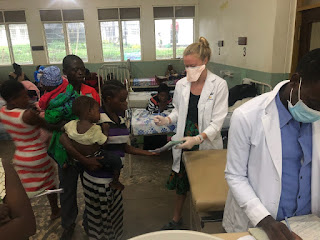
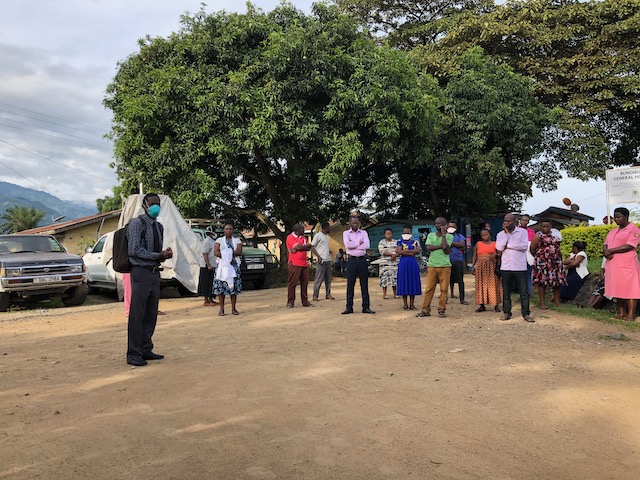
That's the morning gathering of staff at our local government hospital. They are making about $5-$10 a day, and that's considerably more than the average citizen but hardly enough to pay for food, electricity, transport, clothes, school for their extended network of dependants. Yet there they are, day after day, grappling with how to care for the never-ending stream of patients, with the too-soon-ending supply of medicine and tubing and electricity. And in this photo, everyone is smiling under those masks. Because our team in Fort Portal, Jenna and Pat, had their Green Leaf Crafts women's sewing coop make a couple dozen masks to donate to hospital workers. These arrived just as the hospital was completely out of surgical masks, and the leadership had to shut down access to our donated N-95's because they were leaking out to the streets. A nice re-usable cloth mask costs a dollar or two; a simple one being made on the street costs less than fifty cents. But that cost is a barrier and so yesterday morning there was rejoicing. Masks were made mandatory in Uganda, and we know they are necessary in the hospital. This is a photo of people who know that it makes sense to take precautions, and who are grateful to be able to do so.

Contrast that with the growing politicisation of mask-wearing in some countries. Rather than being thankful for a way to protect others, we see people demanding their "right" to be a public source of harm. Suddenly wearing a mask is equilibrated with a whole host of political leanings rather than being a universal sign of kindness to society. Looking from the margins in, we note people videoing THEMSELVES in Costco without masks as if they are freedom-fighting heroes, and it frankly looks absurd. Marginal places that have fought COVID-19 successfully have relied on these basics:
  1. HYGIENE: Washing hands, again, and again, and again. This includes cleaning surfaces and using hand sanitiser.
  2. SCREENING: Staying home if you are sick. Not allowing sick people to come to work. I really can't believe the videos of people purposely coughing on each other!! Though I suppose in a universe where people find it their right to shoot each other it makes twisted sense. But really, we are in an epidemic of a disease that just put a friend of ours in the hospital with a whole-body rash, a blood clot, low blood pressure. She's a nurse and way younger than I am. This is real. Our pastor's family's school colleagues have TWO CHILDREN IN INTENSIVE CARE from coronavirus on maximal life support. How can you want to cough and spit and sneeze when you see body bags stacking up?
  3. DISTANCING: stay at least 6 feet apart, 2 meters, though Uganda changed that to 4 meters in some situations. If you do your visits outdoors with breeze and sunshine, the risk plummets. 
  4. MASKS: when you can't stay far apart, when you're in public, when you're working in closer quarters, wear a mask. This protects others, and is particularly important because this disease has a peak of infectivity just before symptoms start, and a huge under-the-surface iceberg of infected people with no symptoms at all. When I walk to the market with a cloth mask on, I'm not really protecting myself so much as protecting others in case I HAPPEN TO BE on the verge of illness. 
Back in March, we read about the above making an impact in Singapore, and started all four of the measures in Bundibugyo. We bought sanitizers and invested in bleach for the hospital and mission. The hospital set up screening at the gate, with temperature checks and questions, and we did at our mission too. We started holding our staff and team meetings outdoors standing or sitting far apart, and suspended the activities where this could not happen like church and school. And we started wearing masks all day at work, every day. Now we also wear them in public, everywhere we go. These are measures that low and middle income countries around the world have embraced. Marginal people know they won't get on a ventilator, they won't be on an experimental remdesevir protocol, they probably won't even get oxygen. Marginal people know that they have to take some steps that are sacrificial for the long-term good of their elderly relatives, for the communal good of their clan. 

So here, on the margins, you see people trying to comply. Here, the the problems we hear are that people are out of soap, can't afford to buy more. Or struggle to pay for those 50-cent re-washable cloth masks. Here we hear about thieves stealing someone's crops right out of the garden, or taking their chicken at night, not about their demand to buy beer with an uncovered face. Here there is evil and need and breakdown and sorrow, but there is also a strong will to survive, a determination to do what we can to make it through. The president here begins his addresses now with his mask on as an example, and has everyone around him spaced out in 6-feet increments and all wearing masks as well. Public figures sense the need to pay attention to the facts, to lead in practice as well as in words.

Uganda is projected to have 6 million infections, 122 thousand admissions, and 2600 deaths . . . though the continent-wide impact could be up to 250 million infections and nearly 300 thousand deaths. Not as bad as malaria; but malaria won't stop for COVID either, so this will nearly double the toll. All to say, that here in what the power/wealth centers of the world looks like a margin, our public health measures aren't going to spare us completely. But they are going to soften the brunt of the blow. And organisations like ours and many others are buying more oxygen capacity, helping people who have no safety net living day-to-day in informal urban settlements buy food, procuring masks and soap, paying staff as a matter of justice even in times of economic slump.  There is work to be done for sure, and we have a long way to go. But there is hope too, in listening to the basics and enacting sturdy measures. (Yes, the population is also younger, but please don't tell me that as an excuse. A young population to Western ears where the culture is obsessed with youth, beauty, health, immortality, fitness, sounds enviable. In reality it means that people die earlier of other things. Once you are born, you will eventually die, so if most people are young that means that most people who are born aren't making it to 50, 60, 70 and beyond.)

Atul Gawande, a prolific surgeon and writer associated with Harvard in the USA, writes about the measures that work and adds a fifth: a change in culture. Because hygiene, screening, distance and masks all boil down to behaviour, and behaviour is driven by belief. On the margins, people see death up close and personal, day in day out. We have lived through Ebola here. We have lost those we love. We know that virae are real, deadly, and passable from person to person. We believe in protective barriers and limitations to freedom for seasons, in order to fight a disease. 

By reading, following, donating, you are positioning yourself here in the margins with us, and we are grateful for your prayers. In turn, we pray for culture change in the center that will save lives, build bridges of unity and empathy, and bend the arc of our collective story towards justice as Jesus promised.


Tuesday, May 19, 2020

Complex Proximity: #COVID-19UGANDA day 60, going on 600

"Proximity helps us to appreciate complexity. It begets empathy. . . prohibits simplistic solutions.. . causes us to be emotionally invested in the issues. Proximity, then, should be a priority. Mission that is not up-close-and-personal is inadequate." (McCullough, Global Humility)


The call to prayer echoes in the darkness, moonlight on the mosquito net. Fighting this rhythm is a losing battle so we embrace it and stretch to meet the day while it is still the cool hour of stars fading, the outline of palms against the greying sky. A bit of routine anchors the day: exercise, Bible reading, coffee, prayer, breakfast, quick check of news and communication, then out the door. Masks on. We have a permit to drive the 8 miles to Bundibugyo Hospital, with maximum of 3 people in the car. Ivan, a final-year nursing student who grew up with our kids, usually waits just at the road to ride with us, as we open and close the gate to keep our rambunctious dogs in the yard. The mountains are clear, sharp, jagged. We used to see snow routinely on the peaks. This year, none so far. But the way the road hugs the ridges that flow into the valley turns us towards the mountains as we climb, and I always think of Psalm 121, my Dad's favourite.


The 8 am staff meeting trickles to a start as we park in the dirt lot in front of the administration building. We stand a meter or two apart in a semi-circle. A different staff member is tasked to chair the meeting each week, choosing someone to offer the opening and closing prayer, asking for the night nurse's report. 15 admissions to Paediatrics, one death, total on the 25-bed ward is 55 or 63 or whatever the day holds. 5 C-sections over the last 24 hours. 8 babies in NICU. 25 on male ward, and can one of the doctors please review bed 17? And so on. Then there is open reaction, and inevitably, the tenor is this: we couldn't give medicines because the key was missing, there is no more artesunate, we couldn't call the on-call doctor because we had no airtime, we are out of guaze, there is no sterile gown for the next surgery, there is no suture, can we please buy a bulb syringe because we almost lost a baby for lack of suction, we are out of A+ blood. This entire system hangs by a million fragile threads. Matters of a few dollars are life and death. There is so little margin. Yet I admire the process, the attempt to build teamwork, the value on every person being heard, the courage to plug on in spite of a thousand barriers.

From there we disperse to the wards. Scott begins seeing all the women on maternity. I start in NICU then move to Paeds ward. At times we are alone, doing vital signs, getting history, examining, writing notes. Squat and lean over the patients on the floors, stand and discuss. Scott lugs the ultrasound and a bp cuff, I have my hand santizer and a bag of gloves, a pulse oximeter. The masks make communication even more frustrating. At times a student or volunteer tags along, helpfully filling out lab forms, repeating my instructions to help moms understand. Most days our colleagues Dr. Isaiah and Dr. Ammon come in and out, as we choose the busiest wards and they know we need help, but they are also pulled to this politician's sister and this staff member's grandfather. I try my best to note the sickest first, but inevitably I find a child severely ill on my last section of beds. Or a nurse brings in an actively convulsing new admission. My methodical march through the ward always takes turns and detours. Scott ends up with a C-section, or does extra ultrasounds. Jessie and her team point out a child from their nutrition office who needs labs, or who is not improving. I call Dr. Isaiah or Ammon for advice, or the lab in-charge to find out if the machine for bilirubin happens to be working today. I try to focus on each kid, say a prayer as I listen to a chest, not let my mind wander to the next problem, be alert to a clue of a rash or a paleness or a story that doesn't quite fit together. As I see patients I direct them into a small room where nurses sit and inject our limited options, either an antimalarial or one of two antibiotics. Others go into the opposite side room and get tablets for going home, others are given therapeutic food from the nutrition team. Others are placed on one of the three tables in the front where they get a blood transfusion, or some IV fluids, or oxygen.
In the late afternoon, I am toast. It is hot. The masks make it feel suffocatingly so. There are always more problems than we can manage. By 1, or 2, or 3 we wind down, perhaps we run to the pharmacy to spend $20 or $30 on stop-gap medicine measures, to buy ng tubes or ORS. Then it is back into the car, switching the N-95 mask for the cloth non-medical mask. I let my N-95 bake in the sun of the dashboard as I will reuse it for at least 6 days. More alcohol swabbing of everything. Uganda cases are almost all truck drivers at this point, but the march of the virus through Africa is inevitable. The WHO expects 250 million cases. It is hard to imagine.


Back at home, we often have a scheduled meeting, in person with a team mate (socially distanced outside!) or by facetime or other internet medium with a team leader around our area. Today Scott and Patrick spent hours pouring over budgets, because the schools have permission to open in two weeks ONLY FOR THE SENIORS . . . we struggle with the justice of paying our staff, verses the financial reality that every month we lose $5,600 because parents are not paying tuition. When we bring back just 1/6 of the students, continue to pay staff, and resume providing meals for everyone, the losses will continue at about the same pace. The reality of coronavirus never quite recedes to the background. Not just the finances. The masks, the curfews, the limited movement. The uncertainty. Will we ever be able to bring the rest of the students back? What will this mean for the longterm education of this generation? As frustrated as we are with all of that, coronavirus also hits home personally. We listen to a nurse friend tell us about her diagnosis of COVID after her brave few weeks of work in NYC. She has a full body inflammatory rash, a racing heart and low blood pressure. Coronavirus is not just about inconvenience and politics. It is about the random but real young healthy person who develops severe symptoms and lands in a hospital bed. Pray for Allyson.

In the evening we were about to zip down to the market town for milk, but as we come out of the gate, we spot a Great Blue Turaco and have to stop and watch. In the past week we've also seen a crested eagle, and a hornbill. Scott waters the garden and I scavange for dropped mangos and avacados under the trees. All our shopping is on foot, unless a team mate has organized a small cargo delivery from Fort Portal. There are phone calls with moms and kids and sisters, news, or catching up on the latest rules from the President, or preparing for the next day as we make dinner and wind up the day.

The needs of Bundibugyo and the joys of Bundibugyo are complex. They are intertwined. And impossible to understand from a distance. Only by walking through a day, and another, and another, by touching the sick, fumbling with Lubwisi under a mask, praying with a team mate, strolling in the heat to buy tomatoes, answering another knock from a person with a problem, figuring out how to improvise when the incubator doesn't work . . . only by being right in the mire of the world do we get to be on the front row for redemption. 


Sunday, May 17, 2020

The Wind at Your Back: #COVID-19 day 58; Easter Day 35

Four years ago we were heading into our previous company conference, from which we would leave a bit early to attend Caleb's graduation from the USAFA. President Obama was his graduation speaker. Yesterday, Obama spoke online for the class of 2020 collectively, a generation of students leaving high school and college at a fragile time. So it was with a bit of nostalgia that we listened to both versions of his address. Much of it was vintage wisdom of the sort one expects from our leaders, tempered by the truth that no one truly knows what the rest of 2020 will bring, or how profound the impact of this time will be on the world our graduates inherit. He told the high schoolers to have courage, to stick to their values and do what they know is right, and to do that in community. He told the college grads a similar thing: be grounded in real local actions, work with others, seek justice for everyone. To all that we can say, AMEN.
Dr. Isaiah graduated last year, and nurse Ivan is due to graduate in June . . may we have grace to let THEM plan the new NICU care!

Already we can sense a deeper awareness of the smallness of the planet. We interact with our natural environment at seven billion points, and this time the point where a virus jumped species happened to occur in China. Last time it was the DRC. Next time it might be Brazil. The interconnectedness of humanity carries promise as well as potential disaster. And the impact of such disasters is not felt equally around the world: the poor suffer disproportionately from climate effects, from disease, from recession. Obama's points about global thinking and virtual access needing to be combined with local action and community rang true. All change starts with real people and places, with problems being identified and solved in specific locales and times.  We are better when we sharpen and push each other. No one gets to graduation day without help, and the best changes are ones that are refined by others. I hope his words are heard this weekend as a call to hope. And a call to thoughtful engagement with the world. Nothing beats proximity for building empathy and ideas. We need graduates to take risks and reach difficult places, to let the hard days spark ideas and faith. We can use many of those with us in Serge.

But it was his final phrase that stuck with me today: as you set out to change the world, we will be the wind at your back. 

I'm just a year younger than our former president, and I found that encapsulation of our generation's role to be poetically succinct. It is our children who will reshape the post-COVID world. They are already restlessly aware of inequality, of the shallow promise of unfettered greed. They are already thinking about what makes a service essential, of careers that have been necessary when things fall apart. They are already on the front lines of risk, and thoughtfully seeking community.

The wind at their back. The spirit blows where it will. Let us have the graceful humility to empower the story whose plot-line is shifting to them. Let us encourage, enable, inspire, cheer.

Because isn't that how God works for us too? A still small whisper, a bruised reed, an invitation. A wind at our backs that sent us out here to the frayed edge, a breeze that directs and refreshes but does not force. When the seasons change here, the wind blows. Let us be part of that change without needing to control it.


Thursday, May 14, 2020

Of Floods and Thrones: seeing God in the chaos (#COVID-19UGANDA day 55; Easter day 32)

A week ago this morning, foaming walls of water crashed from the Rwenzoris down into rivers on both sides of the range. People in Busunga, on our DRC border, awoke in the night to the sound of water and chaos, and grabbed their kids to move to higher ground. By daylight we joined thousands of others to go and see what we could do to help. By the end of the day, our administrator John had already enlisted Christ School graduates to canvas the affected area home by home, enrolling those who had lost the most. We learned a lot from our work with the December flood response. This time it took some extra steps for permission to travel and procure relief supplies because of COVID lockdowns, and to organize a bit of protective social distance into the distribution. But letters were granted, a truck arranged and filled. Monday night we were lugging mattresses and bags of rice in the dark into our long-closed community center, stacking items in the darkness. Tuesday clean-up and preparation, and Wednesday (yesterday) the joy of giving it all away.


We are called to be the community of care that makes suffering possible to absorb, an apt phrase from Hauerwas quoted by Eric McLaughlin. Here is a bit of what that community looks like. First, the neighbours, the general population that hears "flood" and thinks "go towards the crisis." That caught our attention, so we went too. You have to bear witness, to be present. Nothing replaces actually walking into the mud and water, actually seeing the rushing power, talking to those who lost their livelihoods. Second, the team including our handful of Ugandan staff like John, with can-do organization and ideas. Third, the broader network of Christ School alumni, young people with whom we had 4-6 years of mentoring, who have developed hearts of service and are willing to wade in with us and work. Fourth, the great cloud of witnesses in the literal icloud, the global community of the prayerful, who in the midst of their own pandemic see pictures of devastation far away and want to help. Because of first-responder generosity, we took the immediate six thousand dollars that came in and borrowed nine thousand from our other funds and approved the aid package. Six days post flood we were able to give each of 125 families a new mattress, bed sheets, blanket, plates, cups, cooking oil, beans, rice, and even a bit of cash to hire a motorcycle to drive it the 8 km back to their home.

If you would like to join those first-responders, please help us make up the rest. I contacted the initial 21 donors last night, and found several widows on limited incomes, students, a person working two minimum-wage part-time jobs who decided to donate their government-stimulus check because unlike many others, they had remained employed as an essential worker. We're not talking about people giving out of excess of comfort, we're talking about real sacrifice. The community of care, layering through multiple crises, stretching around the world. Missionaries living proximate to see and connect and act, local people with the willingness and skills to get things done, donors with hearts to participate. And then the recipients, who get to see love in action. We all need each other.

The sudden devastating force of unstoppable water that upended hundreds of lives last week is just a visible form of the same kind of frightening danger that spread around the world this year as a coronavirus too subtle to see. This morning, 4.3 million known cases and almost 300,000 deaths; when all is said and done the official toll numbers probably will represent only a fraction of the true picture. We can feel paralyzed by the enormity of the situation. Yet two things remain true: God is still bringing the Kingdom to come, good to be done, here on earth. And God's people are the primary means by which this happens, as grandmothers stay isolated in spite of loneliness and nurses work long risky shifts and all of us pitch in our resources to help our neighbours near and far.

I've been reading quite a bit in Psalms, and this week both 29, 32, 69 and 93 all mentioned floods. I would imagine that the topography and climate of gullies and hills and storms would mean the force and destruction of uncontrollable water was something people would have experienced, and an apt metaphor for the powerlessness we feel in the face of forces beyond our control. The point of the picture: these are not beyond God's control.

The voice of the LORD is over the waters; 
The God of glory thunders;
The LORD is over the many waters.
The voice of the LORD is powerful;
The voice of the LORD is full of majesty. . . 
The LORD sat enthroned about the Flood,
And the LORD sits as King forever.
The LORD will give strength to His people;
The LORD will bless His people with peace. .  . 
The floods have lifted up, O LORD,
The floods have lifted up their voice;
The floods lift up their waves.
The LORD on high is mightier 
Than the noise of many waters,
Than the mighty waves of the sea.'

Let us, by faith, affirm that the mighty roar of waters cannot dethrone our God, nor can the destructive seep of the coronavirus around our planet. We have help in high places. In fact we are staking our lives upon it.

(Watch the short video of the distribution here to lift your spirits today: link here)

Saturday, May 09, 2020

#Bundibugyofloods ROUND TWO (also #COVID-19Uganda day 51 and Easter day 29): A COMMUNITY OF CARE IN THE FACE OF EVIL

Torrential floods raged through 122 homes, link here to help, full story below.


Thursday we were awakened in the wee hours with the thundering sound of heavy rain on our corrugated metal roof. Before dawn, there were dozens of groups of people on the road, unusual in any time but particularly in this time of restriction and curfew, a buzz of talking and movement. I went out and talked to neighbours and heard the news: floods had hit us again, this time a flash flood of the Lamia River which descends from the Rwenzoris and forms part of our Congo border.

By full daylight Scott and I had driven the 8 km to the border to see what had happened, encountering literally more than a thousand people along the way. The absolute instinct of this culture is to gather towards loss, to move into the place of grief. Some of that is related to the interconnectedness of family-clan-tribe; it is not difficult for most to trace a line of relation to a person. Some is a spiritual drive to be on the side of the victim not the perpetrator. Some is human curiosity. And some is the fact that after 50 days of lockdown a remarkable number of people are willing to walk 8km to be together.
The video shows what we found Thursday morning. Our border river flows down from the Rwenzoris, and the mountains had heavy rainfall. Seasonal variations affected by the increased temperatures of the world, plus population growth with clearing and farming reaching higher elevations and lowland bogs or wetlands being filled . . .means that a massive rainfall on the mountains resulted in torrential river flows on the north-west side (us) and south-east side (Kasese). The Lamia river diverted upstream into two, and one branch flowed right through Busunga town. Unlike the December floods, this one was not a landslide on a steep slope (no destructive rocks tearing down houses), it was a raging river of mud and water sweeping through. Because of the area, 50% more homes than December were affected, but with less loss of life and structure. One UPDF soldier patrolling the border was swept away and drowned; we saw his body being carefully repatriated from the Congo side over the bridge. Others were missing, but I have not heard of more deaths. Miraculously people heard the water and moved their children to higher ground.

One reality of poverty is that property is often on ground level--not so many homes have storage in higher shelves and cabinets and attics. So a sweeping flood like this means that mattresses, sheets, clothes, dishes, papers, tools, keys, lamps, anything in the house was likely ruined or lost.

Five months ago we asked you readers to help 85 families in the landslide area, and you gave so generously we were able to bless them those in the epicenter with resettlement packages, then perform ongoing nutritional surveys and supplements for the displaced more broadly, and even contribute $17,000 towards the re-build of the destroyed clean water pipeline system. That effort truly communicated God's presence and care. On Thursday and Friday we once again mobilized Christ School graduates to register people whose homes were severely flooded. We have a list of 122 homes, 856 people. Our four young men went into each home and verified the damage and loss. Buying and distributing mattresses, sheets, rice, beans, oil, jerry cans, blankets . . basic survival items . . will be much more challenging in this era where we are not allowed to drive or gather. But we intend to make it work.

Uganda is suffering from multiple plagues at once. In the north, a once-in-fifty-year level of desert locusts has descended, devouring crops. In the Lake, an out-of-control proliferation of invasive vegetation has blocked the main power-generating dam, cutting down electricity. In the West, we are having massive rainfalls leading to flooding, plus the subsequent spike in deadly malaria and gastroenteritis. All in the context of the pandemic of coronavirus, which has locked us down to a small area, severely impacted the economy, and left us bracing for a wave of death.

This week in Promises in the Dark we read: "Hauerwas says, 'Historically, Christians provided not a 'solution' to the problem of evil but a community of care that made suffering possible to absorb.' . . .Maybe this community of care that makes suffering possible to absorb is, in fact, the emphatic presence of God's goodness."

In fact, as we began 2020, we heard over and over that the prompt presence that we were able to show in December spoke volumes to the local community. Help was needed then, and it is needed again, and while there are massive gears that will eventually turn, you can help us be a quick first-response. There is so much right now that we can't even begin to fix, but perhaps this one thing we can do.

Would you be part of that presence with us? LINK HERE TO DONATION PAGE .