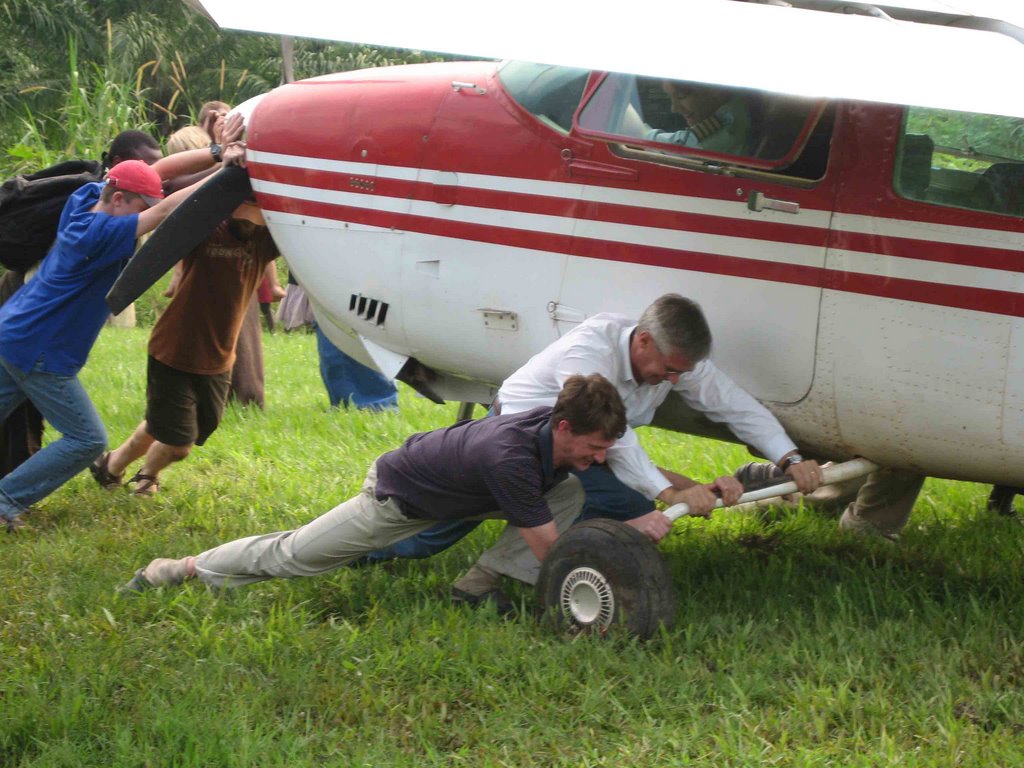
 You know it’s rainy season when airplanes get stuck in the mud.
Yes, just when you may have thought that a flight would free you from the mire, well, you would have thought wrong. Today Kim’s mother Ann and friend Michelle arrived by MAF. First they had several hours of delay in Entebbe due to a problem with the fuel injector. Frustrating at the end of a LONG trip from Seattle WA but preferable to the alternative of flying without fixing the mechanical issue. We thought all was well when they finally sailed into a clearish sky (a whole day without precipitation today, very unusual) and landed on our grass airstrip. At least is used to be grass. Half-way down the one kilometer strip, the taxiing Cesna slipped, turned, and stopped. A ton of airplane rests on three small retractable wheels, and those wheels were half-way submerged in mud. The plane was not moving any further.
It is surprisingly difficult to push and airplane—the machine is delicate in some ways, and the points of contact limited. Many attempts ensued, with some men sitting on the tail to lift the nose, others pushing and straining on the wheel struts or nose, all of us getting dirtier and dirtier in the mud, and our pilot looking more and more resigned to disaster. It took our hero the engineer Josh and our hero the leader Scott to devise and carry out a plan with boards, pivoting, and a dozen helpers. After about two hours of hard work they got the plane moved to firmer ground. But by that time it was too late for our pilot Laura to lift off back to Entebbe. So she’s grounded here, having to arrange last minute baby sitting for her two-year-old daughter in Kampala because her husband is in the UK with their 3-year-old son who needs surgery. Today was their wedding anniversary . .. And the only other time Laura has been stranded here it was her daughter’s birthday. She’s a brave lady but perhaps will stop flying to Bundibugyo on important dates. An armed local guard is watching over the plane tonight. And we’re praying for NO RAIN until tomorrow.
All in all a long and trying day, and the rain is not yet letting up.
You know it’s rainy season when airplanes get stuck in the mud.
Yes, just when you may have thought that a flight would free you from the mire, well, you would have thought wrong. Today Kim’s mother Ann and friend Michelle arrived by MAF. First they had several hours of delay in Entebbe due to a problem with the fuel injector. Frustrating at the end of a LONG trip from Seattle WA but preferable to the alternative of flying without fixing the mechanical issue. We thought all was well when they finally sailed into a clearish sky (a whole day without precipitation today, very unusual) and landed on our grass airstrip. At least is used to be grass. Half-way down the one kilometer strip, the taxiing Cesna slipped, turned, and stopped. A ton of airplane rests on three small retractable wheels, and those wheels were half-way submerged in mud. The plane was not moving any further.
It is surprisingly difficult to push and airplane—the machine is delicate in some ways, and the points of contact limited. Many attempts ensued, with some men sitting on the tail to lift the nose, others pushing and straining on the wheel struts or nose, all of us getting dirtier and dirtier in the mud, and our pilot looking more and more resigned to disaster. It took our hero the engineer Josh and our hero the leader Scott to devise and carry out a plan with boards, pivoting, and a dozen helpers. After about two hours of hard work they got the plane moved to firmer ground. But by that time it was too late for our pilot Laura to lift off back to Entebbe. So she’s grounded here, having to arrange last minute baby sitting for her two-year-old daughter in Kampala because her husband is in the UK with their 3-year-old son who needs surgery. Today was their wedding anniversary . .. And the only other time Laura has been stranded here it was her daughter’s birthday. She’s a brave lady but perhaps will stop flying to Bundibugyo on important dates. An armed local guard is watching over the plane tonight. And we’re praying for NO RAIN until tomorrow.
All in all a long and trying day, and the rain is not yet letting up.
Wednesday, November 29, 2006
You Know It's Rainy Season When . . . Part 2
You know it’s rainy season when airplanes get stuck in the mud.
Yes, just when you may have thought that a flight would free you from the mire, well, you would have thought wrong. Today Kim’s mother Ann and friend Michelle arrived by MAF. First they had several hours of delay in Entebbe due to a problem with the fuel injector. Frustrating at the end of a LONG trip from Seattle WA but preferable to the alternative of flying without fixing the mechanical issue. We thought all was well when they finally sailed into a clearish sky (a whole day without precipitation today, very unusual) and landed on our grass airstrip. At least is used to be grass. Half-way down the one kilometer strip, the taxiing Cesna slipped, turned, and stopped. A ton of airplane rests on three small retractable wheels, and those wheels were half-way submerged in mud. The plane was not moving any further.
It is surprisingly difficult to push and airplane—the machine is delicate in some ways, and the points of contact limited. Many attempts ensued, with some men sitting on the tail to lift the nose, others pushing and straining on the wheel struts or nose, all of us getting dirtier and dirtier in the mud, and our pilot looking more and more resigned to disaster. It took our hero the engineer Josh and our hero the leader Scott to devise and carry out a plan with boards, pivoting, and a dozen helpers. After about two hours of hard work they got the plane moved to firmer ground. But by that time it was too late for our pilot Laura to lift off back to Entebbe. So she’s grounded here, having to arrange last minute baby sitting for her two-year-old daughter in Kampala because her husband is in the UK with their 3-year-old son who needs surgery. Today was their wedding anniversary . .. And the only other time Laura has been stranded here it was her daughter’s birthday. She’s a brave lady but perhaps will stop flying to Bundibugyo on important dates. An armed local guard is watching over the plane tonight. And we’re praying for NO RAIN until tomorrow.
All in all a long and trying day, and the rain is not yet letting up.


Monday, November 27, 2006
Death, unadorned
Innocent died this morning. She was six years old. She died of sickle cell disease and anemia and poverty and family stress and too little too late.
Her father Kapu does gardening work for the Massos, as he has for a decade. They have watched him grow from his early teens into his mid twenties. They have watched him become the father of three children, Innocent being the oldest. The second died on Christmas Day two years ago. The third is a 4 month old baby. Kapu’s mother died on Friday. Karen went to the burial that day and held Innocent on her lap through the whole event, a bright and eager six-year-old girl whom no one expected to be close to death herself. We have possibly the highest prevalence of sickle cell disease in the world here in Bundibugyo, and its victims are too numerous to count. Kapu and his wife had done a good job of steering Innocent through many crises, but I think the events of a family death and burial over the weekend probably threw them into disarray, and no one noted the signs of her impending danger.
I found her this morning having just arrived at the hospital. The alert staff immediately sent her for a check of her hemoglobin and the lab result was 3.3 gm/dl, a value incompatible with life. In sickle cell disease a child can literally bleed to death internally, red blood cells melting, clogging the spleen, disappearing. She was already hooked up to a transfusion when I entered the ward. I immediately heard her labored breathing, saw her lying unconscious on a mattress on the floor, supported by a relative, clinging to life by the merest thread. In spite of mobilizing the nursing staff to give her antibiotics and antimalarials in addition to the blood, she died within the hour. I’ve rarely heard a cry more despairing than this mother’s. Perhaps being near the anniversary of her other child’s death, being left with only one of the three, perhaps she had allowed herself such hope that the treatment would work, I don’t know, but she fell apart.
By afternoon the clan had dug another grave by Kapu’s mother. Most were still at the home observing the four day period of mourning. I arrived just after the coffin, mostly to support Karen whom I knew cared deeply for the family. She sat outside weeping and I joined her, like the other women, sitting on papery dry banana leaves with our legs stretched in front of us, wet sand scratching my legs, leaning against the house. Many of the friends we’ve made over the years were there, the diverse network of relationships that run through the community. When one of Kapu’s age-mates, Kawa Vincent, who is now a primary school teacher but also used to be a little boy hanging around our homes, gave the requisite “report” on Innocent’s life, he got choked up. Seeing this young man struggle to speak moved many of the women (including us) to tears afresh. The hardest part was when the little cloth-covered coffin was lowered into the fresh muddy hole, and the men began to push the excavated dirt back in. Loud, thunking splats as the finality of the act echoed. At that point Kapu broke out in heart-rending cries (not usually seen from the men at these events) and that released Karen’s grief too, so that like the other mourners she just had to sit on the muddy ground and sob.
Death in Bundibugyo is death unadorned. We sang hymns, but while sitting in the dirt, with food scraps covered with flies lying nearby, the hymns giving counterpoint to the wailing of the closest relatives cradling the body throughout the ceremony. There is no illusion that death is a sanitary medical process—here it is sorrow, and filth, and gasping weakness, and empty hearts. Sitting on that ground I could only remember that some of the other patients at the hospital, as soon as she died, did a better job of comforting than I did. They surrounded the mother and said “she’s with Jesus now.” The more bleak the death the more important the hope of Heaven becomes.
Her father Kapu does gardening work for the Massos, as he has for a decade. They have watched him grow from his early teens into his mid twenties. They have watched him become the father of three children, Innocent being the oldest. The second died on Christmas Day two years ago. The third is a 4 month old baby. Kapu’s mother died on Friday. Karen went to the burial that day and held Innocent on her lap through the whole event, a bright and eager six-year-old girl whom no one expected to be close to death herself. We have possibly the highest prevalence of sickle cell disease in the world here in Bundibugyo, and its victims are too numerous to count. Kapu and his wife had done a good job of steering Innocent through many crises, but I think the events of a family death and burial over the weekend probably threw them into disarray, and no one noted the signs of her impending danger.
I found her this morning having just arrived at the hospital. The alert staff immediately sent her for a check of her hemoglobin and the lab result was 3.3 gm/dl, a value incompatible with life. In sickle cell disease a child can literally bleed to death internally, red blood cells melting, clogging the spleen, disappearing. She was already hooked up to a transfusion when I entered the ward. I immediately heard her labored breathing, saw her lying unconscious on a mattress on the floor, supported by a relative, clinging to life by the merest thread. In spite of mobilizing the nursing staff to give her antibiotics and antimalarials in addition to the blood, she died within the hour. I’ve rarely heard a cry more despairing than this mother’s. Perhaps being near the anniversary of her other child’s death, being left with only one of the three, perhaps she had allowed herself such hope that the treatment would work, I don’t know, but she fell apart.
By afternoon the clan had dug another grave by Kapu’s mother. Most were still at the home observing the four day period of mourning. I arrived just after the coffin, mostly to support Karen whom I knew cared deeply for the family. She sat outside weeping and I joined her, like the other women, sitting on papery dry banana leaves with our legs stretched in front of us, wet sand scratching my legs, leaning against the house. Many of the friends we’ve made over the years were there, the diverse network of relationships that run through the community. When one of Kapu’s age-mates, Kawa Vincent, who is now a primary school teacher but also used to be a little boy hanging around our homes, gave the requisite “report” on Innocent’s life, he got choked up. Seeing this young man struggle to speak moved many of the women (including us) to tears afresh. The hardest part was when the little cloth-covered coffin was lowered into the fresh muddy hole, and the men began to push the excavated dirt back in. Loud, thunking splats as the finality of the act echoed. At that point Kapu broke out in heart-rending cries (not usually seen from the men at these events) and that released Karen’s grief too, so that like the other mourners she just had to sit on the muddy ground and sob.
Death in Bundibugyo is death unadorned. We sang hymns, but while sitting in the dirt, with food scraps covered with flies lying nearby, the hymns giving counterpoint to the wailing of the closest relatives cradling the body throughout the ceremony. There is no illusion that death is a sanitary medical process—here it is sorrow, and filth, and gasping weakness, and empty hearts. Sitting on that ground I could only remember that some of the other patients at the hospital, as soon as she died, did a better job of comforting than I did. They surrounded the mother and said “she’s with Jesus now.” The more bleak the death the more important the hope of Heaven becomes.
You know it's rainy season when....

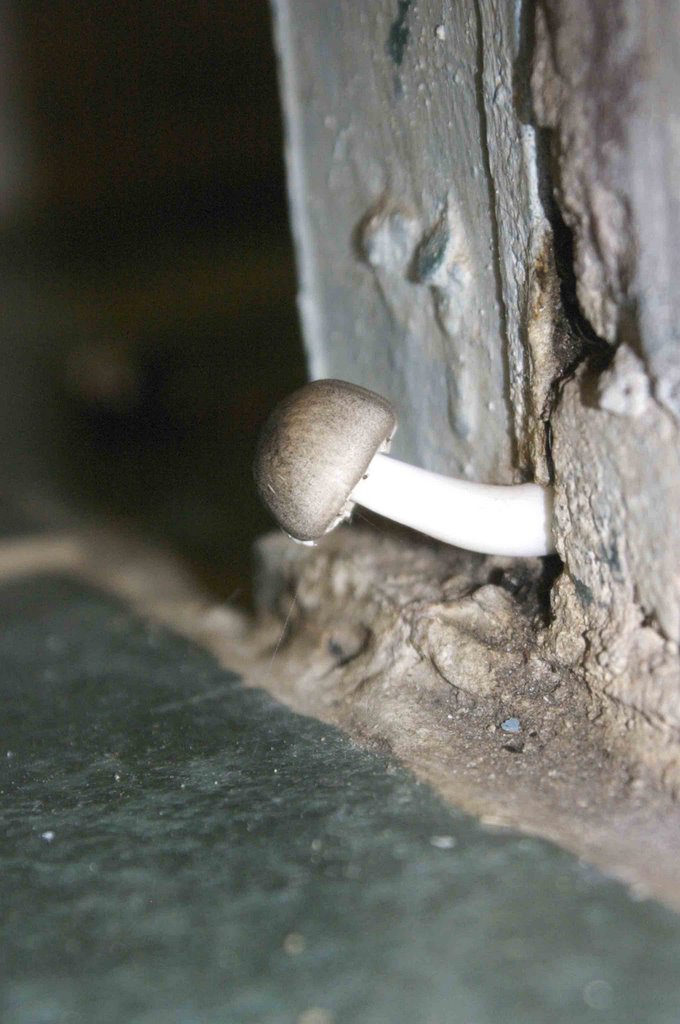 ...your cow has to stand in her water trough to avoid the plague of biting flies
...and there are mushrooms growing in your shower stall.
Yuck.
...your cow has to stand in her water trough to avoid the plague of biting flies
...and there are mushrooms growing in your shower stall.
Yuck.
Sunday, November 26, 2006
Two Worlds
Baby crying,
Drizzling rain.
People dying
Sorrow and pain.
Cold, clear mountain peak
Exotic monkeys so shy
Colorful birds to seek
Beautiful blue sky.
A world of contrast
So different yet the same
Two worlds in one
Beauty and pain.
Luke Myhre (age 13)
(Luke wrote this poem the day he finished exams, it came to him riding home in the mud. I think the contrast between the beauty of Africa and its pain is always before us, and our kids. Thought you might like a more serious poem, and the perspective of another member of the family. Jennifer)
Drizzling rain.
People dying
Sorrow and pain.
Cold, clear mountain peak
Exotic monkeys so shy
Colorful birds to seek
Beautiful blue sky.
A world of contrast
So different yet the same
Two worlds in one
Beauty and pain.
Luke Myhre (age 13)
(Luke wrote this poem the day he finished exams, it came to him riding home in the mud. I think the contrast between the beauty of Africa and its pain is always before us, and our kids. Thought you might like a more serious poem, and the perspective of another member of the family. Jennifer)
Thursday, November 23, 2006
TWAS THE THANKSGIVING SEASON . . .
 Twas the Thanksgiving Season of 2006
When the Bundibugyo Team found themselves in a fix.
Clouds hung o’re their valley, rain ru-ined their fun,
In vain they waited for glimpses of sun.
No power, no road, no dry clothes, no food:
The incessant drizzle frazzled their mood.
Mud coated their legs, frogs thrived in their shoes,
Fungus, boils and flies plagued them with the blues.
When up on the calendar there arose a celebration
Devoted to thanks, in spite of the situation.
To their kitchens they flew to sift, stir, and dash,
Creating dishes worthy of a Thanksgiving bash.
Their leader Doctor Scott, with his usual skill
Slaughtered and plucked a tur-key for the grill.
More hungry than pigs to the Pierces they came,
And Scott merrily greeted each one by name:
“On Myhres and Massos, on Pierces and Barts!
Stephanie Carol Kim Amy Pat Pamela Josh Scott!”
As he called through the door the whole team appeared,
Four families with children and eight singles held dear.
“To the tables come one! To the feasting come all!
We’ll refresh and regroup and press on past this wall.”
So down to the banquet each team member did sit
Devouring turkey and pie, they left not one bit.
And then, in a twinkling, they stormed back out the door
Strengthened with power from on high they would soar.
Karen, how she sparkled, with spreadsheets and goats
And art projects and preschool in this place so remote.
Michael’s bearded chin indicated he was wise
>From flow rates to futurology he could all analyze.
A hundred children? No problem for loving Annelise
She’d tell stories of Jesus and all would be pleased.
Advanced math and batteries give David no pause
Though ‘banker’ must have been hidden in the fine print clause.
Kevin’s ready to preach, teach, raise funds, balance books,
Holding Christ School together is even harder than it looks.
He needs JD, who had twins in her belly,
But now manages teachers between diapers so smelly.
Stephanie just arrived but she’s already raised money
Have you tasted her recipe of g-nuts and honey?
’No problem’ –Carol bodas to track down sick babies:
Intern, teacher, researcher, we hope she’ll come back maybe?
Reading, writing, and Spanish; basketball, Bible studies,
Miss Kim devotes herself to serve everybody.
Teaching science and history while learning Lubwisi
Miss Amy’s joyful endeavors make it all look easy.
Pat loves the wounded, the sick and the poor,
Even when Monday shouts at her door.
Zipping by on the picky, Pamela’s out everywhere,
To TBAs and health centers organizing better care.
Josh resurrects computers, fixes bikes, plays guitar
And bushwacks to water projects near and far.
Master Scotticus, though new, shows no signs of fainting
Tackling French, biology, biking, even filming and painting.
Scott winked his eye as he nodded his head
The security risk was low: they had nothing to dread.
In spite of the rain, they could get back to their work:
Sixteen adults, thirteen kids, not one single jerk.
So refraining from publicly picking his nose,
Scott prayed for them all as from dinner he rose.
He sprang to his Land-Rover, called the team with a whistle,
Away they all slid to continue their Ugandan epistle.
But I heard him exclaim, ere he drove out of sight,
“God’s Kingdom is coming! Don’t give up the fight!”
Twas the Thanksgiving Season of 2006
When the Bundibugyo Team found themselves in a fix.
Clouds hung o’re their valley, rain ru-ined their fun,
In vain they waited for glimpses of sun.
No power, no road, no dry clothes, no food:
The incessant drizzle frazzled their mood.
Mud coated their legs, frogs thrived in their shoes,
Fungus, boils and flies plagued them with the blues.
When up on the calendar there arose a celebration
Devoted to thanks, in spite of the situation.
To their kitchens they flew to sift, stir, and dash,
Creating dishes worthy of a Thanksgiving bash.
Their leader Doctor Scott, with his usual skill
Slaughtered and plucked a tur-key for the grill.
More hungry than pigs to the Pierces they came,
And Scott merrily greeted each one by name:
“On Myhres and Massos, on Pierces and Barts!
Stephanie Carol Kim Amy Pat Pamela Josh Scott!”
As he called through the door the whole team appeared,
Four families with children and eight singles held dear.
“To the tables come one! To the feasting come all!
We’ll refresh and regroup and press on past this wall.”
So down to the banquet each team member did sit
Devouring turkey and pie, they left not one bit.
And then, in a twinkling, they stormed back out the door
Strengthened with power from on high they would soar.
Karen, how she sparkled, with spreadsheets and goats
And art projects and preschool in this place so remote.
Michael’s bearded chin indicated he was wise
>From flow rates to futurology he could all analyze.
A hundred children? No problem for loving Annelise
She’d tell stories of Jesus and all would be pleased.
Advanced math and batteries give David no pause
Though ‘banker’ must have been hidden in the fine print clause.
Kevin’s ready to preach, teach, raise funds, balance books,
Holding Christ School together is even harder than it looks.
He needs JD, who had twins in her belly,
But now manages teachers between diapers so smelly.
Stephanie just arrived but she’s already raised money
Have you tasted her recipe of g-nuts and honey?
’No problem’ –Carol bodas to track down sick babies:
Intern, teacher, researcher, we hope she’ll come back maybe?
Reading, writing, and Spanish; basketball, Bible studies,
Miss Kim devotes herself to serve everybody.
Teaching science and history while learning Lubwisi
Miss Amy’s joyful endeavors make it all look easy.
Pat loves the wounded, the sick and the poor,
Even when Monday shouts at her door.
Zipping by on the picky, Pamela’s out everywhere,
To TBAs and health centers organizing better care.
Josh resurrects computers, fixes bikes, plays guitar
And bushwacks to water projects near and far.
Master Scotticus, though new, shows no signs of fainting
Tackling French, biology, biking, even filming and painting.
Scott winked his eye as he nodded his head
The security risk was low: they had nothing to dread.
In spite of the rain, they could get back to their work:
Sixteen adults, thirteen kids, not one single jerk.
So refraining from publicly picking his nose,
Scott prayed for them all as from dinner he rose.
He sprang to his Land-Rover, called the team with a whistle,
Away they all slid to continue their Ugandan epistle.
But I heard him exclaim, ere he drove out of sight,
“God’s Kingdom is coming! Don’t give up the fight!”
Wednesday, November 22, 2006
Jonah, another chapter
Bright an early Sunday morning we were visited by Gideon Alinga, a prominent community leader, who was bursting with news of the birth of a son. One of his two wives had just delivered her eight child . . . The first C-Section by Dr. Jonah at NHC. As we have heard the full story this week we were again amazed at the way God answers prayers, the orchestration of this birth.
Alinga is an old-time WHM contact, sponsored by previous missionaries for a degree, fallen out of favor over various issues but still a strong force in this community, not always a force in our favor, a somewhat tricky relationship. His wife was in labor late Saturday night when the midwife (Rose, another nurse we sponsored for further studies who just completed midwifery at the same time as Jonah) detected on exam that the baby’s umbilical cord had prolapsed, which means it was coming out of the womb ahead of the baby. If this happens the baby’s blood supply is cut off and the baby will die. She called Jonah, who quickly decided an emergency C-section was the only way to save the baby. The nurse-anesthetist had gone to her home village and was untraceable (it was now after midnight) so Jonah wondered if he should refer them to Bundibugyo, but knew that the baby was not likely to survive the trip. So he operated anyway, delivering a healthy large boy, finishing at about 4 am, with a stand-by lantern in case the solar-powered lights did not last long enough.
Jonah’s first C-section could have been anyone; for it to be this family smacked of God’s timing. The late hour, lack of anesthetist, and critical condition of the baby could have spelled disaster; having a great outcome smacked of God’s mercy. Now Alinga and his fairly powerful clan met and decided to name the baby Jonah Guvenah. They reasoned that like Jonah of the Bible he emerged from the belly miraculously. To name a baby after Dr. Jonah (who is from the Bakonjo tribe, not the Babwisi like this family) combined with the grandfather’s name (Guvenah) is quite amazing. Alinga is now enthusiastically drawing public support for Jonah’s presence here.
More chapters to come no doubt!
Alinga is an old-time WHM contact, sponsored by previous missionaries for a degree, fallen out of favor over various issues but still a strong force in this community, not always a force in our favor, a somewhat tricky relationship. His wife was in labor late Saturday night when the midwife (Rose, another nurse we sponsored for further studies who just completed midwifery at the same time as Jonah) detected on exam that the baby’s umbilical cord had prolapsed, which means it was coming out of the womb ahead of the baby. If this happens the baby’s blood supply is cut off and the baby will die. She called Jonah, who quickly decided an emergency C-section was the only way to save the baby. The nurse-anesthetist had gone to her home village and was untraceable (it was now after midnight) so Jonah wondered if he should refer them to Bundibugyo, but knew that the baby was not likely to survive the trip. So he operated anyway, delivering a healthy large boy, finishing at about 4 am, with a stand-by lantern in case the solar-powered lights did not last long enough.
Jonah’s first C-section could have been anyone; for it to be this family smacked of God’s timing. The late hour, lack of anesthetist, and critical condition of the baby could have spelled disaster; having a great outcome smacked of God’s mercy. Now Alinga and his fairly powerful clan met and decided to name the baby Jonah Guvenah. They reasoned that like Jonah of the Bible he emerged from the belly miraculously. To name a baby after Dr. Jonah (who is from the Bakonjo tribe, not the Babwisi like this family) combined with the grandfather’s name (Guvenah) is quite amazing. Alinga is now enthusiastically drawing public support for Jonah’s presence here.
More chapters to come no doubt!
Monday, November 20, 2006
Pre-Thanksgiving Feasting
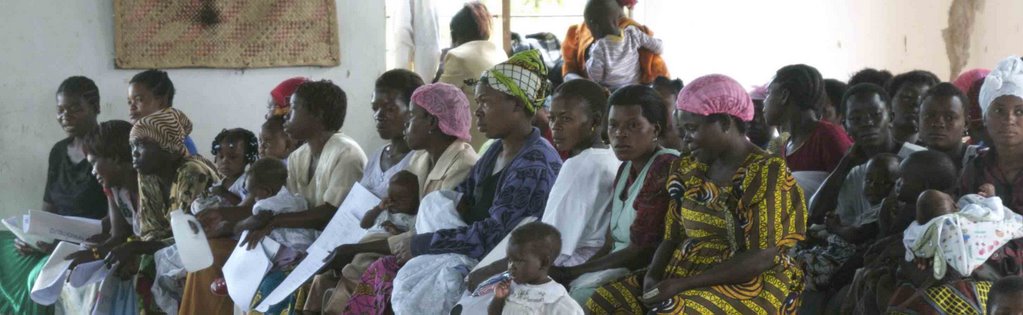
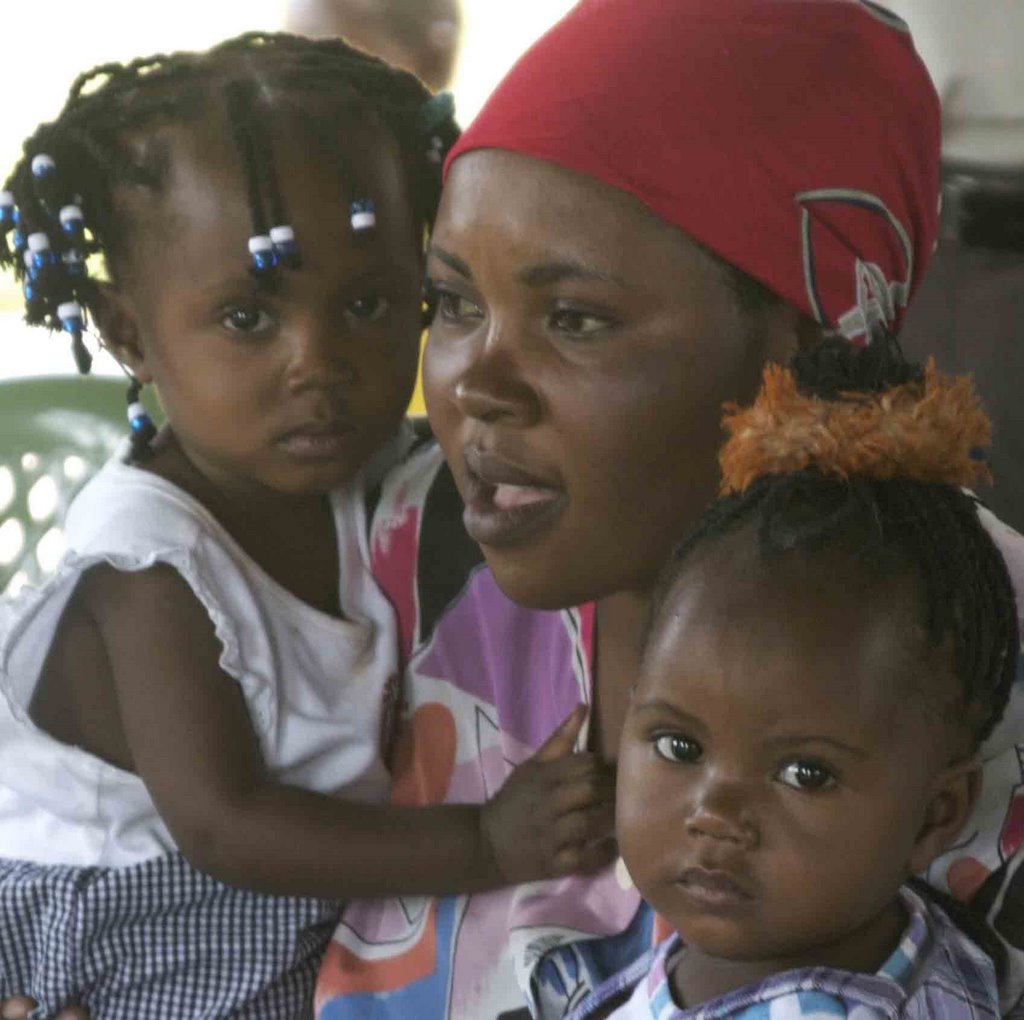
 The last Kwejuna Project Food Distribution . . . .116 HIV+ mothers, half our team, more than a dozen neighbors hired to cook hot porridge for the waiting moms and help them heft the heavy bags of food away, in short a crowd. Again the Community Center was filled with noise, babies, laughter, life. The face of HIV is not all bleakness and suffering I realized as I looked around. No one would pick most of these women out of a crowd, at least not yet. It was one final opportunity to call them all together, preach the Gospel, love them practically, rejoice over babies not infected, counsel some to bring their husbands for testing, encourage those who have been left alone or are struggling on with care. Like the pilgrims we sailed into the PMTCT work and imposed ourselves and our programs on these women, so at the end of the year it is a joy to invite them to a feast.
A treat for me was to reconnect with Robbinah, who came to me over a year ago tearfully pleading for help with her baby. She was articulate and aware of the risks, one of the few with some education, pregnancy made her leave school, the father of the baby did not marry this teenager, and she knew she increased her baby’s risk by breast feeding. Though we promote exclusive breast feeding as the safest option even in HIV infection . . . Something about Robbinah led me to go against policy and take a gamble and supply her with the baby formula she so much wanted, perhaps her determination to save her child. After a few months Karen was able to supply her with a dairy goat. Now a year later she has a healthy toddler. Another facet of the public health/private health dimension, her story is not replicable for all 114, but sometimes an individual case can be different.
World Food Program officially ends all food distribution to Bundibugyo this month. What feast now for the poor?
The last Kwejuna Project Food Distribution . . . .116 HIV+ mothers, half our team, more than a dozen neighbors hired to cook hot porridge for the waiting moms and help them heft the heavy bags of food away, in short a crowd. Again the Community Center was filled with noise, babies, laughter, life. The face of HIV is not all bleakness and suffering I realized as I looked around. No one would pick most of these women out of a crowd, at least not yet. It was one final opportunity to call them all together, preach the Gospel, love them practically, rejoice over babies not infected, counsel some to bring their husbands for testing, encourage those who have been left alone or are struggling on with care. Like the pilgrims we sailed into the PMTCT work and imposed ourselves and our programs on these women, so at the end of the year it is a joy to invite them to a feast.
A treat for me was to reconnect with Robbinah, who came to me over a year ago tearfully pleading for help with her baby. She was articulate and aware of the risks, one of the few with some education, pregnancy made her leave school, the father of the baby did not marry this teenager, and she knew she increased her baby’s risk by breast feeding. Though we promote exclusive breast feeding as the safest option even in HIV infection . . . Something about Robbinah led me to go against policy and take a gamble and supply her with the baby formula she so much wanted, perhaps her determination to save her child. After a few months Karen was able to supply her with a dairy goat. Now a year later she has a healthy toddler. Another facet of the public health/private health dimension, her story is not replicable for all 114, but sometimes an individual case can be different.
World Food Program officially ends all food distribution to Bundibugyo this month. What feast now for the poor?
Saturday, November 18, 2006
Of Health, Public and Private
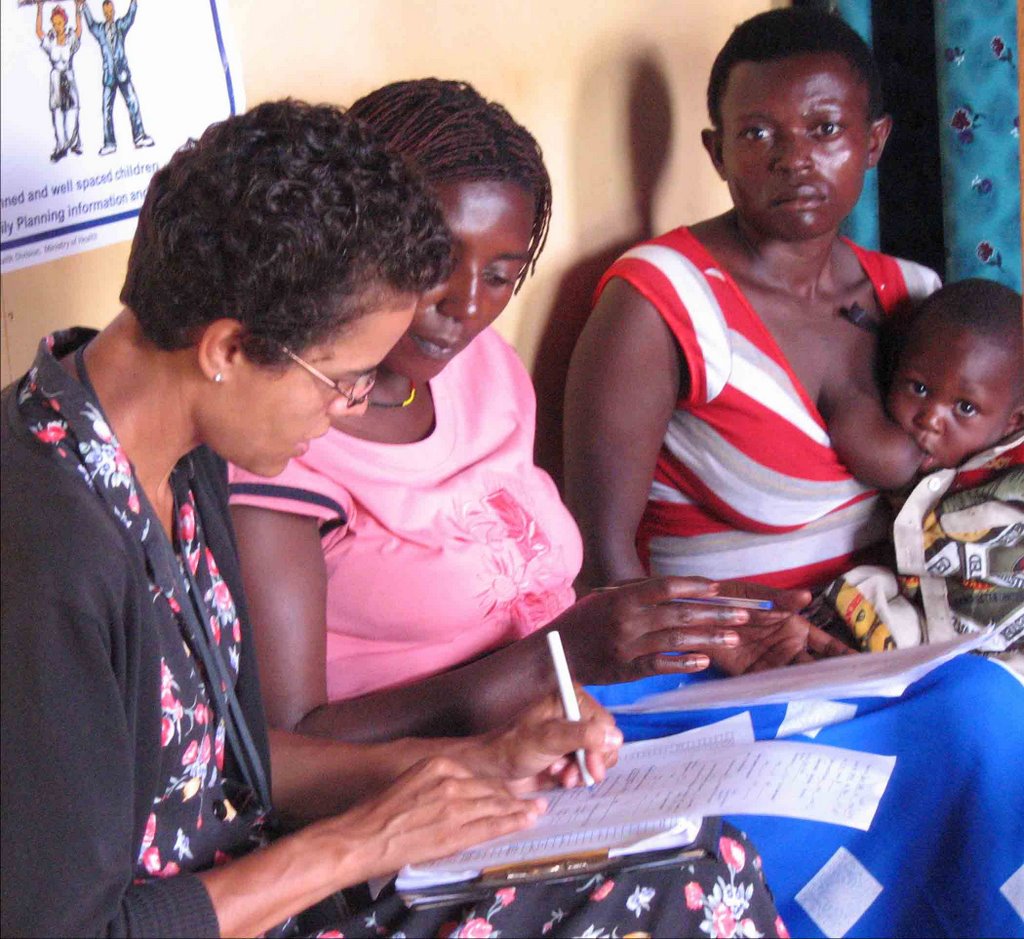 Public health considers the well-being of the community. As we work to improve antenatal care, we hope that the impact is community-wide, with more mothers and babies surviving and thriving. Measuring the impact requires scientifically sound sampling and careful follow-up. So we have Carol delving into an ambitious project, a case-control study of sorts, choosing systematically (every other name) nearly a hundred HIV+ women who delivered babies 1 and 1/2 years ago, and then randomly choosing two controls for each one who are matched by age, parity (how many pregnancies) and village. After she collected these names from the clinic registries, the tricky part begins: finding almost 300 women with only names and villages to identify them over a year after they have delivered their babies. We want to know how many of the mothers and babies survive and are collecting some data on their nutrition and overall health. For the HIV positive mothers, we are able at a year and a half to find out if the virus was transmitted to their babies. While we do this every time we have a food distribution and every time we see people in clinic . . . That only tells us about the health of the small percentage who choose to remain in contact, which may skew our assessment, because we’re seeing the ones who live near, or like medical care, or are organized enough to get help, and therefore more likely to have good outcomes.
For weeks now Carol and her trusty research assistant Ndyezika have been combing the community with their list of names. Take into account that there are no addresses, almost no roads, no phone numbers, no computers, no files. Then consider that names in this culture are rather unimportant and fluid, and a nervous mom at antenatal care may say the first thing that comes into her head when asked for her name. I have frequently asked husbands and fathers the names of their wife or child and seen them struggle unsuccessfully to come up with the name! Many times the name on a child’s immunization record bears little resemblance to what he’s called at home. Then consider the fact that marriages are very impermanent. If a woman registers while living in one village, nearly two years later she may have moved on, back to her parents or on to another husband. So after weeks of struggle they had found less than 20 people. We like the approach of going to the patient .. . But thought we’d try to lure the patients to us one more way. For four days a list of 60 names was announced on the radio. On Friday morning 13 of those women showed up. Not bad, not great. Still slogging on.
Private health considers the well-being of the individual patient. One of the mothers who came on Friday was among the HIV positive group (obviously for reasons of confidentiality, the study is being billed as a general antenatal follow-up with no mention of connection to HIV status). Her 18 month old son was a strapping and healthy looking boy. She had dropped out of any follow-up and was still breast-feeding the toddler. We tested him, and he was not infected! What joy to share this news with her. But then we advised her to wean the child right away. His nutrition was good, and the small risk remained of transmitting the virus through breast milk. She tucked her breast back in her dress, and we gave him sweet biscuits to distract his crying. Maybe one little life saved? It’s possible.
Both public and private health are important. Jesus fed 5000, taught principles of community cooperation. But he also raised one widow’s dead son, or healed one bleeding woman in a crowd. So we continue on, trying to change policies and reach thousands with teaching and testing, while also touching the one toddler who can be saved from infection.
Public health considers the well-being of the community. As we work to improve antenatal care, we hope that the impact is community-wide, with more mothers and babies surviving and thriving. Measuring the impact requires scientifically sound sampling and careful follow-up. So we have Carol delving into an ambitious project, a case-control study of sorts, choosing systematically (every other name) nearly a hundred HIV+ women who delivered babies 1 and 1/2 years ago, and then randomly choosing two controls for each one who are matched by age, parity (how many pregnancies) and village. After she collected these names from the clinic registries, the tricky part begins: finding almost 300 women with only names and villages to identify them over a year after they have delivered their babies. We want to know how many of the mothers and babies survive and are collecting some data on their nutrition and overall health. For the HIV positive mothers, we are able at a year and a half to find out if the virus was transmitted to their babies. While we do this every time we have a food distribution and every time we see people in clinic . . . That only tells us about the health of the small percentage who choose to remain in contact, which may skew our assessment, because we’re seeing the ones who live near, or like medical care, or are organized enough to get help, and therefore more likely to have good outcomes.
For weeks now Carol and her trusty research assistant Ndyezika have been combing the community with their list of names. Take into account that there are no addresses, almost no roads, no phone numbers, no computers, no files. Then consider that names in this culture are rather unimportant and fluid, and a nervous mom at antenatal care may say the first thing that comes into her head when asked for her name. I have frequently asked husbands and fathers the names of their wife or child and seen them struggle unsuccessfully to come up with the name! Many times the name on a child’s immunization record bears little resemblance to what he’s called at home. Then consider the fact that marriages are very impermanent. If a woman registers while living in one village, nearly two years later she may have moved on, back to her parents or on to another husband. So after weeks of struggle they had found less than 20 people. We like the approach of going to the patient .. . But thought we’d try to lure the patients to us one more way. For four days a list of 60 names was announced on the radio. On Friday morning 13 of those women showed up. Not bad, not great. Still slogging on.
Private health considers the well-being of the individual patient. One of the mothers who came on Friday was among the HIV positive group (obviously for reasons of confidentiality, the study is being billed as a general antenatal follow-up with no mention of connection to HIV status). Her 18 month old son was a strapping and healthy looking boy. She had dropped out of any follow-up and was still breast-feeding the toddler. We tested him, and he was not infected! What joy to share this news with her. But then we advised her to wean the child right away. His nutrition was good, and the small risk remained of transmitting the virus through breast milk. She tucked her breast back in her dress, and we gave him sweet biscuits to distract his crying. Maybe one little life saved? It’s possible.
Both public and private health are important. Jesus fed 5000, taught principles of community cooperation. But he also raised one widow’s dead son, or healed one bleeding woman in a crowd. So we continue on, trying to change policies and reach thousands with teaching and testing, while also touching the one toddler who can be saved from infection.
Friday, November 17, 2006
Prayer Update E-mail for Team 16 Nov 06
Dear Praying Friends,
It is the time of year to thank God for His blessings, and though I sigh over the mud, for our neighbors and friends this rainy season’s abundant dampness would surely number among the greatest of blessings. This week we looked at 1 Kings 18 and 19. Just as Elijah called down fire and then rain, God has come to us in great power and goodness here. Some of the many things we are thankful for :
But in 1 Kings 19, as soon as Elijah experienced God’s mighty power and deliverance, he ran away discouraged. Spiritual attack intensifies in times of moving forward, and we feel wearied by this event-ful year. So God moved Elijah out to the wilderness for food and rest, but more importantly for an encounter with Himself. Would you pray for us this Thanksgiving that we would long for the God of the Blessings rather than just the blessings of God? That we would find rest and strength in the whispering voice of His presence? That the Christmas season would be one of focusing on Jesus more than on the great gifts He brings us?
After God meets Elijah, He sends him on to announce and set in motion major world-changing events. Most of that involves choosing new people to do His work. Pray that we would likewise be readied for God’s work in 2007. Specifically:
Thanking God for you as always,
Love,
Jennifer for the team
It is the time of year to thank God for His blessings, and though I sigh over the mud, for our neighbors and friends this rainy season’s abundant dampness would surely number among the greatest of blessings. This week we looked at 1 Kings 18 and 19. Just as Elijah called down fire and then rain, God has come to us in great power and goodness here. Some of the many things we are thankful for :
- You, your prayers and encouragement, your pouring out of your own blessings. We’ve received two major pledges in the last month for the health center, and this week found out that one phase of our nutrition program expansion will be funded by a SALT grant written by one former intern (Stephanie) and submitted/promoted by another former intern (Jenn Butz). These aren’t small amounts and we feel like the Israelites, awed at God’s power.
- Jonah striding around Nyahuka Health Center, confident and competent and testifying to God’s answers to prayer.
- Some of the health issues we asked prayer for looking up, with team kids gaining health and strength.
- A team that has expanded gracefully, drawing in newcomers and opening arms of love.
- Joy Muhlbaier was able to travel safely back to the US with Ward Shope and is beginning to get physical therapy for her chronic back pain. Also the Gray family left today to travel back to the US next week for the anticipated January arrival of boy number three.
- WHM’s new vision and mission statements and new web site, plus the expanding interest in new fields in East Africa
- Against all odds Kabasunguzi Grace still alive and smiling in spite of being blind and bedridden.
- Drawing to the end of another CSB school year and exam period.
But in 1 Kings 19, as soon as Elijah experienced God’s mighty power and deliverance, he ran away discouraged. Spiritual attack intensifies in times of moving forward, and we feel wearied by this event-ful year. So God moved Elijah out to the wilderness for food and rest, but more importantly for an encounter with Himself. Would you pray for us this Thanksgiving that we would long for the God of the Blessings rather than just the blessings of God? That we would find rest and strength in the whispering voice of His presence? That the Christmas season would be one of focusing on Jesus more than on the great gifts He brings us?
After God meets Elijah, He sends him on to announce and set in motion major world-changing events. Most of that involves choosing new people to do His work. Pray that we would likewise be readied for God’s work in 2007. Specifically:
- CSB is in desperate need of funding for meeting end-of-year payrolls; and we expect to need new teachers in several key positions come January. Please pray for God’s provision of money and people!
- It is also time to start thinking of new teachers for RMS for August 07. If you know any elementary/middle school teachers who would be up for such an adventure, start praying for them.
- Our last Kwejuna Project Food distribution occurs Monday the 20th, pray for God to bless the women and children who come, and for more funding to open up for their nutrition next year.
- Carol Logan is working tirelessly to track down many mothers and babies around the district for follow-up, a nearly impossible task. She has only a couple of weeks left; pray for miraculous finding of the right moms!
Thanking God for you as always,
Love,
Jennifer for the team
Monday, November 13, 2006
Feature Presentation: Brutal Beauty, or Scott&Jennifer's Bday Adventure, or Motorcycle Blogs

 Saturday evening our team surprised us with a little video whipped up in honor of Scott’s Birthday, entitled “Feature Presentation”. The inspiration came from Michael, Josh, and Scotticus, with the non-Myhre kids and Annelise providing more ideas (no theme was rejected, as Michael said) and most of the acting. The story involved Scott and Jennifer heading off for the Birthday Trip to the Semliki Safari Lodge. Joe played Scott and kept saying “the security risk is very low” in reference to Scott’s reassuring assessment at last team meeting. Acacia played me with a wild wig of hair, and all the smaller children were an assortment of leopards, panthers, princesses, and kids coming to the rescue from Michael, a fire-breathing dragon who captured us en route. In the special feature cast interviews, they explained this symbolism had to do with Scott’s intimate and sometimes disastrous relationship with fire. It was hysterical, and we felt very loved by the effort involved and the community event of everyone coming to the screening the night before we left.
Well, we did not encounter any fire-breathing dragons on the real trip, but it turned out the drama did foreshadow the real thing. This is November, which means rain, which means mud. Twice in the last week to ten days the road has been closed due to huge trucks stuck in the mud on hairpin mountain turns blocking other vehicles from passing. Being good, stubborn, can-do, frontier missionaries, we said to everyone
“We desperately need a break and we ARE going to get to the lodge, come hell or high water.” Well, it turned out that we encountered quite a bit of both. To avoid the truck-clogged mountain pass road, we decided to adventure forth on Scott’s motorcycle and take a little-used route that runs through the Semliki River Valley north to Rebesingo, then cut back down towards the lodge. We had tried this route twice before, coming from the other direction, and it had always seemed a bit vague and tentatively even passable. But coming from the southwest, and using a motorcycle, we were sure it would be a good idea. So Sunday mid morning we headed off, packing tools and spare tubes and a change of clothes into a heavy back-pack, wearing gum boots and raincoats and zooming away.
Much of the trip was lovely. The road skirts the mountain range’s northern roots, and winds through a cattle-strewn grassland. About a third of the way into the less-traveled part, we began to follow behind another small motorcycle which gave us confidence. When the road was cut through by a river at one point we stopped to eye the steep banks and the herd of cattle lower than our feet drinking the river water . . . When our guardian angel boda drivers waved to us to show us a more gradual path down and the best place to ford the river. We felt optimistic and well cared for. But the road kept getting smaller and smaller until it was barely a path, and we came upon the boda pair again. We could not find a shared language in which to communicate more than the fact that they were heading in the same direction, and they advised us to skirt the swamp they were enmired within. So for about half an hour we tried to find an alternate route while they struggled through the quagmire, but eventually we came to the conclusion that there was no way around, and that we’d have to follow. If they could do it couldn’t we?
Well, their machine was half the weight (or less) of ours. We both managed to get through, but barely. I knew we were in trouble when the mud sucked the boots right off my feet, and it took all my counterweight and strength to pull them out with my hands. By that time I had given up on boots and we were both up over our knees in mud, a gooey, slippery, bottomless, quick-sand like mud that threatened to swallow the motorcycle. It stretched out as far as we could walk in every direction. If Scott were any less strong we might be there still. A few inches at a time we pushed and shoved and pulled and gasped, until we made it through the worst hundred yards or so. We were exhausted and coated with mud, but we pressed on. Then it started to rain, and the track we were following became as slippery as snow. We wiped out twice, bruises but no serious injuries. Our short-cut turned a 2 1/2 hour trip into a 5 1/2 hour survival odyssey. If you have never sat on a motorcyle for over 5 hours (and not more than 30 seconds of that time on any smooth or firm road surface) . . . Then don’t. Many times the road petered out into a confusing crossing pattern of cattle paths, or disappeared beneath ponds of water. Many times we were so sore and tired we weren’t sure we would make it.
The brutality of the trip made the beauty of the lodge even more dramatic. There were only two other guests whom we barely saw, so we had a wonderful evening to reconnect as a couple, read, talk, eat, sleep, and sleep some more. Our tent had a wooden floor with oriental rug, firm poster bed, warm shower, and a view of multiple species of monkeys and birds cavorting in the trees. We heard the breathy, throaty call of lions in the early morning, then went back to sleep, secure in our house-like tent. This afternoon we came back by the road-more-traveled . . No picnic amidst the muddy tracks and stony jolts, but nothing like the challenge of the day before.
Was it worth it? Definitely. We will read some verses (like Psalm 69) about rescue from the miry pit with new feeling now. Will we do it again? No, or at least not until we forget the pain of this trip! We are thankful to our great team for caring for out kids while we got away, thankful to the unlikely angels who offered us the stay and the others who guided us on the path. Thankful that there are evenings of respite in this life of struggle. And mostly thankful that we were in it together.
Saturday evening our team surprised us with a little video whipped up in honor of Scott’s Birthday, entitled “Feature Presentation”. The inspiration came from Michael, Josh, and Scotticus, with the non-Myhre kids and Annelise providing more ideas (no theme was rejected, as Michael said) and most of the acting. The story involved Scott and Jennifer heading off for the Birthday Trip to the Semliki Safari Lodge. Joe played Scott and kept saying “the security risk is very low” in reference to Scott’s reassuring assessment at last team meeting. Acacia played me with a wild wig of hair, and all the smaller children were an assortment of leopards, panthers, princesses, and kids coming to the rescue from Michael, a fire-breathing dragon who captured us en route. In the special feature cast interviews, they explained this symbolism had to do with Scott’s intimate and sometimes disastrous relationship with fire. It was hysterical, and we felt very loved by the effort involved and the community event of everyone coming to the screening the night before we left.
Well, we did not encounter any fire-breathing dragons on the real trip, but it turned out the drama did foreshadow the real thing. This is November, which means rain, which means mud. Twice in the last week to ten days the road has been closed due to huge trucks stuck in the mud on hairpin mountain turns blocking other vehicles from passing. Being good, stubborn, can-do, frontier missionaries, we said to everyone
“We desperately need a break and we ARE going to get to the lodge, come hell or high water.” Well, it turned out that we encountered quite a bit of both. To avoid the truck-clogged mountain pass road, we decided to adventure forth on Scott’s motorcycle and take a little-used route that runs through the Semliki River Valley north to Rebesingo, then cut back down towards the lodge. We had tried this route twice before, coming from the other direction, and it had always seemed a bit vague and tentatively even passable. But coming from the southwest, and using a motorcycle, we were sure it would be a good idea. So Sunday mid morning we headed off, packing tools and spare tubes and a change of clothes into a heavy back-pack, wearing gum boots and raincoats and zooming away.
Much of the trip was lovely. The road skirts the mountain range’s northern roots, and winds through a cattle-strewn grassland. About a third of the way into the less-traveled part, we began to follow behind another small motorcycle which gave us confidence. When the road was cut through by a river at one point we stopped to eye the steep banks and the herd of cattle lower than our feet drinking the river water . . . When our guardian angel boda drivers waved to us to show us a more gradual path down and the best place to ford the river. We felt optimistic and well cared for. But the road kept getting smaller and smaller until it was barely a path, and we came upon the boda pair again. We could not find a shared language in which to communicate more than the fact that they were heading in the same direction, and they advised us to skirt the swamp they were enmired within. So for about half an hour we tried to find an alternate route while they struggled through the quagmire, but eventually we came to the conclusion that there was no way around, and that we’d have to follow. If they could do it couldn’t we?
Well, their machine was half the weight (or less) of ours. We both managed to get through, but barely. I knew we were in trouble when the mud sucked the boots right off my feet, and it took all my counterweight and strength to pull them out with my hands. By that time I had given up on boots and we were both up over our knees in mud, a gooey, slippery, bottomless, quick-sand like mud that threatened to swallow the motorcycle. It stretched out as far as we could walk in every direction. If Scott were any less strong we might be there still. A few inches at a time we pushed and shoved and pulled and gasped, until we made it through the worst hundred yards or so. We were exhausted and coated with mud, but we pressed on. Then it started to rain, and the track we were following became as slippery as snow. We wiped out twice, bruises but no serious injuries. Our short-cut turned a 2 1/2 hour trip into a 5 1/2 hour survival odyssey. If you have never sat on a motorcyle for over 5 hours (and not more than 30 seconds of that time on any smooth or firm road surface) . . . Then don’t. Many times the road petered out into a confusing crossing pattern of cattle paths, or disappeared beneath ponds of water. Many times we were so sore and tired we weren’t sure we would make it.
The brutality of the trip made the beauty of the lodge even more dramatic. There were only two other guests whom we barely saw, so we had a wonderful evening to reconnect as a couple, read, talk, eat, sleep, and sleep some more. Our tent had a wooden floor with oriental rug, firm poster bed, warm shower, and a view of multiple species of monkeys and birds cavorting in the trees. We heard the breathy, throaty call of lions in the early morning, then went back to sleep, secure in our house-like tent. This afternoon we came back by the road-more-traveled . . No picnic amidst the muddy tracks and stony jolts, but nothing like the challenge of the day before.
Was it worth it? Definitely. We will read some verses (like Psalm 69) about rescue from the miry pit with new feeling now. Will we do it again? No, or at least not until we forget the pain of this trip! We are thankful to our great team for caring for out kids while we got away, thankful to the unlikely angels who offered us the stay and the others who guided us on the path. Thankful that there are evenings of respite in this life of struggle. And mostly thankful that we were in it together.
Subscribe to:
Posts (Atom)