rotating header

Sunday, May 02, 2010

assets

Thursday and Friday we spent two solid days of worship, prayer, planning, dreaming, listing, listening together as a team.  A time of recognizing what God has done since our last retreat time of January 2009 . . and a time to officially hand over team leadership to the Johnsons . . and a time to look ahead.  My favorite aspect of this retreat was the "asset-based" approach we took, influenced by a great book gift from Rick Gray:  When Helping Hurts, how to alleviate poverty without huritng the poor and yourself, by Steve Corbett and Brian Fikkert from the Chalmers Institute at Covenant College.  Instead of beginning with NEEDS, which are generally so bold and obvious and overwhelming they bowl us over, we began with "assets", the gifts and resources God has placed in Bundibugyo, the redemptive work He is already doing.  This is a theme of God's teaching for us this year, and fits with the theology of Don Richardson and Eternity in Their Hearts, the reality that God has placed aspects of His truth and image here in African traditional religion (as well as strengths in the society) which serve as doors to the Gospel.  

So, some Bundibugyo assets:  a culture of breast-feeding, which enables our motherless baby program to facilitate surrogates.  A culture of goat-keeping, which enables the Matiti project to thrive with the technical inputs from BundiNutrition. An assumption of spiritual reality, which allows all our programs to be fully holistic.  A culture which places ultimate value on progeny, which has a positive affect on openness to education and health care.  A universal dependence upon agriculture and passion for cocoa production, which enables the Christ School Farm to have hope of becoming an income-generating idea.  A desire for identity and value in a marginalizing world, which drives the translation project, and the coming together of the new Semliki Presbytery within the PCU.   And mostly people, the young ones God has raised up through relationships with missionaries, the hundreds that are coming out of Christ School, the dozens of professionals whom God has brought into partnership with us.

We also took time to verbalize our personal passions as a team, the gifts He has put in Bundibugyo through each person.  That encourages me, too.  I have hope when I see Travis' enthusiasm for "work hard, play hard", his glow of being able to encourage others, to truly build up; when Amy is able to take rats in stride and write a funny poem about them, when she grasps the organizational challenges of the next few months with competence.  When Anna speaks of her friendship with a local young m'lim woman, or comes up with hands-on-cool school projects, or reports that orphan sponsors have risen from 18 to 32 (more than half way there!).  When Loren laments the plight of local women, and tenderly weeps over her own longing to reach more. When John is able to offer the fruits of his hands-in-the-soil, and to facilitate the skills of our agriculturally gifted friends.  When Heidi touches the least of these day by day with nursing care, or keeps us on track behind the scenes with service.  We anticipate the arrival of Chrissy and Jessica; and hope for more.  These are precious gifts.

But few.  In today's sermon Kisembo spoke from 1 Cor 1:27-30 as he preached on Paul's trials in Acts 25.  God delights in bringing good for thousands out of our five loaves and two fish, in showing wisdom through our weak foolishness.  So we balance a healthy respect for our assets and a healthy realization that they are completely inadequate for ushering in the Kingdom unless God miraculously multiplies.

On Pets and Home

Star embodies home for our kids. In a world of change, as even team mates come and go, our dogs have represented a living constant (which was one reason that Angie's death from old age coinciding with the ebola epidemic was so devastating and yet cathartic in grief). In a place that often presents rejection (treating our kids as outsiders) or presents us daily with the unfamiliar, a dog is a dispenser of unconditional love. Whenever we get out of the truck after a grueling trip to Kampala and back, the kids vie for who gets to embrace Star first. A dog is security, barking alerts when would-be thieves or strangers approach, or establishing order if crowds get too overwhelming. Though she has NEVER bitten anyone, Star has kept our home from being a target of the ubiquitous thievery that plagues most of the mission. Star is a companion to run with, a presence when siblings are unavailable. She's part of the stable background fabric of life, especially for our kids.
As we now face a little over two months to wrap up, organize, pack, and prepare before our trip to America in mid-July, item A-number 1 of concern is Star. Ideally we're hoping that an add placed in the "Kijabe Wind" will inspire someone to agree to dog-sit her at RVA from May through December. That allows us to deal with getting her over the border, and provides ONE "family-member" for Caleb when he goes back to first term of 11th grade with the rest of the family across the ocean. She was a puppy Christmas present during our last HMA (2000), and as a ten-year-old dog is definitely on the old side, but hopefully will live a few more years to see our kids through.
So, dog-lovers, please pray for a miraculous provision for Star to be able to live at Kijabe with Caleb and then the rest of the family!

Saturday, May 01, 2010

death stalks

We buried Byaruhanga William today, a 33-year old teacher who grew up as a World-Harvest-Mission-Kid.  He was buddies with the Herron kids, his older brother worked for the Learys, he became a disciple of Rick's and was supported by him for teacher's college, as well as the Fillyaws and Pat and others.  His peers included Kawa Vincent and Kataramu Francis, who also became teachers, and the younger Ndiyezika and Ntunguwa, our boys.  These were the kids who, out of curiosity or desperation or courage or spunk, attached themselves to the foreigners, for better or for worse.  For Byarurhanga, the better prevailed.  He made a profession of faith and joined the church at age 12, was a quiet and pleasant and faithful man, married to only one wife, teaching in a crowded and needy public school.  . . .  while others in his family died of AIDS or became crippled by alcoholism and abuse.  Probably a thousand people attended his burial today, a measure of the community sense of sorrow and loss.  But also a picture of how investment in one life can profoundly affect many others.  It was a many-hour ceremony with some hopeful moments, my heavy heart lifted somewhat by the faith of others who spoke of seeing Byaruhanga healed and happy in Heaven, or of the fact that when God calls He is calling us home, and there is no better place to go.  There were also powerfully sad moments, particularly when his friend Vincent sobbed through his speech, the entire crowd with a gasping sigh as he described the dying Byaruhanga asking him to care for his children.  The plight of orphans being a primal fear in this high-mortality society.  

For us the day was excruciating in its needless waste of a life.  Byaruhanga died of Bundibugyo.  He had a benign conjunctival problem and while waiting for the eye specialists to whom we had referred him to come next month, someone else prescribed a pain medicine with a high incidence of toxic ulcer-inducing side effects.  By the time he called Ndiyezika on his third day of taking it, and Ndiyezika brought him to Scott, he was in retrospect in the process of perforating through his stomach.  His exam was not as impressive as his own sense of pain and impending doom, but enough for Scott to send him to see the surgeon, and request an xray.  If the xray machine had been functional, if the surgeon had decided to operate sooner, if the critical care in the operating room was better, if his blood type had been available . . .as an otherwise very healthy young man he should have pulled through.  But in the real world of Bundibugyo where the system is overloaded and barely a step ahead of collapse (including us), he got too little too late.  And he died.

This is the third burial we've been to of long-term friends and acquaintances in the last few weeks.  None of the three men would have died in even a mediocre medical center in the States.  The injustice of the disparity in care makes us cry out:  how long, oh Lord?  And the targeting of a young teacher like this, or a young doctor like Jonah, seems tragically unfair to a society which needs their gifts.  I can not explain why God allowed them to show such promise and then be taken away decades before their three-score-and-ten.  And I don't expect to see the equation balanced, the wrong made right, in this life.  Death stalks, surreptitious.  A wounded enemy can be the most dangerous.  We believe in death's final defeat, but in the interim life has lost some important battles of late.

Thursday, April 29, 2010

Football Fever

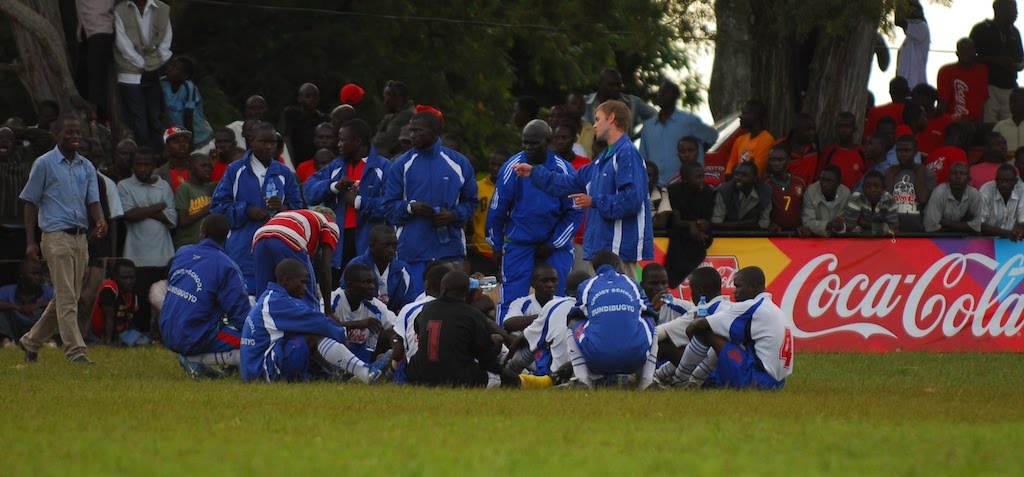
The first term of school in Uganda ends with national football (soccer for Americans) tournaments for both boys' and girls' secondary school teams. Each of Uganda's burgeoning number of districts (recently topping 100) can send one school. For the boys the event is sponsored by Coca Cola, and I have to say this is a fine example of an industry putting something back into East Africa. They do tournaments in Kenya, Rwanda, and Tanzania too, and promote the development of coaches, the identification of talent. They even sponsored an under-18 team to go to South Africa in a World Cup warm-up event. Coca Cola pays for the food for 80 teams of 20 boys and 2 coaches each, over a ten day period, plus t-shirts, banners, prizes, and a major media event for the opening and closing games. Because football is THE SPORT in Africa, the secondary school tournament is one of the major sporting or social events of the year for the country. And because football affords opportunity for health, success, competition, awareness of other tribes and areas of Uganda, team-work, pride, goal-setting, etc., the tournament contributes to the development of young people. And because our boys get to see a new place, interact with new people, spend large quantities of time with their coaches, struggle, and process, the tournament fosters discipleship and growth. As you can tell, I'm a fan.
This year we had planned to try and see the boys play as we returned from taking Luke and Caleb to fly back to Kenya. We were preparing to leave Kampala and checking on the first day or two of fixtures with Nathan when we got the surprising news: CSB had been randomly drawn to meet the host school, the powerful St. Henry's Kitovu, in the opening match. This is the only match that all the invited guests watch from the grandstand, that has a marching band, that every team lines the fields to see, that draws reporters and football officials and coke executives and you name it. This game is huge.
We pulled onto the St. Henry campus, which was nicer than almost any school in Uganda, expansive, huge fields, many, many dorms, chapels, classes, halls, green grass, space. This is a school that's probably five or six times older than ours, several times larger, and a hundred times richer. It was shocking. Hundreds and hundreds of boys from all over Uganda milled about in identical coca-cola shirts, a sea of red, a striking picture of what could have been a military camp (same age group) but was instead a sports camp (praise God for that). We greeted our boys who were nervous but smart in their CSB warm-ups. After music, acrobats, speeches, parades, the match was opened like a Premier League game, with much hooplah. There were our boys lined up on the field with several thousand people watching.
For the first 15 minutes or so we were great. Hope glimmered. We could have won. Nathan is a great coach, and Alex has prepared them well, they are smart and fast and able. I can't really explain the mental aspects of football, but they are huge. Perhaps the booming drum of the home team. Perhaps the murmurs in the crowd that we would lose 20 to nothing (I kid you not another team did lose 19 to 1 in another match). Perhaps the pressure of being in the spotlight. Perhaps playing a team that could do things like intentionally draw us offsides (our in-district competition was not at this level). Perhaps the decades of being colonized and marginalized and losing confidence, the sense of being from a remote and undeveloped place, of being unable to compete. Perhaps the larger pitch and general exhaustion. We lost 4 nil. We played hard, though, and the score does not reflect very well the eveness of the game.
Afterwards we shook everyone's hands, and left praying the boys would not lose heart. Nathan told us the same thing happened today in the second game, losing 3 to 1 in spite of initially coming on strong. Time for Kevin's "I believe in you" speech! It would be great if they won at least one of their next two matches.
Meanwhile we came back to Bundi, more on that some day, but tomorrow the girls' team leaves for their tournament. They are NOT sponsored by Coca Cola. Their tournament is pay-as-you-go, and Ashley and her supporters are our source here. The girls had no in-district games to prepare them, but they have practiced hard. Their tournament is in Gulu, which is a two-day drive from here. The pomp and glory will be lacking I suspect . . but they will probably have more fun. Instead of 80 teams they will be lucky to have 40.
Praying for our girls to travel safely, enjoy their adventure, play their best, and experience a taste of victory (one game won would be great!). Praying for Ashley in a position of responsibility, and Julia too, in cultural immersion. Stay tuned next week for the scores!

Monday, April 26, 2010

safety in isolation

Yesterday I completed mission impossible, penetrating the US Embassy in Kampala, for the controversial and delicate assignment of . . . adding pages to my passport.  You might think I was trying to extract trade secrets or subvert national security for all the barriers one must pass to get a dozen small pieces of blank paper attached to a passport.  

Background:  When you go in and out of Uganda to take kids to boarding school in Kenya several times a year, the pages go fast, since Kenya now has a lovely colorful full-page stick-in visa, and border agents everywhere delight in stamping and signing.  We rarely spend more than a day or two in Kampala, and always have an arm's length list of things to do.  So a couple of trips ago Scott thought he'd swing by the embassy for this relatively simple procedure, during the hours they have set aside for "Americans only" service (there are other times of the day when the poor Ugandans who want to travel to the US have to queue up, and I can only imagine how brutally difficult that is).  But nothing doing, he found they had changed their system so that no American can just enter through security for open hours.  One must apply on-line ahead of time for a designated slot, fill out all the correct computerized forms, and then be issued a computer-generated ticket.  I suppose so they can do a background security check on us, in case we're dangerous spies posing as missionaries.  So before his last trip to Kampala, alone, he did all that, and even though he was thinking several days in advance (which is a lot for us) he had a hard time getting an appointment.  But at last he did.  He approached the fortress, submitted his passport, emptied his pockets, went through security in the concrete surrounding walls, was escorted through locked doors to the waiting area, then sat in the bullet-proof cubicle behind glass to turn in my passport and request pages.  But no go.  Even though he did this for our kids some months back, he could not do it for me, his wife.  I had to be personally present to authorize the blank page addition.  I was 8 hours travel away in Bundibugyo manning the home front.  So he left, having wasted two precious hours of Kampala work time for nothing.

Back to yesterday:  I clutched the precious e-ticket, went through the same tough security, sat in the same chair.  With, I might note, ONE other person.  In the hour and a half I was there, only two of us got seen and taken care of. Meanwhile I had left a distraught American woman standing outside the fortress entrance speaking desperately into her cell phone, catching phrases about how she had tried to get an appointment but there were none available, could she just be seen today???  As I sat for an hour waiting for my passport to be expanded with new blank pages, I thought about all this.  

The new American embassy was built to withstand terrorist attack after the Nairobi and Dar Salaam embassies were bombed some years back.  This was not an idle fear; real terrorists did real and terrible damage.  We were in Kampala on that day, staying at the ARA no less, and it was frightening to come close to that potential, since our embassy was slated for destruction too but the plot here failed.  America reacted with a show of concrete and bullet-proof glass and procedure and protocol, with rules and guns and power.  The new embassy is much, much safer.  Most of the people who died were Africans, and everyone I encountered yesterday was too.  I'm sure there are Americans in there somewhere but even deeper and safer behind the protective perimeter. I'm glad the diplomats and the Ugandans who work for them have such a spacious and secure environment in which to work.

But I also have to wonder if the obsession with safety has gone too far.  Even as an American I felt alienated by the whole procedure yesterday. Our culture is one of no-risk, of insurance and law suits and seat belts and safety.  Which results in many people living long and healthy lives.  Wonderful.  But taken to extremes, also results in us being unable to truly encounter the majority of the people of the world, where life is unsafe.  All that protection leads to some serious isolation.

When we told the church elders we would be working as Field Directors from the Nairobi area for a couple of years, one of the first responses we got was this:  you stayed with us in the war, and you stayed with us in ebola.  All the medical care and projects and funds did not speak as loudly as our physical presence during the two most dangerous and frightening periods of recent Bundibugyo history.  We certainly have taken many isolating precautions in our life here (we drive a car, for starters).  But it was good to be reminded that sharing in common risk is a powerful communication of love.  That is the message of the incarnation.  

An option for missionaries; not for embassies I realize.  But I wished yesterday that America could present a less formidable face to the world.  I guess that's part of our job.

Sunday, April 25, 2010

A day in your courts

Thanks to generous grandparents . . we were able to spend our two-day family get-away goodbye in a place that perhaps mirrors the beauty of the house of God more than most. When we settled in on Wednesday afternoon, I pulled out my Bible and my Psalm for the day was Ps 84. As I read it, on the porch of an immaculate tent overlooking pristine wilderness, flocks of greater striped sparrows swooped through the brush and in and out of the eaves of the roof, a perfect picture of this psalm. That caught my attention . . surely the courts of the Lord would be characterized by good food, cold drinks, space, family, trilling birds, glimpses of wild animals, symmetry and order and tasteful, restful loveliness. And the fortunate sparrows enjoy this all day, every day, while we long for it on our journeys. It's not wrong to feel a sense of release and peace when wilderness and luxury intersect. It is the home for which our souls were programmed in eternity past, the Garden and the City of God.
The middle of the psalm though acknowledges where we are now: hearts set on pilgrimage. Passing through the valley of weeping until those tears become springs of blessing and life. Moving towards our goal, God, His presence, through a world that contains tastes and promises but not ever quite the real thing.
Our 48 hours in the Semliki Valley were ones of blessing. The reserve was practically ours alone. We had long hours of conversation in the pool and beside it, on the porches, around the table. Spectacular lightening rolled in while we were on a game drive, blowing cool wind. The stuffy hot months melted into rain that night, a change in the atmosphere, a reminder of God's mercies, refreshment. The thousand days of separations and struggles were forgotten in the one day of quiet and fellowship.
And we left, hearts re-set for the pilgrimage ahead.

Tuesday, April 20, 2010

Orphans and Vulnerable Children

"OVC's" is aid-speak for kids whose existence is so marginal as to be threatened. And we have a lot of them here in Bundibugyo. In fact the sheer volume often threatens a shut-down of compassion, as one more sickly, rash-ridden, hungry, or goopy-nosed kid comes across our paths, as needs are presented by grandparents left in charge of orphans or mothers left alone to cope. Then as they grow physically, their mental and spiritual needs flood the churches and schools. Every Ugandan values highly the precious resource of an education, though the options are limited and the costs beyond the capacity of many families. Jesus was able to feed the crowds while touching the individuals . . and calls us to do the same. OUR VISION at Christ School - to build an academically excellent senior secondary boarding school that produces servant leaders, for the good of Bundibugyo and God's glory. 340 teens live and learn on campus. These kids receive the best education in the region, in a context of Christian discipleship and community service. They also receive three meals a day, and beds in a cement-floor dorm (a step up from most homes), and electric power for lights to study by, and a library full of books, and access to a computer lab. We keep tuition lower than any other boarding school (in the country!), subsidized by donors to WHM, so that the poor may participate and indeed own and change this district.
However, for some orphans and vulnerable children, even our low tuition is an impossible barrier to overcome. So every year we look for 60 sponsors willing to cover the full cost of a child's education: 10 per class in 6 grade levels, Senior 1 to 6. These kids are selected based on a combination of need and academic promise. They are the harbingers of Jesus' value-inverting Kingdom, the least of these who will be raised to reign. And sponsoring a child is a way to connect with an individual face and name out of the crowds. In 2010 we know that 18 of the 60 are sponsored . . .but that leaves 42 whom we have admitted on faith and need to connect with resources. We offer two levels of sponsorship: $400/year covers the subsidized costs that others pay in Bundibugyo; $600/year ($50/month) covers the actual cost of education.
Click here for the CSB page on the World Harvest web site; click here to sponsor a specific orphan student (touching the individual); or here to contribute to the subsidy for the general tuition of the other 280 kids (feeding the crowds).
Our investment in the lives of the kids in the post below is probably the most important thing we've done in 17 years . . . it is a privilege we invite others to share.

Goodbyes Begin

These boys have been part of our life, our extended family, for a decade or more. John (far right) and Luke used to fight over trucks in the sand under the mango tree when they could barely walk. They all learned their math facts from flash-cards in our kitubbi, and their catechism. They listened to Bible stories on flannelgraphs, and read our books and magazines. They have spent countless hours playing football in our yard, eaten countless meals here, gone on hikes and trips with us. Now they range from just-starting secondary school to mid-University level. (Two are not pictured because they are in schools outside Bundibugyo now). Tonight they gathered to say goodbye to Luke, and to some degree Caleb as well. Luke will not come back to Bundibugyo when he graduates in July, so this was his last night at home. Their commitment to us is not all gain for them, it comes at a cost, since others are jealous of their position and ridicule them. Like adolescent boys anywhere they have gone through their share of restlessness, searching for identity, testing us and our relationship. An occasional suspension from school, or frustrating requests for more than we can give, challenge us. Then letters come from their hearts, full of thanks, and all is well. Ours is a very human and imperfect relationship, made more murky by the ambiguity of parental ties in this place, and by the chasms of culture and economy. However, when all is said and done, we love this crew, and the daily monitoring of their development counts among the greatest losses we anticipate. A true friend is a rare gift and Luke has found that (in some more than others, but it's there). On Friday we will pass through Fort Portal and say goodbye to three of his former classmates, who are also good friends. None of these boys will be on facebook in the near future, or have phones with international calling capacity. None will be traveling the seven thousand miles to visit Luke. None have ever even heard of Yale, though they're glad for his chance to go to University. Their worlds are diverging, painfully, though we will all do our best to hold them in some kind of parallel, to bridge the gap whenever we can, leaving high school and home is a pretty drastic step when home is Africa.
The goodbyes begin.

Monday, April 19, 2010

Unbelieving, I believe

Read one of my favorite passages in Mark today . . the father who brings his convulsing son to the disciples who fail to heal him, and then Jesus gets pulled in.  I love the father's heart cry:  Lord, I believe, help my unbelief.  This paradox of vacillating certainty, accentuated by parental love.  My own son is not falling into fires or dramatically beset by indwelling demons.  But I long for his healing and safety and happiness all the same. 

Luke has opted for Yale.  It has been a good, long, restless month of processing.  Praying, reading, researching, corresponding, trying out arguments, deciding and not-deciding.  There were other great choices, closer to grandparents.  So it took him a long time to sort out that this was where he really WANTED to go, and to courageously step through a door God graciously opened with fantastic financial aid.  It's a whole new world out there, where the best schools in the country can also be the least expensive for low-income missionaries.  Luke is an amazing person and it is a frightening privilege and responsibility to be his parent.  

The decision brought a moment of relief, it's done.  But then reality set quickly in.  We're out of limbo-land, where we can pretend that life goes on like this indefinitely, where we ignore the fact that tomorrow is the last day our family of six will live together in the only home we've ever had.  Suddenly we have a real college to deal with, with paperwork and schedules and dates and decisions.  Suddenly we are here, at the end of all things we've known.

That's where I cry with the father of the epileptic:  Lord I believe (look what you've done, bringing this 8-month-old baby to Uganda in 1993 and now he's survived 17 years and grown to  6' 2" and read a thousand books and is encouraging US that God is the constant in all the moves ahead).  Lord help my unbelief (this child of Africa thrown into the icy competition of the Ivy League, this home that has been our base shifting).  The father's faith is gritty, honest, unpolished, real, and desperate.  I like that.  But it's not the real story:  the real story is Jesus who does not let the boy suffer from the failures of others, who breaks in, who asks questions, and who at last authoritatively brings life, who is willing to pay the cost of prayer and fasting to pull this boy out of the fire and water.  Let me rest on that Jesus.

Sunday, April 18, 2010

Lame Ducks

Well, in the midst of chaos and grief, a little humor goes a long way.  A package from the Johnsons arrived at last: they had mailed it to our team more than 4 months ago as a way to begin to bond with us, little imagining that they would beat the package here by a wide margin.  Among the many fun gifts was a set of little rubber duckies for the Pair-o-docs/ ducks.  See above.  And now that we're in a leadership transition . . . that makes us not only a pair-o-ducks but lame ones at that.