rotating header

Sunday, August 28, 2011

Putting faces to the facts

Kijabe Hospital Paediatrics . . children come from nearby villages or from neighboring countries, some with major surgical problems that can not be treated very many other places south of Cairo or North of Johannesburg. Some come with the same issues that kill most children in the world: hunger, socially non-coping parents, exposure to lethal infections, poor quality water and food and education. And many come without the resources to pay for their care, even though that care is offered at about 1% of the cost of similar care in the States. Since this is a not-for-profit hospital belonging to the Africa Inland Church, we seek to help all of them, while still paying our Kenyan staff and maintaining a decent facility. Which is easier said than done. So some years ago other missionary physicians started a "Needy Children's Fund" to subsidize the care of select patients who were so poor they couldn't even afford the minimal fees charged by Kijabe. Here are a few of the kids we've helped with that fund this week. The first is a 16 month old girl with Kwashiorkor, peeking around her mom's shoulder as she rides on her back, similar to my patients in Bundibugyo. Malnutrition, a mom that weaned her too early and was unable to provide enough food, a father who seems to be at odds with the rest of the family. A treatable condition that is too often fatal. The second is a 10 year old boy who had been progressively more and more tired, unable to play and run like he used to, until in the last two weeks his whole body began to swell up. He was in heart failure, and we subsidized his referral to a cardiologist for an echo in Nairobi which confirmed that he was born with a major structural heart defect (common AV valve). The cardiologist helped us get him on a good combination of medicines, and he left feeling MUCH better. The third is a 3 year old who came in with a bad cough and was found to have TB, which lead to the diagnosis that she and her mom are both infected with the HIV virus. Now they are being treated for TB and AIDS, and what would have been a few months' decline until death can be redeemed into a decade or two (or more?) of life. All three of these children would have been dead within a few weeks or months without treatment. All three will have ongoing challenges, but left improved and hopeful. If you are interested in contributing to this fund, follow this link to: Kijabe Hospital Needy Children's Fund You will have to type "For Needy Children's Fund Kijabe Hospital 70351" in the comment box to be sure the money goes directly to help children like this. As you do to the least of these . . . I think Jesus thanks you.

TRANSITIONS

Transitions.  Again.

Goodbye to Luke, he walked through the airport security alone, again, this is now beginning our fourth year of sending him to another country from the rest of the family for school.  At 18, he's already walked this path many times.  My confidence in him carries me through the airport scene, where we all stand huddled in Maasai blankets peering through the glass.  But when we get home and he's not there, it aches.  And when we hear that he was singled out for security checks, had his trunks pulled and opened on the tarmac in Istanbul with Turkish airline officials brandishing his Maasai swords and him explaining that they are "cultural artifacts", we're glad for his poise but sad that he was in that situation (images of a Turkish jail . . . ).  And when we get a facebook message from a friend and my mom, who drove him back to Yale from DC, we're so thankful for their care, but sad that we aren't the ones helping him settle into his new dorm, or anywhere available as he's told to brace for the hurricane and stay in his dorm today.

And hello to Jessica, Anna, and the Massos.  Dr. Jessica from our Bundibugyo team is here for a month at Kijabe to gain experience in OB, and Miss Anna is here to substitute teach at RVA.  The entire Masso family is here to settle Acacia in as a new RVA student.  As Anna pointed out, it was like a Bundi Saturday night, tacos at the Myhres with a dozen at the table.  We are blessed to be here in missionary central, a place where others from our teams can come for specific boosts.  This morning we all attended chapel together, filling a whole row of the folding chairs.  Mr. Crumley the chaplain brought us God's word from 1 Samuel, the story of Hannah, who gave her child up to the Lord.  Another paradox of faith, that those who lose will gain, that life comes from death.  The call to missions is fraught with so many goodbyes, such transition and loss.  What kind of God would ask that of us, he queried?  The God who went through the same thing Himself, the God who works all things for the good of those who are called, the God who will bring us all back together for eternity and wipe every tear.

We hold to these truths by faith, in the storm of transitions.  


Tuesday, August 16, 2011

tides

The ocean recedes, rhythmically. The tide is going out, slowly, stepwise, leaving a flat white stretch of sand.

This week has been that for us. A quiet declining tide, washing away long nights of anxious call, sadnesses of bereaved mothers, months of separation as a family, and a year of extreme change. 12 1/2 months ago we left our home in Bundibugyo, with the life, ministry, friends, purpose that had fallen to us there. In this year Scott transitioned to a new role as Field Director, our first kid went to college, we traveled through months and miles to visit countless people, we moved to a new country, fixed up and furnished and entered a new house, started new work, and have studied a new language. Like a high tide, this year has churned up a lot of sand and seaweed. It's murky. That's a lot of transition and loss and recovery. A lot has been great, cheering kids from the sidelines of their games rather than from a poor phone connection a continent away, re-learning so much of medicine that had lain dormant and musty, being blessed by the community and atmosphere at Kijabe. So much has been hard, watching the team we love struggle with unexpected sicknesses and loss of personnel and cutting back of programs and feeling unsupported, holding on to kids through disappointments and struggles, saying more goodbyes. So we really needed this low-tide break, these accumulated days of sun and breeze and quiet. No agenda, no projects, not really accomplishing much. Reading, sleeping, swimming. Emptying. Letting the crashing surf of this year ease back. Creating a space.

On Thursday we will move from this rented house to the small cottages we booked for our whole East Africa Field. And I think it will be time for the tide to turn, to begin to come back in. So we are praying that the space created by this week of rest will be filled with God himself. Not with plans or worries or strategies, but with His presence. Please pray that for us, with us.

Friday, August 12, 2011

just another day in paradise

The click of palm fronds in the ocean wind, swaying branches silhouetted, dark and papery against the bright day. A misting rain moves in, and out, leaving damp tiles that steam in the sun. Fishermen push heavy wooden canoes through the shallows, bumping over the waves of a receding tide, to reach the rich waters as dawn breaks. The thin dark arc of monkey's tails as the shy group of sykes brushes through trees, pausing to pick fruits. Thick adobe walls, brick floors, grass mats, pillows, thatch roof, dark shutters open to the fresh ocean air, house on a coral cliff, outside and inside blending without barrier. The smell of sea foam on sunscreened skin. The soft give of sand. The sweetness of coconut rice, the creaminess of a seaweed sauce, the firm chewiness of octopus, the charcoaled flake of grilled snapper. Books, more books.
Yesterday, trip to Shimoni, people milling about the cement pier, the piles of vegetable oil and plastic cups being loaded onto a huge wooden dhow. We board a small creaking swahili fishing boat, the motor sputters to life after the captain pulls an extra spark plug out of a plastic bag of greasy miscellaneous parts. We leave the harbor heading for a protected reef, the boat rising and slapping against the churning water, which gets rougher as clouds gather. Our little crew scrambles to pull a tarp out and rig it over the mast as we huddle, chilled, wondering what in the world we got ourselves into, the sea tossing our small boat, then we pass through to cloud-filtered sun. Two kids pale and queasy; two unaffected. Then we are there, anchoring near a small atoll, pulling on flippers and masks and snorkels, slipping over the side of the boat into the aqua water, bright blue. Beneath the surface, another world. Purple and golden corals, lumps and fans and lace and castle, mushrooms of rock. A school of mustard-colored sleek fish disperses and re-forms. Every color, every size, every pattern of creature darts around. Long sleek, thin; fluorescent blue on emerald green; yellow stripes and black spots. Floating, drifting, kicking, chasing, the bubbling effervescence of someone else's fins kicking. Julia pulls my arm to point out sea turtles, two, gracefully and slowly flying through the waters. The boys dart down to touch an octopus which has retreated into a cave. Later three dolphins swim through, playful, glimpses of silver fins. Back to the boat after two hours of swimming over the reef, another moment of doubt as the dhow teeters aground in shallows, we wait for the rising tide to allow our return.

Paradise is in the setting, but moreso in the wholeness of being together, time to discuss majors and futures, applications and ideas. Time to rest. A Sabbath from the agendas and demands of others. Sunrise on the flat roof patio, prayer and scripture. Late evenings watching a video as the moon shines on the water. Very thankful to be here.

Wednesday, August 10, 2011

Tsavo

First wildlife spotting of the trip: a warthog in the parking lot of the shopping mall in Nairobi where we stopped for breakfast and supplies.
Most tense moment of the trip: the gate at Tsavo, where the KWS had to make a ruling on whether we were residents or not. Visiting a park in Kenya is not cheap. For our family of six, including Luke now as a post-18th-bday adult, to spend two nights in the park camping with all our own gear and food, our own car, no guides or drivers or extras . . we pay about $150 as residents. But if we were tourists, we would pay bout $600. Actually, we wouldn't pay it, we just wouldn't go. So we had spent the time to be fingerprinted and temporarily registered as aliens when our long-awaited residence permit was still delayed, we had sms'd with a park tourism officer, we had stopped at the headquarters of the KWS . . all good news . . but in the end all that mattered was the lady at the gate. Who was not impressed with our receipts, our explanations, our insistence. So she called her boss. Listening through the Kiswahili one-sided conversation we weren't hopeful. But she hung up, and pronounced, "He said that because you are missionaries, you can pay the resident rate". Ahh, so none of our efforts mattered, but God provided.
Most exhilarating moment: Dawn, wrapped in Maasai blankets on the roof rack, bumping along the dirt track, stopping to watch a baby giraffe nurse, then looking up and behold, in the background, Mt. Kilimanjaro in all its glory, bathed in the light of the rising sun, purple and massive with the barest hint of a snow fringe outlining the crater. We knew we were close to the Kenya/TZ border, but honestly we've been in this area, even right at the BASE of Kili before, and never had a view due to clouds. So we had not really thought about seeing Africa's highest peak from Tsavo, until there it was.
Most delicious: toss-up between the chili we cooked up the first night, after setting up our tents, as the sun set and our campfire blazed and Caleb played his guitar . . and the brunch of grilled chicken with roasted carrots, onions, and pasta the next day. Yes, it was ALMOST lunch time, but we realized our cool-bag was not very cool, and thought our chicken might not make it 'til dinner time without making us sick, so we moved up our main meal. Which left us free to picnic on bread, cheese, wine and chocolate atop the Roaring Rocks viewpoint at sunset.
Most disappointing: The rhino-less rhino reserve. A swathe of the park is fenced as a protected area for the nearly-extinct black rhino. A large swathe. It is only open from 4 to 6 pm, and it was about a two-hour drive from our camp site (this is one HUGE park). The drive there was spectacular, in fact the scenery is almost as striking as the animals. Bare red rocky cliffs with tiny klipspringers standing at attention at eye-level as we drive by, elephants bathed in the red dust ambling through the brush (we watched one push over a big tree!), tiny dik-diks darting out of the road, we drove and drove. A lava flow from volcanic activity in the last few hundred years, still black and rough and massive and bare. Winding up hills and into valleys. An ostrich who played chicken with us, staying in the middle of the road until we braked (proving that ostrich are not chickens). By the time we reached the reserve, we had only about a half hour to see the rhinos and drive back by dark. So we were a bit taken a back to realize that one doesn't just drive into the gate and view them. There are supposedly 70 within the fenced area. We drove, and drove. Up one trail and down another, criss-crossing. It was the only place in the park where we ran into lots of other vehicles, pop-top vans sprouting long lenses and big binoculars and hopeful guests. All kicking up dust and looking for the elusive rhinos. We never saw a single one, or found a car who had. For something so large, they can disappear in the thick tangle of bare bushes, grey bark and and grey skin. Or perhaps they don't really exist. Who knows.
Most painful: The roads, by far. The classic corrugated wash-board effect. No matter how slowly you go, or how fast, it feels like your car and your spine are being systematically disassembled.

Most unlikely spottings: By Caleb, a crocodile sunning on a rock as we walked through a literal oasis. The Mzima springs, where water literally bubbles up out of the ground, having been collected and filtered by the nearby Chyungu Hills into an underground water table, it suddenly bursts out in the dry savannah, a fully-formed river in midstream, surrounded by palms, an unlikely spot of green. Blue fish dart about in the clear water, and an armed guard escorts visitors from the parking area to the spring source. But after miles and miles of near desert, a crocodile on a rock was sort of shocking. And by Luke, a leopard sauntering away into the bush, at noon no less, and a few minutes from the park gate as we were about to exit. Though Tsavo is synonymous with man-eating lions, and we heard hyenas during the night, we did not see any dangerous carnivores in 47 1/2 hours . . until the last minute.

Most satisfying boy-moments: Not politically correct I'm sure, but people who shall remain unnamed seemed to derive great satisfaction from aiming harmless slingshot-slung volcanic rocks at the fat little rock hyraxes, and finally it one (a mere sting, nothing lethal). And in running around our campsite with a slingshot and knife as we packed up and the baboon troop moved in, hoping to find our leftovers. It was a bit eerie to be stalked like that, dozens of the baboons moving through the site, keeping a perimeter, waiting. One darted up and stole a carrot in a ziplock bag where I was washing out our cool-bag and packing up cooking items, but I think we packed the rest out carefully. So I was glad to have one of the boys on watch with weapons.
Most unusual animals: the Lesser Kudu, the Orynx, the Eland, all large antelopes which we rarely saw in Uganda. And the lone wildebeest hanging out with a herd of zebra.

And lastly, the best planning, as it turns out: coming to the coast after the game park, to beds and showers and seafood and luxuries like chairs, after two days on rocks and campfires.

Saturday, August 06, 2011

Aliens and Strangers

Nyayo house, 7:30 a.m. on a foggy cold Friday morning.  We have braved near-zero visibility along the ridge of the Rift to get into Nairobi early.  Traffic is surprisingly light, and we slip easily into a nearby parking area and pay our fees.  A dozen police in military-like camouflage fatigues mill about the entrance, each armed with a brutal-looking heavy stick in addition to their guns.  This is the city that riots, and they are ready.  Nyayo house was notorious for torture and abuse in past administrations.  Now it houses the immigration department.  We pass through the front gates of the grim city multi-story structure, and are told not to enter the spacious front doors.  Instead there is a sign that directs "aliens" around to the side. 

We're early, and though the offices open at 8, people drift in slowly.  We are accompanied by a brand-new early-20's administrative assistant from the hospital, with her curled hair, slim jeans, dainty glasses, and constant reference to her cell phone, she is quiet and polite and sweet, but this is a new scene for her too.  Thankfully the AIC has sent another experienced man who barely acknowledges us before his business-like approach to one barred window after another while we sit and wait.  As it turns out, we're really only there for the purpose of 4 signatures and 20 fingerprints, he does everything else for us, whisking our passports from one station to the next.  A whilte middle-aged lady chats in Italian to a small Kenyan boy who calls her mom; Africans sit and talk in Swahili and compare their papers. We're hopeful with the efficiency until we reach the final stage, the actual finger-printing.  The office, it turns out, is being cleaned.  Several women with rubber gloves, buckets, towels are bustling around the office, and we are told to wait on a bench outside the door.  For about 45 minutes, while they mop and wipe and chat and come in and out.  People come and go, a line accumulates, but no one seems perturbed.  There is an Indian family, a couple of non-Kenyan Africans, a European nun, and us, each with various Kenyan facilitators.  But always room for one more on the bench, until we are so pressed we can't move.  

And though we were the first in that group to arrive, we're the last called for the printing.  A bored young man takes us one by one, holding our fingers, rolling them also one by one, along a black wooden block covered by a film of ink.  Then he presses them into the correct boxes on a piece of paper.  We're offered a little cotton-wool to wipe our fingers very ineffectively.  And that's it.  It takes about one minute.  Or five hours, depending on how you look at it.

Now we have a temporary alien registration, so we won't be arrested and sent to jail if anyone looks at our passports and questions why we've been in the country seven months on tourist visas (three months, then out to Uganda, then three more, which just expired).  

After almost 18 years in Africa now, I don't usually feel so much like an alien. But it is very alienating to be labeled as such.  It takes away the illusion that we belong.  Hebrews calls us aliens and strangers, like Abraham, leaving our home land and looking for something.  For that substance of things hoped for.  For healed babies and changed hearts, for abundant water and an end to hunger.  For a home that we will not likely find, here.

Tomorrow we will wander a bit further.  Since January we've been working pretty hard, even our two-week-trip in April was to Bundibugyo, not exactly a vacation even though we're glad to have been able to visit.  Luke goes back soon, and so we put in a request for leave for 2 weeks again.  We will camp at a game park and then stay in a house we rented off the internet from the owners in Mombasa, the first 9 days being pure vacation.  Then from Aug 18-22 we will lead a retreat for all the WHM missionaries in Africa, arriving back in Nairobi a few hours before Luke flies out to his second year of University in the states.  Then back to work.

Pray for us aliens to rest in our real home, even as we travel.  Pray for all the details of the retreat to fall together as we gather aliens and strangers from four African countries, and try to create an opportunity for God to speak to them.  Pray for us as a family to be blessed by this time apart.


Sunday, July 31, 2011

tears in the veil

There is a veil that obscures reality, that gives us the illusion of living independently and temporally in a dependent and eternal universe.  But occasionally there are tiny tears in that veil, gaps, glimpses of the great and whole and good and true.  Perhaps most of those occur on life's edges, the beginnings and endings, transitions into and out of this visible world.  

And it is good to name, to recognize, those moments.  

Today I sat with my arm around a 16 year old young woman, C., while her baby died.  C. had delivered her first child a few days ago at another hospital, and it was a long and ugly process I'm afraid.  C. was a teen, had dropped out of school pregnant, was living with her mother, and not really ready physically.  Her baby girl, Monica, came into this world limp and blue and gasping, in severe distress.  By the time she was transferred to our hospital she was convulsing.  She had meningitis, bacterial or herpetic we weren't sure so treated both, jaundice, evidence of liver damage, and respiratory distress.  For 48 hours we gently kept her alive with fluids and antibiotics and continuous positive airway pressure with oxygen.  But as I was reviewing other infants around noon today, the nurses working on a new IV line for baby Monica called me over to see her because her oxygen saturation was falling.  It was falling because she wasn't breathing.  At all.  We used a bag and mask to blow air into her lungs numerous times over the ensuing half hour, perking her heart rate up, but as soon as we stopped she made no movements or effort on her own.  I knew our ICU beds were full, but even if they weren't, this baby's brain damage I was pretty sure was irreversible and unsurvivable.  So I called her 16-year-old mother into the nursery, placed Monica in her arms, and kept vigil with her.  Monica never really breathed, but she had little agonal gasps of movement that went on for longer than one might imagine was possible, well over an hour.   We prayed.  We called C.'s mother on my phone.  We called in our on-call chaplain to sit and pray some more.  I agonized, was this the right thing, should I have tried harder or longer to keep her alive artificially.  C. cried, and I could have but pushed the tears down, and tried to tell her over and over that she was a good mother, that she had done everything she could, that she would be reunited with her perfect healthy baby in the new heavens and new earth eternity, that this was hard and sad.  And that her baby Monica could feel her love as she lay there in her arms.

Could she?  Well, the veil tore a little at the very end of this vigil.  Finally C., exhausted and grieving, told me she wanted to put Monica down.  I had checked the baby dozens of times, she was on a monitor, I knew her heart rate was still hanging in there low and soft, and though Monica was unconscious and a deathly grey-green color, she continued to have those little convulsive gasps every minute or so that kept her body from completely dying.  Nothing had changed, but I sympathized with C.'s desire to just lay the baby back in the cot and go back to her own bed.  So I took Monica from her arms, and she walked away.  I laid the limp jaundiced little body down and arranged her blanket, and looked up at the monitor.  Flat.  The second C. let go, Monica died.  

That was a holy realization to me.  Death was hovering, but the baby seemed to know when her mother was ready, was done and gone.  After at least an hour and a half of waiting, her heart stopped the instant her mother let go.  

There is so much more to medicine and life and every equation than the concrete things we an see and control.  I'm thankful for that.  I had to break death news to another mother at 2 this morning, a neurosurgical patient who was waiting for surgery and didn't make it.  Soon after that tragic scene I went to check up on one of the evening's malnourished-vomiting-diarrhea admissions whom I had suspected had a bigger problem, a telescoping of the intestines one piece inside the other, an unusual, potentially disastrous situation.  At 3 a.m. I found that the Paediatric surgeons had whisked him to the operating theatre, and I walked in just in time to see his purplish distended twists and fans of bowel glistening outside his abdominal cavity, and hear the surgeon marvel that  in spite of the intussusception and malrotation and volvulus, everything looked salvageable.  Two moms who brought their children for care and came away bereaved.  One who came for what she thought was a simple problem, and was saved from almost certain death.

No use trying to make it all add up, and make sense.  Instead I find comfort in the details, the way Monica's heart knew her mother's touch and then quit when it stopped.  The small glimpse through the obscurity of some who live and others who die, the glimpse that says there is more happening than meets our eyes, this is a drama whose stage stretches out to eternity, and the curtain keeps us from seeing the final act.


Friday, July 29, 2011

John Stott, 1921-2011

John Stott, a giant of the Christian faith, died this week at age 90.

Time magazine called him one of the 100 Most Influential People in 2005.

I had the opportunity to speak with him over tea in the mid-90s when he was the keynote speaker at the Christian Medical Society Conference which Jennifer and I attended here in Nairobi.

At the time I was a distraught young missionary, troubled by the untold suffering of the poorest of the poor in Bundibugyo. I came to Stott with my struggles in seeing countless children dying of preventable disease, of women beaten senseless repeatedly by their drunk husbands, of relentless encounters with hunger, pain, and loss. Dr. Stott listened patiently, offered some words of consolation and pointed me to one of his most notable books, The Cross of Christ. He directed me to a specific chapter in which he addresses the issue of pain and suffering in our world. It is there that I found his words:

I could never myself believe in God if it were not for the cross. The only God I believe in is the One Nietzsche ridiculed as ‘God on the cross’. In the real world of pain, how could one worship a God who was immune to it? I have entered many Buddhist temples in different Asian countries and stood respectfully before the statue of Buddha, his legs crossed, arms folded, eyes closed, the ghost of a smile playing round his mouth, a remote look on his face, detached from the agonies of the world. But each time after awhile I have had to turn away. And in imagination, I have turned instead to that lonely, twisted, tortured figure on the cross, nails through his hands and feet, back lacerated, limbs wrenched, brow bleeding from thorn pricks, mouth dry and intolerably thirsty, plunged in God-forsaken darkness. That is the God for me! He laid aside his immunity to pain. He entered our world of flesh and blood, tears and death. He suffered for us. Our sufferings become more manageable in the light of his. There is still a question mark against human suffering, but over it we boldly stamp another mark, the cross which symbolizes divine suffering. ‘The cross of Christ … is God’s only self justification in such a world’ as ours.1 (John Stott, The Cross of Christ, pp. 335-336)

Suffering continues to be a an issue close to my heart. Other books on suffering which have been helpful to me include DA Carson's How Long O Lord, J Earekson Tada's When God Weeps, CS Lewis' The Problem of Pain, Phil Yancey's Where is God When it Hurts, and my favorite, Michael Card's Sacred Sorrow.

John Stott while not known widely outside of the church led an exceptional life of faith keeping one foot in the Scriptures and the other in the world where he was deeply committed to the salient issues of our day - justice, peace, and climate change. Extensive obituaries extolling his broad influence have appeared in the New York Times, The Guardian, and Christianity Today this week.

He will be sorely missed.

Thursday, July 28, 2011

suffer the little children

Kijabe Hospital is an outpost of the Kingdom of Heaven. One among many in Africa, where suffering little children are suffered to come unto help, shelter, love, healing.
Mercy models the latest in oxygen fashion. She sits perkily in her bed, her heart too weakened by nutritional deficiency for her to walk, her rickets-enlargened head looking heavy on her small body. But she smiles at us, after surviving a debilitating pneumonia, she is almost ready for discharge. And her oxygen prongs pointing uselessly into her eyes instead of her nose show us she's improving.
Naomi is only a couple of weeks old, but has already had neurosurgery to relieve the fluid pressure damaging her brain at birth, then struggled with infection until the drainage had to be externalized, and most recently started treatment for a nasty pathogen in her urinary tract as well. But I find her matching pink spiff outfit heartening, the love of a mother who sees her as a valued baby rather than as a severely damaged being.
Abondo was brought in by a community health worker who found her abandoned by her family. Her age and history are unknown, but she seems to be about six and also had a ventriculoperitoneal shunt at some point. She chills with fever, and can barely stand on wobbly legs as she leans on her bed. The community health worker is staying with her in the hospital as a surrogate mom, which amazes me. We're looking for the source of her fever, but mostly trying to feed her. She's hungry, and who knows what other abuses she has suffered, how many days she has spent lonely and neglected.
Most kingdoms boast of those who have explored territories, won battles, written books, passed laws, made speeches, succeeded in elections. Jesus' Kingdom stars the Mercies, Naomis, and Abondos of this world. The overlooked and neglected, the mentally and physically dependent, the fragile. And these three were just cute enough that I snapped pictures on my phone yesterday; there are many more whose appearance conjures more pity than hope. I confess that sometimes as I move from bed to bed, and see these little wasted bodies barely clinging to life, I become frustrated. I want someone with a simple defined problem that can be treated and cured. Yes, I miss malaria, odd as that sounds. On our service of thirty-some patients, few are straightforward. Many will never reach adulthood. Some will never walk, or even talk. We're excited when we can get a child weaned from oxygen, and don't expect a lot more.
So I need to remind myself, of such is the Kingdom of Heaven. It is a holy and awesome privilege to walk the halls of those welcomed by Jesus.

Friday, July 22, 2011

pizza progress

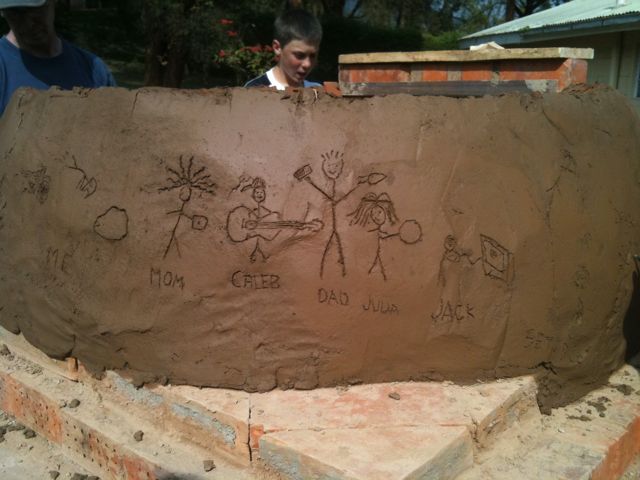
Here's the latest on the oven, which creeps along a few bricks at a time whenever Scott has time . .the slab is done, the hearth laid, and now the dome is inching upwards. Scott decided to add a plaster layer over the bricks for increased insulation and support, which offered good opportunities for help from Caleb, Julia, Jack, and Luke. Who me throw mud? Cave art by Luke, family portraits . . We're still a long way from cooking, but there is hope!