rotating header

Friday, May 24, 2019

Ebola Vaccines, Justice, and the crazy confluence of life imitating art

Eleven years ago, in the wake of potentially the hardest month of our lives (death of our dearest friend, separation from our kids, staring down our own mortality as we waited through 21 days of Ebola incubation), I wrote a book for our kids that helped us all honor Dr. Jonah's sacrifice and process our own grief.  Last Fall, it was published. The plot involves a hemorrhagic virus, political corruption and intrigue, potential immunity, risk, friendship, mystery.  I know I'm not objective but it's actually a good read. ( I wish more people would buy it and read it, but I'm stymied on how to promote that . . . . message me if you have an address for me to send copies to anyone famous . . . ).

officially enrolled, standing outside the doors of the NIH

Tuesday, Scott and I drove to the NIH in Bethesda, Maryland, where we were enrolled in a trial to study the newest attempt at an Ebola vaccine. VSV-EBOV was developed by a scientist hired in the Canadian public health system. Like many advances in science, this one came from alertness to unexpected results. Because Canada 20 years ago lacked adequate high-security biocontainment laboratory facilities, while such level-4 labs were in process Dr. Feldman used a safer method of studying Ebola.  He attached an Ebola glycoprotein to an unrelated virus called VZV, vesicular stomatitis virus, a virus not particularly dangerous to humans that caused disease in sheep and cows. He was infecting mice with this modified VZV-EBOV virus, and noticed that they were not getting sick. He wondered if the glycoprotein was inducing immunity, so got permission to try a real Ebola virus on the mice.  They survived. This research was picking up in the early 2000's, and post 9-11 there was renewed interest and funding for combatting bioterrorism.  The US military paid to test the potential VZV-EBOV in monkeys.  It was effective. A small US company bought the rights to the vaccine but then nothing happened to develop it for almost a decade.  The decade in which our Bundibugyo epidemic occurred, though this strain was different so the vaccine may not have helped us. Why the long dormancy? Ebola occurs sporadically, in rural African places, affecting predominantly poor and isolated populations. That was not enough to drive the market towards profitability for vaccine development.

Then in 2014-2015, an Ebola epidemic in West Africa raged out of control. There was panic that this disease would spread out of Africa. It became clear that a larger company would need to buy the vaccine rights to move forward on testing and development. Merck bought the vaccine, and GAVI stepped in to push development forward. Pharmaceutical companies are profit-driven entities, and there is not much profit in Ebola. I know that many people put faith in the free market to solve our problems, but in this case we would NOT be where we are today without GAVI. GAVI is an organization seeded with funding from the Bill and Melinda Gates foundation that now includes dozens of other private foundations and national entities, a massive alliance to bridge the gap between need and profit.  Simply by infusing 5 million dollars into Merck to get the vaccine up and running for clinical trials, and promising up to 300 million dollars into the future, we went from a monkey-experiment to viable human use. By the time they were able to field test, the massive multi-country West African epidemic was nearly over, and those trials were not sufficiently powerful to prove the vaccine's effectiveness. However the capacity was now primed to be ready for the next disaster. GAVI continued to push behind the scenes from 2016-2018, actually quite remarkably they went against their own policy in order to fund a vaccine that was not yet licensed.  When Ebola was confirmed in North Kivu province, Eastern DRC, on August 1, 2018, they were ready.
This epidemic is not showing signs of control yet


Over the last ten months 122,695 people have been vaccinated in a ring strategy: once a diagnosis is confirmed, all the contacts of that person then all their contacts are vaccinated. Initial results from this epidemic show 97.5% efficacy for this vaccination, though it takes about ten days to see immunity so the post-exposure strategy has some drawbacks. Health care workers have been immunized in the region pre-exposure as well. The VSV-EBOV vaccine still has not been adequately studied for licensure: dose, duration of immunity, need for a booster dose, safety in children and pregnant women, etc. are all unanswered questions. Our Serge medical workers in DRC and Uganda received the vaccine, but we sadly missed the moment when it was being offered. The hospital where we work is probably the closest in Uganda to the DRC border, about 60 miles from Beni and 100 from Butembo/Katwa, the disease epicenters, with thousands of people crossing the borders and dozens of alerts for potential cases we have felt both vulnerable to exposure, and awed that none has yet occurred. We assumed that if a case was documented in Uganda, we would be offered the vaccine then, and hoped it wouldn't be too late.
the location of the disease does not inspire action . . . this is a close-up of the DRC-Uganda border zone. We live in the whitish grey area just above the top blue line
Darker maroon = more poverty. Note DRC and Madagascar . . 

However, even GAVI support and good testing results and 1877 cases with 1248 deaths demonstrating need are not enough to overcome the "opportunity cost" for Merck to devote more factory time to Ebola vaccine production. As they clearly state, there just may not be enough money in it for them. Generally the insecurity in Eastern DRC (132 attacks on health facilities over 10 months killing 4 and wounding 38) also produces some victim-blaming and hand-up-in-the-air-what-can-we-do disinterest. If the market is only governments and NGO's, and the ongoing potential is limited, they just might not scale up. So a couple of weeks ago, it was announced that going forward vaccine dosing would be cut in half or quarter. Having already faced Ebola in Bundibugyo (both of us) and Liberia (Scott) with no vaccine, and knowing there is a very effective vaccine now, we decided to pursue a back-door option.

The National Institutes of Health here in the USA are studying the VSV-EBOV, and graciously agreed to enroll us.  We had to spend a day at the main hospital, having blood drawn (9 tubes each!!), a physical exam, signing consents, waiting for the live-virus (the animal mouth-sores one that carries the Ebola protein, not an actual Ebola virus) to thaw from its storage at negative-60 degrees, then being injected with the very painful solution. The next 48 hours were a bit rough for me, basically like the flu with aches, fatigue, and a pretty high fever. Now we will return in 30 days for titres, then every time we are in the USA for more to follow our immunity over time. At 18 months we will be randomized to get a booster or no booster. This will help governments like the DRC or Uganda, and international organizations like the WHO or UNEPI, decide whom to immunize, when, with what dose, and how often.
About to be jabbed

Probably more than you wanted to know about Ebola vaccines. There are a dozen more in earlier stages of development. But I found the story instructive. Science is driven by brilliant people paying attention to incongruity, but it only moves forward with financial support. The original researchers were working in the public health lab, but they patented and sold their method. The geographical and economic gap between disease and the capacity to address it means that pure market forces will not lead to the capacity and innovation that the majority world needs. If HIV/AIDS had not spread in the American blood supply and gay community, would we have the incredibly effective medications we do today? Most likely not. For majority-world problems that actually harm/kill/lose years of life on the most massive scale, we need the kind of public-private partnerships that are driven by justice and not just by self-interest and profit. The global connectedness means that a dedicated research nurse in Bethesda, Maryland, who took time to listen to our story and accommodate us in a trial, can be impacting the course of an epidemic ten thousand miles away. GAVI just approved another $9million for this epidemic response. There are good people making good decisions out there, which gives us all hope.

A decade ago, a vaccine for Ebola was a dream in a book. Now we actually got one.  Amazing.


Wednesday, May 15, 2019

The Paradox of Celebration: Jack, Duke, and a pause to be grateful

Duke 2019 Graduation was an Ebenezer of a weekend for us: hither by thy grace we've come.  This strong, faithful, intelligent human being began his life in the most vulnerable of ways, at a time of war and flight. His childhood held challenges from significant illness and injury, grief and loss, encounters with extreme poverty and the constant exclusion of being the outsider. And yet, his life also shouts the mercy of God in solid opportunities, loving community, voracious learning, protection and grace. So that celebration holds the first paradox, two disparate but true things: the last 21 years were not an uninterrupted march of glory . . . . and yet all in all, they have been a gift. We would not change them, and we marvel at the kindness of God to bring us to this point.


And in celebration, there is the related paradox of effort and blessing. Hard work and perseverance pushed Jack on for sure, yet many others do the same; so we attest to the truth of "work out your salvation because God works in you."  Only by grace did he reach this point of speaking as the Senior Class President of the Engineering School (listen here beginning minute 33); or of being a Gates Cambridge Scholar and one of eight featured graduates. We could never have dreamed of all the open doors and honors he has found in these four years.  So we clap for his late nights and ambitious attempts, and we sing praise for the thousandfold undeserved return on every investment.


And I was reminded of a third paradox as we celebrated with my family.  My youngest was graduating this weekend with accolades from one of the best universities in America. My sister's youngest will be even more excited next year as he graduates from high school. Micah has Down Syndrome, an extra chromosome that has made his story very different from Jack's. There is no reason Jack's and Micah's stories should be so divergent and I'm not going to generate one. In this paradox I can merely affirm that both young men, and both families, take what has been given with grace and thankfulness and use it in the best way they can. Both love their families and love Jesus, and most importantly both will be invited to the banquet of eternity with equal joy. God does not place more value on scholarships or GPA's than on joy and connection, which is hard to remember when in the midst of pomp and circumstance.

From throwing together a grill-out for the eight families of the boys who shared adjacent student-housing apartments, to baccalaureate with the excellent message from Dr. Luke Powery, to the receptions and parties, to hearing a final concert from the men's acapella group, to hanging out with family, to dinners, to speeches and ceremonies. . . . this past weekend was well worth 21 years and thousands of miles to reach. Grateful to and for Jack Myhre; grateful for paradox that binds us into truth from both directions; grateful for the hope of seeing where this path leads in the next 21 years.

Thursday, May 09, 2019

Appalachian Spring

In a move of brilliance some months ago, Scott booked our travel to Jack's graduation/Luke's wedding/family visits/a few support follow ups/Serge things/etc. that fills our May/June to have us arrive a few days before the cascade of events begins. Meaning we pulled into the farm in Sago that we inherited from my family just as the darkness gathered on Saturday night, and stepped into that hundred-plus year old house where my mom had left fresh flowers and food. Meaning we slept in a comfortable and familiar bed, got up the next morning to walk to the little country church that embraces us literally and figuratively, took walks in the woods and biked the back roads, and worked. Meaning mornings on skype or phone, keeping up with our dispersed Area, then afternoons digging, sawing, raking, planting, mulching, weeding, fixing. There are always more projects on a farm. Meaning an anniversary grilling sweet corn and salmon (small town Kroger amazes us). Meaning sitting in the plastic Adirondack chairs at sunset, listening to birds in the surrounding woods, feeling the chill of the mountain night seep in, sensing the mercy that has given us this place.
Anniversary photo from this morning
Dogwood at the forest edge, Appalachian Spring beauty

32 years ago today, we were married. I was still in medical school but took vacation time as we loaded the smallest U-haul trailer and dove it to Chicago where Scott started his internship. 25 years ago, after a series of apartments, moves, finishing residency, and a seminary course (Scott) and having a baby (me) we boarded our plane to Uganda. We chose the sojourner life, aliens and strangers, mostly never owning even a car, holding things in common belonging to our mission. So it still strikes us as a wonder and grace that in this season when travel has become more necessary (four kids in the USA, two widowed moms, leadership requiring more meetings) and much easier, instead of our two decade-plus habit of basements and spare rooms, borrowing and transience, we have a place to go. A place we did not earn or deserve, hence the grace. A place connected to family history, a place where a fox trotted through the yard and the blackberry bushes are blooming, hence the wonder.
Arriving in town Saturday night, misting rain
The house on the rock, a century of refuge
Work boots and garden gloves from Southern States, check. Fashionable wear for events, not quite yet.

In one of our calls this week, a colleague said "I was told that Bundibugyo is the West Virginia of Uganda" and while that phrase is mostly meant to point out the poverty and isolation of people dwelling on the ridges of mountainous terrain, the clans and suspicion and subsistence and self-doubt and low educational and health rankings. . .it is true in other ways as well. The natural beauty. The abundant rainfall, the rivers and streams. The self-sufficiency of small scale farms. The family commitment and loyalty, the warmth. The traditions which less connection to the wider world allows to continue with less homogenization. The way that proximity to peaks makes the spirit soar.

I distinctly remember the way that connection encouraged my heart when we drove into the district in 1993--no one had told me that the curvy road and steep inclines of Bundi would remind me of an Appalachian home. In 2019, Bundibugyo remains the place we have lived the longest, the core home in which we raised our family and encountered God through the community and work, so now perhaps West Virginia reminds me of that home too.

On this anniversary day, rejoice with us that some circles remain unbroken, that we fell in love on an Appalachian Spring hike, were married on a sunshiny May day, have lived most of our life since then in a season of hilly isolation and majority-world reality, and yet God gives us this touch point of respite back in the hills of home.

Front porch for visiting and listening to the river

Scott's been sawing up a fallen tree (truck not ours but it has been a handy rental)

View from the kitchen 

an even better kitchen view

Laundry and gardening, anchors of the soul

Order and a new rose bush


Friday, May 03, 2019

SILVER and GOLD

When I was growing up and going to summer camp, we used to sing:
Make new friends, but keep ye old
One is silver and the other gold.
I suppose it was a way to encourage us to keep in touch with each other year to year, and to embrace the newcomers.


Over the last week, we have found ourselves appreciating both as we drove about a quarter of the equatorial stretch of Africa, from the Congo border to central Kenya. Originally, we had planned that our time in Uganda would be January to the beginning of May, so we would drive back to Kenya and fly from Nairobi for Jack's graduation (and Acacia's) in May and Luke's wedding in June. Long story short, we believe God is calling us to remain in Uganda for at least another year and possibly longer . . . which still meant we had to drive to get our Kenya-registered LandRover back to the origin of our flight. More on that later. If you drive solid 10-12 hour days, you can do that trip in 3. But we took 5 as we had some work along the way, and believe it or not, sometimes we DO admit our age and try to plan life a little more gently. Not that there is much gentle about all those potholes and trucks and police stops, but we DID have some great connections along the way. 

we also had a stop along the road for the Huduma number registration, now required of all Kenya residents, which we technically still are . . . 


GOLD

The morning we left, we stopped in Fort Portal for breakfast with Pat. We both came to Uganda in 1993. Pat is pure gold, refined by fire, one of a kind. You won't find many people half her age willing to do what she does. Sorry I didn't snap a picture.  We diverted slightly from our path to visit the Wrights in Mbale, another family with whom we've had long-term connection, commiseration, encouragement, perspective.


Once over the Kenya border, our next night we reached Sunrise Acres, a little cluster of homey cabins on a working dairy farm run by AIM missionaries who make us look like newcomers. This is a place that has offered us respite along our weary travels time and time again, a place of prayerfulness and peace. And of many fond memories. We took some prayer time, reading, and rest.


The next day we reached Kijabe which is generally a gold-mine of old friendships and our own history, from Caleb's birth in 1995, evacuation and short term work in 1997 up to Jack's birth in 1998, then five years of intense investment as we began our AD role and grew a team 2011-15, and close connection as we worked in Naivasha 2016-18.  Part of the poignancy of this trip was some closure and processing with Michael Masso as the Masso family wraps up the African chapters of their sojourn. Besides Pat, they are our longest-lasting colleagues here. Though we only spent one full day at Kijabe, we were delighted to greet old friends, many in the hospital and a few in their homes.


Bob and Lilian were my first Kijabe colleagues and friends, and are the heart and soul of the service still.

Mardi and I were colleagues for many Kijabe years, and it's a treat to see her and the other pediatricians pushing care so far forward for needy kids.


The Letchfords! and I wish I'd taken pictures with other colleagues including Sarah Muma and Ima and Jack Barasa . . 

SILVER
Interspersed along the bumpy jog down memory lane, plenty of glimpses of the plethora of new relationships God has brought us, the younger people who are growing into their calling. Our very first night as we stopped in Kampala we met Ivan and Isaiah for dinner.  It's always a delight to hear them process their education and vision for Bundibugyo as they near the end of their training (nurse and doctor).

Of course we are always dreaming and seeking ideas and wisdom as we travel, so it was a treat to visit a regional referral hospital's neonatal unit in Eastern Uganda along the way and hear from the nurses they way warmth, CPAP, oxygen, feeds, care has reduced mortality dramatically . . . in spite of the fact that there were 40 babies in a very small room. 
Almost all the Kijabe team have been on the ground for less than one term, so they are a breath of fresh air as well. It is a privilege to listen, encourage, process, dream with them. What a wonderful group, and they dedicated their team meeting time to praying for us!


Our last stop was Nairobi, lunch and annual reviews with our Team Leaders the Rigbys, and appropriate for the silver medal: our newest Serger in East and Central Africa, Eoin!


WESALO/KWAHERI

Which brings us to tonight, our pile of suitcases and carry-ons, the last minute scramble to the airport.  In a couple of hours we will take off for a two-month USA time, to attend graduations and a wedding and reunions, to see our patient octogenarian moms. We'll still be managing from a distance the school, and our Area, praying for wisdom from afar.

And we'll be reveling in all sorts of silver and gold, friends old and new, people whose history gives us glimpses of God's faithfulness and glory, as well as those whose new connections point us to hope for the future.

Saturday, April 27, 2019

Participating in Resurrection: Bring the Fish

Easter is more than a day, it is a season of the church calendar, an epoch of history. Yesterday's reading came from John 21, where the perhaps bewildered disciples have returned to their previous occupation as fisherman. They've had glimpses of Jesus, but life has radically changed. Rather than the thrill and intensity of daily movement through the crowds, they have scattered without a clear plan for ongoing mission, without a clear assurance of when they would next encounter him. Sort of like all of us, now. Naturally they return to fishing, but they're having a fruitless night on the water, empty nets. Very much like us. As the sky fades into the grey of dawn, they see a man cooking on the shore, who calls and tells them to throw the net out one more time over the starboard side. This time they haul in a shockingly abundant and specific 153 large fish, and as they haul and laugh it occurs to them, this is Jesus. Who then tells them, "Bring some of those fish you have just caught."

Did he need more fish? He already had fish and bread roasting over the charcoal. But just as he told the crowd to move the stone and unwrap the embalming cloths upon raising Lazarus, Jesus asks for participation in the meal.  Bring your fish. Bring your livelihood. Contribute your skills. What you do matters. 

Surely, God could shake up the corrupt governments, could strike down the suicide bomb planners, could heal all the malarious fevers, could open the water pipes and purify food supplies. God could personally appear, in dreams and visions, to every household. And yet, Jesus says, bring the fish. Go out and use your skills, your training, your passions, for the nourishing good of yourselves and this world. Join with me in reaching all people, renewing all believers, restoring all things.

So here we are, spending some days in futility, some nights feeling our powerlessness, empty nets and unclear futures. Yet Jesus appears in the morning fog, and invites us to participate in the resurrection he is accomplishing. That means showing up at the hospital where on Thursday there were 96 patients on the ward designed for 25 beds. Slogging through, bending, stooping, laying on hands and probing, questioning, checking meds and pulses, making plans, identifying the handful who are critical. That meant Dr. Marc yesterday seeking out a child with a femur fracture we had seen earlier in the week: this 4 year old was hit by a soldier on a speeding boda, then when we sent her to the operating theatre to reduce and cast the broken leg under anesthesia, the staff had refused care due to the inability of the family to come up with a $50 bribe (probably a month's income for them). The family had taken this child in pain home to languish, until Marc found her and brought her back and did it all himself. That means paying for a professional auditing team to come and scrutinize our books, for World Harvest Uganda and for Christ School Bundibugyo, to be sure we are practicing good accountability and using our resources as intended, with transparency. That means preparing for new team and honoring departing apprentices. That means praying for justice. That means meetings, hours, intention, care for our team leaders around the Area, for our partners here, discussing vision and strategy and spiritual health and resources for coping. That means inviting teachers into our home for fellowship, or our grown-foster-kids over to our house for an Easter feast, building community and trust. That means planning with some of them for ongoing further education, or rejoicing with others as they complete. That means inspecting the farms the mission owns, working to make them bless others.  That means advocating for the education of our mission kids.  All of those activities have occurred this week. All of those are ways we bring our fish. Enjoy some photos below that demonstrate glimpses of participation in God's reaching, renewing, restoring work.

Easter Sunday afternoon grill-out and feast. L to R, newly minted business man, CPA, electrician, teacher, lab technician, agricultural manager, and librarian, who were once primary school kids playing in our yard. Relaxing with family and food made us feel more at home than anything else could.  Grateful.

Bundi team selfie as we said goodbye to Mary Kendall, who has served for 18 months as a nutrition apprentice.

Paeds ward, where in spite of chaotic numbers and limited resources most kids do actually get better. So much malaria with rainy season, but artesunate and blood transfusions have been life saving.

Christ School quad in the quiet of end-of-term exams, students within are consolidating the first term's knowledge before going home for their month break in the coming week.

The vision and mission: changing hearts and building competence so we send out servant-leaders into this district.

Farm tour inspection

Boda (motorcycle trauma)--can you spot the broken leg? And would you let that child go home untreated??

More boda trauma--this little girl was knocked in the head because the driver had a wide box of bread he was selling on the back, and misjudged his clearance. Possible skull fracture.

The accountants giving a preliminary report, mostly about how much we've improved!  Yeah! These are the unsung heroes of development. Watching the money flows brings justice to the poor.

This dorm was packing up, but we wanted you to see the new metal beds, safer (fire) and stronger than the old wooden ones. We and the boys who live in this dorm are truly grateful for the generosity that allowed 136 double bunks to be constructed, transported, and placed at Christ School.

Another day on the ward, running out of even floor space.

And more kids, sickle cell, malnutrition, pneumonia, burns, abscesses, trauma, malaria and more malaria.

Final pizza party with Mary and Anna, two apprentices who complete in May.

This week's group of CSB teacher families, really enjoyed their testimonies, hopes and dreams, prayer requests, commitment to educating students.  These people are the KEY to transformation.

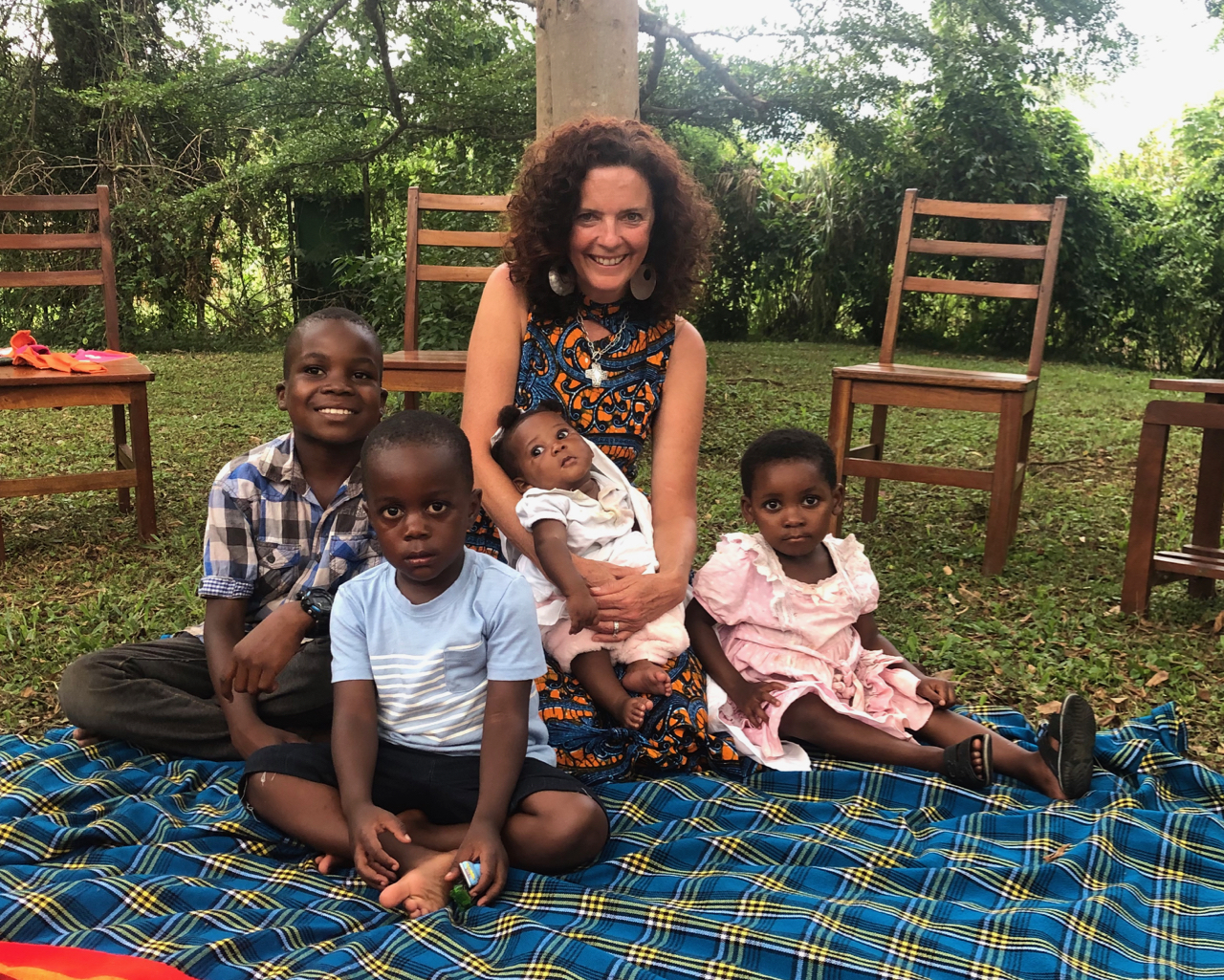
Me enjoying my grandmother status; these kids are being raised with love by parents whose hearts have been grabbed by Jesus.

Reward for scrolling to the bottom--Wedding invite from Luke and Abby (they did small personal ones for each family member), as we prepare to return to the USA in May and June for Jack's graduation, Acacia's graduation, Krister's graduation, Luke's wedding, two reunions, thanking a handful of supporters, and spending time with our moms.

That's what this week looked like. Thanks for praying, and keep bringing your own fish.