
Tuesday, September 18, 2012
Exchange of Thanks


Monday, September 17, 2012
Strike 2, you're about to be out
Well, I felt about out today. This second major Kenyan doctor strike is hitting us hard, but one thing we are thankful for is that we're not totally abandoned. Our Kenyan interns are in a difficult position, required to strike by their colleagues but also wanting to help us out because they're caring people. So they worked out an arrangement to cover some extra night/weekend call hours. Daytimes, however, it's me and the clinical officers, and today was a MONDAY in all caps.
28 or 29 babies in the nursery when I left tonight, I kind of lost count, but am pretty sure they were all taken care of. We had six admissions (which is a lot for a smallish intensive care unit) today. Our competent clinical officer ended up going to the C-section delivery of the sickest one, and I did the intern-level work to admit the rest. Well, 4 of the 5. The 5th one I looked over and decided didn't need admission in the context of this crowding. One good thing, I had to spit out some Swahili because everyone is too busy to help me. Even the nurses were pushed to the limit. I did three lumbar punctures and almost a fourth they brought me until I realized that baby was waiting for something else . . . It was just one of those Mondays where a lot of details had to be mopped up from a weekend where coverage is lighter. Our OB service is one of the few left in the area providing safe C-sections, so the moms are pouring in. We have several babies with serious infections from other hospitals, whom we are trying to keep isolated from our pristine majority. Several with surgical problems who have come for our great surgeons but are too sick to be operated upon, so land in our pediatric care. Two babies with cleft lips/palate who could not feed and became severely malnourished. A delightful preemie who beat the odds of a 27-week delivery (he tested at 25 weeks) and now on hospital day 49 is cute as can be, but his mom is in tears about stress in her life and family and had to be begged not to abscond quite yet. Many are improving, a few are struggling, and all require more thought and focus than I can give to so many sick ones. We lost three kids on our services in the last few days. Two died from severe congenital heart defects (again, transferred from other hospitals). One was a normal 9-day-old whose frighteningly lethal bacterial infection just escalated in spite of antibiotics until his brain was full of pus. THAT is hard, a preventable and treatable illness in many places, but too virulent for our resources.
Meanwhile in Kenya researchers have found a brand new species of mosquito that caries malaria parasites and bites earlier in the day, making it potentially a significant contributor to human illness. Countries all around us are erupting in violence. People we know are in risky places. Kenya just recovered vests stuffed with explosives being prepared for suicide bombings in a neighborhood where our friends work. The doctors and teachers are both on strike. Elections set for next March are feared to be another stimulus for tribal violence. I am a way-behind-in-planning mom who is still trying to book something for our mid-term weekend and something for a 3-day break between Christmas and airline tickets for Caleb . . . and so far striking out on all of that, which is frustrating.
So in all of this, I have to rejoice that thanks to cell phones and internet I booked Luke and airline ticket to come home for Christmas (he usually does it himself but the best-price site only accepted credit cards and he only uses a debit card). YEAHHH. And I have to rejoice that my mom who is 76 and who loves to ride ATV's in West Virginia survived a potentially serious accident when she flipped backwards on a steep hill and came away with bruises and stitches but no broken bones or internal injuries, and her passenger was completely unharmed. Miraculous. And I have to rejoice in many other things I'm sure though most of them aren't coming to mind right this minute.
Because life is so often this way, a hard sprint of a day and then 11 pm catching up with the parts of our hearts that are scattered abroad.
Sunday, September 16, 2012
Muslims worship who?
I (Scott) sat in a meeting a few weeks ago and heard a chaplain make reference to "some of our patients who are worshipping their little gods in our courtyard." It surprised me and, unfortunately I think, revealed a prevailing view of many Christians who believe that Muslims worship a "little god" or an "idol."
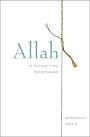
In light of the current raging fire of protests against America sweeping across the Middle East, I've begun to re-read a book I just finished a couple of months ago: Allah, A Christian Response by Miroslav Volf. Volf is currently a Professor of Systematic Theology at the Yale Divinity School. Having grown up in the former Yugoslavia, he experienced first-hand, a bitter war between Muslims and Christians. In his dedication of the book he says this:
To my father, a Pentecostal minister who admired Muslims
and taught me as a boy that they worship the same God we do.
Volf says that the goal of his book "is to explore how Christian and Muslim convictions about God bear on their ability to live together in a single world" (p.12).
In the end of his first chapter he has a section which he calls "Hot and Spicy." Here he lays out a number of theses which he realizes are sure to rile the feathers of a lot of people who have fixed ideas about the religion of Islam and the relationship between Islam and Christianity. The first of his theses is plain and unambiguous:
Christians and Muslims worship one and the same God, the only God.
They understand God's character partly differently,
but the object of their worship is the same.
I reject the idea
that Muslims worship a different God
than do Jews and Christians.
This is a fascinating book. Like Volf, I venture publicly into this inflammatory topic with great trepidation. Volf does say early on that he leaves "the question of salvation and eternal destiny aside. To use technical terms, the book is not an exercise in soteriology (the doctrine of salvation), but political theology" (p.12).
While some may doubt whether Volf is a Christian, he makes explicit statements about his faith: "What matters is not whether you are Christian or Muslim or anything else: instead, what matters is whether you love God with all your heart and whether you trust and obey Jesus Christ, the Word of God and Lamb of God. I reject making religious belonging and religious labels more significant than allegiance to the one true God" (p.14).
And his final "hot and spicy" thesis has relevance for some of the current debate in this election season: "To give allegiance to the one God who enjoins humans to be loving and just to all, as Muslims and Christians do, means to embrace pluralism as a political project--the right of all religious people to articulate their views in public and the impartiality of the state with respect to all religions. I reject the idea that monotheism, properly understood, fosters violence and totalitarian rule" (p. 15).
So, I implore those of you with any interest at all (and those of you who are Americans should be interested in light of the current Muslim protests against all things American) to grapple with Volf. You may not end up agreeing with him, but he's studied the Quran, dialogued with Islamic theologians, and sought to find common ground for discourse and peace. Personally, I think he should be nominated for the Nobel Peace Prize --and not because he's conjured up some fiction to appease Christians and Muslims, but because he's perceived and articulated some real truth in one of the most incendiary issues of our age.
Friday, September 14, 2012
Benediction
As the hands and feet of God,
we put our faith to work in service to the world,
trusting in the One who has helped us,
named us,
and called us
to lead us to those in need.
Let us love as God loves:
with hands ready to get dirty,
with feet ready to walk far,
with eyes ready to see hardship,
with hearts ready to receive.
Let us love as God loves:
with lives ready to serve.
(This is the benediction for this week's devotions on this site. A fitting prayer for our days at Kijabe, and yours wherever you are).
Benediction
As the hands and feet of God,
we put our faith to work in service to the world,
trusting in the One who has helped us,
named us,
and called us
to lead us to those in need.
Let us love as God loves:
with hands ready to get dirty,
with feet ready to walk far,
with eyes ready to see hardship,
with hearts ready to receive.
Let us love as God loves:
with lives ready to serve.
(This is the benediction for this week's devotions on this site. A fitting prayer for our days at Kijabe, and yours wherever you are).
Wednesday, September 12, 2012
a short thankful list
Fifth day back in Africa, third day of work, and starting to feel like we never left. I'm getting used to sweatshirts and down blankets, to the rattle of wind and the cadence of Swahili. But I'm not used to the absence of half our family. Rinsing dishes, setting out the morning granola, hearing the motorcycles, walking into the bedrooms, the startling absence of guitar chords, all leave a gap. More like a crater. So tonight I'm remembering a few things to be thankful for.


First, Scott. This is us in our favorite airport, Schipol, on the way home. Only the coffee gives you a hint that we had been awake for more than 24 hours straight at that point . . . This year has involved a lot of separation, and more to come, something I didn't think we'd allow in our lives but now seems to be part of the territory of compromise. Allowing children to be different ages with different needs, allowing jobs to continue.
 These smiling faces. Julia hard at work on a Bible paper, when she's not at tennis practice, or a meeting. She's a jewel.
And Acacia shown here working on an art project, standing as she prefers when working. Note the incredible drawing of her cleat. So thankful to have her in our family for a good chunk of the year.
Jack I think refused to be photographed . . .


 NMy USAFA paraphernalia. Besides the rainbow moment, the placement of Caleb in the THUNDERBIRD squadron was a most confirming moment for me that he's in the right place. My dad's car, and the camp where Scott and I worked the summer after college. This was like walking into the chapel at Yale and hearing a hymn that meant something very specific to me, ways that God affirmed His presence and planning. On a lighter note, my mom found this late 1940's pillow in an antique shop in the small town where my Dad grew up. She had to buy it.


And Acacia shown here working on an art project, standing as she prefers when working. Note the incredible drawing of her cleat. So thankful to have her in our family for a good chunk of the year.
Jack I think refused to be photographed . . .


This baby was born on Tuesday. She weighed 760 grams with all her equipment, and was an unexpected precipitous surprise at 26 weeks, feet first, head caught, an all-around disastrous start to life. But she's pink and fighting, and her parents raised 13,000 KSH ($160, no small sum in this place) to buy her surfactant, a slippery soapy liquid derived from the lungs of pigs and cows that should be present to smooth and expand all lungs, but is not developed at 26 weeks. So day two of work saw me struggling to pass an endotracheal tube into the minuscule airway of this tiny girl after more competent but less senior people failed. It took two tries and a bold out-loud prayer but we got it in, and today she was improved, huffing along with the extra airway pressure blowing into her nose, but no added oxygen. And though her chances of survival are still slim, between her spunk and her parents' love and my doubt we had to try. Partly because of babies like the one pictured here:

Her mother walked and hitched rides on a motorcycle at night when she was born tiny and premature, arriving at Kijabe holding baby Leah against her skin for warmth. Now she's about as cute as they come. This is the goal, a growing active alert little person who eats and cries and is almost ready to go home.


Home is on my list, with the profusion of blooms where once there was mud alone. The top picture our gardener Ernest created around a bare stump that has now been engulfed in flowers. Though this house looked cluttered and dirty and small after America, five days in it feels quite homey. I'm thankful for this place.


Chardonnay and Star. Nothing beats a dog. Chardonnay is perky and pesky, Star tolerates her. (Luke take note that C is outside, and S moved inside . . ) I've taken them on some walks/jogs since returning. Today a mentally ill frequenter of these paths saw me go by with Star, and said in the friendliest way, something along the lines of "you're running! We clap our hands for you!" Made me feel nearly olympian.
NOT PICTURED but the most important: friends. Anna L and Bethany F are now working at RVA, Anna for at least a year and Bethany for one term. Wonderful to have team mates, people who have known us for a decade and counting, people who worked with us in Bundi. And they're both just wonderful women. Karen M was here when we arrived, orchestrated by God to give us a welcome. Last night we had a prayer time with a couple of neighbors. It's been wonderful to see my good friend and partner Mardi, and to welcome new paediatricians (3 since I left!). More on all those people when I remember to snap their photos. Then there are RVA friends, our fellow-sponsors of Julia's class, our fellow nurses and parents and teachers. There's nothing like connection to ease the sorrow of goodbyes. We've been here for less than two years, but the relationships are deepening and precious.
So we're back, immersed, in work and meetings, patients and phone calls. We're reading books and making meals and mourning the terrible news from Libya and Egypt tonight, the news that reminds us we are strangers in a strange land in many ways, and Africa is vast and other and capable of anger. But Africa is also home, and friends, and solid useful work, and history and love.
Sunday, September 09, 2012
Re-entry, again
I never lived at Kijabe with Luke. So when we said goodbye to him in college and moved here, departure was a sorrow, but arrival did not bowl me over in poignant memories. I suppose that's why this morning broadsided me, going to worship at RVA where Caleb played guitar a few times and sat with us every Sunday, where the people are familiar and connected to him. Sometimes life seems like a series of surprises of grief-waves, that one has to bob to the surface of and hold onto the raft, gulping air until the next crash. Good to be home, yes, but this particular home points out absence as well as presence.
And this particular home is a mess. I'm not a good housekeeper, I admit it. Half my family is pretty messy as well. A veritable herd of people have slept/eaten/hung out here over the last couple of months. It's raining and muddy. We have a puppy who has to be kept largely indoors. There are bugs and sticks and spattered sauces and dusty corners. Junk accumulates. We brought back four suitcases FULL of it. None of this bodes well for visual peace or healthy cleanliness. And it's all ten times more noticeable when coming from my mom's.
So in the midst of missing Caleb and Luke, and of despairing over dirt and disorder, it was God's good plan to plop a buoyant cushion of wonderful WHM friends here to soften the fall. Karen spent the weekend. Bethany has moved here for the term, and Anna for at least a year. Plus I saw my friend and colleague Mardi. Instead of merely unpacking, I had multiple good friends to share with, to hear, to debrief.
Transitions are just tough. Tomorrow will be a doozy of a day. Will be glad when this week is in the past. But given everything else in life, I'm super thankful for Karen, Bethany, Anna, and Mardi, and many others I greeted at church, even if their kind words made me cry.
Saturday, September 08, 2012
From the African Skies
At 583 miles per hour, a thousand miles from home, far above the eastern reaches of the Sahara desert into northern Sudan, we speed southwards towards the equator. In two hours the epic which has been a two-and-a-half month sabbatical for me, and a two-week family visit for Scott, will end. So before that happens, a few more thoughts on the value of sabbath.We are coming up on 19 years in Africa, 21 years with World Harvest Mission. And while we've failed to keep the sabbath at many turns, to our own harm, I think the rhythm of our life has not been completely off of the patterns established for good. A weekly day of rest? Mostly, at least a day of worship and family time, though in medicine one does get pulled into the mercy exceptions. Yearly weeks of festival? The Israelites traveled, gathered, camped three weeks a year, and we've done similarly, with team retreats and adventures, though the return travel in Africa generally seems to negate the rest of that time away. Years of sabbath every seven? Hmm. We did that after the first seven years, but then as leaders we felt less option to leave for extended periods. One year after 6 1/2, 5 months after the next 9, perhaps another year after 5 and that will even out a bit. The once-in-a-lifetime Jubilee, the 50th year after seven cycles of seven, debts forgiven? Not exactly, but this summer was my approximation of that, a true forty-day period of solitude, prayer, reflection, rest. Perhaps not all these rhythms are eternally applicable to a non-agrarian society, but perhaps they do reflect the way we are created, and the concept of sabbath is part of the ten commandments.
The old missionary pattern was four years on the "field" and on year back at "home" in every five-year cycle. This pattern was set when travel took weeks not hours. When kids had little schooling option or flexibility. When expectations were low for maintaining American culture and relationship in the interim, when letters crawled back and forth over the globe, when those in "foreign" lands had little contact with their family and friends left behind. And when those kids were expected to fully immerse in American school on that fifth year, because they were more American than global citizens. It's a different world now, where we can fly to America for important events like weddings and Parents' Day weekends, where we can check on facebook and find out immediate news, where we don't want to miss anything. What used to be the year-long furlough can be parceled out into smaller chunks that allow us to remain connected in more immediate ways with people we love. Where our kids have consistently attended Ugandan and missionary boarding school because we haven't pulled them out for a full year. This is largely good. I believe it was the RIGHT thing to be physically and emotionally and spiritually more available to at least some of our kids this summer by taking a trip. And as my mom said, it's the most time I've spent with her since I was married 25 years ago (or more likely since I left for college 32 years ago . . . ). Perhaps one surprise of this phase of life is that graduating from high school is not graduating from the family, that it may take more from us to get ourselves to regularly input and support in young-adult lives than it seemed to when we all lived together.
"Furloughs" or "HMA's" involve visits with family, because through the years away one can't just show up for the weekend, or gather for Thanksgiving dinner. They involve doctors' appointments, dentists, getting glasses. They involve paperwork and shopping and errands compressed into a few days that someone in America might spread over a couple of years. They involve thanks to supporters who are the essential bedrock of everything, but too often silently taken for granted, as we show up at church, at lunches or dinners or prayer meetings. They involve (often) meetings with supervisors, plans for the future, or debriefing the past. They involve recruitment of new help. They involve updating of skills and qualifications, perhaps study of some sort, a course, an apprenticeship, access to resources after years of isolation. All of this takes time that a normal person might spread out over weekends here and there, afternoons, phone calls, vacations or study leaves. Instead we do it in concentrated doses. All of that with international travel can probably fit into an annual 6 weeks, or a biannual 3 months. All of that except the most important part, the actual sabbath. The rest.
That's why this summer was so different for me. I did a lot of that visiting time and appointment time and errand time, and it was good. But in the middle I had the inviolable 40-day block thanks to Caleb's basic training and the kindness of our friends who leant me a cabin-like home on a ranch. I don't know all that happened on a soul level just by doing that, but I sense that some good things did.
It would be easy for the shorter more frequent time periods to always fill with the fixed amount of family/church/errand/appointment time, because those events are a constant whether done every year or every five years. There is freedom, I think, for us to take the sabbath principle and use it for our good. The sabbath was made for humankind, not humans for the sabbath. As always truth lies in two paradoxical poles: hard work, solid rest. We can easily drift into over-busy over-working over-self-importance. We can also drift into fixation on our right-to-rest, fear of the challenge can drive us to be away from ministry more than is right It's hard enough to strike the right balance for ourselves, let alone for others. If sabbath is always equated with leaving the "field", that can lead to disruption of bonding and language and sense of home. I think that's why I rarely use the missionary-ese "HMA, Home Ministry Assignment". Home is a complicated concept. So is ministry. The phrase implies geography, leaving Africa and going to America, which is not necessarily better for purposes of rest and reflection. And not necessarily home for 2/3 of the family who spent their entire lives in Africa. As I said, complicated.
More Christians who are not in professional ministry probably need to think through issues of sabbath and sabbatical, of rhythm and rest. We're blessed to be in a profession, and a mission, where such time is valued and even required. In the end for us it boils down to the same issues of faith that determine the rest of life. Following God's patterns involves cost, to me, to my kids and coworkers and extended family. Following God's pattern requires faith that the time of not-being-productive is good time, that Gods' grace will bubble up to infuse the spaces created, to supply our needs. I need that faith as we land this evening, that the cost others have borne will not truly hurt them. That I'll be able to walk back into relationships and work and life after such a long absence.
Khartoum has passed beneath us as I type, and we are nearly to the Ethiopian border, nearly to the curtain of night time. My body has changed time zones a lot lately--this is the seventh switch in a month, from 1 or 2 to 7 or 10 hours difference. Ironic that rest should make one weary, but anything that is worthwile usually does.
Monday, September 03, 2012
Parenting 101
Perhaps by now we're actually in Parenting 212, or 365, or even a grad school course. We've been at it for 19 1/2 years, which is longer than it takes most people to get a PhD. But the subject keeps changing faster than we keep learning. We made enough mistakes in the first year (horrendous sleep habits, for instance) that we probably did deserve to fail and repeat. Which we did. But parenting, like living in Africa, is one of those endeavors that never morphs into something simple. I know when we had our first full night of sleep (at the end of year one) we probably thought we had arrived. Instead the whole thing just keeps getting more complicated, but also more interesting, and more fun.

 This phase has some amazing views. And more than a few tears. As we bustled Caleb back in his full dress uniform for the 7:10 pm deadline to sign into the dorm, the sun was dropping behind the Rampart Range of the Rockies, the eastern clouds suffused in grey and pink and then a stark half-arc of rainbow stretching right up from Caleb's dorm. Scott pointed out that it looked very much like a promise from God not to destroy something, like Caleb, and instead to bring hope. We were about to say goodbye when the loudspeaker system came on at 7:05, all over the cadet area. Playing, I kid you not, "I'll be home for Christmas", in a tinny sappy Bing Crosby voice that immediately made me cry. Thankfully we are planning that Caleb and Luke will be home for Christmas. But not until then. And I thought it was a bit cruel for every mom getting and giving goodbye hugs to be hit with that song.

 So this chapter, this unit, ends tonight. Tomorrow (Tuesday) we fly to Virginia, drive to West Virginia for one day (Wednesday), then depart for Kenya on Thursday, arriving Friday. To another good chapter, the one where we study how to support high schoolers again, where we cheer for Jack playing varsity football (soccer), Acacia playing JV basketball, and Julia playing on the tennis team. Where we go to sponsor meetings and health clinics and work and feed the dog and cook and pull in friends and proof-read papers and quiz on vocab and find missing uniform pieces and art projects. And the one where we try to SMS and email and stay in touch with the two college sons too.

 This is one course from which I have no desire to graduate, only progress.
Now we're in a whole new phase. Two kids in America, two in Africa. Two in college, two in High School. Plus the bonus child, Acacia, who comes to us 9 months a year as a gift. Plus a dozen ambiguous, good, "foster-child" sort of relationships with teens and young 20's back in Uganda. It's a phase that involves a lot of email, and airline flights, and prayer. And a whole new round of sleep deprivation.
The cell phone question nearly did us in. In Africa it is fairly straightforward. You buy a phone, for as little as $20 or as much as $100 depending on the model. You buy a SIM card for $2. You buy as much airtime as you want, load it on, and you're good to go. It takes a few minutes, only requires a few decisions, and if you don't like the SIM you chose there are a handful of other companies and you're only out $2. Ten dollars of airtime can last days, weeks, or months, depending on what you do. An SMS costs next to nothing. Calling America is about 5 cents/ minute. Data is more complicated, but possible. It's not perfect by any means, but it is no preparation for life in America. We just watched Hurt Locker, with that fantastic cereal-aisle scene. We felt equally bewildered by the simple necessity of buying our son a cell phone. Prepaid versions it turns out don't work at the academy due to some fluke in which the companies don't rent that tower for that service or something. That means a 2-year contract . . . as we were trying to sort all this out we could tell that we didn't know what we were doing, and this was small comfort to the child involved. We also messed up communication about Thanksgiving break and airline tickets, another unexpected steep learning curve where information is not very forthcoming from the academy and we aren't on top of it all. Being around too many other parents always makes me feel like we are behind the curve. Then there is the whole unexplored territory of relating to your kids as adults, of their character and emotional state and potential relationships, their friends. Of all the things we don't hear or know anymore, because we aren't around. It can feel like a lot to learn.
Thankfully a very nice Sprint guy explained the whole cell phone contract in ways we could understand, like an unexpected angel. Luke worked out Caleb's travel. Others keep offering help. We've had three great days with Caleb at the Grahams, with their comfortable, private basement apartment allowing him to just relax, sleep late, do homework, skype friends, and not be under the constant pressure of the USAFA. We heard about some of the myriad of opportunities and the things that draw his heart and imagination, and came away with even greater peace that he listened to God's call and is in the place that is right for him. We had a great time with Luke before that, meeting his friends, and giving him what he called the "perfect start to Junior year". He is also in the right place. Little moments of grace, of food, of hugs, of asking questions, listening.
And mostly of seeing with a degree of awe what people these sleepless/ sleepy babies turn into. I think at this moment that's the thesis for the degree: discerning what unique gifts have been instilled in each child, and cheering for them along the way loudly enough that they have the courage to step out, to become their own person, to choose hard directions, to march to their own beat. Hoping that they stand confidently upon the love, that all our mistakes do not obscure the fundamental truth that they are particularly and absolutely loved.


Friday, August 31, 2012
Parents' Weekend Day One


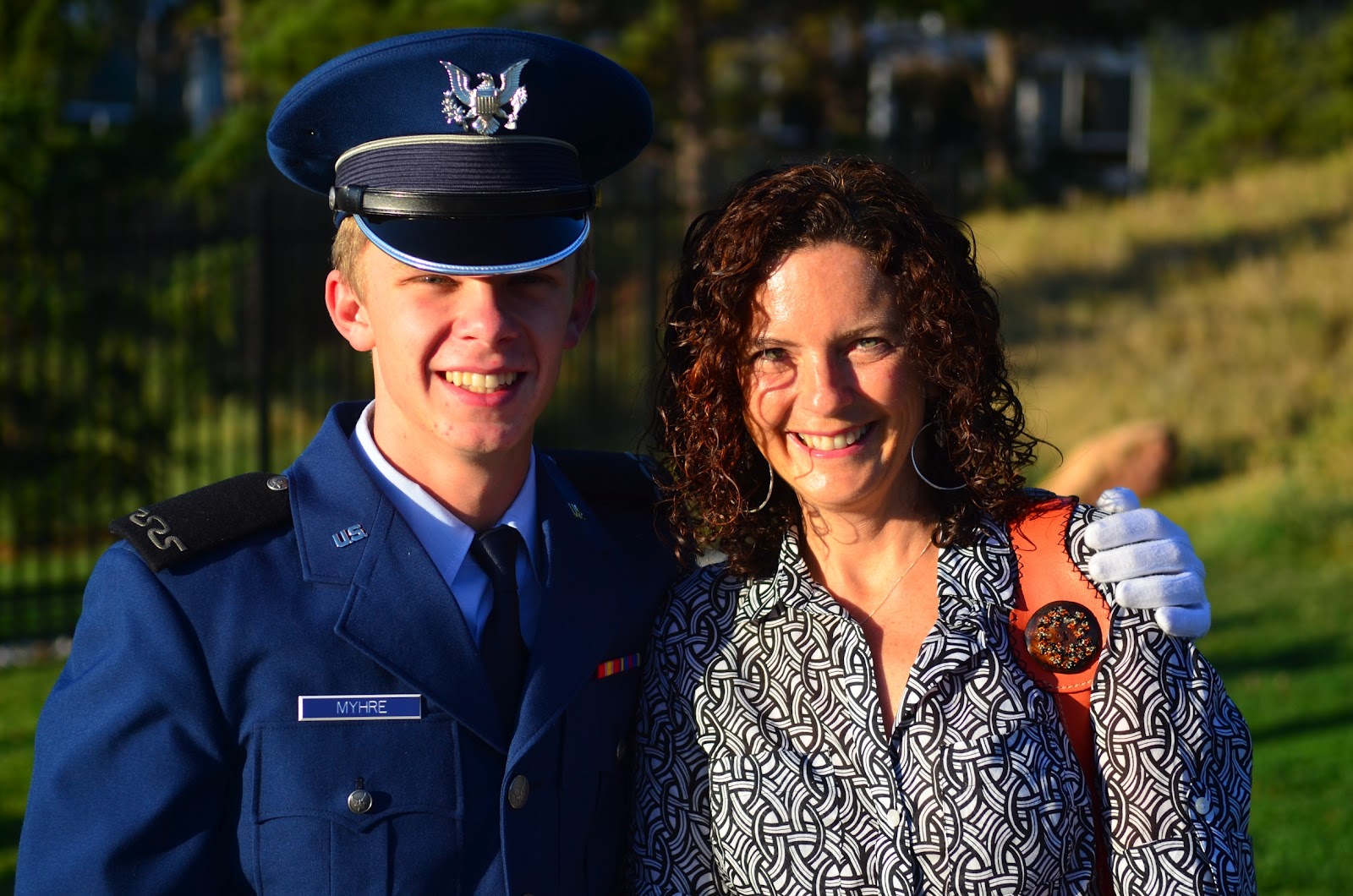

Scott took pictures of the airshow and parade. Not your average college visit, that's for sure. At least a dozen cadets parachuted onto the field, followed by acrobatic gliders rolling and turning and looping in the sky above us. Four F16 fighter jets roared over in formation just as the parade started, the 4000+ cadets marching in squadron by squadron with flags and a band. There were cannons fired, the National Anthem, honors mentioned. Even one of the trained real-bird falcon mascots flew in a demonstration.


Caleb also has great room mates, like Luke, really faith-restoring to see the quality of the young men in this generation.
Caleb is doing well. He works hard, and trains hard, and while there is a lot about the Academy that is stressful and unpleasant, he pushes on through. We are thankful for his quiet strength and dependable effort, and delight to see his humor still shining through. Love this kid.
Subscribe to:
Posts (Atom)