rotating header

Saturday, March 02, 2013

Meeting for Peace: East Africa Model UN


This past week Jack accompanied 16 other RVA students daily to Nairobi for the East Africa Model United Nations Conference.  Nearly a thousand kids from Kenya, Tanzania, Rwanda, Uganda, and beyond congregated in the actual UN buildings (there are only 3 places in the world like this I'm told, though I can't remember the one that's not New York or Nairobi).


These kids were African, Asian, European, American, all hues and backgrounds, from those who grew up a stone's throw away to those whose parents are posted here on diplomatic or business purposes.  They conducted a week of speeches, resolutions, debates, and parliamentary procedures.  Each school was assigned a handful of countries or organizations to represent, and then their delegates were divided between four major sections of about 200+ each:  politics, economics, ecology, and human rights, with a smaller number sent to a special session that debated a few specific and varied topics.


Jack was assigned to represent the IMF on the Human Rights committee.  The resolution he wrote was chosen for recognition as best in his committee, and I'm told he spoke very well (let me testify that the boy can argue a point).  He had designed a program for Columbia to combat the use of human mules in drug trafficking.  RVA received 4 other certificates for speaking, so netted 5 of about 20 awards given.  (that's Jack in the blue shirt below).


One of our students, Daniel Letchford, was Secretary-General and gave a very inspiring speech in the last session in front of the entire thousand people.  He pointed out that only opportunity, not merit, separated the kids in the room from their neighbors all over Africa, and challenged them to make the most of those opportunities.

I was able to join the last day, Friday, as an observer, and am so glad I went.  This is a microcosm of the world, and these students will be the very people who lead us into peace or war in the next decades.  By meeting each other, they formed understanding and bonds.  They learned to debate issues with logic and passion.  They got a taste of the political process.

Particularly poignant and urgent as Kenya approaches elections in two days . . .


 This is the whole RVA group in front of the UN sign.  Tim Reber, principal and MUN sponsor, is in the back on the left.


 The Human Rights committee, above and below.


This was as close up as I could get to Jack, blue shirt in center . . . 

They also missed a week of school, so Jack's paying for that this weekend as he tries to catch up.  Tomorrow he turns 15. We measured him at 6 feet 1 3/4 inches this morning.  He just finished basketball season and starts rugby tryouts tomorrow; he writes creatively and aces precalc and physics; he thinks deeply about eternal issues.  Whenever I think of how his life started, with me running from rebels and extremely ill with dysentery and high fevers in the first trimester of his gestation, I marvel that someone so robust could emerge from that inauspicious beginning.  Grace, all grace.  

Thursday, February 28, 2013

18 years ago today

This boy was born, right here in Kijabe, Kenya.


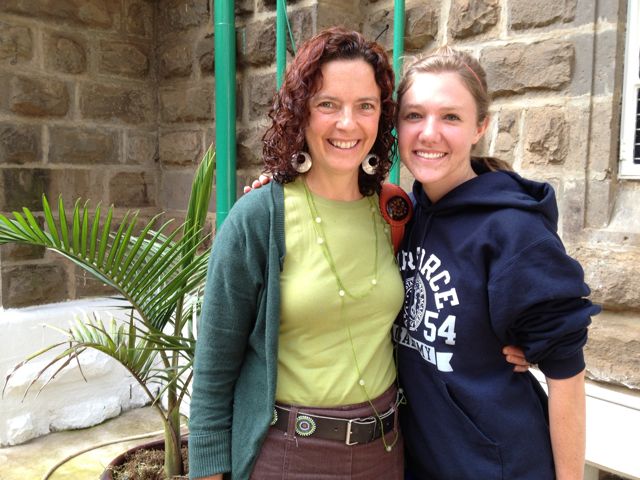
This morning I thank God for one of His four greatest gifts in our lives.  In honor of the day, I walked into maternity (where I now rush in to revive struggling newborns on a regular basis) and asked a student nurse to take my photo on the very bed where Caleb was born.  We had come to Kijabe in January 1995, one of the first flights off our new jungle airstrip, after preterm labor was failing to resolve.  We stayed in the Kijabe motel, took Luke to visit the rabbits at the demonstration gardens daily, drank chai at what is now Mama Chiku's, and waited.  On Feb 28 morning I walked Barns with Luke on my back and that did the trick.  Diane Bannister and Scott let me hold onto their shoulders to climb up on that bed, and Caleb Scott Myhre came perfectly into this windy beautiful place just after noon.  We spent the rest of the day in a bed on maternity (what is now the 50's) and then took him to the motel where he slept in a trunk with the lid removed. About two weeks later we drove four days back to Bundibugyo.


Where the Bhana Bhana (4 kids) grew up.  With wagon rides and friends and football and hikes and a sandpile and legos and stories and singing and bug bites and pizza and sombe and mountain peaks and funerals and school and gunfire and crises and love.


I would give much to see a smile like this on Caleb today.  Thankfully our friends in Colorado Springs have managed to penetrate the Academy with some packages.  But this 18 year old continues to hobble a hard road.  He's on his 10th week of crutches, and as if that is not punishment enough, restricted to the Academy until he serves 50 hours of sitting in a supervised study hall.  He plugs away at physics and Arabic and calculus and spends a couple hours a day going to do physical therapy.  He encounters a constant stream of abusive interaction and stress.

When Caleb was born, God gave us the story of Abraham and Isaac to lead us to take some risks with an uncertain outcome.  This year it is the story of Joseph that resonates:  he also fell in a pit, served hard time, was isolated and challenged.  But God used all that evil for good, both for Joseph, his family, and the world.  

So please join us in praying for Caleb today. Thank God for his life, his courage, his grit.  Pray that he would not lose sight of HOPE.  That he would have true friendship and community in an environment that can be hostile.  That God will redeem this year of torn ligaments and nose-to-the-grindstone work to mold a man who will bless the world in ways we can not foresee.


Sunday, February 24, 2013

breaking radio silence...

Someone wrote a comment and said, "It's been 20 days since you posted on the blog...are you OK?"

Well, I guess there's a reason: Life happens.  It was a perfect storm....

- We are one of six couples who officially "sponsor" the RVA Junior Class (Julia's class).  Every February, the Junior Class puts on "Banquet", the RVA equivalent of "Junior Prom."  It's a "Dinner-Theater Event". So, we have been consumed by Banquet Prep - Jennifer on the "Tables and Settings" Committee and me on the "Drama-Entertainment Committee".  The theme was "TITANTIC"! 


- One of our missionaries in South Sudan was in Arusha, Tanzania about two weeks ago when she developed severe malaria.  She was critically ill and required air-evacuation to our hospital so that we could take care of her (if there's one thing we know how to do, it's treat complicated malaria).  That two sentence summary doesn't really do justice to the utterly stressful and consuming two weeks of treating a colleague who has a life-threatening illness.  She's been discharged from the hospital and is convalescing in our home now.

- Kijabe Hospital.  We're living on the edge, with very little margin.  But it's worth it.  The video link HERE gives a different glimpse of the kids who come for care at our hospital.

Wednesday, January 30, 2013

Kijabe Hospital Video


to see a video about Kijabe Hospital, our home for the past two years.

This video beautifully portrays the work of Kijabe Hospital:  compassionate healing of the poor and vulnerable, spiritual care, and training for service.

While the video focuses on the surgical services of Kijabe Hospital, there are many other non-surgical services behind the scenes as well (general outpatient, pediatrics, internal medicine, etc.).

Bottom line, it's a busy, busy hospital serving patients from every corner of East Africa and proclaiming the Kingdom come in word and deed.

(P.S. - you may catch a glimpse of Scott in several different clips as he delivers a baby by C-Section).

Sunday, January 27, 2013

Jua Kali

Saturday morning, 6:30, pulling out of the rough driveway to scour Nairobi for several items my Banquet (the non-dancing version of a prom here at RVA, more like dinner theatre with elaborate sets, better-than-usual food, dressed-up couples, and plenty of drama) committee still needs for decorating tables.  This has been a heavy burden weighting me down, because I never find time to shop in Nairobi, I'm not a good shopper, I'm not sure what is even possible to find, and the hopes and dreams of a bunch of kids shouldn't rest on my busy-ness and inexperience. We tried to save money by ordering a small item on line, which ended up originating in China, taking so long to get to California it missed connecting with Luke and Caleb at my in-laws, then being lost in the bowels of the Air Force post office for a month and a half, until yesterday . . . not a smooth plan.  Time to focus on local procurement.  So I invited my old Swahili teacher to come with me. He does a major family shopping trip to Nairobi every Saturday, to pick up the fruits he loves (buusukali, the little Ugandan bananas) or certain vegetables that he wants his kids to acclimate to from their western Kenyan roots (pumpkin leaves), to visit friends and get a haircut and exchange news and who knows what else.  So Scott had the brilliant idea of offering to drive him around to some of these excursions and transport his groceries, in exchange for advice and initiative in my own hunt.


We flew down the nearly empty Saturday morning roads just after daylight, chatting and plotting.  First stop, a little shack of a flower shop where E thought we might ply the owner for advice on where to find wreaths we could use for a flower decoration.  I had only found small bricks of flower-holding foam previously, nothing circular, or big enough to cut a circle from.  Our time was drawing near, and I didn't know where to look.  As we arrived the brilliance of Scott's plan became apparent.  Various security guards and casual laborers were lingering around the wooden stall behind a gas station, drinking porridge which an enterprising woman was selling to the pre-work early-morning crowd, pouring from her thermoses into a series of plastic cups.  As they sipped and waited, E struck up friendly conversations.  He politely enquired and prodded and came up with several good leads on other items we were searching for.  Eventually the stall's owner showed up.  Buy a wreath?  Why?  He showed us how he makes them.

Jua kali translates as "hot sun" in Swahili, but it's the term for innovation.  The people who work on the roadside.  Out of their house.  Behind buildings.  The people who cobble together this and that, who repair tires with plastic bags, who bend wire to keep an engine running.  Who can serve a meal from a pot balanced on rocks, who can sew a suit on a treadle machine.  These people don't have offices or titles, they live on a fragile margin.  But they can almost always solve a problem, and they are good-natured about the effort, willing to extend time and help to a stranger.  There is almost always an interested crowd since this happens outdoors, without the isolating barriers of walls and procedures.  There is abundant advice, and celebration of success.
Note the wheel barrow, matatu, and bus

Africa abounds in creative ingenuity.  The old adage "want is the mother of invention" could have been coined here.  If a more pampered person like me lacks the tool or the access to find what I imagine, then I'm stuck.  But in Africa one does not expect the exact item to be available, one simply makes do and improvises.  We found what we needed on Saturday, not by a google-search or an amazon-order.  We found it by hitting the streets, striking up conversations, asking for help, accepting compromise.  Those two aspects of jua kali intrigue me:  concocting solutions, and doing so communally.

So I'll end with a picture I snapped that morning while waiting for the flower-stall owner.  Two men jumped off a truck to load some massive sacks of carrots which had been dropped there earlier in the morning.  The 50-kg bags were extended in capacity (more jua kali) by a rope net, so I"m sure each weighed more than I do, at least 70kg?  I wondered how they could get hold of the bulky bundle, let alone lift it.


As I watched, one man gripped the other's arm tightly, then they tilted the sack of carrots back onto their human bridge, used their other hands to grab the bottom of the bag, and off they went to the truck.

Instead of struggling to hold the bag, they held onto each other.

The beauty of this hit me like 50 kilograms of carrots.  We try to solve our problems alone, or if we can draw in help, we both try to hoist the burden, grabbing and clutching unsuccessfully.  If we hold onto each other in community instead, the burden becomes lift-able.

African jua kali, wisdom of the streets, born in desperation but leading the way.

Thursday, January 17, 2013

Knitting Sinews


Therefore strengthen the hands which hang down, and the feeble knees, and make straight paths for your feet, so that what is lame may not be dislocated, but rather be healed.  (Heb 12: 12-13)

Almost a week ago, a surgeon in Colorado Springs cut into Caleb's knee to repair and re-attach the same strands of ligament that God had originally knit together in utero.  The extent of damage was considerable, and the task of healing three ligaments at once no small thing.  Yesterday Caleb went for his first post-op check, and the news was good.  He has very little swelling or bruising and more flexibility than expected already.  His surgeon seemed surprised.  I'm sure there are many pray-ers out there who aren't.  Through medicine, surgery, rest, and supernatural strengthening, that which was lame is being healed.

Scott moved Caleb back into his dorm, and said a painful goodbye after five days of intensive paternal nursing care.  Caleb got on his crutches and went to class, trying not to slip in the snow.  He gave me his usual line on the phone:  "I'll be all right."  

But I waver.  It was hard for all of us to see Scott go.  The discipline and medical review board juries are still out, and may be for many months.  Catching up on work, just getting to class, just getting dressed, are exponentially harder than they were last term.  It's dark and cold and the middle of the most intense hazing of the 4 years.  The USAFA is an enclave of the physically perfect, a place where only the healthiest and fastest and strongest are allowed. It is not a nurturing environment for the disabled.  And the things which made it bearable:  soccer and the hope of flying and jumping and the release of hiking or skiing . . . are all a year or more away.

So as you pray for that knee, for that healing, for the bones and ligaments to knit together, can you also pray for our hearts to be whole?  Faith is that elusive evidence which remains unseen.  With Scott gone, Caleb is in God's hands alone.  Which should be more comforting than it feels when you read the entire chapter of Hebrews 11.  Pray against discouragement.  Pray for hope.  Pray right on into chapter 12, that Caleb would see this chastening as a mark of God's love, that as painful as it is now he and we would cling to the assurance that it is for his profit.  That we would all be able to rest on the Kingdom which can not be shaken, by grace.

Slow-Motion Miracle


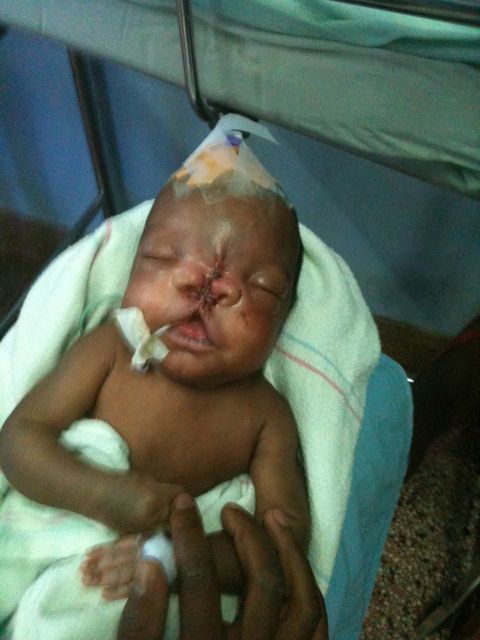
This is Bedan, who was born with a large sac of brain membranes and fluid protruding from the middle of his face (wish I'd thought to take that photo).  He went home from his seventh surgery yesterday (bottom picture), having been admitted many times in this last year.  His mom thanks those who helped and those who prayed.  And we all thank her for believing in this baby, even at the cost of her marriage and security.  And we thank Dr. Nthumba, the plastic surgeon.  He's part of the heart of Kijabe.  The young Kenyan doctor with a passion for surgery who serves at Kijabe, is sent for further training, forgoes lucrative positions, and returns to establish services here that smooth contractures, reconstruct damaged bodies, heal burns, save lives.  When he's not sewing people back together he also manages all the interns and medical education.  Bedan's story is one that illustrates well the essence of Kijabe:  rescuing from the ash heap those that most of the world would abandon.  Mobilizing resources to help the marginalized.  Pioneering services that are not available on many places on this continent.  Investing in the next generation of Kenyan doctor-leaders.  And doing it all in the name of the love of Jesus.


Wednesday, January 16, 2013

Show the path

Read Psalm 16 this morning.  "I have set the LORD always before me, because He is at my right hand I shall not be moved. . . You will show me the path of life."  Praying today for Scott and Caleb.  In about 45 minutes they'll be at the clinic for follow-up.  In the next few hours they need to decide if Caleb is ready to return to the rather harsh life of the dorm, and go back to classes.  Because of the bone fracture and extensive surgery it is no small thing to crutch around a large campus in the snow where 3/4 of the inhabitants are bent upon abusing you anyway to make you tough.  But missing classes is also no small barrier to overcome in survival.  And Scott has a plane ticket to fly out of Denver this afternoon, out of Dulles on Thursday, and land in Nairobi Friday night.

Meanwhile the US embassy just issued all sorts of dire Kenya advice, totaling up all the random bombs and deaths and kidnappings in the last year, so that we're properly sober about the potential for chaos in light of the primary elections due to take place tomorrow.

We are grateful for so many prayers and know they carry us along as the world shakes with torn ligaments and uncertain futures and corruption and riots.  I guess I'm just feeling it today.  Ask the One in whom we put our trust to heal Caleb, to show him and Scott the right path.  To not let him be moved from his USAFA path, nor us from our work here in Kenya.  To give us counsel, to let us rest in hope (v. 9).

Sunday, January 13, 2013

The rest of life: 2013 year in review

In between phone calls to Colorado, life still goes on.  And 2013 feels long enough already for a year-in-review post.  Perhaps the first one in the blogosphere for this particular year . . . Here goes the 2013 year in review.


Research, education, goals, and public health:  Last week a group from Kijabe hospital joined other paediatric and obstetric doctors and nurses at the University of Nairobi and Kenyatta National Hospital to discuss our progress, or lack thereof, in reducing neonatal mortality.  60% if infant mortality occurs in the immediate post-birth period.  While overall under-five child mortality in Kenya has halved in recent decades, neontal mortality stays stubbornly high at 31 deaths/1000 live births.
We listened to presentations on the top killers:  sepsis, prematurity, and asphyxia, and discussed ways that better communication and team work, appropriate hygiene, basic warmth and feeding, could avert up to 75% of those deaths.  Inspiring stuff.

And particularly relevant at Kijabe where the new year started with the delivery of quadruplets.

Patient Care:  On Jan 1, on the way back from taking Caleb to the airport, I got a phone call from the medical director and thankfully we could mobilize four docs to receive them on short notice.  They are all girls, perhaps identical, perhaps two sets of twins.  
Here are Erika, Immaculate, and OB Martin speaking to the media.  The safe delivery and so-far survival of these 900-1100 gram girls was quite an event.  I was standing behind them looking useless and official.  The next day a random guy stopped me and said "I saw you on TV!"  That was fun.

After a couple months of ICU, Dr. Sarah and I have switched to the general paediatric floor, also covering the maternal-and-child-health clinic.  High volume, lots of malnutrition and seizures and sadness, and a sprinkling of the truly puzzling.  Last week we figured out (with tons of help) that the 11 year old girl we thought had TB because of the fluid in her lung linings actually had a quivering  floppy failing heart because her kidneys were being damaged by obstruction to their blood flow.  And that the toddler with diarrhea actually had an unusual sequelae called hemolytic-uremic-syndrome.  And the teen with a massive liver had been infected with Hepatitis B at birth and developed liver cancer.  And on and on.   Some stories I find particularly heart-breaking.  Like P, who is cradling his little cup of porridge as we try to extract his story.  Ten years old, with AIDS, abandoned by an abusive alcoholic father that ended up in jail after his mother ran away, shuttled through four orphanages already in the last year or two, stunted and infected and quiet.  We tried to find any person in his life to connect him to his family or past; he could only remember one lady who owned a salon where he used to live who was kind to him.  In the end my colleague connected him with an excellent ngo which serves HIV-infected orphans.
Or baby N, from Sudan, a refugee in the vast border Kakuma camp, born with hydrocephalus and twitching for weeks until the agencies in charge managed to transport her and her mother to Kijabe.  Where they can't communicate with anyone.  We plug through rounds day by day, hearing the stories, prodding and probing, thinking and tweaking.
Many get better, thankfully, like this bundle of cuteness.  There are satisfying moments such as popping a heavy needle through the tibia (leg bone) of a 10 month old who is probably less than an hour away from dying of diarrhea, pushing syringe after syringe of fluid, and watching him wake up, his eyes flutter open, his arms start to push us away, his face looking for his mom.

Training:  We are a teaching hospital, continuously raising up the next generation.  This past week I led daily devotions for the next class of nurses Dr. Erika is training in neonatology, to improve our NICU.  And I taught the weekly mid-day paediatric conference, this time looking at the Lancet's publication in December about the Global Burden of Disease.  But because I'd been to a teaching-training at RVA last month, I used some of my newly-learned techniques.

Here are the interns sitting in groups of four, each a committee from the WHO who must decide how to spend a hundred million dollars on health.  Targeting the most prevalent diseases?  The most lethal?  The ones which rob younger people of life?  At least no one fell asleep.  Later Luke interestingly said he'd put it all into poverty-reduction measures, because before anything was known about bacteria and viruses it was empirically evident that disease targets the poor.  Fascinating.  And true.


RVA life:  School is back in session.  We passed our two-year anniversary in Kijabe, and the kids started term 2.  I zip back and forth for Student Health clinics and Junior Class meetings, and field phone calls from the nurses about everything from sore throats to insomnia to broken bones to depression.  Here are Julia and Acacia in USAFA-shirts from Caleb, a reminder to pray for him in his trials:

Much of our best RVA moments come in watching our kids play sports, which for me is the sacrament of the present moment.   Looks like we'll get plenty of opportunities if we can juggle the hospital duties with the above schedule.  I love sitting with my community of fellow parents, cheering, soaking up some sun, not trying to multitask any other productivity into those moments, rejoicing in who these kids are.

Julia and Acacia are playing football-this is Julia getting the ball at a scrimmage.
 Jack is playing JV basketball, which is not his strongest sport but since he's 14 and passed the 6 foot mark and is generally athletic we think he has great potential.


Community and friendships:  I'll end this post with shots of friends and visits.  The Christmas season spills over into January.  Luke was with us until early yesterday morning as he flew back to school, and with Luke our home becomes more social, more adventurous, more fun.  

 He and the Congdons (Stephen from his class at RVA, Robert from a few years earlier) rode to a lake on the Kenya/TZ border which is the breeding ground for all the Lesser Flamingos in East Africa.  His pictures are beautiful of spectacular landscape and challenging terrain.  I only got the moment of departure.  Oh, and the laundry and dishes afterwards.
 We hosted families passing through, such as our friends the Wrights bringing their daughter Anna back to school, or   teachers from RVA whom we wanted to get to know . . .
Or the lovely Dr. Emily whom we met by email correspondence years ago when she decided to make her birthday party a Matiti project goat fundraiser, then visited us in Bundibugyo, then we visited her in Indianapolis and met her Kenyan friend Dr. Evans, and they both stopped by to say hello on their way from Eldoret to Nairobi. 
 We are grateful for some friends returning from HMA, like Rich K.
 And sad that others, like Luke, have to return to the US to progress in their schooling, like Rachel and Hannah, the core of the Caleb fan club and wonderful young women who are friends and role models for Julia and all of us.


And so life goes on.  We pray for Caleb, mourn his pain, and wait for each day's unfolding progress.
 We mourn Luke's leaving back to America, miss those moments of kicking a ball around, making a meal, building a fire, watching a movie.  We correspond and do homework and update databases and go to meetings and take call and do dishes, and pray for Jesus to make 2013 a year to remember for healing and deliverance and love.


Early Lent

Lent officially opens exactly one month from today, Feb 13.  But this 2013 year is already so out of control that an extended season seems in order.  If anyone else has that same impulse, feel free to join. I had the idea (hopefully from the Spirit) of fasting from 3 normal, beautiful, pleasurable  life-giving things to remind me that all life really comes from Jesus alone.  One for each ligament in Caleb's knee that's healing.  Alternatively one could add 3 spiritual disciplines that one does not already normally practice.  There will be no public accolades or heavenly brownie-points.  But there will be this:

1.  A daily reminder that in our weakness (when we really WANT that thing given up; when we FORGET to pray) Jesus is strong.  We lean on him to do what we can't.  In fact as we struggle, and even when we fail, the power of Christ comes upon us, and is completed. (1 Cor 12:9).  This is Lent by Grace, not a contest for the super-strong, but a life-source for the weak.

2.  A daily reminder that the things which promise life (a certain food or drink, a certain show or hobby, a certain place or luxury) are mere reflections of true life.  (John 1:4)

3.  A daily sense of participation in what God is doing.  In our flesh.  In continuity with the sufferings of Jesus.  (Col 1:24)

4.  A daily conviction that the Kingdom comes, with a cost.  That that which doing in this world is not easily done.  That the battle matters, is real.  (1 Pet 4:12-13).  This is the normal way that redemption marches forward, that darkness is fought back.

5. A daily, incremental, barely perceptible growth in core faith, as testing results in patience, endurance, molding of character into that of Jesus (James 1:3-4).

You will undoubtedly think of more, those are just what comes to mind this afternoon.

Perhaps a healing knee seems peripheral to the work of God, to the suffusion of the earth with glory and truth.  But the Bible is full of small healings.  This is where real life is lived, in the agony of a child's pain, in the loss, in the overcoming of discouragement to struggle on, in the actual restoration of a limb or a heart.  When Isaiah announced the coming of the Messiah, he described the filling in of valleys and smoothing of roads (Is 40:1-5), the rough places made smooth. The abysmal state of the desert path was part of the curse upon the world; anyone who has lived in Africa can relate to that.  The sudden drop-off of the road into a gully was a literally broken piece of this world that caused Caleb such grief.  And when Jesus announced his Kingdom coming (Luke 7:22) he referenced the poetic picture of Isaiah 35:
     Then the eyes of the blind shall be opened,
     And the ears of the deaf shall be unstopped. 
     Then the lame shall leap like a deer,
     And the tongue of the dumb sing,
     For waters shall burst forth in the wilderness,
     And streams in the desert . . . 
     A highway shall be there, and a road . . . 

Sometimes we over-spiritualize everything to the point of forgetting that my child is lame, Jesus can heal him, and so let's just ask for that.  Literal knitting of ligaments, literal strengthening of feeble knees (Heb 12:12-13).  That alone is a goodness and redemption.  My suspicion is that it's part of something bigger, too, of what God wants to do with this boy's life in this world.

I think it will be our privilege, then, to look back and remember the community of saints which drew together to pray and strain through this time of healing.