rotating header

Wednesday, August 03, 2016

Lubwisi New Testament Journey: Celebrating the Kingdom Coming (part 4)

Besides the all-day launching party, numerous team meals, talks, walks, visits, we also had the privilege to tour many of the ministries of our team in Bundibugyo.  For nearly 3 decades now this team has sought to walk amongst the Babwisi, the Baamba, the Bakonjo of this remote place as a pale reflection of the way we believe Jesus would enter into this life.  Reaching hearts by supporting local church movements.  Renewing minds with this new translation, with a deeper understanding of the Gospel, with a radically alternative view of marriage and parenthood and civic justice.  Restoring the broken and sick with medical care, physical therapy, counsel, nutrition.  Since the late 80s this work has shifted to be primarily in the hands of Ugandans, but we still have a team of nearly 20 adults and ten kids laying down their lives in this valley.  They advise, consult, teach, exhort, and give hands-on care to the needy.  So it was a tour of the Kingdom to witness first-hand what they are up to.


Water
Michael Masso designed and built the first gravity-flow system from Ngite waterfall to the town of Nyahuka, back in the mid-90’s, just in time for it to save the lives of untold hundreds (thousands?) as war spilled over the border and displaced tens of thousands of people into camps.  That system has served us well, but the road construction followed the same route and damaged the line, and the population growth has outstripped the capacity.  Rather than having to replace it all ourselves, God provided EU money and Kampala company expertise so that Josh as the new engineer could consult and partner without having to actually be the lone executor of the project.  Saturday morning we toured the line, from the new massive intake up in the waterfalls, to the sedimentation basin also newly expanded, to the WATER TREATMENT PLANT just outside of Nyahuka and the BRAND NEW MASSIVE STORAGE TANKS.  Yes, we’re talking filtration and chlorination!  Truly safe water, on a scale that is at least four times more plentiful than the old system.  Hallelujah.


Literacy
I’ll just mention Books for Bundi again.  The power of words, the power of story, to show kids they are not alone in the world.  That the pain they may find in their story can have a redemptive ending.  That God is bigger than they imagined. 

And the translation work is only one step in getting the Word of God into the hearts of the population.    We have supported in small ways the efforts of SIL to introduce reading materials to primary schools and women’s groups.


Education
We toured CSB and were delighted to find a sense of orderliness and hope.  A quiet confidence from the Head Teacher, a spark of enthusiasm in the team who work as staff there.  A pride amongst the students.  Sunday morning Scott was invited to preach at the chapel and chose Psalm 146, with a theme of trusting God the creator of Heaven and Earth and the one who cares for the details of even the life of the most oppressed, rather than trusting human divisions, fear, tribalism.  These kids have the capacity to change this place, and they are already doing so.  But it is always a spiritual battle.  Pray for CSB.  One treat was that the lovely, competent young woman in her final year of secondary school who sang a solo came up and introduced herself:  the daughter of Captain Levy who often looked out for us in war times. 

RMS, the Rwenzori Mission School, is the heartbeat of the families on the team.  Without these teachers, these simple classrooms, these books, much of the rest of the ministry of the team would not be possible.  So grateful, and we are always in need of new teachers since most stay 2 years.  Men or women or couples, with qualitfications as teachers and preferably a couple years’ experience who want to work with some of the cutest most courageous kids in the world, live cross-culturally in a place God has not forgotten, and grow in faith . . . apply!  And we could use a school administrator/senior teacher to support the excellent work at CSB too.


Health
The new doctor and nurse-practitioner family are still in their initial period of learning language and culture and setting up a house.  No small task with four small children.  But they are already looking for ways to support the health of the district, visiting villages, connecting with local church leaders, seeking to connect the physical and spiritual health, beginning to design education and support for health at CSB, meeting the district doctors and pursuing wisdom on where to focus.  Our physical therapist holds two clinics a week in the former medicine store on the pediatric ward, which he has transformed into an exam and treatment room, and we enjoyed seeing him gently and kindly working with two kids with club foot.  Our team continues to support BundiNutrition, producing local supplements out of peanuts, soy, and moringa leaf, weighing babies, counseling parents. 

The Kule-sponsored students have started to trickle back into the district to work, which is also very hopeful. But we could use another doctor (or a couple!) to partner with the Carrigans.


Construction and Support
A team this large becomes logistically challenging in a remote place.  Thankfully we now have some practical expertise on the team with a new couple who have started by renovating one of the oldest houses.  Long ago Paul set up a workshop on the mission property, and now those carpenters and welders can gain more skills.  One of the delights of this trip was to see the way the old houses have been well loved by their new residents, even as some new ones are being built.  In our day, we felt conspicuously privileged for putting cement over the mud-bricks of our house, and even having a cement outdoor latrine, a tank to collect rainwater from our roof, a solar panel for lights.  Now the houses are connected to the national grid for electricity, with humming fans and cool fridges.  They all have running water and toilets.  AND they all show the creative eye for beauty of their new occupants, with tasteful touches that we certainly never thought of. 


Churches
Which brings us to this morning.  After attending the early service at CSB, we went to Bundimulinga New Life Presbyterian, as we used to.  Dan preached from Luke 12 “consider the lilies”.  Pat and I remembered when the man who is now an elder leading the service had knelt in front of his wife in front of the whole congregation and confessed infidelity.  Powerful and real.  We rejoiced to see the current elders standing in front as a choir, leading in worship.  To have walked with these couples through loss and sickness and struggle to survive, and to come back and find them faithful, is so encouraging.  The little woman whose severely malnourished twins landed her in the nutrition program and who came to the church as a refuge after being abandoned by an abusive husband was still there, almost a decade later, with the boys.  The church was collecting for three homes.  One a widow whose house washed out in a landslide.  Another an extended family of ten who had been unjustly evicted from their property, and I remembered the day this young man started turning back towards God after some bad choices in his life and felt thankful that the church had been there to embrace him.  Another younger man whom we know well we learned now preaches regularly, and when he earned money from doing new language lessons with missionaries he donated his salary towards the widow’s house.  These are just a small sample of the true-life stories of the Gospel being lived out in real time, in this place.  And this was only one church of the many that have been impacted over the years by the patient discipleship of this team for church leaders, the innumerable women’s Bible studies, the Sunday School lessons, the Christmas pageants, the choirs, the translations, the catechism, the hard questions, the seminars, the pioneering outreaches. 


Apprentices
This large team has opened their arms to 18-month short termers who encounter poverty and Scripture together and try to grasp God’s good purposes in a broken world.  They work through a specific Serge curriculum while participating in various other ministries.  Once housing is finished, we will have capacity for 6 women and 4 men in this program.


Sports
Rhett the PT loves sports, and has invited young men to come play 5 v. 5 football in the yard and listen to a Bible story on Saturday evenings.  They train and even play in matches.  Others help with sports at CSB, particularly for girls which is not common culturally.  We’re big fans of the way this teaches discipline, team work, respect for rules, and promotes health, while building trust in a way that opens hearts.


And . . .life

All of the above are things we can touch and see.  Projects.  Buildings,  Activity.  But most of what we do, what this team does, is hard to put on a tour.  Moms supervising kid hordes.  Listening to peoples’ problems.  Praying with neighbors in their suffering.  Planting flowers and bananas.  Cooking meals and washing clothes.  Living out a marriage of equal partners, a singleness that chooses restraint and delayed gratification, a non-violent parenting, an integrity with money.  Giving generously and sacrificially.  And supporting each other.  This is the body of Christ in which each person is a unique and irreplaceable cell, interdependent, no one more essential than the other, moving as one for the world’s good.  And God’s glory.

Friday, July 29, 2016

Lubwisi New Testament Dedication Journey: the Party (part 3)

The Ndaghaano Mpyaka Mu Lubwisi has been handed to the people. 


Friday morning the pointy white party canopies were erected in the football field at Christ school, then lines of plastic chairs and mountains of speakers.  Julia and I went down about 10:30 knowing that the event scheduled for 10 would begin between 11 and 12 . . but wanting to visit our friends Ndyezika and Juliet who had a baby girl two months ago while we waited.  That was a very sweet time of thankfulness, seeing a new life whose impact and blessing we can only guess, and knowing the suffering and loss and waiting that the last five years have cost them.  In that way Abigail and the New Testament are two concrete pictures of the same redemptive process, just as the Word came not only in sounds and writing but in flesh in Jesus.

We then milled about, greeting, talking, waiting, as hundreds of church leaders and community members gathered.  Even our normal expectations of a long day of speeches were blown out of the water by this day.  The ceremonies didn’t start until shortly before 1pm and went continuously until after 6 pm.  That’s a marathon.  But when you have something this important and you attract dignitaries from afar, well, everyone must have their say.  The guest of honor was the head of the Church of Uganda  Rwenzori Diocese from Fort Portal, who could not make it in person but sent another delegate from his office.  There were Reverands and Bishops not only from that original Anglican stream but from the Presbyterians, Charismatic Episcopals, Seventh-Day Adventists, and Independent Pentecostals known as “Born Again.”  Most excitingly, a delegation from DRC attended, since the Batalinga are close cousins of the Babwisi and in fact share the same language.  Back in the late 80’s, our team formed and chose this area specifically to reach this language group and our original intention was to go to DRC.  But a series of events led us to western Uganda instead, where it turns out there are actually more speakers. 

And the ultimate dignitary who made a dramatic entrance just as we were beginning:  the cultural King of the Baamba.  Since cultural Kingdoms began to get recognition from the government, the Bakonjo people centered in Kasese (who form a solid minority in this district as well) chose a King and the Babwisi followed suit to assert their culture and avoid assimilation. So there were guards, anthems, standing, protocol, and this ululating noise with waving hands every time he stood up or walked. 

Besides the locally invested religious and cultural groups, the main organizations supporting the project also sent representatives.  SIL (Wycliffe)’s country and regional directors, the Bible Society of Uganda who did the printing, and of course our delegation of nearly 50 former and current Sergers.  The Bensons who were part of our original team were the ones who sparked this language to be a focus for translation efforts, though they could only stay a few years here due to health issues with their second daughter and handed over to the Tabbs who stayed Wycliffe missionaries but functionally lived on our team for support. 

All that to say, it takes a huge concerted team effort to translate a Bible.  Yes, there are a few translators in an office, first missionaries then local speakers who are trained.  Charles Musunguzi and Hannington Bahemuka did the bulk of the work right here a stone’s throw from our old house, in their office.  But they were backed up by constant input and checking from SIL consultants, and every word was approved by the Translation Committee of the Semiliki to ensure broad understanding and acceptance.  The team on the ground, the technical support from abroad, the funding from SEED company, all played a role.  It is a sobering task to be the first ones to determine how God’s word is expressed for an entire culture.  And a task with high cost.  Over the 25 years of the project, families evacuated, wives died, war came, ebola came, people suffered who were invested in this work.  It truly was a take-up-your-cross path that brings life and redemption in the end.

A Bible translation has an interesting cultural effect as well.  The Babwisi/Batalinga/Baamba may number several hundred thousand, but in the grand scheme of the world that’s not a quorum that commands much power or attention. Their culture has been encroached upon by other tribes, and more recently by globalization, by the road, by the erosion of time and media and money.  Yet encoding the language, deciding on sounds and vowels and an alphabet, standardizing words, has a preserving effect.  This is beautiful and important, because God’s image in humanity can not be contained in one culture, but each gives a different facet to an unknowable-in-fullness glory. 
But paradoxically, there can be a danger in a day like yesterday.  The King, the pomp, the language could be used to exclude or to divide.  Bundibugyo district has been torn apart by clashes between tribes in the last few years as these cultural Kingdoms are seen to provoke fear and grabbing for survival.  Several speakers addressed this obliquely yesterday, reminding us that the word of God comes to show us primarily his LOVE, and that brings peace.  Scott decided to address the issue of tribalism head on, and as soon as he got to that sentence in his speech, the power for the district went out.  The microphones fell silent.  It isn’t easy to speak to an audience of many hundreds of people outdoors spread over an area the size of half a football field without a microphone.  Nevertheless, the crowd fell very silent and he shouted his message aloud.  He took the Gospel of resting secure in God’s love a step further and declared “May this translation make the Babwisi a people who are known by their love for their enemies.”  As he said to the team afterwards, if you didn’t believe in spiritual warfare you should now.  The enemy of our souls wants us to fear and hate each other, and yet the Gospel written on the pages of this book brings the antidote.


Over five hours of songs and speeches can’t be contained in a blog post, even one this long.  Pictures will follow from Jack.  There were dramatic moments when the Bibles where held up and officially presented to the church leaders, there were songs and dances, there were photo ops and hugs.  But rejoice with us that the New Testament, Genesis, and of course Jonah (the first book translated because it is short and simple) all are now available to the people of Bundibugyo.  And pray they will read, and experience God in new and deep ways, and that that Presence heals the wounds of war and fear.

Thursday, July 28, 2016

Lubwisi New Testament Celebration: The Return (part 2)

Wednesday evening, we drove the new smooth amazing beautiful pristine wide spacious road into Bundibugyo.  In the 17 years we lived here, not one of those adjectives applied.  But as soon as we left, a Chinese construction company won a contract to change the worst road in the world into one of the best.  Rather than harrowing switchbacks of mud, the road now stretches gently around the northern spur of the Rwenzories and back down into the valley on the other side where we lived.  Baboons on the roadside, towering trees, the same piles of oranges at Milo Mukagha, the army barracks, the schools spilling out uniformed children, the carpenters making chairs, the dark shadow of the mountain range fringed by clouds . . . so much was the same.  Yet in the two years since our last visit, much had changed too.  Huge water tanks for a brand new water system parallel to the one Micheal built in the late 90's will provide much larger quantities of water, CHLORINATED, for a growing town.  The once chaotic pile of dukas and houses that was Nyahuka is now divided up into paved blocks.  A brand new petrol station, new school buildings, new signs.  The landmarks came up too fast, the travel was too easy.

A meal and a visit, and a night in the little room we built for guests between our two containers as massive thunderstorms moved in.  And then a day of the peculiar mix of relational intensity and feeling at home, as we moved about greeting people, stopping in homes, exchanging news, exclaiming over children.  We walked down to the health center where we worked for so long; perhaps the highlight was to find one of our original Mother and Child Survival Project nurses, Margaret, in her sharp white uniform working in a well-cleaned Maternity ward.  Yeah.  Other favorites, the quick amazement as recognition washes over someone, the hugs, the exclamations, the handshakes, the "webale webale" over and over (thank you, thank you, and often applied to Jack who was definitely a huge hit . . there is something beautiful about the way the people consider our growing healthy kids to be something of value, something of pride for this place, something they are part of and enjoy).  The choir of students at Christ School who sang us about five songs, in the rain, welcoming us.  The neat new signs around the school, organized offices, sharp uniforms. The new building going up, a HUGE new assembly area.  The Books for Bundi library, which now contains all our kids' old books and five times as many others from donations.  Shelves all around the walls, bright paint, colorful curtains, and a pack of little boys turning pages and looking at stories.  Alanna invited me to read a book, I reached for a familiar one about the world God made, and saw the dedication:  to Luke for his 2nd birthday, from Aunt Janie and Uncle Steve and Emma.  Sweet.  Not so favorites: visiting a few friends and finding them thin, weak, frail.  Jack's massive reaction to insects, horrible welts.  The bittersweet nature of missing all those books which are like familiar friends.  The pediatric ward looking rather dingy.  However, on a positive note, the health center was bustling with more activity than we had expected from the rumors.

The day ended with a massive pizza party at the Stevens' (our old house).  24 visitors and 27 team, basins of dough, kids running and jumping all over Jack and Julia, sun suffusing the horizon with pink, conversations shifting and flowing.  As darkness deepened Michael asked the Tabbs and Rich Benson to tell the story of the translation project.  How they connected with us and each other, their challenges along the way, the long struggle over how many vowels and how many different 'b' sounds.  The interruptions of war.  The losses along the way.  And how it all comes to this point, 25 years later, awaiting the dedication of the New Testament.  We ended the evening praying for the Word to go out, for the love of Jesus to be known.

Tomorrow the big party!


Wednesday, July 27, 2016

Lubwisi New Testament Celebration: The Journey, part 1

Lubwisi New Testament Celebration Journey:  Day 1-2

Monday after Swahili (finished Level One!) we packed the Landrover with our suitcases, camping gear, cooler, and miscellaneous survival junk and hit the road.   First stop, using our new Swahili skills, we bought roasted corn for lunch which consists of guys at the roadside grabbing the ears of corn off their charcoal grills as you slow down and thrusting them through the window.  Kenyan fast food.  The road from Kijabe to Eldama Ravine descends to the floor of the Rift Valley, passing lakes Naivasha and Elementitia, then heading north up the escarpment to the cool misty forested hills.  There are flocks of zebra incongruously grazing by the busy roadside, and it would be a spectacular drive if it weren’t for the hundreds of slow trucks rumbling over the potholes.  The two-lane road is one of the most dangerous in the world as lines of cars and matatus (public transport vans) pile up behind a truck, vying for an opportunity to pass.  At times we had matatus passing on both sides, the shoulder and the oncoming lane, recklessly forcing traffic coming the other way to pull off the road.  It’s crazy. 


So when we pulled into Sunrise Acres at dusk, it was a relief.  This little dairy farm sits on the site of a missionary family dynasty in Kenya, the Barnettes, who have served for generations.  There are a handful of very simple cabins, furnished with items and taste of your grandparents’ generation, somehow wholesome and familiar and comforting in spite of where they land on the scale of shabby to sleek.  We’ve been stopping here on trips back and forth from Kenya to Uganda for almost 15 years, finding the peace and quiet a place of prayerful safety.  And we miss our cows, so it’s always a treat to see these. Not to mention that you can buy amazing homemade ice cream and jams.  A couple of times we’ve invited the older missionaries who run the place to eat with us, and tell stories of their days as students at RVA, as kids growing up, as newlywed teachers, in pre-independence Kenya.  I appreciate the untold debt we owe to the pioneers who preceded us on this journey.


Tuesday we were up by 6 for breakfast and packing up, reluctantly leaving the little green cottage as the day lightened.  The road from Eldama Ravine to Kampala is also no joke.  Thankfully we have Scott who is a skilled and experienced driver making the thousands of decisions on when to swerve, when to attempt a pass, which path to take when the pavement is scant.  We had two pleasant chats with Kenyan police, who wave cars off the road and ask a lot of questions, partly to show their power (information=power) and partly because they are curious.  We made it to the border before noon, and are happy to note that the process has improved since we first drove this way well over two decades ago.  New buildings, a more professional atmosphere, less haggling and hassle.  It is expected that one hire a border agent when bringing a car through, and we called the same guy we always use, Salim, who ushered us through the process.  Out of Kenya, over the unremarkable creek that represents the border, into Uganda.  Flourishes of stamps in passports.  The money-changers remembered Scott and asked about our old red truck (!) and chatted about life and insisted we move back to Uganda while we waited.  Ugandans are very welcoming.


The traffic increased the closer we got to Kampala as urban sprawl, women walking with baskets on their heads, pesky darting boda-cycles, lumbering lorries, aggressive matatus, struggling tiny pick-up trucks all competed for road space.  Jack spotted a motorcycle with FOUR PIGS (live, trussed upside down on a clever rack).  I spotted a family of five on a cycle, the two kids sleeping between the three adults.  Soldiers glared as we crossed the Nile at Jinja, protecting the dam that supplies electricity (heard later that another family got pulled over because their son was playing on a hand-held gaming device, and taking photos of the bridge is strictly forbidden).  So much about Uganda feels like home—the bunches of matoke and bright red piles of tomatoes or mountains of pinapples for sale by the roadside, the broad banana leaves and towering mango trees, the stretches of papyrus swamp, the exposed mud-brick buildings, the bright yellow painted advertising slogans on shop-fronts.  And the crawling traffic, the burgeoning population and economic growth straining an outdated infrastructure to the limits.


We pushed on, willing to forgo more than a quick snack of warm lentil-filled samosas so we could reach our destination in Kampala in order to join Massos and Pat for dinner.  In fact we were pretty proud of ourselves as we located our Air BnB destination (YES, Kampala now has listings on Air BnB), a large apartment complex north of the bypass.  I had been texting the owner every hour or two with updates on our progress, but it still took him quite a while to fight traffic from his location to meet us with the key.  And that’s where the day took a plunge. Hungry kids, 11 hours in the car, time ticking, waiting waiting.  And in the confusion of the arrival of the man-with-the-key (a classic Uganda phrase for “we can’t help you” is “the man with the key is not here”) and Scott getting a phone call from Kenya, the keys got locked in the car.  So we spent the next 30-40 minutes with a flimsy hanger trying to unlock a sliding back window (no go), or a door (no go), and finally managed to hook the keys lying on the seat and squeeze them out between the door and seal.  Whew.  Another innovation, like Air BnB, is Google Maps in Kampala, which took us on roads-never-traveled to wend our way into the city for dinner.  It was now well past dusk, sinking into fully dark, as the evening pedestrians crowded the roadsides, hawkers sold shoes and chapatis, dukas opened their doors and turned on lights.  At one point we were on a steep dirt track barely as wide as our car with ditches dropping off on each side. 

But all was forgotten when we walked into our favorite restaurant in the world, Khana Khazana, and the waiter who knows us from many Kampala visits over the years had already helped Karen order exactly the quintessential Myhre Indian-food dinner:  everything from papadam masalal to palak paneer to methi murgh and mango lassi.  Peace, candlelight, a huge round table for 13, greetings, stories, dipping naan into the spicy dishes.  One of our young men whom we have sponsored through school and acted as distant surrogate parental figures for, John, met us there too for the meal and a proud review of his latest exam results.  Three more exams in August and December and he will be a certified accountant.


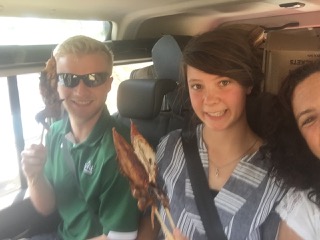
Back through the congested night streets to the apartment we had rented, a tasteful and spacious three-bedroom modern flat for $60, with superb water pressure for hot showers and some food stocked for breakfasts.  Which brings us to today, Wednesday, emerging from the city to head west on the finally open road.  Unlike the rest of the trip, the road from Kamapla to Bundibugyo was surfaced in the last decade, with generally wide shoulders, clear lines, and sparse vehicles.  Long stretches of swamp and garden and rolling hills space out the inevitable speed-humps in the small towns we pass through.  This stretch feels less dramatically changed than Kampala has, or Bundibugyo will, both because it is rural and because it is less familiar than our actual home.  We pause at Mubende for our usual fast food, the vendors swarming around the car until they figure out Scott has the money and is bearing the brunt for purchasing hot charcoal-grilled chicken breasts on sticks, greasy chapatis, sweet soft gonja, a rolex (omlette rolled in chapati). 


And so we continue westward.  About half the team is sick, and we know the spiritual significance of the Lubwisi Bible means this won’t be a simple week. Thanks for prayers.

Thursday, July 21, 2016

The Iceberg Principle


This diagram, given to us by our language guru Karen Masso on our first day, has become my favorite aspect of this program.  

Before, if I still could not remember the word for tongue, eraser, boat, or embarrassment (just to bring up four words that I know I was taught in the last week, reviewed today, and can not say tonight) I would have been discouraged.  Just more evidence that we're too old to learn, that we are failing.

Now, they are words in my iceberg, that I am pretty sure I'd recognize and understand if they were put into a clear context, even though I can't recall them at this moment.

We are nearing the end of Phase One.  Meaning that the fun of dolls and cards, the Kindergarten comfort of games and repetition, is almost over.  But what a great time we've had this month with Gideon our guide.  We're making our own sentences, and making him laugh a lot.  But all in all it's a great program.  Do keep praying for us to absorb, to improve as we move into Phase Two later in August.


And perhaps there are iceberg principles in your life too.  Ways you need to look under the surface and be thankful for the hidden work of the Spirit, for the subtle impact of your work, for the rich depth and weight of your relationships.  What is seen is only a small part of the truth of this universe.  


Thursday, July 14, 2016

This Week: Busting Tribalism One Story at a Time

In a few hours we will reach the one-week mark back in Kenya.  And what a week it has been.

While we were struggling with the embassy of India and its designated private visa company in Washington DC as the clock ticked inexorably towards our departure hour, while we were traveling across three continents and 8 time zones, while we were jet-lagged and bleary-eyed and filling forms for the bag our frazzled BA check-in attendant threw onto the conveyor belt without tagging, while we were processing goodbyes and anticipating hellos, while we were settling into a borrowed home and sorting out all the little glitches of daily life and survival . . . the world was disintegrating.

Two more black Americans were shot by police, the injustice rank and raw on video.  Five police officers were murdered by a sniper with a vendetta.  Across the ocean, and on a scale hundreds of times as dire, South Sudan fell apart on their 5th Independence Day as government soldiers attacked the body-guard force of the opposition during talks in the capital, which triggered extensive violence and chaos and the deaths of hundreds of combatants and civilians.  Days before, terrorists blew up a market in Iraq, again, killing hundreds, and others held hostages in a bakery in Dhaka resulting in 29 deaths, plus several suicide bombers struck in Saudi Arabia, while drones keep targeting alleged plotters and leaders. An IJM lawyer with his client and driver were murdered in Kenya, then pastors on a bus in the North East as well, targets because of their work.  Today an uneasy truce holds, both in America and in South Sudan and in Kenya, but suspicion and fear swirl in a deadly brew that could reignite at any spark.

It's a hard time to have left our passport country.  And a hard time to be what feels like a step back from the front line, immersing ourselves in Swahili classes.  Here we are on this little mission station on the Rift Valley escarpment, chilly in the morning clouds, sipping chai and gathering around a table for four hours of vocabulary and pointing and listening and responding.  "Pick up the sister of the boy" "Buy the cabbage for 25 shillings" "Show me the large purple paper" "Put the chicken between the donkey and the cat" "Hold two spiders" "Touch your nose" . . . and on and on it goes.  It's a very interactive and concrete language method, well-organized by Karen.  But does it really matter when people are being killed for their skin color or origin or religion?

Yes, in fact, it does.

The racism of America and the tribalism of South Sudan and the murky brutal politics of the near East have the same root:  fear that my group will not get enough, not be OK, because of the other group.  Millenia after Cain and Abel, we still worry that love is a limited commodity, that survival is a zero-sum game, that grasping forcefully will be justified.  We still have not learned to celebrate diversity.  We still fret over who is favored.  Only now we do all that armed with weapons increasingly lethal.  Now we bump against each other constantly.  But we rarely hear and see.

In spite of globalization and travel and immigration and media, we seem stuck in our own limited stories.  White Americans rarely enter into the reality of living as a person of color in our society; Dinka distance themselves from Nuer.  Muslims and Christians have lost any sense of common ground.  The other color, class, nationality, sexual orientation, etc. remains opaque and distant.

Which is why these hours of tedious vocabulary and adjective endings and proper demonstrative pronouns matter.  Incomprehension furthers division, but a shared language gives grounds for understanding.  Tanzania seems to have had much less intra-tribal tension than Kenya, South Sudan, Rwanda, Burundi, Uganda all around it.  Could that be related to the insistence upon Ki-Swahili as a unifying national language?  It's a tricky paradox, holding onto unique heritage while embracing kinship.  But surely telling our stories and hearing those of others  forms the foundational bridge of peace.


So pray for us as we slog through hours of study.  Pray this time will allow us to bridge into many lives, to hear their stories, to share The Story.  I feel the same way about my books, hoping that those stories of Africa bring the continent to life for a rising generation who will respect and love the people rather than boxing them into stereotypes of otherness.


Jesus is the Word made flesh.  It's all about reversing the polarizing effects of confused language and fear and hate.  Building a new community based on love, and this is the right place for that, an international community with a true kinship.  Here is the antidote to hate, as expressed and pictured by the multi-cultural choir at RVA.