rotating header

Saturday, September 19, 2020

Of sacred wounds and shining wonders: COVID-19 day 183 in Uganda

Ministry can indeed be a witness to the living truth that the wound, which causes us to suffer now, will be revealed to us later as the place where God intimated [God’s] new creation. —Henri J. M. Nouwen (1932–1996)

Sacred wounds of severe malnutrition

Same skin that was broken be the same skin takin' over. . . 

Most things out of focus, view

But when you're in the room, they notice you (Notice you)

'Cause you're beautiful

Yeah, you're beautiful

Them men, them gon' fall in love with you and all of your glory

Your skin is not only dark, it shines and it tells your story -- Beyonce, Brown Skin Girl

shining but not escaping

This morning we worked in our garden. The weeks are long. Most days begin before sunrise and work ends well after sunset, a stretch of  malaria and fever that seems to never end, meetings, calls, emails, prayer. So it is a gift to have a morning for a walk with the dogs, a cup of coffee, and a chance to hoe and crumble the composted dirt into rows for the next wave of planting. 

The wound in the earth, the broken surface, becomes the place of newly created goodness. 

The new rows, with papaya and banana looking on

And the journey of 2020, the journey of faith, is to not refuse the suffering but to expect it to become the actual place of glory. This is the cross, and a thousand times we learn it yet still resist the lesson. The way up is down, life comes by dying, God's power breaks through our weakness. This is the picture of the seed becoming a tree, the picture of a mother birthing a child, the picture of bodies with wounds that shine as stories.

So many stories.

COVID-19 for one. I have sticky-notes for prayer for people we know who have been infected, so far all recovered. 30 million stories, and for nearly 1 million (198,000 or 1/5 of those in the USA) the story has ended in death. Here in East Africa, we've been bracing for six months, yet the pandemic has not come with the ferocity of Wuhan or NYC. So far so good, or not. While coronavirus spread and death has not overwhelmed Africa (? some combination of younger populations/older people already dead, less travel exposure, previous similar rainforest miasmas breeding similar virae with some unknown immunity, early strict lockdowns, prayer and mercy, no one knows for sure), the global impact will be felt here for many years. The USA pulling out of the WHO; less investment in TB, malaria, AIDS, malnutrition; less access to a new vaccine; less income from tourism; school closures resulting in an epidemic of teen pregnancy; the world tending to turn inward and self-protective in the face of hardship; the list is long. After decades where child survival has improved, this new decade may look very bleak.

Is there any wound that cannot become the place of new beauty? 

African American spirituality was forged in the fiery furnace of slavery in the United States. The ore was African in origin, in worldview, in culture, and in traditions. The coals were laid in the bowels of ships named, ironically, after Jesus and the Christian virtues, which carried untold numbers of Africans to the Americas. The fire was stoked on the “seasoning” islands of the Caribbean or the “breeding” plantations of the South where men, women, and children of Africa were systematically and efficiently reduced to beasts of burden and items of private property. Yet those who came forth from these fires were not what they seemed. Despite the oppressive and ungodly forces applied against them, they forged a spirituality that encouraged hope and sustained faith, which enabled them to build communities of love and trust and to persevere in their persistent efforts to be the free men and women they had been created to be. . . Diana L. Hayes, Forged in the Fiery Furnace: African American Spirituality

If the history of America gives us any hope, it is found here. Injustice and oppression on a continental scale still cannot snuff out the shining lights.

We awoke this morning to the news of Ruth Bader Ginsburg's death. No one is obligated to agree with all her arguments, but we have to admire the way she found good right in the hardest places. Being a woman in our parents' generation, forging a way for equal pay and opportunity. Even just the example of standing on principle and being willing to work and work hard.

And this week's news in general has been discouraging; the hope of reunion with family recedes as vaccine development feels less certain and travel remains a mirage. Nevertheless (an important word) the truth remains that there is nothing too impossible for God to turn to good (Rom 8).

Let's take courage then. In spite of forces that distress us all, let us look for the forged gems. 

A gem, see story below

Remember the 15-year-old whose premature baby the nurse was wrapping up as a dead body? Innocent, we learned this week, in the Latin root means not-yet-wounded. I don't wish wounds on 15 year olds, or 15 day olds. But this pair returned for a check up this week. K smiled proudly as I paraded her little chub-cheeked baby around the NICU as inspiration to all the other moms of 1.2 kg strugglers: here she was weighing in at 2.52, very much alive and well. Every day we feel the weight of all that is broken, and yet see the glimpses of beauty. A mom of twins who was determined to leave the hospital, but because we do rounds and assess and talk we convinced her to stay, which allowed a transfusion to save one twin's life. A mother whose blood pressure had reached danger levels, who could be induced and rescued. Our young doctor Isaiah tracking down a missing lab result that made a diagnosis of possible leukemia, needing a referral. A school staff engaging with the Gospel in new ways as our team continues mentorship. An accusatory email trying to wound us, that required a soft answer because more important issues are at stake. A toddler with signs of starvation who came too late to be included in the day's milk distribution; yet our BundiNutrition staff took it upon himself to return to the hospital and start him on feeds. These are tiny sprouts of new creation, but significant nonetheless. Every single person around us has their own wounds, some open and some scarred, all telling a story of growing glory.

the toddler on his grandmother's lap that needed therapeutic milk

Lastly, here is a two-set album from Porter's Gate, worship music that gives a soundtrack to all the above. Listen to "O Sacred Neck", which talks about wounds and glory.

Thursday, September 10, 2020

SERE-ING through COVID: Day 174 in Uganda and trying to RESIST

 Parallel to COVID upending our world killing over 900 THOUSAND people, and the economy tanking causing half of families in US cities to experience un- or under-employment and all families in the majority world to struggle more for food and health care, and the political order wobbling in response to those two things with the largest sustained movement of protest in US history, and some pretty crazy environmental cataclysms leaving Scott's mom in an orange haze of smoke and our Utah kids and Oregon niece and nephew way too close to fires  . . . . life has been lurching forward on other fronts. Sometimes it is hard to know what daily life looks like for most people. Much of ours is the same crowded ward and plowing through patients with insufficient help, to find places we can make a difference . . . only we are doing it behind smothering masks, with even more interrupted-than-usual supply chains, more delayed-than-usual response from the Ministry of Health. Or meeting for mentoring, prayer, supervision, study, only now it's outside with spacing or online by calls and zooms. Or sitting at a desk, only now it's hard to think more than a short distance ahead and the general weariness of crisis hovers.  One big difference for us has been that our semi-annual meetings as Serge leadership have gone to remote-online rather than gathering for fellowship. So whereas in Septembers past we were spending a week with the Executive Leadership Team and all the other Area Directors at a conference hotel somewhere, having meetings and extended times of prayer but also long talks over meals or relaxed evenings of bocce . . . now we are dialling in to four hours of zoom each day this week. And while we miss the face to face fellowship, the silver lining is that the zoom technology exists, we actually ARE getting decent communication, and the Holy Spirit is not limited. I was dreading it at first, but now it's Thursday and I'm looking forward to 4-8pm (OK not really thrilled to be in maybe the most Eastern therefore latest time zone in the group, and that means that in spite of trying to slow down 8a-4p pacing to have something left for the meetings, it's still a long day, but other than that . . .).


(Above, the mornings, Below, the evenings.)


And for our kids, residency marches on with surgeries and calls (Luke), trauma nurse-practitioner shifts (Abby), gruelling training in tactics and leadership (C), farm work feeding the hungry and extra shifts taken at a local bakery (Julia), and the final dissertation completed with an uncertain horizon of job hunting (Jack). Except for Jack, everyone has a steady job with disparate but sustainable income. Everyone wears masks and plans their life around not harming others. Everyone is a bit limited in the opportunity for fun, or friendships, or down time, but handling the year with some resilience.

The next step for our soldier is a course called SERE, so that acronym was on my mind this morning. Survive, Evade, Resist, Escape. As his brother put it, oh, it's basically about suffering, he's really good at that . . . .Sigh. It's been over 8 years since he started on this path, and he's done this kind of SERE training before, but I am sure this round will be the most intense. The idea is to be prepared for being caught behind enemy lines. If your plane crashes, if the battle goes into unanticipated failure, if you are betrayed, what do you do?

How much of life in general follows the SERE pattern, I was thinking this morning? Most of us are trying to SURVIVE 2020. We are often behind enemy lines so to speak, living in unfair and imperfect situations. A lot of our energy gets taken up by the basics. I know for us, going 5 months without a trip to the groceries in Kampala meant more dependence on basic local food, a minor inconvenience. For many families, survival means stretching inadequate budgets, depending on stressed support networks, juggling home-based distance learning. My special-needs nephew misses his sports and social programs, which are survival not fluff. Our elders are surviving with less too, being isolated and confined. If we get this virus, survival will not be assured in a land of limited oxygen and almost zero intensive care. We are also trying to EVADE more exposure, evade being caught with no options, evade the worst consequences of upheaval, evade floods and landslides. And we'd all like to ESCAPE into 2021 or beyond, or into a more just world, or into a holiday. Even the church seems to be in this mode of just hunkering to survive, evading the pitfalls of politics perhaps, escaping towards Heaven.

None of that is inherently wrong and each has its place. But an anchor in there is the word RESIST. How do we live in 2020 resisting evil? 

Maybe the same way Jesus lived in 0030 resisting evil. Yes, he had to survive and evade and escape too. His parents struggled for safe shelter to survive birth, fled to Egypt to evade genocidal soldiers. There were times he escaped angry crowds or the pressure of people's unending needs, with early morning mountaintops or desert marathons. But ultimately he had to walk right into the worst of evil in a posture of resistance unto death. He resisted the false narratives of his day by turning upside down the prevailing notions of who is blessed, resisted the shortcuts to fixing everything by means of power, instead focusing on heart-level changes in a handful of followers, resisted the forces of death and disease by touching individuals with healing miracles, resisted the injustice of his religious culture by eating with and embracing the marginalised people. Mostly he resisted the expectations for a Messiah by allowing himself to be killed. This meant resisting even the well-meaning pleas of his friends, resisting even the desperate desires of his own heart in Gethsemane. 


One of my favourite verses is Rev 12:11 "And they overcame him (referring to the dragon) by the blood of the Lamb and by the word of their testimony, and they did not love their lives to the death."

That is how we resist I think. First, it is grace, we can't resist evil on our own. The blood of the Lamb means that the death and resurrection of Jesus definitively defeated all evil. That is our foundation, trusting a power outside ourselves, an event that already occurred, being part of a family whose identity and ultimate home is secured. Prayer is our foundation of resistance, because in prayer we are oriented to God's work in the world not our own. Second, the word of testimony. Speaking, writing, bearing witness to truth is the biggest tangible blow to evil in our day. For some issues that is highlighting facts: the efficacy of a mask, or the statistics on racial disparities in mortality. For others, our word is our story, the witness of how we are living based on a different set of values, or ways that God has worked. Third, evil is defeated when ordinary people live lives based on love. When avoiding death is not the most important metric, people do evil-defeating things, like starting businesses to employ women trapped in sex-trafficking, or teaching preschool, or praying over neighbourhoods marred by violence, or creating new music and art. 

I don't know what kind of RESIST-ance the SERE course teaches. But I do know that God's people are called to resist with their trust, their words, their lives. We can emerge resilient in 2020 as we embrace faith that God still has the final word and will bring good. As we choose to speak truth, giving no shadow to rumour and lie and fear and hate. And as we engage in acts of justice and mercy, lives oriented outward in whatever way we can in our little spheres.

Oh, and as you're resisting evil by looking for ways to serve, by bearing witness, by praying . . .don't forget to vote. And send prayers for the soldier in SERE.

Thursday, September 03, 2020

Life as Performance Art: #COVID-19UGANDA day 167, September 3, and Ezekiel

As missionaries we have a complex relationship with social media. As does everyone. Yesterday, for instance, we had some zooms with people potentially interested in working with us, and each referenced a blog post or story (from us and our team) that they had found meaningful. That is encouraging; it can also be paralysing. I never even heard of the word "blog" until some colleagues who had one joined us. I just looked up our first post: Sep 3, 2006, oddly EXACTLY THIS DAY 14 years ago. According to the stats on the sidebar, we have posted 2,016 times since then, an average of every 2.5 days (!!), and 2009 was the most prolific year.  These days my favourite medium is probably the instagram story (jamyhre) because the images are transient, immediate, allow for short text, and feel both poetically specific and grittily real. Facebook, Instagram, and Blogger are all platforms that project our life into a public sphere, and we keep throwing it out there. Which teeters on narcism or exploitation for sure. And yet . . . it also can be prophetic.

I mean that literally. Because in the march through the Bible, now it is Ezekiel's turn. As the world is falling apart, God does not just send Ezekiel messages to verbally warn or denounce or lament. In chapter 3, he eats the scroll of words from God that he will take to the people. By chapter 4, he's involved in his own art installation, lying on his side outside his house for over a year, cooking limited rations in the dust, to represent hard times ahead. He makes a model city and builds siege ramps. Later he takes a sharp sword to his beard and hair and publicly weighs and burns portions according to the coming judgement. When his wife dies, he breaks cultural rules to avoid mourning traditions, foreshadowing death to come that will be so all-encompassing the nation will be unable to hold onto their ceremonies. 

Ezekiel doesn't just talk about what he hears from God. He lives it. In front of everyone. He's an influencer for repentance, against a culture of injustice and consumption.

Bear with me, but I think that there may be a modern equivalent in some corners of the web. When people share a story about their differently-abled child and his job. About their cancer diagnosis and the struggle. About loneliness living in a country far from home. About impossible decisions to ration care in an epidemic. About the wearying parade of need and the relentless demands of love. These stories challenge our assumptions. They only make sense if the entire fabric of the universe is based on a different metric than winning, strength, power, or fame. 

Today in our team meeting we looked at the fact that 41% of the Bible is narrative. Not just the painfully bizarre stories of Ezekiel, but most of what we call the Gospel itself. Stories of real people in real-life situations, and stories that are parables, both have a way of getting behind our defences.  We might react argumentatively to propositions about the police, guns, protests, or politics. But a story of a person shot in the back seven times humanises the situation.  Truth is objective and absolute, yes. But our ability to perceive it is always subjective and bound by culture and language and history and perspective. Which is another way of saying, God is real. But we can only encounter and describe God from our puny limited selves.

So here we are, September 3rd again, 14 years later. Telling our story a few days at a time. Today we had four different meetings, 3 of which were mostly cross-cultural and one with our American team. I had spent many hours in the last week prepping a Uganda-specific teaching morning about malnutrition for our BundiNutrition team, gathering the latest local data and protocols. I'm pretty passionate about the value of treating hungry kids and the way this is a window into everything that is broken and in need of redemption. In other meetings we listened to people going walking hard paths. Those are their stories to tell, not mine, but the sheer weight of bearing loss and confronting evil and struggling to survive sometimes feels shocking. There were laughs too, like when some fairly new team mates made the pizza dough which was wet, limp, difficult to roll, impossible to stretch, a bit of a funny grey color, falling apart (Mike described the pizza table as a crime scene . . . we were NOT laughing at that point). We worked hard to eke something out that was edible. About an hour ago, after everyone went home, Scott said, I wonder if that was actually wheat flour or cassava flour? Sure enough, there is only one Lubwisi word for both, kahunga. So our colleagues thought they were getting a great deal on locally milled baking flour . . . only wheat is not grown here, so they were being sold a massive sack of kahunga (dried milled cassava). Which does not have gluten, and does not easily make a dough or a pizza.

Well, we're not Ezekiel, but we do struggle with cooking and live out our inadequacies publicly. We do TRY to point to God, to choose life paths that would not otherwise make sense. We do ask our faith questions out loud, and (thanks to Scott) share real-time photos of what we see. Thanks for reading along for all these years, watching with us for the redemption we KNOW is coming.


Sunday, August 30, 2020

Of portions and leanness: #COVID-19UGANDA day 163

 2020, the perfect year to linger in the major and minor prophets. The waning years of the Kingdom of Israel, the intersecting sorrows of the modern globe. Last week I finished Jeremiah with his long acrostic poem, Lamentations. Each chapter works through the 22 letters of the Hebrew alphabet.  Chapters 1, 2, 4, and 5 paint the demise of Israel and the tumult of the nations in poetic terms. But chapter 3 turns personal, a deep dive into Jeremiah's own heart in the midst of international events. And tucked into the middle of the middle chapter, a very Hebrew form of emphasis, are some of the most well-known lines in the Bible. 


Remember my affliction and roaming, the wormwood and the gall.
My soul still remembers and sinks within me.
This I recall to mind, and therefore I have hope.

Through the LORD's mercies we are not consumed, because His compassions fail not.
They are new every morning; Great is Your faithfulness.
"The LORD is my portion", says my soul, "Therefore I hope in Him."

We all like to claim the comfort; but it is important to remember the context. Jeremiah was accused of being unpatriotic because he told the truth about his country's injustices and the peoples' sins.  He was starved, thrown in a pit, despised, ridiculed . . . while his country was attacked and over-run. His betrayal by friends and by the governing authorities breaks his heart; then he attributes the storyline to God's direct bone-breaking siege on his soul. 

Yet, this line. The LORD is my portion, therefore I have hope. 

Personally, this idea of satisfaction in God alone, not God + health, or God + people who love me, or God + some agency and accomplishment in the day . . . I find very challenging. 

I suspect almost all of us are finding the portions of 2020 lacking. We lament the relentless march of this virus. Who can even grasp the boggling 180,000 USA deaths, let alone 5x that many globally? Where do we even begin to mourn the babies cut off from seeing grandparents, the students interacting only with screens (in some places) or with empty days of waiting and manual labor (majority world), the absence of a hand to hold on a death bed, the fact that it is September in two days yet none of us know whether we can spend Thanksgiving or Christmas together? Then we mourn the rising fragmentation of fear, the politics of scarcity, from a new DRC ethnic militia just over our border here to polarising suspicion-mongering speeches on every continent. Frightened people who feel they must protect their own survival lash out, and every day brings more stories of shootings, deaths, hatefulness. Closely entwined with both the pandemic and the politics is the poverty that is driven by both. Gains in measures of longevity lost, jobs wobbling, medicines not delivered, safety nets punctured. And let's not forget the acts-of-nature craziness this year either, the fires consuming California, the hurricane pounding Mississippi, the floods sliding Bundibugyo down the mountainside, the heat waves and power-outages. All of that is big-picture. Like Jeremiah, though, it's the up-close and personal mid-chapter afflictions that really get my attention. I would like to be nobly distraught over distant disasters, but I am really just tired of the daily indignities.

So, if I could be honest, I'd pad my portion for sure. With mothers in their 80's, subtracting this season of seeing them is time not easily replaced. We love our team and our work, but when we examine our hearts we thought that God's portion was going to include more respite as we plod on through a third decade of it. I am deeply grateful for and respectful of the Ugandans with whom we labor, but the brokenness of the system stacked against all of us pounds me. Friday, multiple people melted away to the burial of a nurse who died, which is culturally crucial. But evaluating 54 admitted kids alone (discharged 17, kept 35 even as new ones started flowing in, and listed 14 that should have been in monitored higher-level-of-care, ICU or step-down beds, those breathing 80 times or more a minute, those with way less than half the normal blood capacity, not including covering the 8 NICU patients whose survival is so fragile). . . . took me a long long day. Scott was doing two emergency surgeries, the second one in a not-really-sterile gown that he literally took OFF a nurse's body because there were no others available. Wednesday, a student nurse walked in with a baby waiting to be admitted, who when I unwrapped the blankets was cold dead. The point is, that while I like the aspirational poetic sentiment of "the LORD is my portion," I am not really under the illusion that my heart is fully there.

But that gap is where we live. Sure, we can try to pad our portion with protective comforts. It's not wrong to ask for good things. But demanding them as necessary for life risks the most chilling verse of all, from Psalm 106, reviewing the complaints of the Israelites in the post-Exodus desert: they forgot God's delivering power, craved the comforts they thought they were due . . . and "He gave them their request, but sent leanness into their soul." And then, equally chillingly, how can I even feel a modicum of self-pity when looking umpteen times a day into eyes of human beings whose portion is, by any earthly measure, so much slimmer than mine? How soon I forget. (two examples pictured below).

Lord, have mercy, those new-morning mercies, in 2020. Let us pray that the trials of a pandemic, of violence and protest and confession and justice, of upheaval and loss of our plans . . . would result in us, in me, paring away all the false-hopes of my portion and leaving me satisfied with the part that can't fade. Let us pray we enter 2021 with souls that are shinier, deeper, more grounded, more generous and communal, for all we are going through now. Let us have hope.


Saturday, August 22, 2020

Power, weakness, and a tale of three babies: COVID-19Uganda day 155

 One hundred days into the Ugandan Covid epidemic, a 15-year-old "K" walked into our hospital and delivered a 1.2 kg baby girl (that's 2 1/2 pounds) ten weeks too early. Yesterday, She took her 4-pound baby home, after a 55-day marathon of tube feeds, incubators, IV lines, antibiotics, hours of skin-on-skin kangaroo care, countless replaced ng tubes. That's still two weeks shy of her actual due date. This was a Christmas school holiday baby, a young girl who had just finished her 7 years of primary school, a dad half-way through high school. The pregnancy and COVID aside, she statistically was not likely to receive further education besides the hard way. And she learned quite a lot over the last two months. She knows how to express milk and draw it up in a syringe, measure quantities, drip it into a tube. How to secure a tiny speck of life to her chest. But mostly, she learned hope. Because at first, she was quite disengaged and reluctant. Her baby did not look likely to survive, and she withdrew into a protective shell. It took the community of other moms spurring her on, and her own mother-in-law, a spunky lady who showed up to take care of her (she's only 15 remember). But it also took Ivan.

Ivan with K and baby, preparing for discharge from NICU

Ivan grew up in our orbit, his dad having been one of the young men we sent for nursing school in the late 90's. Over time he became Jack's best friend, spending much of his time at our house, and when his parents' marriage broke apart his mother asked us to take responsibility for his schooling. He was two months short of graduating from Uganda Christian University with a degree in nursing (most nurses get diploma-level education, so this is a boost to our district's skill level) when the world shut down. In the 2020 limbo, he's been volunteering several days a week and focusing on our newly opened NICU. Kacie spent time teaching him newborn resuscitation using the Helping Babies Breathe curriculum. Dr. Marc, Dr. Isaiah, Scott and I have worked with him and explained and entrusted more and more.

So a few weeks ago, when K came down with a cold and then her tiny baby got sick . . . and then stopped breathing, Ivan was on duty. He found another nurse wrapping the infant's body up in defeat. But Ivan did CPR. He sent someone to get me. Over the next week, we did everything we could to keep this baby alive, oxygen and a transfusion and medicines and monitoring. She had to be revived more than once. And improbably, she clung onto that thread of life. 

Her discharge was a concrete moment of hope. It was really Ivan's belief in not giving up that saved this baby's life. And that's what the good news of God's rule seeping in looks like. It's a multi-decade process of relationship that gave this nursing student the courage to see the survival of a 1.2 kg apneic baby as a possibility. That brought in partnerships with Save The Children building a tiny NICU, brought in incubators and ng tubes. It's the refusal to write off a 15-year-old grumpy teen, and slowly coax her into being a skilled mother. It is little acts of faithful work, over and over, 55 days in a row.

Last week, we picked up urgently and rushed to Kampala for another birth. This one was right smack on time and in spite of a last-minute C-section, all went well as Jenna and Boas welcomed baby Nile. The day before, Karis and Stephen delivered baby Zaks in Nairobi. Neither of these moms had their ideal birth plan; both had hoped to be in other places, and with family support. But both faced the reality of 2020 with courage, and both are now holding nearly 2-week old healthy boys, with minimal help from anyone but a husband and very limited friends. We had the joy of being surrogate grandparents, ooohing and ahhing over the sweetness of Nile (with masks and clean hands of course) for days, and admiring Zaks on What's App.

Nile in Kampala day of birth 

Zaks meeting big sis in Nairobi

Two weeks ago was the last normal Saturday I sat here at this desk, and asked for prayer for baby of "K", for our two Serge moms about to deliver, for our own weary souls. I'm still plowing through the melancholy of Jeremiah and Habakkuk . . . "in wrath, remember mercy" is his prayer in chapter 3. As their global situation devolves into chaos they see ways God moves in power to show mercy to the remnant. In the wrath of 2020's insidious viral death-march, ripping open of festering racial injustice wounds, divisive tribal fear-stoked hate on multiple continents . . . the babies represent a message of mercy. Potential. Hope. Seeds for good that will grow in ways we can't predict. God's power in several vulnerable packages.

-------------------------------------------

Which, besides anxiety over survival, has been the other major current of thought in the last two weeks. Because I pulled off my shelf a 20-year old book by Marva J. Dawn called Powers, Weakness, and the Tabernacling of God. Dawn delves deeply into the Biblical passages and literature exploring the idea of "principalities and powers", something that is taken for granted to be true in African culture and Biblical culture but must be re-established for the average American audience. 

We need to recover a more nuanced and holistic view of evil, which paradoxically helps us see more clearly into good. The world is broken, people sin, and there is an unseen realm of forces that are both institutional and demonic that seek to harm us. As I was writing, I was interrupted by a phone call from a friend desperately worried about his sick child, and on the way to my car to respond to the emergency my young neighbour (another kid who grew up with ours) met me to tell me about his sick daughter. COVID-19, malaria, and other pathogens are part of the frayed fabric of our world, the brokeness of the Fall, the intrinsic sorrows that are part of being human. That these children live in a town where the hospital is out of malaria drugs and never had much oxygen capacity is not part of their personal sin, it is a world system of poverty that is stacked against them. Yet there is probably sin in these scenarios too, perhaps a nurse somewhere stole or sold off the medicines meant for needy patients, or a greedy pharmaceutical company set a price high enough to finance yachts while leaving the poor to die, or a parent spent his small fees earned by his boda business on alcohol instead of a mosquito net. And behind the scenes, though Satan was defeated on the cross, the mopping up of all spiritual powers that set themselves to harm us has not been completed. In most situations we can find multiple forces of evil, and the good news is that the cross reverses the decay of a groaning creation putting us on a path towards all things new, justifies and forgives all the sins we have committed and will commit, and chains evil powers, limiting their capacity as a promise of their eventual disappearance. 

The brilliance of Dawn's book lies in the way she moves from an overview of evil and the power of the Cross to .  .  . well, if this is most places, it would be either a name-it claim-it simplistic prosperity-promising temptation to grab the victory in full this side of time, and be financially successful, physically healthy, socially "in", and gorgeous to boot. Or a sober diatribe on personal sin and repentance that boils all evils down to individual choices and wants a uniform set of moral rules to keep things straight. But the Bible, shockingly, after affirming Jesus as victor by a literal resurrection from the dead . . . has him cooking fish and calming hearts and quietly fading away. Within a generation, his followers grasp that the rule of God is not pounding in with an army or a gilt temple, irrefutable and irresistible. The power of God comes at the end of human power, when we give up our rights, our voice, our time, our wisdom, embrace our weakness and limits, and depend fully on the grace of God. The more we get out of the way, the more people can see the glory of God.

Throughout the New Testament, then, we have seen a diversity of evidences for weakness a God's primary method, including the weakness of a suffering Messiah, the weakness of our sinfulness that necessitates a Saviour from outside ourselves, the weakness we have relative to the powers of the world, and the priority for our communities of welcoming the weak. (p 55)

I believe her final two chapters have much to say to the American Evangelical Church in 2020. If we are called to a path of the cross, of suffering, of embracing weakness . . . when did we become so obsessed with winning, with power, with control, with position, with status, with numbers? She calls us back to the basics, particularly to prayer, to fellowship, to being countercultural, in the world but not of it. She calls us to gracious generosity, to compassionate insistence on justice, to metrics of faithfulness and dependence upon God. I think that her descriptions of the early church, and of the Ephesians 6 "armour" of the Spirit, give us a challenging vision of living out the rule of God as salt and light in a world that needs to taste and see.

We need not feel overwhelmed by the cultural forces arrayed against Christianity; the battle against the powers has already been decided. And we need not feel overwhelmed when we remember that such ending of our power as we might be feeling is exactly what Christ desires for the fullness of his tabernacling.  . . .The cross is the heart of history. (p 163-164)

-------------------------------------------------------------

If anyone is still reading, thank you. Because I want to end by saying, a robust theology of evil, and of good, matters. Putting the blame for a preem on the shoulders of a 15-year-old girl is demonstrably wrong. Did she sin? Yes, daily. Me too. But she also suffered the consequences of systemic evils so much larger than her. Does the victory of Jesus on the cross mean no more premature babies? Not yet! But yes, someday, no more tears at all. The dense and complex narrative of baby-of-K reflects the dense and complex narrative of the incarnation. Jesus, vulnerable, in the flesh, pitching his tent here amongst us in a decidedly marginalized people. Jesus, resisting the short-cut to power and glory, carrying the cross and meeting death head-on. Jesus, forgiving sin and healing disease and promising Heaven, because in that death and resurrection the entire order of the universe shook back towards a trajectory of hope. Jesus, choosing to work behind the scenes through the Ivans of this world, blowing a spirit of life into a dying baby, preaching the forgiveness of sin, breaking the power of evil. The full establishment of shalom is not yet here, but we catch those glimpses of glory and hold on for more.


Ivan on one of those 55 days of doing the next needed task (furthest from camera)

Ivan teaching NICU moms, K is in the center

Arriving in Kampala after 8 hours in the car, to celebrate a Ugandan-American miracle!


Nile and mom


The whole Fort Portal team turned out to celebrate!

Baby of K, oblivious to the drama, ready to go home

a glimpse of my weakness, a ward crowded with sick children

One more of Zaks meeting his big brother


Saturday, August 08, 2020

"I am weary of holding it in." COVID-19Uganda day 141 from Jeremiah

 141 days are feeling long for all of us in Uganda, yet our troubles are only a minuscule taste of the world's.  August finds the read-through-the-Bible-chronologically march in Jeremiah, in the final days of the crumbling Kingdoms of Israel and Judah. And perhaps because we have to Sergers in our Africa area awaiting childbirth, every time Jeremiah says "pain as of a woman in labor" it jumps out. Labor is inevitable yet unpredictable. You can learn about it but no two experiences are the same, no one can feel another person's pain, no one can really prepare you precisely for the experience. Anguish is going to grab those two, as it has women since Eve. I wonder if Jeremiah's mother or wife was a midwife, since he goes to that analogy repeatedly to warn the Jewish people of the trauma ahead. We are globally in the 8th month of being aware of the spread of the novel coronavirus. In January we read the early reports of a mystery respiratory highly contagious viral syndrome, briefly wondering if it might inconvenience us with impact on our May all-company conference. Now in the 8th month the entire globe is reeling with heaviness. Our US Embassy yesterday told us that if we were not paying attention before, it is time to pay attention now and assume anyone we meet is infected (link included as many American readers may find it more helpful than much of what they are hearing). We watched coverage from Georgia last night, with skyrocketing infections and the death of an otherwise-healthy 7 year old. Meanwhile we are about to celebrate the 7th birthday of a kid on our team.

That dissonance is weary-ing to us all. Perhaps being a doctor in 2020, a team leader, a writer, a human whose heart holds the heaviness of traumas and injustice past and present, is similar to being Jeremiah in the ascendency of the Assyrian and Bablyonian invasions of the known world. In chapter 6, he wonders, who should I warn? No one is listening to this, they have no delight in it. Therefore I am full of the fury of the LORD, I am weary of holding it in. We try to stick to policies of masks and hand santizer and distance and outdoor meeting, of limiting travel and interaction. All of these are counter to the Gospel-picture of community and openness and immersion. This is hard for all of us. We are weary of holding it all in.

I think our two women facing labor and delivery are way wearier than any of us, stuck in countries they did not intend to stay in for this process, unable to have family nearby, no guarantee a husband or friend can even enter the labor room with them. I know that having done this a few times including in some marginal places, there is always the nagging doubt, how bad can this get, and can I survive it? Am I strong enough? What if.. . .? And I think everyone is getting a little taste of that right now. How long can we deprive ourselves of human contact, of hugs, of parties, of connection? How long can we put our kids' educations on hold? How high is the price of a lonely 84th year, or 87th? 

Last night I read a story that for the first time, malaria resistant to our main medicine (artemisinin derivatives) has been found in Africa. Two sites in Rwanda. The potential loss of lives over the next five years if this mutation takes hold and spreads is 78 million cases, over 100,000 deaths. In another year, that might have been interesting or sobering, this year it is alarming and makes me want to cry. Because those deaths occur right in front of me right now, currently due to delayed care or poor systems or co-morbidity with sickle cell and malnutrition . . but if we get to the point where we are doing all that right . . .  and we are still powerless, malaria will make COVID-19 look minimal. The paediatric ward is now not even standing-room-only, because standing room is almost gone. People have to line up and wait to weave their way through mattresses on the floor because I'm squatting between two that are only inches apart. I had to put my head down on a bed fast because the umpteenth squat-and-stand left me dizzy. It is pouring rain right now. Mosquitoes are proliferating.
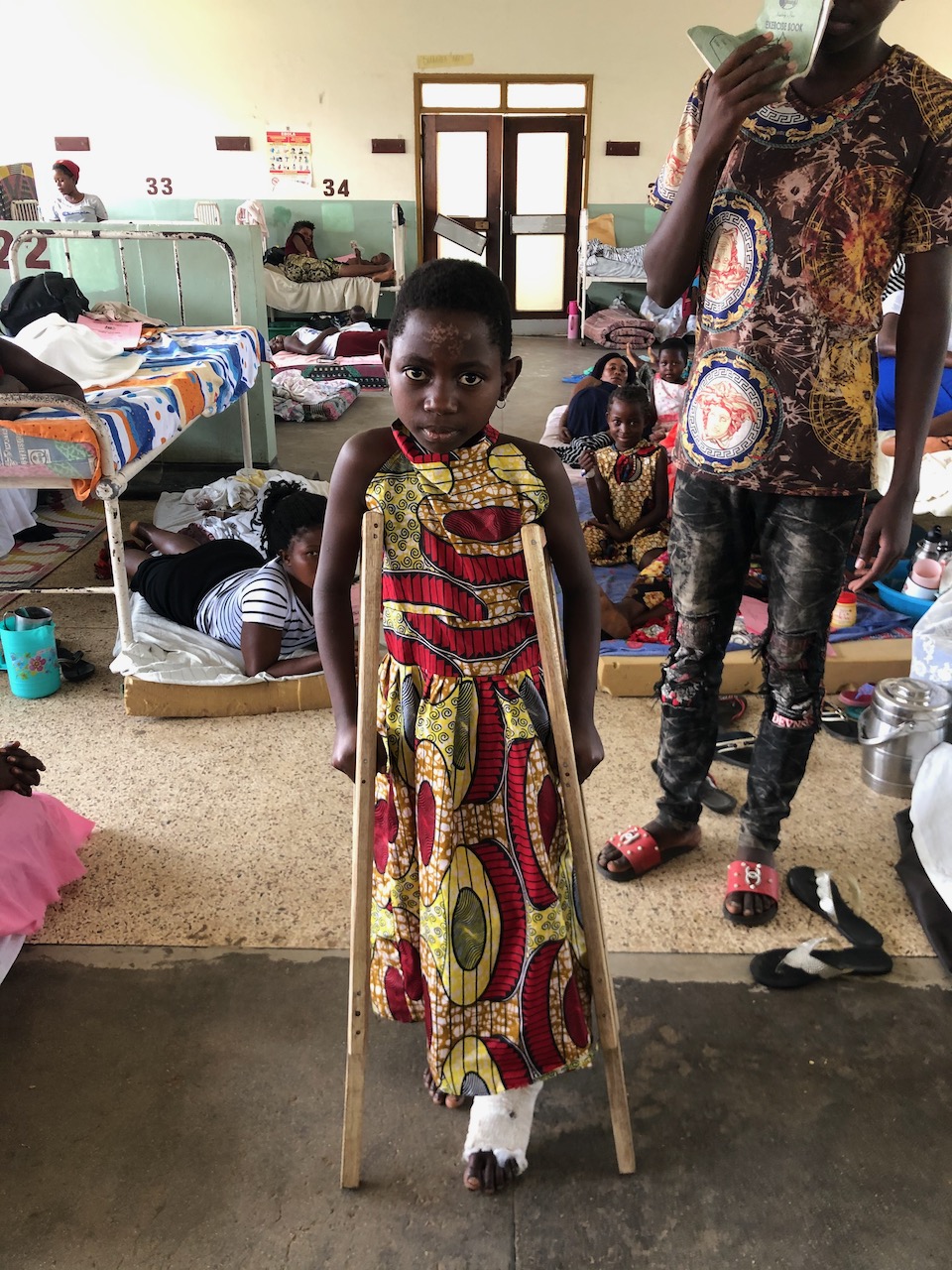
The childbirth analogy continues right on to the teachings of Jesus. In John 16 he is talking to his disciples prior to his arrest, and says:

"A woman, when she is in labor, has sorrow because her hour has come; but as soon as she has given birth to the child, she no longer remembers the anguish, for joy that a human being has been born into the world. Therefore you now have sorrow; but I will see you again and your heart will rejoice, and your joy no one will take from you.  . . These things I have spoken to you, that in me you may have peace. In the world you will have sorrow; but be of good cheer, I have overcome the world."

Bahati with the joy that she laboured for!

Both-and. Yes, you are weary, you are facing anguish, things look rough ahead. Yes, you will have sorrow. But . .. also yes, you will have joy and you can go forward with peace, because Jesus holds the end in hand, and all shall be well. Coronavirus and malaria, racism and poverty, greed and abuse, will all be overcome.

So prayers appreciated for our two about-to-enter-anguish moms. For a glimpse of the joy of holding those newborns to see them through with courage. 

And prayers appreciated for two weary doctors, in the unending sorrows of this broken world. Yesterday Scott found his two lost sheep: a woman who had laboured all night with zero progress . . . meaning he had to push against the inertia of the system, supply sutures and some of the anaesthesia medicines, often he has to wheel the patient to the theatre or put in the IV himself to get the C-section moving. The baby was not-quite-dead, and revived. Then as he was writing up the operative note, a nursing student begged him to ultrasound scan her sister. People love ultrasounds here, and want them for all kinds of inappropriate indications, and Scott is the only source of free and accurate ones so he gets weary of these requests. But he trudged back to maternity to discover an undiagnosed ruptured ectopic pregnancy, again having to set up and push and innovate to get the woman to surgery. Her hemoglobin was 2.4; she had 5.5 LITERS of blood in her abdomen, as he worked to remove the burst tube the anaesthetist transfused the little amount of blood available, and she survived. My lost sheep were a preemie that Ivan resuscitated on Weds when the staff generally were ready to call her dead . . . she got a respiratory infection from her 15-year-old mom 40 days into her incubator stay (and a glimpse of joy, that Ivan saw the potential for action, sent another mom to grab me for help, and saved this life for now). And two very very lethargic and weak malnourished children, little girls who did nothing to land themselves in families with HIV or TB or divorce and abandonment. Plus a little boy with sickle cell and malaria, on a mat on the floor squeezed between two other actual mattresses on the floor, whose labs I happened to find under some books on a desk while looking for something else . . . hemoglobin 3.8. This is why we keep pushing through the crowds to find those closest to death and focus the team's energy there. Meanwhile we are trying to teach students, and I personally am failing to remain calmly gracious at the fray. Repenting for my sense of self-righteous input; and yet also relating to Jeremiah's sense of "isn't anyone listening???"

This is 900 grams of vulnerable life, entering the world at 28 weeks instead of 40, just as we unwrapped the bundle brought to us 18 hours after birth . . . 
Celebrating the discharge of this little child who may not look great YET, but is 100% better than two weeks ago!


In that incubator is the baby Ivan rescued; join us in praying for her survival (baby K).


This was Wednesday, numbers were up even higher by Friday . . . 

Saturday, August 01, 2020

Systems and Powers: #COVID-19UGANDA day 134

Monday, Wednesday, and Friday we spend the first 30+ minutes (OK who are we kidding it is often an hour) of our hospital day in an outdoor, socially spaced, all-staff morning report. Twice in the last few weeks we've spent an extra all-day meeting for government and partner planning on health, education, care for children. Every day we have people coming to talk to us, or we are interacting as we work and move. And IN EVERY SINGLE CASE we are the only people from beyond the borders of Uganda in the conversations, which means we are always listening and learning and processing and comparing. We are always running a little behind the curve of a dynamic system of beliefs, habits, values, history, proverbs, language, culture. Then many evenings we are viewing through the window of CNN or newspapers back into our birth culture, watching testimony before Congress, or reporting on protests or the pandemic. This week there has been a slew of live-coverage from Congress. Again we are outsiders by location, slightly out of step and behind the dynamic curves of popular opinion. But in both cases, I would say our off-balance not-belonging can be a strength as well as a weakness. Because we can bring a fresh view.


So when Attorney General Barr said that he did not believe there was systemic racism operative in our criminal justice system, I immediately applied that to the kind of systems-thinking we try to do in medicine in Africa.

When problems arise, the human tendency is to look for the person to blame. Bad outcome of treatment? Well, whose fault was it?

But while it is important to hold people accountable to do their jobs, most of the real progress in improving care and reaching goals comes from thinking about the system that is functioning to produce the results that we see. For instance, here are some of the problems we have been present for discussions of this week:


  • A child dies of severe anaemia from Sickle Cell, because there is no blood in the blood bank to transfuse them.
  • Teenage pregnancies are on the rise during lockdown, and we're all realising that many girls are safer in school than at home.
  • An infant is still born because the nurse called the doctor to do a C-section, but he did not answer his phone, and so she waited for the next shift in the morning.
  • Rats are eating the hospital register books and plaguing the operating theatre because they are attracted to placentas left in buckets.
  • A two-year-old comes in with an abdominal stab wound inflicted by his own father who was high on a substance and mentally ill.
  • Alcohol and marijuana are in our markets because the parliament gets income from this business.
  • Artesunate, a key malaria drug, is out of stock because people believe it is so powerful that they sneak into maternity ward and copy the name and file number of patients so they can go to the dispensary and fraudulently take it.
  • Before all schools were closed, teacher absenteeism was rampant because they take loans which they cannot repay on their salary so are constantly working other jobs.
  • Government staff do not respect their supervisors because their salaries come via bank transfer not tied to performance.
  • Coronavirus deaths are now three in the country (extremely low, but the beginning of the wave) because people have stopped wearing masks and distancing.
  • Families complain to the police when their daughters are enticed into sexual relationships as teenagers or even younger, but as soon as the threat of action generates a financial settlement from the seducer they drop the case.
  • Medicines are out of stock because the national supply chain is months behind schedule.
  • A friend has to move out of his paternal home because his alcoholic brother keeps beating up the friend's wife when he is at work, and the family cannot send this alcoholic brother away.
  • Another friend calls a community meeting because the neighbours have blamed a death on the statement "you should take her to the hospital; if you don't she might die" , attributing that statement rather than the delayed care as the cause of disaster.
  • A neighbour limps in with snakebites because the local house construction has many gaps.
  • The school gets a 2.4 million shilling water bill (almost $700, or more than 30x normal) because of a shoddy repair five years ago that has now allowed thousands of liters to silently leak into the ground. 
  • We are on our last tin of therapeutic milk, because our district relies on UNICEF supplies that do not reflect the reality of the need.
  • Food production is inadequate for our district, because people planted so much land in cocoa over the last two decades to make some cash, at a ratio that benefits the buyers and leaves the small holders with hunger.
  • A baby dies because his exhausted mother is over 40 and on her tenth delivery and she just can't summon the strength to push him out.
  • A rape case is not followed up because the family can't pay the extortion required to get all the forms filed with police and medical reports.
  • With primary elections approaching, people are warily testing the winds to figure out who will win, because the voting is done publicly by lining up for your candidate. So what is meant to quell rumours of ballot box stuffing becomes, in peoples' hearts, a fear that they will be punished for supporting the wrong person (whoops, your name was deleted from the payroll, spend a few months with no salary to try and sort that out).
  • The further from town a school or health center is, the less likely it is to be fully staffed, because as people move up in education and responsibility they want to live more centrally with access to shops and power.


It is exhausting to generate a quick list of items we have been presented with in just a week, let alone months and years. I am not making any of these up, and I know I'm not remembering many. Pretty much any of those issues could be traced to an individual who cut a corner, took a bribe, failed to show up, made a bad decision, committed a crime. But the fact that they happen, over and over, is bigger than any one individual. They are part of systemic injustices that have brought pain and suffering into Bundibugyo for centuries. The Bible speaks of the world (the fallen state of everything from the coronavirus to flooding), the flesh (our own sinful desire to promote ourselves at the expense of others), and the devil (principalities and powers in the unseen realms bent on evil and destruction). These are seen in the objectification of women, the colonial systems of administration, the removal of resources, the corruption in allocation of services, the extreme fear of the spiritual powers, the personal conflicts, lack of agency, lack of trust. None of the solutions are simple. We can exterminate a few rats or buy some milk or boxes of medicine or pay for some court cases . . but the real solutions require generational changes in values and habits. They require hearts for serving others, access to adequate food and information, dependable safety nets. 

Which is, of course, why we are here for the long haul. In the meeting of the district committee on orphans and vulnerable children (OVC's), I noticed that amongst the two-dozen people in the room were two young adults who had received OVC scholarships at Christ School. OVC's who were now planning for the care of OVC's. This kind of change takes time, lots of it. But it is happening. The people of this district are resilient and committed, patient enough to listen to a dozen sides and opinions, willing to sacrifice and wait, willing to pitch in and change.

So Mr. Barr, let us respectfully disagree.  The broken world, self-absorbed human hearts, and evil intentions, permeate every part of our globe. Our problems in America are not just a handful of agitators or trigger-happy outliers. Change in the USA and in Uganda both require some deep works of the heart, some careful attention to policies, some just allocation of resources.

Today I finished my read through the book of Isaiah. The prophet is writing at a time of danger and upheaval, and I imagine his audience felt something like we do in 2020. And much of what he has to say relates to big-picture, large-scale, national systemic transformations. Yes there is talk of individual piety, it is never either-or, always both-and. But let's not forget that God works through people for peace to cascade in like a river that carries life to all.