rotating header

Thursday, March 12, 2020

Tropical Coronavirus, pandemic views from the African continent

Africa is generally last to the table. Last economically, last in health indices, last in control of resources, last in accessibility to education or electricity.

But at this moment, being last is being best. Unlike times of Ebola, when the rest of the world is frightened of any contact with Africa . . . this time, for now, the only reported African cases are from travellers (mostly from Europe), and African countries are blessedly dark on the coronavirus map. Which is a good thing, but also a tricky thing for those of us with a foot in multiple worlds.

So here's some of the complexity of watching a pandemic from afar.

Being on the edge of a current Ebola epidemic (which is now almost over, and had 3444 cases and 2264 deaths) and having had a massive measles epidemic (which killed more Congolese children in 2019 than coronavirus has world-wide so far, at least 300,000 cases and more than 6,000 deaths, which we as a human society didn't get too alarmed about sadly) . . . we are not strangers to the importance of paying attention to disease and its prevention. So when the WHO and the CDC and numerous universities issue warnings, and when Lancet starts publishing studies that are peer-reviewed and sobering, paying attention is a matter of life and death.  The key facts we know are

  • The coronavirus that causes COVID-19 is a new one, probably from a bat reservoir that crossed into humans in China. 
  • It is different from common-cold coronaviruses in that no one was immune, and it causes a severe illness in up to 15% of people infected, particularly older adults and people with chronic underlying diseases. Unlike many diseases, infants and children are not the most affected. 
  • The infectivity of this virus is pretty high, it stays on plastic and metal surfaces for days and is easily transmitted by coughs at proximity (6 feet or less). Touching hands transfers the virus person to person, and then touching your face (eyes, nose, mouth) lets it enter your body.
  • But the infectivity measure is not a fact of nature that can't be changed. Right now it varies depending on the behaviour of people. In most places we are using a number of 2.5, meaning each person infected then transmits to more than 2 more people. That's why the graphs slowly slope up then suddenly shoot to the ceiling. 1, 2, 4, 8, 16 . . . the momentum grows until you have a thousand becoming 2 thousand and quickly tens of thousands. 
  • If a disease has an infection multiplier of 2.5, it will eventually infect 60% of a population. Think about that for a minute. That's a lot of people. So even if the rate of dangerous or fatal infections is relatively low (much lower than Ebola, or possibly even lower than measles), just the sheer extent of the spread can make it a big-impact disease. 1% of millions of people is still a lot of deaths. 
  • If we change our behaviour, stop traveling, massing together, hugging and touching, coughing into hands, etc. WE CAN GET THAT NUMBER DOWN. 
  • The most important measure we can take to protect ourselves is washing our hands with soap and water or using an alcohol hand cleanser, again and again throughout our days. 
  • The second most important things we can do are: stay home if you're sick, stay away from people who are coughing and sneezing and febrile, clean surfaces touched by a lot of people, etc.
  • And all of this should be particularly done in care of the older people in our societies, who have much higher (up to 15% in the oldest groups) risks of death from this virus. Trying to INCREASE the time it takes for 60% of the population to be infected spreads the timeline out, which allows the health systems to remain functional, or gives time for investigational therapies to become available.

So, those are the facts.

Now, there are admittedly a zillion things we do NOT know. For instance, when a country reports a case, or ten, or thirty, is that how many cases truly exist or just a factor of the number of tests done? Sadly it seems to be more the latter.  For every death, there are probably a hundred or more cases in the population. Another thing we don't know is the exact timing of an infected person being able to infect others. It looks like that timing may include the day or two before symptoms appear. Meaning that well people may be well, or may be a day away from sickness and still able to make others sick. We don't know how long it will take to reach the rest of the world, what the impact will be of all the information blitz and the travel restrictions. We don't know the health impact of the economic downturn. 

And we don't know how long Africa can hold out. Uganda has banned arrivals from 16 countries including the USA; anyone who insists on coming is required to self-quarantine for 14 days. This continent's main advantage is that half our population is under age 15, therefore less likely to get severely ill.  Our older people might be healthier than most continent's older people, just to have survived. Poverty might mean less lung damage from smoking. Temperatures routinely get over 30 degrees C, 100 F, which decreases the virus's lifespan on surfaces. 

All that might be outweighed though, by our fragile health system capacity.  In the best of times we don't have enough oxygen to supplement kids with pneumonia; what will happen if large numbers of people need it? In the best of times we lack ICU care. IN the best of times our ratios of doctors and nurses to population are frighteningly small.  People live in close proximity; social distancing is definitely a counter-cultural stretch.

Besides the facts, what we know and don't know, there is also the vague cloud of instability.  To me this feels like the days after 9/11.  We were here in Africa, and felt safer than our families were. It was hard being far away. The wobble of the world was such that there would always be before and after. And that made it hard to think very far ahead. Would travel stay unsafe? Would we be able to see family in the coming months? Similarly, now, our Serge Africa friends are feeling the punch of restrictions.  Visitors are canceling. Plans we had for an every-four-years- reunion conference in late May have been canceled. The intersections with our kids and mothers most likely won't happen this summer. These kinds of losses are huge.  We feel the exhaustion of decisions, of care, of predicting, of vigilance. We feel the weight of making a mistake that could make us the vectors of bringing disastrous consequences. We feel the likelihood that a crashing stock market will translate into less generous capacity for giving, less funding for Christ School, less emotional space for people to pray for us and care. We feel the anticipatory sadness that further pressure on African systems will mean further instability and death.  Most likely, we and our teams and our families will all hunker down and find a new normal and pull through just fine. But the months ahead look trying.

That's the pandemic view from Uganda tonight, in the rain, with news playing in the background. Tomorrow we'll be back to rounding on too many patients, meeting with staff, struggling for justice, gently caring for the sick, praying for others, and finding the new normal.

And we will be reminding our own hearts, and yours, that God is with us.


Monday, March 09, 2020

A glimpse of R-E-S-P-E-C-T

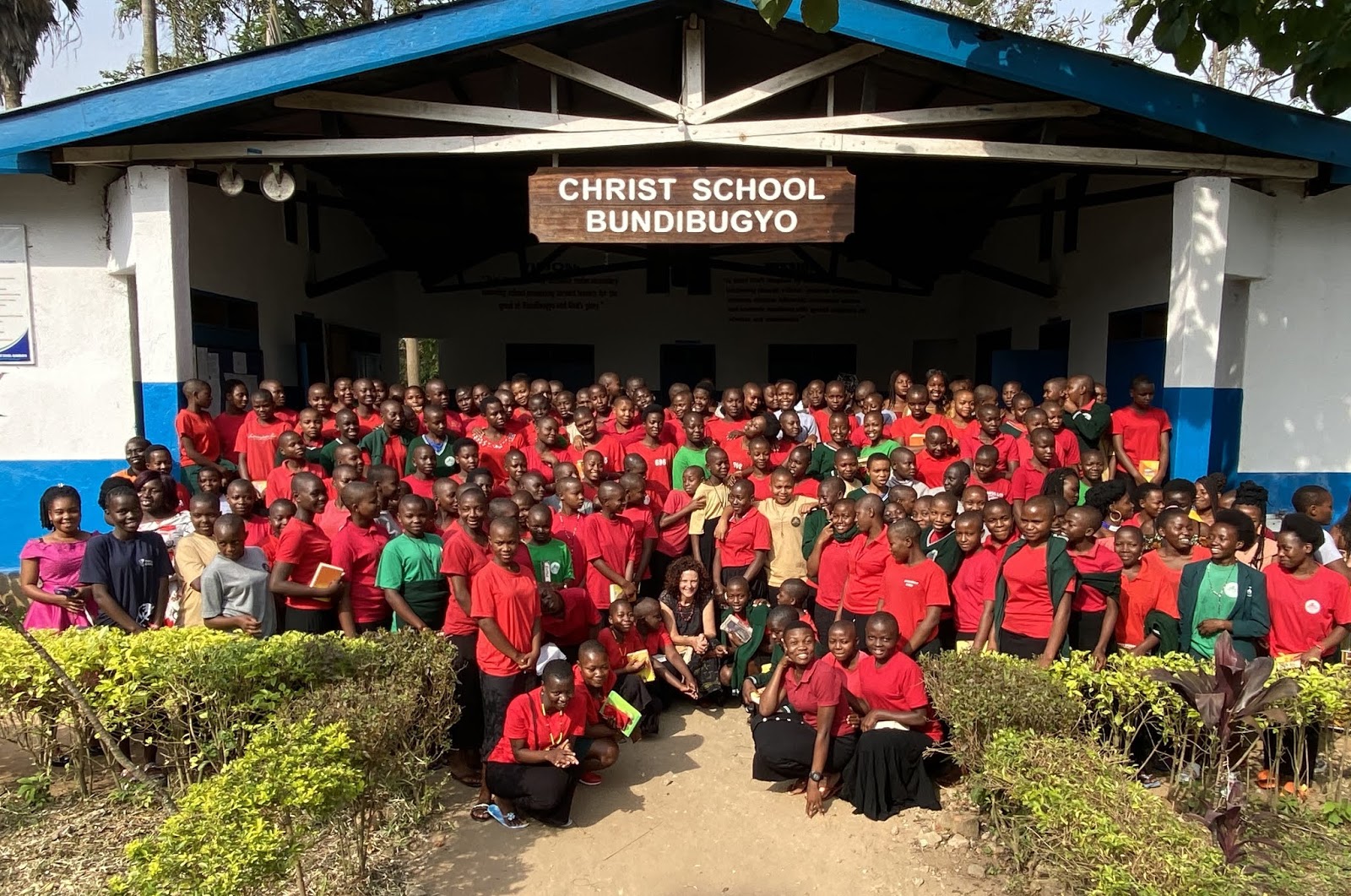
Here is a video glimpse of the day-long celebration of International Womens' Day at Christ School-Bundibugyo.


We are incrementally pushing a boulder up a hill and by God's grace the lives of our girls will be different.  They will be hired, be respected in their marriages, do what's right and stand up for justice.

We still need partners to support tuition subsidy we provide to every student.

A dollar a day can subsidize one student for a year.  JUST CLICK HERE TO GIVE.

Saturday, March 07, 2020

Numbers Matter: on leadership, sacrifice, and the God of details

Numbers is the book for early March in my read-through-the-Bible plan. 
Numbers are also required by our Serge leadership as we monitor and evaluate our work.
This is my Bible and it happens to be sitting on a document about metrics . . . 

And my computer this am.

And numbers are a big part of our daily life in a world of epidemics. We are looking at data on Ebola, measles, influenza . . and COVID-19, frequently, writing guidance for our Area, interacting with other leaders, making travel decisions, part of two different crisis committees.

From this particular read through the biblical Numbers, I am struck by the incredible attention to detail. Individuals matter. Persons count, one by one. The exodus of a nation of hundreds of thousands of people through a desert required attention to public health: rules about rashes and molds, rules about hygiene for sex and burials and animal slaughter.  Numbers alternates between repetitive counts, poetic blessings, and gripping stories.  There is artistry in the golden candle stands and tragedy in the attempted coups, lament in the plagues and provisions for the parties.

And chapter 7 details a leader from each of the 12 tribes bringing their own specific sacrifice to the newly dedicated mobile worship tent, the artistic tabernacle. Each day for twelve days, a specific leader from a specific tribe brings a sliver platter of a specific weight, a silver bowl, fine flour and oil, a gold pan filled with incense, a young bull, a ram, and a male lamb, a kid goat, two oxen, plus five more each of rams, goats, and sheep. And like a children's book, each day the same tally is repeated and recounted.  It's a very long chapter. At the end the entire twelve days of offerings are tallied up, and the final verse describes the voice of One speaking from above the mercy seat to Moses. I have read a lot of very helpful and good resources about leadership, but this chapter rings most true. A foundational aspect of being a leader is being required to offer to a level where we feel the impact. For us, that is rarely silver or goats (though to be honest this week the we donated a goat to the CSB staff for a party to celebrate exam results!). But it is time, attention, walking down to someone's house, prayer, study, research, advice, lugging boxes or cooking meals.  It is distance from family, or uncomfortable circumstances.  It is lack of freedom to do what we want. It is downward mobility in the organizational chart, or late nights still at a desk. It is absorbing blame or dissatisfaction, it is letting go of the expectation of justification. It is a lot of things more difficult to count, it is the tears that God numbers in the bottle (Psalm 56:8). 

At the end of it all, it is the presence of God that we long for. That presence is convicting and exacting; even Moses who sacrificed more than we can imagine, who was offered multiple times by God to just give up on the recalcitrant mob and start over, paid a high price in the end being denied entry into the promised land. But the One who asked so much spoke to Moses of mercy, met him in the desolate places, "gathered him to his people" (which is the most beautiful word for death, and should be on more tomb stones).

So this week I'm thinking about numbers and leadership and sacrifice. There were between 137 and 180 patients in our theoretically 100-bed hospital this week (which we now know because we started having morning reports), 60 or more of whom are on the theoretically 25-bed Paediatric ward (rounding on 1/3 to 1/2 of the hospital validates the feelings of exhaustion?). We had two deaths on our ward this week, one because we could not transfuse fast enough when a very sick baby with malaria came in anemic and we lacked the blood type needed, the other because we could only give oxygen to a few of the kids with pneumonia and not all. Clovis and I have been retelling the Jonah story to our inpatient families, and I counted 75 on Friday morning listening to the Gospel of faith from the fish's belly, hope while still in the darkness before healing is sure. We have 357 students now at CSB, and those numbers have meant a lot of Scott's time sucked into projects to make new beds, new desks, new budgets. Our team now has 14 adults and 15 children.

And while the COVID-19 numbers explode around the world, East Africa remains a territory where either the virus has not reached, or the testing is not being done. Our health systems are fragile and stretched and it is entirely possible on this continent to not distinguish one viral epidemic from the next . . . I think. But we are bracing for the impact of another wave of illness and death, soberly aware that there may not be oxygen to go around and we KNOW there won't be intensive care. Meanwhile it is now 16 days since the last positive Ebola case in DRC over our border, and our team there starts to breathe a cautious sigh of relief. The background of bigger problems remains: malaria, more malaria, sickle cell, AIDS, road traffic trauma, diarrhea with dehydration, malnutrition, premature births, obstructed labor. These will kill many times more people around us in the coming months than coronavirus will, but all are important, all are worth fighting against.

In all of this our hope is in a God who sees us, who knows the numbers, who cares for the details, and who is at work in all things to bring good and glory.

INDIVIDUALS WHOM GOD SAW THIS WEEK:
Team tweens hanging out on the slack line

Dr. Ammon and his wife Nurse Esther, preparing the new NICU to open (gulp!!)

Anna is a real woman: carrying two at a time . . . 

B from the McClure fam making friends at CSB

These two devour books

Numbers we don't like to see--plummeting weight in a malnourished child

Our newest team cuties with their freshly imported colors

The above-mentioned goat party, celebrating good exam results with the teachers who made it happen!

The number 4 is approaching for this one next week

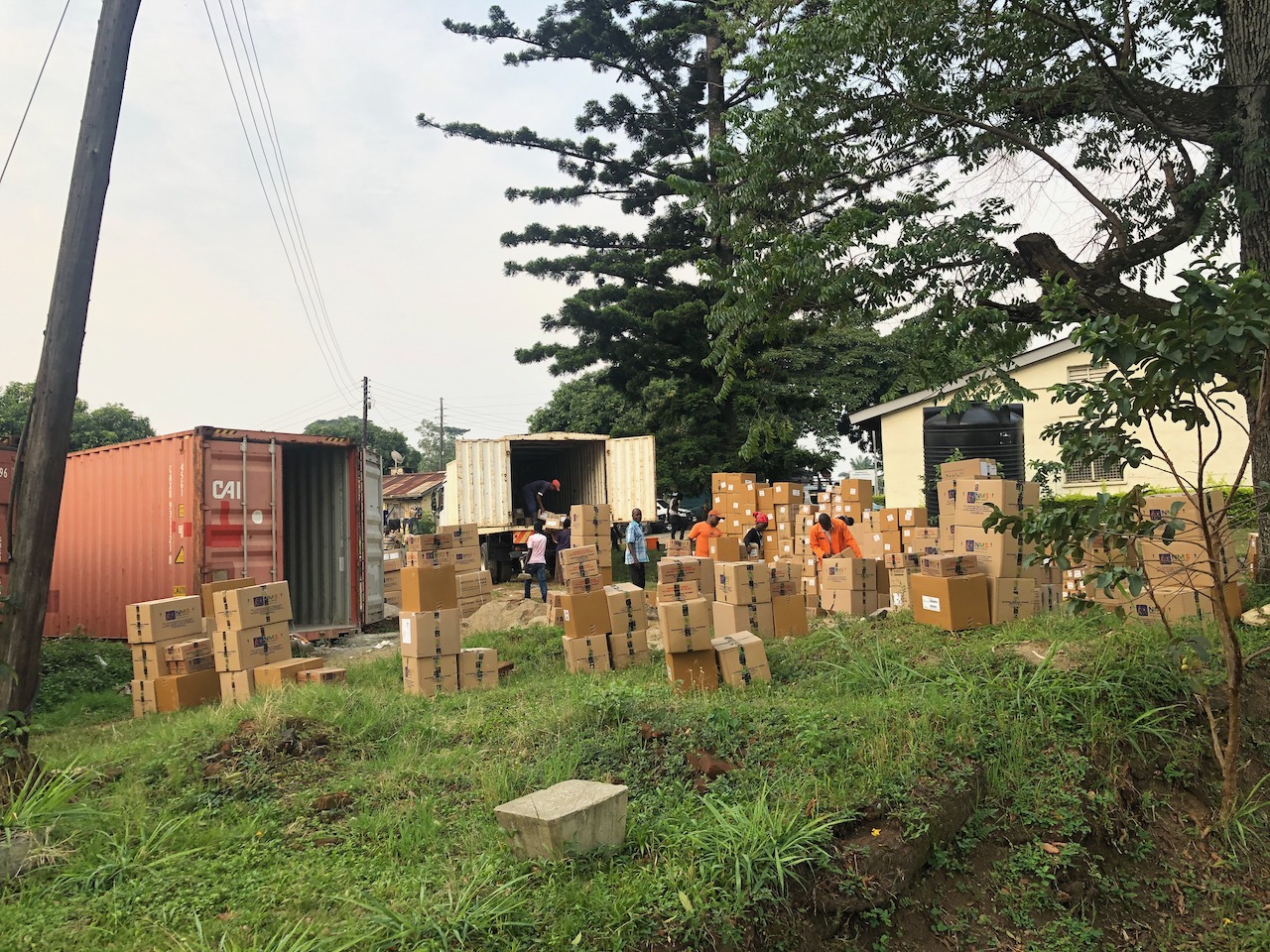
National supplies of medicine, much delayed, much welcome

Helped a tiny bit as Dr. Isaiah moved to his new apartment (one of the doors in this courtyard). He is one of the dozen Kule Leadership Fund scholars, now blessing us all.

Burgeoning student numbers means more desks had to be constructed!

This clinical officer was teaching our weekly CME on HIV care for adolescents. The highest risk age group for new infections? Adolescent girls. 

She's just the cutest, and this rug makes me happy. Babysitting team kids is a perk of the job.

When you invite a team kid to help you paint a shelf, good idea to choose this one.

Just snapped this because the snowmen in USA-flag gear juxtaposed with a mom showing me her baby's distended abdomen was so . . . paradoxical?

Thankful that Jessie's mom Janet came for a visit, and thankful for the delicious Ugandan food cooked by my neighbor Asita.

A view from the back of chapel of what 357 students looks like

One of Uganda's favorite numbers: two. Twins abound. And when one gets malaria, better check the other one.

Scott found our old dominoes this week, which made it into several fun kid times, and reminded me of my Dad.


Saturday, February 29, 2020

Leap Year February: when Lent and Black History Month and Life collide

Can't say I'm too sad to say goodbye to this February. It is not often that we can't find a single space in 2 weeks to communicate. Dr. Travis's death hit us hard, and the pummelling hasn't let up.

For instance, and in no particular order the days have ricocheting from a limply sick team kid . . three students with serious medical issues taking up hours of parent meetings and diagnosis and planning down at CSB . . a neighbour comes to say her young husband has taken in a second wife after their baby died, what grief . . thieves break in violently to another team's housing and we are heartsick for the aftermath of that trauma . . the US Embassy sends out terrorism warnings for a neighbouring country . . a zillion calls and emails and texts some of which we miss following up . . begging for help and finding it hard to come by . . the looming threat of coronavirus as it seeps across the globe with confusing and obscure implications for all of us, but particularly those living in places where intensive care will NOT be possible . . preparing for the arrival of new team mates which is good news but also a lot of responsibility . . pulling together the right people and documents for various meetings . . advocating for justice . . worrying and walking with anxious parents who are friends when their kids are sick . . buying life-saving meds when the hospital has run out . . meeting with counselors who will serve our mission in May/June to prepare them (slightly) for the realities of the complex sorrows of life on the edge . . pondering difficult cases on the ward . . trying to push through 76 patients while getting called to deal with other emergencies . . missing our own kids on their birthdays . . scrambling to have more beds, desks, chairs fabricated when 357 students flood into CSB on a wave of community positivity . . keeping up with Ebola news and making contingency plans . . struggling to advocate for people we have invested in to get jobs . . listening to some deep heartaches . . praying over distant friends with cancer, with unknown masses, with a child with serious head injury, with worrisome pregnancy issues, with previously undiagnosed fatal illness in a child, with a preemie, often trying to read or give advice when asked . . planning for half a dozen upcoming visitors . . anyway you get the picture. Doing a lot of good things but not doing them particularly well, because it's always too many issues for a day.

And then there is the bigger picture, always there just out of sight. The small tremors of our difficulties are only symptoms of a bigger truth. In this world you will have trouble, Jesus said. The global reality of brokenness. 

Certainly the transatlantic slave trade that led to Black History Month must be right at the top of those world-trouble truths. And certainly the death of Jesus himself on the cross must be right at the center of how we grasp for meaning.

Which is why reading this book, this month, has been both challenging and encouraging:
"The cross is a paradoxical religious symbol because it inverts the world's value system with the news that hope comes by way of defeat, that suffering and death do not have the last word, that the last shall be first and the first last. . . the cross places God in the midst of crucified people, in the midst of people who are hung, shot, burned, and tortured. . The final word about black life is not death on a lynching tree but redemption in the cross--a miraculously transformed life found in the God of the gallows." (all quotes from chapter one, but the whole book is deeply worth reading).

The promise to the suffering is two-fold. One, God is with us. This path of the cross is the very path God walks. That is a great comfort, and hard to keep preaching to oneself let alone others, that success and fame and glory and comfort are not the normal measure of God-nearness in a world still groaning. Suffering is God's tabernacle. Until, promise two breaks in. Suffering has meaning, and that meaning is redemption. Our light and momentary afflictions are part of a bigger arc of God's story, a hidden, slow, yeasty transformation. God is in the process of making all things new, and the cross is that process.

And so this lent, we are called to a discipline of noticing redemption as we carry the cross.  Bearing witness to the God-with-us in the darkness, to the reality of light growing.  For my complaining and easily self-pitying heart, that means a mid-day re-set of looking for a praise. This is not a Pollyanna denial of the hard, but a searching eye for that little sprout of hope in the middle of it.

This week that has looked like two babies who were nearly dead at birth, given the breaths of life to pull them back into this world. That has been the heartening reminder that our little limited ecosystem sometimes gets supernatural infusions of grace, such as a counsellor getting on a plane to fly across the world to help. That has been dinner at 9 pm cheered by video chatting with our kids, and a rescue of generosity by our brother-in-law adopting a mother's too-wild but much-loved cat. That has been the young man with devastating mental illness who was nearly killed by the mob, and was disrobing and violent and threatening . . . returning from the national referral mental hospital in calm mind and spirit, such a wonderful transformation. That has been unexpected sweetness from team kids, and unexpected beauty in finding a quiet place to pray.  Look for hope, because it lands like grace.


Saturday, February 15, 2020

A short life and a different sort of death . . . M. J. Dec 2019 to Feb 2020

Yesterday we wrote about Dr. Travis, a team leader, colleague, and friend who died on Thursday of colon cancer.

At about the same time he was dying, one of the two-month-old severely malnourished patients on the paediatric ward also passed away.

MJ was the first baby his mother had. She delivered in a small government health center, and was sent home. Only her bleeding continued post-partum, and by the time she and her family returned a day later, she was in serious condition. According to her mother-in-law (MJ's paternal Grandmother), the health center had no blood to transfuse and so she died, leaving him motherless. So this grandmother and her grieving son did what they could. They bought straight cow's milk, which is not common in Bundibugyo, and fed it to MJ.  They took him for his immunisations at 6 weeks, but no one noted the baby's weight or any problems.  A week or two later, they brought him to our District Hospital. Where we noticed he was starving, anemic himself, and extremely ill. Over the next couple of days we were able to transfuse, start antibiotics, start gentle feeds alternating with oral rehydration, start a program for his grandmother (who had a 3 year old, so had only stopped breast feeding in the last year or so) to re-lactate. We moved him from the back corner of the ward to the acute area in the front, and put him on oxygen. We confirmed he did not have serious underlying malformations or infections; he was "just" starving and reacting poorly to the cow's milk protein, causing him to loose a lot of blood in his intestines.
MJ on rounds, so thin and wasted, an allergic rash, and oxygen saturations of 73% (should be 95-100%).

He was back in that corner with the 37 on the wall . . . 

We did all we could, and he died anyway.

After two marginal months at home, he only lasted a few days in our care.

This is a story of a broken system. MJ's mother should not have been sent home bleeding. She should have received one of several medications very effective for post-partum hemorrhage. She should have been transfused, immediately and repeatedly.  NO ONE should die of bleeding, and certainly not a 20 year old in good health who just delivered a baby. MJ's grandmother should have been given advice and resources to care for him. The 6-week check should have screened his weight and pulled him into care. When he finally came to the hospital, it should not have taken an overnight wait for me to be the one to check his vital signs and find out just how sick he was.

I suspect that MJ was buried by mid-day Friday, wrapped in a cloth, with a handful of family in attendance. I suspect that once his mother died, no one really expected him to live anyway. I suspect that thousands of people are mourning Travis's death right now, around the world, and many many of us hoped he would live into old age. Besides the day of their death, there is very little in common between the two stories of MJ and Travis. But as I felt heavy hearted last night, this is what shocked me:

God knew each of them. God knew the days they would have. God knew the hairs on their heads. God loved them equally well.

I can feel sad, and even angry at the brokeness of the world, at cancer and hunger and poor supplies of blood and inadequate research. But the truth that God knows MJ and Travis and loves them both, that God is at work for good in the very moments of these deaths, that God continues in the process of redeeming all that is wrong and making it right and new? That is news so good and so big it is impossible to fully grasp. The truth that Travis and MJ could be sitting down to a banquet together right now? Also beyond comprehension, but why not? Maybe they recognized each other's Lubwisi greeting, or smile.

That's an image that gives me hope. And for Travis and for MJ, we bear witness that their lives mattered to God and to those who knew them. We go back into the battle of each day's push, bringing a little more light into dark corners and prayerfully making small bits of progress. That's about all we can do.


Friday, February 14, 2020

A good life, a hard death, a modern Saint Valentine. Dr. Travis Johnson, Feb 14 1976-Feb 13 2020


Team Bundi on my prayer card circa 2012, Travis in glasses, Amy front center holding Adian, Lilli and Patton standing on wall in back

Church this evening, pc Alanna, as Scott shared from Rev 21

Dr Travis Johnson died yesterday. Travis and Amy joined Serge to serve on the Bundibugyo team, and were immediately and rightfully seen to be gold. Fun, faith-filled, competent, eager, courageous people who would inspire courage in others as well. Our leaders had wanted to move Scott into an Area Director position, and we were questioning anyway the sustainability of distant boarding school for the duration of our kids' high school, so win-win seemed clear. Travis and Amy with their children Lillian and Patton would come to Bundi and overlap us (the plan was a year, but by God's grace baby Aidan was a much better plan so that ended up being only half a year) then they would remain as Team Leaders while we took a few months of Home Assignment to put Luke in college before moving to Kenya to work at Kijabe Hospital. We (Scott initially, both of us later) would be supervising the Johnsons in Uganda and the Nairobi team, as the Area Directors for Africa. Travis was a a family medicine doctor like Scott, an all-around medical practitioner as well as a leader and teacher. Amy was a teacher with three young children, and a passion for literacy. She had an interest in the community library we were trying to establish and so started the "Books for Bundi" program, while leading the team with Travis.

A few months is never enough to be prepared for surviving let alone leading in a remote and difficult place, with its deeply entrenched spiritual fears, physically challenging conditions, and constant turnover of personnel. Diving directly into leadership while still getting one's balance as parents is no easy task either. The way those nearly 3 years weighed them down, spread them out, brought them to Jesus is their story to tell. But they created a home and established a Sickle Cell Disease clinic, saw patients, hosted and recruited new team mates, invited interns, planned retreats, went on safari, developed friendships, facilitated reconciliations between people, oversaw Christ School, prayed against spiritual warfare, nursed pets back to health and mended the tender hearts of their kids, and a thousand other things. Some of the key partners we have now: Ann Kieser, Josh and Anna Dickenson, Michael and Lesley Stevens and others who work in the Home Office, were shepherded in by the Johnsons too. They invested in young CSB grads. Travis preached and prayed and blessed many. While on their own home assignment, the chronic intestinal irregularities that have plagued quite a few foreign workers here just didn't get better for Travis. It took time to treat parasites and decide to pursue further work-up and at the end of the process we were shocked to find out he had a late-stage small but highly dangerous cancer in his colon that had already spread. He was 37. They were just at the turning point of blossoming in Bundibugyo. And they had to cut that plan short, stay in the USA for surgery and chemotherapy.

And in spite of a less than 1 in 5 chance of living to 5 years, Travis lived 7 more years after diagnosis. The Johnsons kept their heart for Bundibugyo but were never able to move back here due to round after round of chemotherapy (62 courses), surgery (6 major and many minor), radiation (20 treatments) and immunotherapy (18). Consultations.  New combinations of drugs. Two steps forward and one back. Fasting and prayer, anointing with oil. Vegan smoothies and marathon bike rides. They went to battle with this cancer, all the while creating a stable life for their family, working at jobs, attending sports games and school events and serving on the Serge board. For most of those 7 years Travis appeared to be trim, tan, grinning, youthful, bubbling over with ideas and absolute assurance that God's goodness and love were to be trusted. Until the final couple of months, with metastases to the brain, he was indomitable. He carried us along in his hopefulness, praying for cure and extending the months.

I saw the news from Amy in the early morning, and I'm sure others did too. We decided there would be a need for some community gathering to mourn. In this place we are hard-wired to go to the grieving. There is nothing higher in priority than sitting with the bereaved. So we mentioned to a few people that we would open the community center at 5 pm for prayer and songs and testimony. Remember that Travis spent about 6% of his life in Uganda, and has been gone for 7 years. But somehow the very intensity of life makes those years loom in importance, for the Johnsons and for all of us. So when we quickly put together a plan with Pastor Kisembo (prayer, scripture, sing, speak) the chairs began to fill until there were 50 people or more. And our service went on for two hours, and probably could have continued another except for darkness. The ENTIRE Christ School staff walked up the road, even though only a handful had been teachers when Travis was chairman of the board. There were young men who had been fatherless, old women who had found an advocate. Dozens of people told their stories. Travis gave me a job, Travis gave me advice, Travis shared this verse with me, Travis invited me into his home, Travis sponsored my education, Travis told me not to worry he would help me, Travis went and looked for my sick husband and brought him home, Travis came to my house. People who felt seen and loved. Who felt connected and safe.
Scott recording testimony

clinging to Jesus, our only comfort in life and in death


The very last two testimonies, though, were my favorites. Byomuntula told a story of Amy playing a prank on Travis that involved a bowl of water balanced over a door, and a surprise dousing. He was mystified by this act of disrespect from a wife . . then mystified even more when Travis laughed. He learned that humor is part of marriage, that joy trumps order. Many people described Travis as joyful. Then Isaiah Kule spoke of the other side of Travis, his determination to help and to change, his sacrificial spirit. When Isaiah was an orphan on scholarship at Christ School, he had an opportunity to work alongside Travis by translating for him. Soon he decided to change his career direction and apply to medicine like Travis. And Travis agreed to sponsor his education through the Kule fund. He spoke of how this continued even when the Johnsons left, staying in touch, sending gifts. Then he said, "one of the last verses Travis shared with me was that God wants me to call him Abba, Father. He told me that I should stop calling myself an orphan, because I have a Father who is caring for me and watching over me, who is meeting all my needs. " Isaiah was barely controlling tears and paused to get in control. Then he looked directly at the phone where Scott was recording testimony to send to Amy and the kids. "Lilli, Patton, and Aidan, you are not orphans either. God is your good father. God is the one who will meet all your needs."
Isaiah carried this photo from about 2012, when Travis reached his home. His mom is on the right.


Wow. Travis preached to this fatherless boy many years ago, and now he is preaching back to Travis's fatherless children.
Dr. Isaiah today, with his mom again, and Gladys another very sad older lady

It hits me that this moment is what it's all about. We are here to seek out the marginal, to invest in the poor, to share what we have been given.. . . . but the truth is that we are needy and lost ourselves. And if we press into this long enough, we find those very people pouring back the love and truth to us.

Pray for the Johnson family. Pray that when they look back over life, they will have a tender spot for this place and its importance. Pray they would walk by faith even right in the thick of their sorrow and their questions.
A less outdated but still not current prayer card, the one taped to my wall


And though this story is not about us, we would also love prayer. This team has had 8 team leader families over its 30 years of existence. Three have left because of cancer at surprisingly young ages (all died). Two had children with significant needs that could not be met with the limited medical and educational resources here. Two stepped down due to extreme feelings of burn out. It has not been pretty, from a certain perspective; it feels like this job is impossible. It's a sobering line-up that is repeated in many places. We can run and hide, or we can say that until God pulls us out with something equally dramatic, here we are.


Monday, February 10, 2020

The Gospel according to Desmond. And Nehemiah.

First Sunday of the 2020 school year, and Desmond is our preacher. He's a math teacher who has been part of CSB for over 15 years. Our founder said Desmond's blood is in our mortar, and what he means is that this man has held onto the values of the school through hard times and helped keep us on track. To launch the year, he brought the theme Patrick McClure chose for the teacher workshop "Rise and Build" and expanded on it for students. His usual style is to have a student or two up front with him, and as they read the passage a verse at a time, he repeats and expounds.  So today he brought up three young men, and we walked through chapters 1, 2, and the beginning of chapter 3 in the book of Nehemiah.

Desmond, Salube, and Peter, the leaders of the team!

With a large donation from December, Scott has been repairing the perimeter fencing, turning it into a brick wall to keep thieves out and maintain a safe environment for boarding school students in a very crowded urban environment. Our women member of parliament even donated 100 bags of cement, because this is a matter of protecting girls in a school that prioritises their education. So the story of Nehemiah rings true in a literal sense right in front of our eyes--20 years have taken a toll, things fall apart, and we are making a fresh start to rebuild. We're recovering from people who wanted to do harm. The last year by God's grace we've invested in lots of visible improvements in addition to the new brick sections of fencing: repaired roofs and fresh plaster, new coats of paint, replacement of all the bunk beds, new doors, new books for the library, new pots for the kitchen, and on and on. And in spite of many predictions that our 2019 problems would torpedo our students' exam performance, we celebrate the fact that out of 11 Division One (best) grades in the district, 10 were from CSB. We finished as the best secondary school in the district again, and 11th percentile nationally (better than 89% of schools in Uganda).  There is momentum and hope in these efforts.
Brick piles last week ready for the next section of fencing (it is now underway!)

Desmond took it a step further, though. As Nehemiah decides to join the campaign to restore Jerusalem, he begins with a soul-searching prayer of repentance. And Desmond challenged us to all do the same. Where do we need to tear down some damaged walls in our own lives, order to build afresh? What is God calling us to change? His example: if a student cheats on tests through the year, the teacher has no way to find out the issues that need to be addressed. So that student will reach the final national security-conscious proctored exam and fail. Don't hide, repent and let God work!  Let's not just have a nice-looking campus, winning sports teams and good grades. Yes, those are good. But what God is doing here is bigger than all that. God is remodelling lives.


By the end he had them cheering with expectation that 2020 will be a year for shining.


The Gospel is good news. When the paint is being scraped or the damaged fence pulled up, it may not feel that way. When I look realistically at the pitiful progress in my own heart, I sigh. But I believe that Nehemiah's example is true. Side by side, pulling down rubble and rebuilding, we are creating a community where glory dwells, where good prevails, where justice grows.