Sunday, March 13, 2011
For all the saints . . .
Limping for Lent
Friday, March 11, 2011
sports-woman-ship
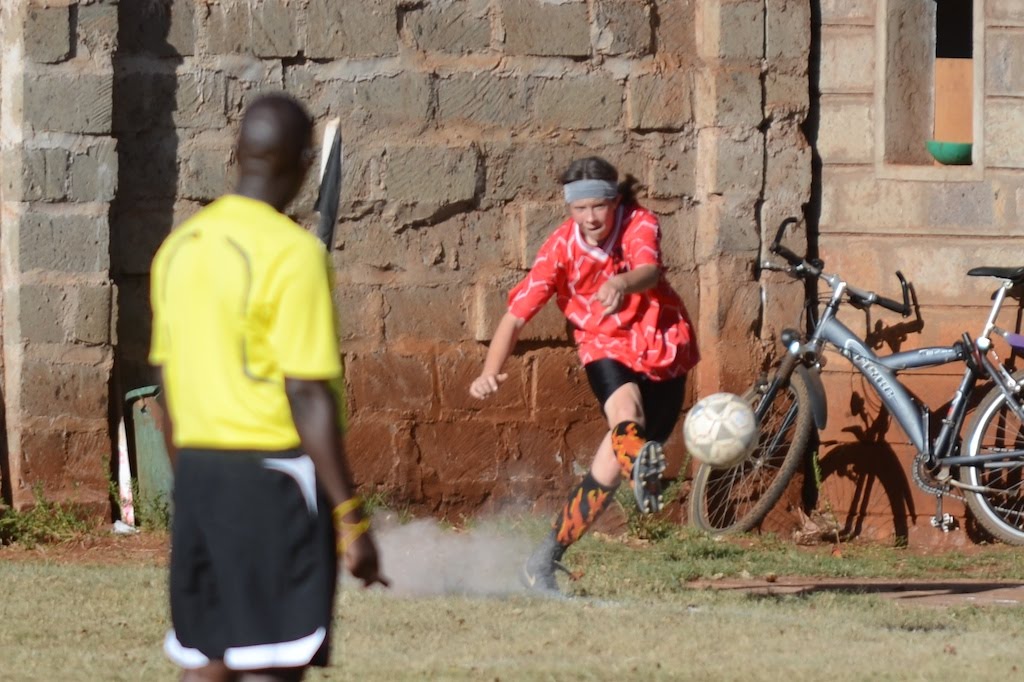
Today, beautiful sunny day, late afternoon, loading up the car, following two vans and a big bus, to the International School League Sports Finals in Nairobi. The biggest school, Rosslyn, hosts the final matches, the top two teams in each category, narrowed down after a 3-month term of play and a series of semi-finals. Boys and girls, varsity and JV, basketball (boys), football (soccer) (girls), field hockey (both), and swimming (a more limited number of schools with pools, not RVA). RVA made it to the finals in boys' basketball, JV and Varsity, and girls' football, JV and Varsity. A traffic jam of schools and parents streaming into the school grounds, teams swarming, kids from Africa, Asia, Europe, America. Coaches, balls, whistles, screams, cheers, friends, claps, laughter, dust flying, colors. Tuesday, March 08, 2011
International Women's Day
On this day, we reaffirm the Gospel that calls out good news for the women of Sudan and Uganda and Kenya and Burundi and beyond, the hope of dried tears and justice, the comfort of real love.
On this day, we honor women like Melen Musoki, wife of the late Dr. Jonah, who three years ago this day gave birth to their only son, months after he husband had died of ebola. She labors on with her nursery and primary school which provides a head start education to many of our friends and colleagues in Nyahuka, with her five daughters all in various boarding schools, with her management of the family farm, with her tenacity to protect her children from the greed of relatives who would cash in on Dr. Jonah's compensation.
On this day, we stand humbly beside the moms in the hospital, those that hover in this grey realm of having brought life into the world but unsure how long it will last, those sleepless patient women, who gather courage in the midst of foreign beeps and screens and monitors and tubes, to touch their babies. The lady with AIDS whose rocky post-partum course dried up her breast milk, whose husband abandoned her and her older children, who labors to feed her precious baby D. The lady with what looks like metastatic ovarian cancer who is too weak to get out of bed, but requested that the staff slip her feisty little preemie P out of her incubator and wrapped in warm blankets for a glimpse today. The eighteen-year-old with cute braids and a simple smile who cares for her devastated toddler, his brain severely damaged, his face half-eaten by infection, on morphine and fluids for comfort, death inevitable but slow. The mom of Baby N who spent her 95th day in the NICU today, plugging along with feeding and growing, up to 1700 grams (3 3/4 pounds). The new mother of twins, delivered too-early, one pink and calm and perfect, the other fighting hard for her life, ribs pulling against non-compliant lungs, tiny fists batting against her oxygen tubing. All these women, every two hours, day and night, around the clock, coming in to sit by their babies' incubators and cots, to squeeze out life-sustaining breast milk and drip it through naso-gastric tubes, or to hold the larger babies and breast feed them.
On this day I remember the international team of women who have been friends and mentors and prayer warriors and encouragers. Who cooked food for our family, who planned school or taught it for my kids, who read our blog and cared as if it really matters, who planted flowers to welcome us back from furlough or sorted umpteen ages and sizes of baby clothes when I was overwhelmed, who stepped in to care for our team and kids in crisis, who listened and prayed and biked and walked with me, who showed up to work in chaos so I wasn't alone. Women from Uganda and America, and a few places in between. Nurses, teachers, counselors, missionaries, neighbors, friends. And most especially, my mother and Scott's.
On this day we ponder the wholeness of the nature of our God, expressed in the paradox of male and female, a celebratory dichotomy and an essential equality.
And lastly, on this day, we cook breakfast and sort clothes, we examine patients and xrays, we chop vegetables and sweep floors, we answer homework questions and wash dishes, because it is, after all, women's day.
Sunday, March 06, 2011
In Praise of a Home
Thursday, March 03, 2011
Thirteen
Today is Jack's day . . . and it seems to be a popular one with Kijabe babies, there were so many being born this morning that the nurses were scrambling to get the ID bracelets attached to their ankles as we stacked them up two to a bed where they lay blinking and waving, waiting for their mothers to revive and hold them. We began our celebrations this morning by breaking out the final tiny 4-ounce jar of apple butter that our kids smuggled through security in their backpacks, to have with our biscuits. By 7:30 the kids were heading up the hill to school and Scott and I to a staff meeting. As I tried to engage in the discussion of appropriate triage of patients, and the structural implications of the nursing school upgrading from a diploma to a degree program under Scott University, I was thinking of how to get my NICU work done in time to finish party prep, and looked around the room. There are three other women consultant-level doctors here on a staff of about 25 to 30, but none come to meetings, and none are really in my position (two are young Kenyans who are married and mothers-of-one, and one is a single American surgeon). It hits me: I'm a mother of four teenagers, as of today. And it's as demanding in its own way as being a mother of four toddlers.
Jack decided to invite his whole basketball team to lunch. There are ten boys on the Jr Hi "A" team, and they finished their last regular game of the season undefeated this week. I am so thankful for this natural grouping for Jack, a healthy way to spend almost every afternoon with a core of classmates. I never dreamed he'd spend his 13th birthday with a basketball team, since he just learned to play a few months ago! They came down the hill shouting and teasing, very comfortable with one another, and thanks to help from my trusty houseworker Abigail and an hour-off from my trusty paeds team, I was ready. We turned ice cream, and ate chili and corn bread, then celebrated with a chocolate cake. Noisemakers, balloons, sodas, laughter, stories. It turns out that Jack was by far the youngest, 2 boys have been 13 for a while and the rest are 14 and even 15, even though they're all a similar size, there is a wide range on the puberty issue (sometimes I try to remember why we let him be an 8th grader, but it's complicated. Should have thought harder about sports). An hour later they all bounced off the walls and into each other and back up the hill to school. It was a fun party, and the first time Jack's had such a large group of peers to celebrate with. This evening we had a family gourmet dinner (Jack does love his food), much quieter than the wildness of the junior high boys. Phone calls from Grammy, the Bundi team, and Acacia. Emails from a CSB classmate (may you live to blow a thousand candles), and absent brother Luke.
Jack at 13: still growing into his body, reckless abandon in all pursuits, intensity, messy, curling up with a book, avid fan of premier league football, affectionate, teaser, handsome, attention-seeking, anxious at times, friendly, popular, loud, sprawling, adventurous, emotional, spiritually sincere, still mostly kid with hints of the young man shining through, sharp and creative with unanswerable questions because he sees things in his own unique way, smart and artistic, unsure of himself, low frustration tolerance, a drive to win. A remarkable person, who surprises and enriches us every day. I am thankful for that day 13 years ago when I walked into Kijabe hospital with Scott as my doctor and delivered him on the very bed where my patients today were born.
Monday, February 28, 2011
Sixteen
Caleb, sixteen, and sometimes sweet (are boys allowed?). Thoughtful, affectionate, affirming. Quiet, needing down time to play guitar, to listen to music. Never quite enough sleep. Aggressive on the field, coordinated, strong, wiry, endurance. Aware. Thankful. Sometimes a loner, not one to bend to the crowd. Keeps his thoughts to himself mostly. More likely to just shut the door and do the work than to complain or ask for help. Quick wit. Sharply funny, in the right mood could be a stand-up comedian, the eye for the incongruous. Still silly. Sunday, February 27, 2011
A Burundian Story
Burundi emerges in folds and ridges, green, rumpled steep, then a snaking river that twists into one of the deepest and longest lakes in the entire world. Rice paddies and dusty roads and then the tarmac of the small international airport, we are in Bujumbura. A single rusted Air Burundi jet sits neglected by the old terminal, but we taxi past to the shiny silo towers of the new one. We stumble through the French arrival forms and smile a lot. Our bags are x-rayed as we LEAVE the arrival area, which sort of fits the general tone of isolation and suspicion. It's not an easy country to get into. Being from Appalachia, I wonder at the parallels, mountainous terrain where clans cling to coves and hillsides and remain inaccessible and independent.
Word Pictures: Burundian drummers, tall, red-robed, springing handstands and jumps and claps, flashing sticks, chanting hymns, wild enthusiasm and rhythm. The winding smoothly paved road that snakes up from the lakeshore capital and into the hills, clay-tiled roofs, fields and villages flying past. The carefully handwritten lists of tests and patients in the laboratory, malaria, malaria, malaria. A peek into the operating theatre where a visiting short-term retired missionary doctor was amputating a young girl's severely infected arm, medical students watching, drapes and blood and a clutter of equipment. Bright kitengi-clad mothers lined up on the benches, waiting for care. Wide boulevards in the capital, cobblestone side-streets. The multi-story Hope Africa University buildings, solid and fresh, rising from the dirt, disgorging hundreds and hundreds of young people from multiple countries in Africa, with their jeans and braids and cell phones and chatter. A peek into the grocery stores, sparse goods neatly arranged, too much space. The noisy clatter of the University dining hall where we chat over lunch with professors from Congo and Canada. Fresh cement, the whine of wheelbarrows and clang of hammers, more buildings under construction. A young boy in traction for a broken leg, his x-ray hanging over his bed, so poor in quality one can hardly tell the bone from the background. The thrumming of a grain mill where the church manufactures a nutritious porridge for malnourished children. Walking down the dirt paths of Kibuye, imagining houses for the team somewhere back in the weedy perimeter. Dredging up new Swahili skills when the taxi driver kept stopping and changing direction; hearing the echos of Lubwisi in KiRundi; resurrecting college French as others spoke. Whipping wind and rain as a massive storm moved in one night, flashes of lightening, powerful, while we ate dinner under and open-walled pavilion. 
Highlights: For a three-night, four-day trip, we packed a lot in. But the biggest highlight for us was our traveling companions, three of the McCropder group. After almost a year of goodbye and transition, we were looking ahead. We laughed, more than we have in a long time. Should we admit this? It was fun. And, we sensed God's presence with us. My Bible reading prior to going fell in Ezra and Nehemiah, which was amazing timing. The parallels between Burundi and Israel at that point in her history are striking: small country, over-run by war, now with exiles returning to a destroyed infrastructure, rebuilding, facing opposition and doubt, balancing prayer and practicality, depending on God while also asking for financial help, repenting and reconciling and ready to be a blessing to the larger world. Our first night we met with some Burundian Christians who said the same thing, let this nation be rebuilt to bless others, even though we are small. The passion for tackling the problems of poverty, disease, tribalism, discrimination, witchcraft, hunger . . . was infectious. It is the Burundians who are leading, and they are asking for a few outsiders to come alongside and help, to train and teach and encourage until the 6 Americans are replaced by the 15 Burundians the Bishop prays for.