rotating header

Wednesday, July 27, 2016

Lubwisi New Testament Celebration: The Journey, part 1

Lubwisi New Testament Celebration Journey:  Day 1-2

Monday after Swahili (finished Level One!) we packed the Landrover with our suitcases, camping gear, cooler, and miscellaneous survival junk and hit the road.   First stop, using our new Swahili skills, we bought roasted corn for lunch which consists of guys at the roadside grabbing the ears of corn off their charcoal grills as you slow down and thrusting them through the window.  Kenyan fast food.  The road from Kijabe to Eldama Ravine descends to the floor of the Rift Valley, passing lakes Naivasha and Elementitia, then heading north up the escarpment to the cool misty forested hills.  There are flocks of zebra incongruously grazing by the busy roadside, and it would be a spectacular drive if it weren’t for the hundreds of slow trucks rumbling over the potholes.  The two-lane road is one of the most dangerous in the world as lines of cars and matatus (public transport vans) pile up behind a truck, vying for an opportunity to pass.  At times we had matatus passing on both sides, the shoulder and the oncoming lane, recklessly forcing traffic coming the other way to pull off the road.  It’s crazy. 


So when we pulled into Sunrise Acres at dusk, it was a relief.  This little dairy farm sits on the site of a missionary family dynasty in Kenya, the Barnettes, who have served for generations.  There are a handful of very simple cabins, furnished with items and taste of your grandparents’ generation, somehow wholesome and familiar and comforting in spite of where they land on the scale of shabby to sleek.  We’ve been stopping here on trips back and forth from Kenya to Uganda for almost 15 years, finding the peace and quiet a place of prayerful safety.  And we miss our cows, so it’s always a treat to see these. Not to mention that you can buy amazing homemade ice cream and jams.  A couple of times we’ve invited the older missionaries who run the place to eat with us, and tell stories of their days as students at RVA, as kids growing up, as newlywed teachers, in pre-independence Kenya.  I appreciate the untold debt we owe to the pioneers who preceded us on this journey.


Tuesday we were up by 6 for breakfast and packing up, reluctantly leaving the little green cottage as the day lightened.  The road from Eldama Ravine to Kampala is also no joke.  Thankfully we have Scott who is a skilled and experienced driver making the thousands of decisions on when to swerve, when to attempt a pass, which path to take when the pavement is scant.  We had two pleasant chats with Kenyan police, who wave cars off the road and ask a lot of questions, partly to show their power (information=power) and partly because they are curious.  We made it to the border before noon, and are happy to note that the process has improved since we first drove this way well over two decades ago.  New buildings, a more professional atmosphere, less haggling and hassle.  It is expected that one hire a border agent when bringing a car through, and we called the same guy we always use, Salim, who ushered us through the process.  Out of Kenya, over the unremarkable creek that represents the border, into Uganda.  Flourishes of stamps in passports.  The money-changers remembered Scott and asked about our old red truck (!) and chatted about life and insisted we move back to Uganda while we waited.  Ugandans are very welcoming.


The traffic increased the closer we got to Kampala as urban sprawl, women walking with baskets on their heads, pesky darting boda-cycles, lumbering lorries, aggressive matatus, struggling tiny pick-up trucks all competed for road space.  Jack spotted a motorcycle with FOUR PIGS (live, trussed upside down on a clever rack).  I spotted a family of five on a cycle, the two kids sleeping between the three adults.  Soldiers glared as we crossed the Nile at Jinja, protecting the dam that supplies electricity (heard later that another family got pulled over because their son was playing on a hand-held gaming device, and taking photos of the bridge is strictly forbidden).  So much about Uganda feels like home—the bunches of matoke and bright red piles of tomatoes or mountains of pinapples for sale by the roadside, the broad banana leaves and towering mango trees, the stretches of papyrus swamp, the exposed mud-brick buildings, the bright yellow painted advertising slogans on shop-fronts.  And the crawling traffic, the burgeoning population and economic growth straining an outdated infrastructure to the limits.


We pushed on, willing to forgo more than a quick snack of warm lentil-filled samosas so we could reach our destination in Kampala in order to join Massos and Pat for dinner.  In fact we were pretty proud of ourselves as we located our Air BnB destination (YES, Kampala now has listings on Air BnB), a large apartment complex north of the bypass.  I had been texting the owner every hour or two with updates on our progress, but it still took him quite a while to fight traffic from his location to meet us with the key.  And that’s where the day took a plunge. Hungry kids, 11 hours in the car, time ticking, waiting waiting.  And in the confusion of the arrival of the man-with-the-key (a classic Uganda phrase for “we can’t help you” is “the man with the key is not here”) and Scott getting a phone call from Kenya, the keys got locked in the car.  So we spent the next 30-40 minutes with a flimsy hanger trying to unlock a sliding back window (no go), or a door (no go), and finally managed to hook the keys lying on the seat and squeeze them out between the door and seal.  Whew.  Another innovation, like Air BnB, is Google Maps in Kampala, which took us on roads-never-traveled to wend our way into the city for dinner.  It was now well past dusk, sinking into fully dark, as the evening pedestrians crowded the roadsides, hawkers sold shoes and chapatis, dukas opened their doors and turned on lights.  At one point we were on a steep dirt track barely as wide as our car with ditches dropping off on each side. 

But all was forgotten when we walked into our favorite restaurant in the world, Khana Khazana, and the waiter who knows us from many Kampala visits over the years had already helped Karen order exactly the quintessential Myhre Indian-food dinner:  everything from papadam masalal to palak paneer to methi murgh and mango lassi.  Peace, candlelight, a huge round table for 13, greetings, stories, dipping naan into the spicy dishes.  One of our young men whom we have sponsored through school and acted as distant surrogate parental figures for, John, met us there too for the meal and a proud review of his latest exam results.  Three more exams in August and December and he will be a certified accountant.
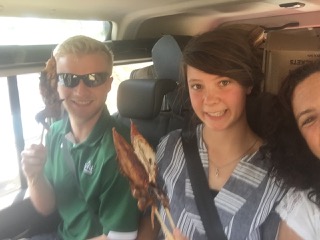


Back through the congested night streets to the apartment we had rented, a tasteful and spacious three-bedroom modern flat for $60, with superb water pressure for hot showers and some food stocked for breakfasts.  Which brings us to today, Wednesday, emerging from the city to head west on the finally open road.  Unlike the rest of the trip, the road from Kamapla to Bundibugyo was surfaced in the last decade, with generally wide shoulders, clear lines, and sparse vehicles.  Long stretches of swamp and garden and rolling hills space out the inevitable speed-humps in the small towns we pass through.  This stretch feels less dramatically changed than Kampala has, or Bundibugyo will, both because it is rural and because it is less familiar than our actual home.  We pause at Mubende for our usual fast food, the vendors swarming around the car until they figure out Scott has the money and is bearing the brunt for purchasing hot charcoal-grilled chicken breasts on sticks, greasy chapatis, sweet soft gonja, a rolex (omlette rolled in chapati). 


And so we continue westward.  About half the team is sick, and we know the spiritual significance of the Lubwisi Bible means this won’t be a simple week. Thanks for prayers.

Thursday, July 21, 2016

The Iceberg Principle


This diagram, given to us by our language guru Karen Masso on our first day, has become my favorite aspect of this program.  

Before, if I still could not remember the word for tongue, eraser, boat, or embarrassment (just to bring up four words that I know I was taught in the last week, reviewed today, and can not say tonight) I would have been discouraged.  Just more evidence that we're too old to learn, that we are failing.

Now, they are words in my iceberg, that I am pretty sure I'd recognize and understand if they were put into a clear context, even though I can't recall them at this moment.

We are nearing the end of Phase One.  Meaning that the fun of dolls and cards, the Kindergarten comfort of games and repetition, is almost over.  But what a great time we've had this month with Gideon our guide.  We're making our own sentences, and making him laugh a lot.  But all in all it's a great program.  Do keep praying for us to absorb, to improve as we move into Phase Two later in August.


And perhaps there are iceberg principles in your life too.  Ways you need to look under the surface and be thankful for the hidden work of the Spirit, for the subtle impact of your work, for the rich depth and weight of your relationships.  What is seen is only a small part of the truth of this universe.  


Thursday, July 14, 2016

This Week: Busting Tribalism One Story at a Time

In a few hours we will reach the one-week mark back in Kenya.  And what a week it has been.

While we were struggling with the embassy of India and its designated private visa company in Washington DC as the clock ticked inexorably towards our departure hour, while we were traveling across three continents and 8 time zones, while we were jet-lagged and bleary-eyed and filling forms for the bag our frazzled BA check-in attendant threw onto the conveyor belt without tagging, while we were processing goodbyes and anticipating hellos, while we were settling into a borrowed home and sorting out all the little glitches of daily life and survival . . . the world was disintegrating.

Two more black Americans were shot by police, the injustice rank and raw on video.  Five police officers were murdered by a sniper with a vendetta.  Across the ocean, and on a scale hundreds of times as dire, South Sudan fell apart on their 5th Independence Day as government soldiers attacked the body-guard force of the opposition during talks in the capital, which triggered extensive violence and chaos and the deaths of hundreds of combatants and civilians.  Days before, terrorists blew up a market in Iraq, again, killing hundreds, and others held hostages in a bakery in Dhaka resulting in 29 deaths, plus several suicide bombers struck in Saudi Arabia, while drones keep targeting alleged plotters and leaders. An IJM lawyer with his client and driver were murdered in Kenya, then pastors on a bus in the North East as well, targets because of their work.  Today an uneasy truce holds, both in America and in South Sudan and in Kenya, but suspicion and fear swirl in a deadly brew that could reignite at any spark.

It's a hard time to have left our passport country.  And a hard time to be what feels like a step back from the front line, immersing ourselves in Swahili classes.  Here we are on this little mission station on the Rift Valley escarpment, chilly in the morning clouds, sipping chai and gathering around a table for four hours of vocabulary and pointing and listening and responding.  "Pick up the sister of the boy" "Buy the cabbage for 25 shillings" "Show me the large purple paper" "Put the chicken between the donkey and the cat" "Hold two spiders" "Touch your nose" . . . and on and on it goes.  It's a very interactive and concrete language method, well-organized by Karen.  But does it really matter when people are being killed for their skin color or origin or religion?

Yes, in fact, it does.

The racism of America and the tribalism of South Sudan and the murky brutal politics of the near East have the same root:  fear that my group will not get enough, not be OK, because of the other group.  Millenia after Cain and Abel, we still worry that love is a limited commodity, that survival is a zero-sum game, that grasping forcefully will be justified.  We still have not learned to celebrate diversity.  We still fret over who is favored.  Only now we do all that armed with weapons increasingly lethal.  Now we bump against each other constantly.  But we rarely hear and see.

In spite of globalization and travel and immigration and media, we seem stuck in our own limited stories.  White Americans rarely enter into the reality of living as a person of color in our society; Dinka distance themselves from Nuer.  Muslims and Christians have lost any sense of common ground.  The other color, class, nationality, sexual orientation, etc. remains opaque and distant.

Which is why these hours of tedious vocabulary and adjective endings and proper demonstrative pronouns matter.  Incomprehension furthers division, but a shared language gives grounds for understanding.  Tanzania seems to have had much less intra-tribal tension than Kenya, South Sudan, Rwanda, Burundi, Uganda all around it.  Could that be related to the insistence upon Ki-Swahili as a unifying national language?  It's a tricky paradox, holding onto unique heritage while embracing kinship.  But surely telling our stories and hearing those of others  forms the foundational bridge of peace.


So pray for us as we slog through hours of study.  Pray this time will allow us to bridge into many lives, to hear their stories, to share The Story.  I feel the same way about my books, hoping that those stories of Africa bring the continent to life for a rising generation who will respect and love the people rather than boxing them into stereotypes of otherness.


Jesus is the Word made flesh.  It's all about reversing the polarizing effects of confused language and fear and hate.  Building a new community based on love, and this is the right place for that, an international community with a true kinship.  Here is the antidote to hate, as expressed and pictured by the multi-cultural choir at RVA.

Friday, July 01, 2016

Foxes have their holes

Home has been something we have wrested into existence by faith over 29 years of marriage, in apartments as student doctors, in our mud-brick tin-roof no-plumbing house in Bundibugyo, in the quaint mission-station house in Kenya, in hundreds of nights of travel, on floors, under the stars, in basements, in tents, evacuated, guests, campers.  We have laid these heads many, many places.


This year, however, was the first time we laid them in a home we could hope to keep indefinitely, an inherited property which we invested in rehabilitating to create a base-camp for our scattered family.  After months of projects, the last few weeks of June saw the pizza oven final touches (the third one Scott's built).  We hosted my sister's family, and some groups of overnight friends from Serge.  We celebrated my birthday and West Virginia Day and the 70th annual Aylestock family reunion.  We had three kids under the roof most of the month, with a touch of Luke.  There were hikes and bike trips and innumerable floats down the river.  There were cinnamon rolls and pizza and homemade pies and tacos.  There were camp fires and s'mores.  There was book reading on the porch and guitar playing in the living room.  Sunday morning playing piano for church, evening inviting neighbors to dinner. In short it was a glimpse of a life that we didn't even know we'd missed all these years.


And leaving it is not easy.

In Kenya, we were asked to choose a bird name for our house, so that as missionaries come and go the house names could be more consistent.  We chose "Flamingo", which sounded like a party, and connected with the great Rift lakes of birds.  So before we came here Luke put a plastic pink Flamingo in the garden he made as a gift for me.  Sometime in the Fall, Scott and I woke one magical morning to watch a fox jumping in dainty vertical bounces around the hole of something he was hunting in the side meadow.  After that I started calling this place "The Fox and the Flamingo Farm" which is not only alliterative, but captures the paradox of a quintessentially WV animal with a classic East African one.  It seemed to bind our story.  Then this week, my Bible reading plan gave me this verse:

Scribe: "Teacher, I will follow You wherever you go."
Jesus: "Foxes have holes and the birds of the air have nests, but the Son of Man has nowhere to lay his head."
Disciple: "Lord, let me first go and bury my father."
Jesus: "Follow me, and let the dead bury their own dead."

These words, and this week, have crashed down like a ton of bricks.  Foxes and birds have their homes, even The Fox and the Flamingo Farm can be such a place, but Jesus is calling us to keep moving.  Literally we are leaving Tuesday, the day before Wednesday's funeral for my 96-year-old uncle, who died early this morning.  All year I've been visiting him and my aunt regularly, including some times in the hospital before other family could arrive.  Over the last ten days I've held their hands and prayed. We've waited, advised, reliquinshed, known that death was imminent for him, watched him fade.  So it is a bitter blow to have the timing such that we just miss the burial.

Today has felt somber.  Our last guests left as the news of my uncle's death and my aunt's fall with a broken hip hours before reached us. We heard that two terrible attacks took place in Kenya, one to kill IJM lawyers working for justice and another to target pastors in the North East to whom some of our new team were connected.  I took my last book back to the library, and nearly cried.  Mailed last letters from the post office.  Julia's passport is in a purgatory of the Indian embassy for her semester-abroad visa, which is threatening to make our departure day extremely long and complicated (and may be threatening to not let her depart at all).  Julia and I both came down with a severe allergic reaction to poison-something (ivy, sumac, oak) and are on huge slugging courses of prednisone, with intractable itching and scary faces.  We aren't sleeping great, and feel lousy. The floods that devastated WV were milder, but still present here.  As much as I love Sago, it seems to have decided to send me off with a slap.

So we listen to the words of Jesus, telling us to move on, again (and I'm hearing them in musical form like this, thanks to the K-Love radio station).  We hold the paradox of a home for which we are thankful, a spot on the earth to which we can belong, and yet in which we can not stay.  We strain to hear the love in this calling, the assurance that we are meant to keep walking on a path that goes back into some dark places.  We ache to see the brokenness and sorrow where we are going, and the grief we are leaving behind.  Pray for us to soldier on.


Sunday, June 26, 2016

Why Family Reunions Matter


Yesterday the Aylestocks of Sago/Buckhannon West Virginia celebrated the 70th annual Family Reunion.  A Saturday in late June has meant a family picnic gathering since 1946, after all five brothers who served in WWII came home alive.  Since those five only represented 1/3 of the 15 siblings, a family reunion in this clan can involve quite a crowd.  I remember playing in the creek in the woods around Uncle Woody's, contiguous with the hollow where my grandfather and great-grandfather were born in log cabins, as the food was spread on picnic tables.  Later the event shifted to my parents' "Camp", a century-old farmhouse a few hundred yards down the river which they slowly and lovingly transformed into a family gathering place.  As both my grandparents and 12 of the 15 aunts and uncles have passed away, the enthusiasm for the gathering has waxed and waned.  But this year, as the 70th, was a BIG DEAL.


And so on Saturday, 87 of us gathered.  Uncle Woody, the oldest survivor, was hospitalized just a week before; at age 96 with pneumonia and cancer he is slowly releasing his grip on life and peacefully preparing to go home.  That left Uncle Harold and Aunt Ann, the two closest in age to my Dad who was youngest, to represent, along with my mom and Aunt Wonie as faithfully loyal surviving spouses.  The festivities actually start Friday night with grilled burgers, s'mores, and fireworks at a nearby camp.  The Reunion Day centers around food, of course, this year a whole pig barbecued by my cousin Doug, plus tables sagging with salads, breads, fruit, beans, and dozens of cakes and pies.  Games of corn hole, badminton, bocce, croquet, and basketball and baseball occur around the yard.  There is an opening prayer, and we recognize the many other families in Southern WV who suffered great loss in the Thursday night extreme storms and floods.  There is a time to recognize the youngest (Henry, a few months) and oldest (Uncle Harold celebrating 90) attenders, the first-timers, the ones with the most grandchildren and great-grandchildren (Aunt Wonie with 37), those driving the furthest (cousin Vicky and family, from Mississippi), those celebrating birthdays (me, on the very reunion day, and Lois two days later).  People who only see each other once a year, or once a decade, catch up.  Photos of the many missing are shown on ipads, and old photos of decades past are passed around.  Stories are told, hikes to the nearby Split Rock complete with bear scares occur, and a few hardy souls brave the cold rain-swollen river. The youngest form new friendships, gelling as a pack.  The oldest sit ensconced under the trees in the most comfortable chairs, holding court.  As evening gathers, home made ice cream is turned and my sister's famous chocolate chip cookies come hot out of the oven.

For my mom and sister, and for some of the cousins, this event represents a tremendous amount of work as they plan, clean, prepare, organize, cook.  For others it represents a huge investment of time off work, of travel, of arranging accommodations, of looking up old recipes for coconut cake or a particular cole slaw.  So why keep doing this, 70 years in a row?

Identity.  In America, a family of 15 siblings who all survived to adulthood, is not common.  So something about that number always made all of us feel special.  We may have been poor WV hillbillies, but by gathering and celebrating our heritage we all gain a little anchor of identity.  We come from this spot of ground, from these people.

Peace.  We are all sinners.  So every family has its tensions, people who feel hurt or left out, who remember offenses, who feel a dearth of love and a disappointment of expectations.  Some feel unappreciated, some feel judged.  But a day of a shared meal, of handshakes and hugs, or compliments and service, goes towards cementing bonds and smoothing squabbles. A day of abundance reminds us that we are all cared for.  A day centered on the concept of family takes the focus off a particular person and levels the field.

Connection.  For most of us, our parent amongst the 15 siblings has died.  Yet a day with one of the remaining siblings reminds us of our own parent, their mannerisms, their teasing sense of humor, their stubborn hold on integrity and common sense, their twinkling eye.  Sometimes a story comes out that brings the old days alive.  My mom was missing in her first reunion photo, which she attended as my dad's girlfriend, because they were "on a walk in the woods."  Hmm.  I asked my Aunt about how they sat around their huge family table, and her assigned seat on the bench between her two brothers was pure torture as she would refuse to eat if they waved their hands over her plate (and her brother corroborated saying "we didn't have kleenex in those days, we had long sleeves . . ").

Perspective.  Let's face it, as life goes on, we tend to segregate amongst people with whom we are comfortable.  But the family connection is based on blood, not politics, religion, sexual orientation, socioeconomic status, education, geography, or any of the common poles of difference in our American life.  So a reunion brings together groups of people who might not socialize otherwise. It also brings us together over time, over and over, so that instead of only knowing a particular slice of a story we see its arc.  Sort of like the book The Time Traveler's Wife, we get that Divine point of view that holds the innocence of youth and the wisdom of age in tension with the messes in the middle.  And the benefit of that diversity over time is perspective. Perhaps a handful of people who are carrying concealed weapons (one cousin thought it funny to ask for a show of hands, and half a dozen went up) find themselves in the orbit of another handful who work for gun control, and we realize the people who think differently are people we love.  I'm sure some of the tattoos would put off some of the people if they weren't attached to our own flesh and blood.  Someone who makes their living in a church jokes with someone who hasn't entered one in ages.  Farmers and soldiers and teachers and doctors and bikers and musicians, all remembering each other as awkward tweens or cute babies, humanizes the next drug-addicted or mentally ill person you meet, because you remember it is only a small part of who they are.   As the token crazy people who moved to Africa and lived in a jungle, I like to think we bring a touch of diversity to our relatives as well, an opportunity to feel bonded with outliers on the spectrum of life.

Hope.  Over the decades, one thing remains constant.  Adorable toddlers.  Take away the background and the disarmingly cute blond two-year-old could be her own grandmother back in the day.  The stuffed animal left behind this year could have been my cousin's rag doll "Precious" from 50 years ago.  The youngest ones remind us that in spite of cancers and accidents and horrible sadness, life renews.  Everything we've made a mess of has another chance.

I have only made it to a handful of reunions since I left home.  My kids don't know their relatives well enough, a cost of our distance.  We aren't part of the way things are always done, so we have to ask a lot of questions, and we generally don't hit the right times for being useful.  It is only reasonable to not depend too much on people like us who may not show up for another five years.  But for this year, I'm glad we were able to be at the right place and the right time.  We get a lot of the connection and perspective and hope from our Serge family too, but there's no substitute for this patchwork of people from these beautiful hills.  So if your family has a reunion, try to get there.  And if they don't yet, consider planning one.  The hassle will be outweighed by those golden intangibles.


Which brings us to the closing speech, offered by my 16 year old nephew with Down Syndrome, when cousin Mike the MC opened the stage.  I'm sure we were all a bit nervous, he watches a lot of action hero movies and knows how to push buttons and say inappropriate things for a reaction.  But not this time.  He stood up on a chair, and listed off the people he loved.  His mom, his dad, his sister, Julia, me, and on and on.  Which was the essence of the whole affair.  LOVE.  He got it right, exactly.

Thursday, June 16, 2016

Reflections on the Orlando massacre

Stunned grief, again, in another week of hateful carnage in the USA.  This crime pretty much distills all of our woes into one grisly event:  a hate crime against the LGBTQ community, targeting people of color, committed with a military-style gun, a mass shooting in a place meant for relaxation and belonging, potentially a religiously motivated assault on perceived laxness and sin in the society, spun (by the shooter and the press) for its connections to ISIL-inspired anti-American-involvement in the world at large, by someone who exhibited at least some signs of anti-social violent behavior (against his wife no less) and one might assume mental illness, an born-and-raised American whose parental origins immediately connected the event to anti-immigration sentiment.  Complex?  I should say so.  If one set out to crystalize all the dissent, angst, mistrust, discomfort of America into one event, it would be hard to top this one.  Muslims, gays, guns, immigration, and psychotic breaks.  There's not a small leak in the dike of safety which one can easily point to and plug on this one.

So should we cynically deride anyone who tries?  Should we helplessly throw up our hands?

The song that keeps going through my head this week is a Dave Wilcox oldie.  "There'll always be a crazy, with an army or a knife, to wake up from your day dream, put the fear back in your life . . . "  Yes, we live in a broken messy world.  There will always be evil people.  But the song goes on to state in faith that "we get up on our feet and do our best . . because it's love that wrote the play."  So in that spirit, let me list a few truths.

1.  Love is stronger than death.  The ultimate, final truth of the universe is love.  One day all the shooting and hating will stop.  We live in a trajectory that ends in beauty, newness, healing.  We aren't there yet, but the ending is ultimately good.  We don't have to live in fear.  The love of God is enough to go around.  

2.  In the meantime, we are called to be wise as serpents and innocent as doves.  Wisdom would dictate that when the crazies get to hating, it's better when they can reach for a knife than an army.  So our political process matters.  Our mental health care system matters.  Keeping guns out of the hands of people being investigated for terrorism matters.  Limiting guns to those that are difficult to fire rapidly and repeatedly matters.  Voting for people who don't foment hate, isolationism, shaming matters.  There are big picture systems that we can improve.

3.  While there is not an easy prevention to this event, a million small interactions along the course of a lifetime could have changed the course of history.  When your kids love a bully (Geniene S!), when your kids befriend an immigrant or learn a new language or seek to understand a different religion or lifestyle, the ripple has an effect.  Repeated local acts of justice and kindness matter, the small picture day to day ways we live.  Terrorism will never be defeated by force.  Force can win a conventional war, but not a battle of trust, beliefs, not a struggle of the heart.

4.  And lastly, in view of all of the above, I think there is no better answer to Orlando than to live missionally in the footsteps of Jesus.  I've also been reading this week some good critiques of the "white savior Barbie mentality" that we can so easily slip into (here and here and here and here).  Thinking that we Americans have all the answers, or that a quick trip to a distant place is inherently saintly.  I cringe at the elements of truth in this, the ego-boost of being needed and appreciated and admired.  Yuck. But I do not reject the entire enterprise, because I think the best of what we do is exactly in opposition to Orlando and San Bernadino and Paris.  To Ferguson and Charleston.  That is to actually live in places where infant mortality spikes off the charts, and have children there as well as resuscitate other people's babies.  To teach in places where literacy lags, and invest in students over the long haul there.  To preach an alternative to fear-based tribal spirits in places crushed by war, and be a witness there.  To become part of a community to the extent that a stand against raping teen girls or a stand for accountability in medical funds will be heard.  To take on some of the risks that the majority world can not choose, because we can choose.  To learn language and listen carefully, to become true partners with our host communities.  Those things take long-haul commitment, and we are thankful for the scores of people we partner with who are doing just that.

If this week has you down, listen to the Wilcox song, and think about the lyrics.  In the darkness love can show the way.


You say you see no hope
You say you see no reason we should dream
That the world would ever change
You're saying love is foolish to believe
'Cause there'll always be some crazy
With an army or a knife
To wake you from your day dream
Put the fear back in your life
Look, if someone wrote a play just to glorify
What's stronger than hate
Would they not arrange the stage
To look as if the hero came too late?
He's almost in defeat
It's looking like the evil side will win
So on the edge of every seat
From the moment that the whole thing begins, it is
Love who makes the mortar
And it's love who stacked these stones
And it's love who made the stage here
Although it looks like we're alone
In this scene set in shadows
Like the night is here to stay
There is evil cast around us
But it's love that wrote the play
For in this darkness love can show the way
So now the stage is set
Feel you own heart beating in your chest
This life's not over yet
So we get up on our feet and do our best
We play against the fear
We play against the reasons not to try
We're playing for the tears
Burning in the happy angel's eyes, for it's
Love who makes the mortar
And it's love who stacked these stones
And it's love who made the stage here
Although it looks like we're alone
In this scene set in shadows
Like the night is here to stay
There is evil cast around us
But it's love that wrote the play
For in this darkness love will show the way
Show the way, show the way


Read more: David Wilcox - Show The Way Lyrics | MetroLyrics 

or Watch the live performance https://www.youtube.com/watch?v=Za5AH7qVlqE

Sunday, June 12, 2016

Spain, Serge, and the love our culture needs

This week David Brooks wrote an editorial in the NYT responding to the bathroom uproar, which said our country has become addicted to sideshows that distract from the real struggle to develop a culture of character and care.  One paragraph caught my attention as we returned from our triennial Serge conference:

The larger culture itself needs to be revived in four distinct ways: We need to be more communal in an age that’s overly individualistic; we need to be more morally minded in an age that’s overly utilitarian; we need to be more spiritually literate in an age that’s overly materialistic; and we need to be more emotionally intelligent in an age that is overly cognitive.

For ten days, we were in Spain with about 500 people who are committed to these very things.  Most were Serge leaders and staff, plus board members, musicians, counselors, child-care volunteers.  We were there to encourage one another, to give thanks to God for where we have come, to strengthen our leadership structure with more training, to attend to the hurting, to forge closer relationships face to face, to lean into the future with prayer.  But the Brooks' analysis crystalized for me that we are very very privileged to have Serge as our lens for viewing not only our work but also our cultures of origin, and in fact we can bring some of our triennial sense of who we are as we move on.


 Communal:  The ethos of our organization rests in the local team, which functions as an extended family, a small mobile church, a bond of kinship and commitment.  As we gather, we realize the community extends beyond each small band to include our ties to each other all over the world.  We challenge each other, pray for each other, share our burdens and our humor.  There are hugs and sidebar conversations galore, so that it is difficult to get meetings started.  Meals are a chaotic cacophony.  Kids find each other and the three-year-gap melts in the face of shared experience as perpetual outsiders tasting the one spot where they are home.  The Kingdom is not an individual pursuit, and this reality is something we can bring back to our culture.  Bethany's catchy phrase from some training we did a couple of years ago on our field kept getting repeated:  comparison kills community.  Serge embraces the value of acknowledging our weaknesses, repenting of our sins, reminding ourselves that God's love is inclusive enough for each unique person's existence, and doing the work of living in true community with all its messiness and joy.

Morally Minded:  By this Brooks seems to mean basing decisions on a code of right and wrong rather than a short-sighted utilitarian metric of benefit and loss.  That shines through when you listen carefully.  We have teams in places which are beset by war or disease or poverty or extremism or isolation or a thousand other difficulties, not because that brings results but because IT IS THE RIGHT THING TO DO.  Our vision and mission call us to lay down our lives.  We are following a Person whose only metric is love.

Spiritually Literate:  Yes, we all struggle with this, the paradoxical reality of our embodied spirituality, the simultaneous truth of living in a material world that is spiritually alive.  We enjoyed Spain, the coast, the sun, the abundant fish and olives and cheeses and figs.  We enjoyed the bracing waves of the Mediterranean Sea and the quiet rest of a hotel room.  But those things alone would have left us empty.  Our time was also spiritually rich with teaching by Pastor Scotty Smith, exhortations from our Director of Ministries Josiah Bancroft, worship, and prayer.  Our seminars focus on things like sabbath and rhythm, not success.  We may not be completely literate yet, but we are putting that spiritual health front and center.

Emotional Intelligence:  I commend our leadership for bringing a bevy of counselors to acknowledge that we are beat up by the reality of living on the edge.  We had seminars on how a team can embrace and support members suffering from depression, because depression and anxiety are all-too-common facts of life everywhere but even more so on our fields.  Our kids' program had a theme (loosely connected to A Chameleon, A Boy, and A Quest) of finding out who you really are.  This is an organization that is not afraid to cry openly and laugh raucously.

So while we are working in places from rural South America to massive Asian cities and everywhere in between, I hope we can take the sense of inclusive community, of commitment to truth, of a rich spirituality, and of a merciful emotional kindness, everywhere we go.  And for those of us who returned to the USA (temporarily) in a week in which the nation was in an uproar over the light sentencing of a campus sexual offender at Stanford, and mourning the shocking mass shooting in Florida, we know that standing for these things is actually a matter of life and death.  If we are only individuals making utilitarian decisions based on a cognitive understanding of a material-only world, we will continue to pick up the pieces of the devastation that follow in the wake of greed, anger, self-centered actions.  Instead we need to quietly, boldly, consistently live an alternative lifestyle of love.  I'm thankful for the way a conference strengthens and reminds us to do just that.